
discuss@lists.openscad.org

OpenSCAD general discussion Mailing-list

View all threads

rendering problem

NH
nop head
Tue, May 26, 2020 11:58 AM

Yes the PolySet grid snap bug should be fixed but it is hard. It is exactly
the same issue that STL files have. OpenSCAD needs a mesh fixer to make it
robust whenever vertex resolution is reduced. If it had one then it could
also fix broken STL imports and bad polyhedron data and stop this endless
list of why does my model not render.

On Tue, 26 May 2020 at 12:53, Michael Marx michael@marx.id.au wrote:

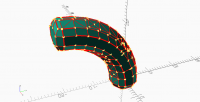
All well & good, but F5+F6 should work.

It needs to be fixed.

Your render() based designs are probably prone to this issue.

In this specific case, Flush Cache & F6 & Export STL, produced a broken
STL, that one on the Netfabb images above.


From: Discuss [mailto:discuss-bounces@lists.openscad.org] *On Behalf Of
*nop head
Sent: Tue, 26 May 2020 21:03
To: OpenSCAD general discussion
Subject: Re: [OpenSCAD] rendering problem

As long as I flush the cache and do F6 it all looks fine to me and I can
export the STL to Netfabb and that says it's fine as well.

On Tue, 26 May 2020 at 11:41, MichaelAtOz oz.at.michael@gmail.com wrote:

nophead wrote

It works fine for me if I flush the cache before F6 but not if I do F5,
F6.
So it is not a bug in Minkowski, it is just the normal PolySet grid snap
bug that breaks topology and caches it.

I'm not so sure.
As I said, z-fighting outside-face & inside-face.
In Netfabb I was able to delete the wrong face, and the right one was then
exposed.
I'm still looking, but it does look like duplicated faces.


Admin - email* me if you need anything,  or if I've done something
stupid...

  • click on my MichaelAtOz label, there is a link to email me.

Unless specifically shown otherwise above, my contribution is in the
Public Domain; to the extent possible under law, I have waived all
copyright and related or neighbouring rights to this work. Obviously
inclusion of works of previous authors is not included in the above.

--
Sent from: http://forum.openscad.org/


OpenSCAD mailing list
Discuss@lists.openscad.org
http://lists.openscad.org/mailman/listinfo/discuss_lists.openscad.org

http://www.avg.com/email-signature?utm_medium=email&utm_source=link&utm_campaign=sig-email&utm_content=emailclient Virus-free.
www.avg.com
http://www.avg.com/email-signature?utm_medium=email&utm_source=link&utm_campaign=sig-email&utm_content=emailclient
<#m_-2680461609479847789_DAB4FAD8-2DD7-40BB-A1B8-4E2AA1F9FDF2>


OpenSCAD mailing list
Discuss@lists.openscad.org
http://lists.openscad.org/mailman/listinfo/discuss_lists.openscad.org
Yes the PolySet grid snap bug should be fixed but it is hard. It is exactly the same issue that STL files have. OpenSCAD needs a mesh fixer to make it robust whenever vertex resolution is reduced. If it had one then it could also fix broken STL imports and bad polyhedron data and stop this endless list of why does my model not render. On Tue, 26 May 2020 at 12:53, Michael Marx <michael@marx.id.au> wrote: > All well & good, but F5+F6 should work. > > It needs to be fixed. > > Your render() based designs are probably prone to this issue. > > > > In this specific case, Flush Cache & F6 & Export STL, produced a broken > STL, that one on the Netfabb images above. > > > ------------------------------ > > *From:* Discuss [mailto:discuss-bounces@lists.openscad.org] *On Behalf Of > *nop head > *Sent:* Tue, 26 May 2020 21:03 > *To:* OpenSCAD general discussion > *Subject:* Re: [OpenSCAD] rendering problem > > > > As long as I flush the cache and do F6 it all looks fine to me and I can > export the STL to Netfabb and that says it's fine as well. > > > > On Tue, 26 May 2020 at 11:41, MichaelAtOz <oz.at.michael@gmail.com> wrote: > > nophead wrote > > It works fine for me if I flush the cache before F6 but not if I do F5, > > F6. > > So it is not a bug in Minkowski, it is just the normal PolySet grid snap > > bug that breaks topology and caches it. > > I'm not so sure. > As I said, z-fighting outside-face & inside-face. > In Netfabb I was able to delete the wrong face, and the right one was then > exposed. > I'm still looking, but it does look like duplicated faces. > > > > ----- > Admin - email* me if you need anything, or if I've done something > stupid... > > * click on my MichaelAtOz label, there is a link to email me. > > Unless specifically shown otherwise above, my contribution is in the > Public Domain; to the extent possible under law, I have waived all > copyright and related or neighbouring rights to this work. Obviously > inclusion of works of previous authors is not included in the above. > > -- > Sent from: http://forum.openscad.org/ > > _______________________________________________ > OpenSCAD mailing list > Discuss@lists.openscad.org > http://lists.openscad.org/mailman/listinfo/discuss_lists.openscad.org > > > > <http://www.avg.com/email-signature?utm_medium=email&utm_source=link&utm_campaign=sig-email&utm_content=emailclient> Virus-free. > www.avg.com > <http://www.avg.com/email-signature?utm_medium=email&utm_source=link&utm_campaign=sig-email&utm_content=emailclient> > <#m_-2680461609479847789_DAB4FAD8-2DD7-40BB-A1B8-4E2AA1F9FDF2> > _______________________________________________ > OpenSCAD mailing list > Discuss@lists.openscad.org > http://lists.openscad.org/mailman/listinfo/discuss_lists.openscad.org >
RP
Ronaldo Persiano
Tue, May 26, 2020 12:42 PM

It works fine for me if I flush the cache before F6 but not if I do F5,
F6. So it is not a bug in Minkowski, it is just the normal PolySet grid
snap bug that breaks topology and caches it.

Help me to understand that.  It seems that CGAL is not called for doing
minkowski. What library does the minkowski operations? What data structures
are used for that?

<nop.head@gmail.com> wrote: > It works fine for me if I flush the cache before F6 but not if I do F5, > F6. So it is not a bug in Minkowski, it is just the normal PolySet grid > snap bug that breaks topology and caches it. > Help me to understand that. It seems that CGAL is not called for doing minkowski. What library does the minkowski operations? What data structures are used for that?
NH
nop head
Tue, May 26, 2020 1:28 PM

I am sure CGAL is used to do 3D Minkowski, that is why it is monumentally
slow.

I get

Total rendering time: 0 hours, 0 minutes, 9 seconds

Top level object is a 3D object:

Simple: yes

Vertices: 359

Halfedges: 1498

Edges: 749

Halffacets: 790

Facets: 395

Volumes: 3

Rendering finished.

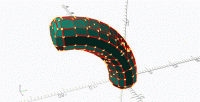
NetFabb says there are 906 edges and 604 triangles in the STL. Presumably
that is because CGAL outputs polygons and they have to be broken into
triangles for STL.

[image: image.png]

On Tue, 26 May 2020 at 14:17, arnholm@arnholm.org wrote:

On 2020-05-26 00:06, Ronaldo Persiano wrote:

Congratulations! You have found a bug in the minkowski operator. That
is what I get with Thrown Together:

Could be an intermittent problem, or behaviour depends on version of
OpenSCAD and/or operating system. It is not necessarily minkowski that
fails, since difference is the final operation.

I tried with OpenSCAD 2017.01.20 under Win10 and it shows no obvious
problems (but see below), it is reported as

Total rendering time: 0 hours, 0 minutes, 10 seconds
Top level object is a 3D object:
Simple:        yes
Vertices:      369
Halfedges:    1556
Edges:        778
Halffacets:    826
Facets:        413
Volumes:        3
Rendering finished.
STL export finished.

However, testing the exported STL in polyfix reveals a higher number of
faces (628) compared to what OpenSCAD reports (413), which is kind of
strange.

polyhedron 0 ================= volume=1469.81, dtol=0.01, atol=1e-06,
maxiter=10
iteration 0: vertices=1884 faces=628
warning: 4 zero area faces.
warning: nonmanifold edges: uc(1)=1884
merged 1574 vertices
removed 16 collapsed or zero area faces
removed 2 duplicate faces
removed 2 nonmanifold faces
total changes=1594
no warnings

iteration 1: vertices=310 faces=608
removed 2 unused vertices
total changes=2
no warnings

iteration 2: vertices=308 faces=608
total changes=0
no warnings

Summary:
polyhedron 0: vertices=308 faces=608 : no warnings

When instead exporting the same model from OpenSCAD to OFF format, it
showed an even higher number of faces (710):

polyhedron 0 ================= volume=1469.81, dtol=0.01, atol=1e-06,
maxiter=10
iteration 0: vertices=359 faces=710
warning: 86 zero area faces.
merged 49 vertices
removed 98 collapsed or zero area faces
removed 2 duplicate faces
removed 2 nonmanifold faces
total changes=151
no warnings

iteration 1: vertices=310 faces=608
removed 2 unused vertices
total changes=2
no warnings

iteration 2: vertices=308 faces=608
total changes=0
no warnings

Summary:
polyhedron 0: vertices=308 faces=608 : no warnings

As you can see, polyfix resolved both of the above to vertices=308
faces=608, even if the starting points were different. I think this
shows that at least part of the problems lie in file export code.

It does not make sense that the number of faces exported depends on the
file format chosen. Clearly, there is no check for zero area faces on
file export in OpenSCAD.

I also tried this, which seemed to work
https://gist.github.com/arnholm/de50168cd1a477be1de116e100a8066a

Carsten Arnholm


OpenSCAD mailing list
Discuss@lists.openscad.org
http://lists.openscad.org/mailman/listinfo/discuss_lists.openscad.org

I am sure CGAL is used to do 3D Minkowski, that is why it is monumentally slow. I get Total rendering time: 0 hours, 0 minutes, 9 seconds Top level object is a 3D object: Simple: yes Vertices: 359 Halfedges: 1498 Edges: 749 Halffacets: 790 Facets: 395 Volumes: 3 Rendering finished. NetFabb says there are 906 edges and 604 triangles in the STL. Presumably that is because CGAL outputs polygons and they have to be broken into triangles for STL. [image: image.png] On Tue, 26 May 2020 at 14:17, <arnholm@arnholm.org> wrote: > On 2020-05-26 00:06, Ronaldo Persiano wrote: > > Congratulations! You have found a bug in the minkowski operator. That > > is what I get with Thrown Together: > > Could be an intermittent problem, or behaviour depends on version of > OpenSCAD and/or operating system. It is not necessarily minkowski that > fails, since difference is the final operation. > > I tried with OpenSCAD 2017.01.20 under Win10 and it shows no obvious > problems (but see below), it is reported as > > Total rendering time: 0 hours, 0 minutes, 10 seconds > Top level object is a 3D object: > Simple: yes > Vertices: 369 > Halfedges: 1556 > Edges: 778 > Halffacets: 826 > Facets: 413 > Volumes: 3 > Rendering finished. > STL export finished. > > However, testing the exported STL in polyfix reveals a higher number of > faces (628) compared to what OpenSCAD reports (413), which is kind of > strange. > > polyhedron 0 ================= volume=1469.81, dtol=0.01, atol=1e-06, > maxiter=10 > iteration 0: vertices=1884 faces=628 > warning: 4 zero area faces. > warning: nonmanifold edges: uc(1)=1884 > merged 1574 vertices > removed 16 collapsed or zero area faces > removed 2 duplicate faces > removed 2 nonmanifold faces > total changes=1594 > no warnings > > iteration 1: vertices=310 faces=608 > removed 2 unused vertices > total changes=2 > no warnings > > iteration 2: vertices=308 faces=608 > total changes=0 > no warnings > > Summary: > polyhedron 0: vertices=308 faces=608 : no warnings > > When instead exporting the same model from OpenSCAD to OFF format, it > showed an even higher number of faces (710): > > polyhedron 0 ================= volume=1469.81, dtol=0.01, atol=1e-06, > maxiter=10 > iteration 0: vertices=359 faces=710 > warning: 86 zero area faces. > merged 49 vertices > removed 98 collapsed or zero area faces > removed 2 duplicate faces > removed 2 nonmanifold faces > total changes=151 > no warnings > > iteration 1: vertices=310 faces=608 > removed 2 unused vertices > total changes=2 > no warnings > > iteration 2: vertices=308 faces=608 > total changes=0 > no warnings > > Summary: > polyhedron 0: vertices=308 faces=608 : no warnings > > As you can see, polyfix resolved both of the above to vertices=308 > faces=608, even if the starting points were different. I think this > shows that at least part of the problems lie in file export code. > > It does not make sense that the number of faces exported depends on the > file format chosen. Clearly, there is no check for zero area faces on > file export in OpenSCAD. > > > I also tried this, which seemed to work > https://gist.github.com/arnholm/de50168cd1a477be1de116e100a8066a > > Carsten Arnholm > > > > > > > > _______________________________________________ > OpenSCAD mailing list > Discuss@lists.openscad.org > http://lists.openscad.org/mailman/listinfo/discuss_lists.openscad.org >
A
arnholm@arnholm.org
Tue, May 26, 2020 1:33 PM

On 2020-05-26 14:42, Ronaldo Persiano wrote:

It works fine for me if I flush the cache before F6 but not if I do
F5, F6. So it is not a bug in Minkowski, it is just the normal
PolySet grid snap bug that breaks topology and caches it.

Help me to understand that.  It seems that CGAL is not called for
doing minkowski. What library does the minkowski operations? What data
structures are used for that?

I believe OpenSCADs implementation of 3D Minkowski sums rely on CGAL
https://doc.cgal.org/latest/Minkowski_sum_3

Carsten Arnholm

On 2020-05-26 14:42, Ronaldo Persiano wrote: > <nop.head@gmail.com> wrote: > >> It works fine for me if I flush the cache before F6 but not if I do >> F5, F6. So it is not a bug in Minkowski, it is just the normal >> PolySet grid snap bug that breaks topology and caches it. > > Help me to understand that. It seems that CGAL is not called for > doing minkowski. What library does the minkowski operations? What data > structures are used for that? I believe OpenSCADs implementation of 3D Minkowski sums rely on CGAL https://doc.cgal.org/latest/Minkowski_sum_3 Carsten Arnholm
MM
Michael Marx
Tue, May 26, 2020 1:38 PM

For consistency please use add_rotate=7, it seems to be worse.


From: Discuss [mailto:discuss-bounces@lists.openscad.org] On Behalf Of nop head
Sent: Tue, 26 May 2020 23:28
To: OpenSCAD general discussion
Subject: Re: [OpenSCAD] rendering problem

I am sure CGAL is used to do 3D Minkowski, that is why it is monumentally slow.

I get

Total rendering time: 0 hours, 0 minutes, 9 seconds

Top level object is a 3D object:

Simple: yes

Vertices: 359

Halfedges: 1498

Edges: 749

Halffacets: 790

Facets: 395

Volumes: 3

Rendering finished.

NetFabb says there are 906 edges and 604 triangles in the STL. Presumably that is because CGAL
outputs polygons and they have to be broken into triangles for STL.

image.png

On Tue, 26 May 2020 at 14:17, arnholm@arnholm.org wrote:

On 2020-05-26 00:06, Ronaldo Persiano wrote:

Congratulations! You have found a bug in the minkowski operator. That
is what I get with Thrown Together:

Could be an intermittent problem, or behaviour depends on version of
OpenSCAD and/or operating system. It is not necessarily minkowski that
fails, since difference is the final operation.

I tried with OpenSCAD 2017.01.20 under Win10 and it shows no obvious
problems (but see below), it is reported as

Total rendering time: 0 hours, 0 minutes, 10 seconds
Top level object is a 3D object:
Simple:        yes
Vertices:      369
Halfedges:    1556
Edges:        778
Halffacets:    826
Facets:        413
Volumes:        3
Rendering finished.
STL export finished.

However, testing the exported STL in polyfix reveals a higher number of
faces (628) compared to what OpenSCAD reports (413), which is kind of
strange.

polyhedron 0 ================= volume=1469.81, dtol=0.01, atol=1e-06,
maxiter=10
iteration 0: vertices=1884 faces=628
warning: 4 zero area faces.
warning: nonmanifold edges: uc(1)=1884
merged 1574 vertices
removed 16 collapsed or zero area faces
removed 2 duplicate faces
removed 2 nonmanifold faces
total changes=1594
no warnings

iteration 1: vertices=310 faces=608
removed 2 unused vertices
total changes=2
no warnings

iteration 2: vertices=308 faces=608
total changes=0
no warnings

Summary:
polyhedron 0: vertices=308 faces=608 : no warnings

When instead exporting the same model from OpenSCAD to OFF format, it
showed an even higher number of faces (710):

polyhedron 0 ================= volume=1469.81, dtol=0.01, atol=1e-06,
maxiter=10
iteration 0: vertices=359 faces=710
warning: 86 zero area faces.
merged 49 vertices
removed 98 collapsed or zero area faces
removed 2 duplicate faces
removed 2 nonmanifold faces
total changes=151
no warnings

iteration 1: vertices=310 faces=608
removed 2 unused vertices
total changes=2
no warnings

iteration 2: vertices=308 faces=608
total changes=0
no warnings

Summary:
polyhedron 0: vertices=308 faces=608 : no warnings

As you can see, polyfix resolved both of the above to vertices=308
faces=608, even if the starting points were different. I think this
shows that at least part of the problems lie in file export code.

It does not make sense that the number of faces exported depends on the
file format chosen. Clearly, there is no check for zero area faces on
file export in OpenSCAD.

I also tried this, which seemed to work
https://gist.github.com/arnholm/de50168cd1a477be1de116e100a8066a

Carsten Arnholm


OpenSCAD mailing list
Discuss@lists.openscad.org
http://lists.openscad.org/mailman/listinfo/discuss_lists.openscad.org

--
This email has been checked for viruses by AVG.
https://www.avg.com
For consistency please use add_rotate=7, it seems to be worse. _____ From: Discuss [mailto:discuss-bounces@lists.openscad.org] On Behalf Of nop head Sent: Tue, 26 May 2020 23:28 To: OpenSCAD general discussion Subject: Re: [OpenSCAD] rendering problem I am sure CGAL is used to do 3D Minkowski, that is why it is monumentally slow. I get Total rendering time: 0 hours, 0 minutes, 9 seconds Top level object is a 3D object: Simple: yes Vertices: 359 Halfedges: 1498 Edges: 749 Halffacets: 790 Facets: 395 Volumes: 3 Rendering finished. NetFabb says there are 906 edges and 604 triangles in the STL. Presumably that is because CGAL outputs polygons and they have to be broken into triangles for STL. image.png On Tue, 26 May 2020 at 14:17, <arnholm@arnholm.org> wrote: On 2020-05-26 00:06, Ronaldo Persiano wrote: > Congratulations! You have found a bug in the minkowski operator. That > is what I get with Thrown Together: Could be an intermittent problem, or behaviour depends on version of OpenSCAD and/or operating system. It is not necessarily minkowski that fails, since difference is the final operation. I tried with OpenSCAD 2017.01.20 under Win10 and it shows no obvious problems (but see below), it is reported as Total rendering time: 0 hours, 0 minutes, 10 seconds Top level object is a 3D object: Simple: yes Vertices: 369 Halfedges: 1556 Edges: 778 Halffacets: 826 Facets: 413 Volumes: 3 Rendering finished. STL export finished. However, testing the exported STL in polyfix reveals a higher number of faces (628) compared to what OpenSCAD reports (413), which is kind of strange. polyhedron 0 ================= volume=1469.81, dtol=0.01, atol=1e-06, maxiter=10 iteration 0: vertices=1884 faces=628 warning: 4 zero area faces. warning: nonmanifold edges: uc(1)=1884 merged 1574 vertices removed 16 collapsed or zero area faces removed 2 duplicate faces removed 2 nonmanifold faces total changes=1594 no warnings iteration 1: vertices=310 faces=608 removed 2 unused vertices total changes=2 no warnings iteration 2: vertices=308 faces=608 total changes=0 no warnings Summary: polyhedron 0: vertices=308 faces=608 : no warnings When instead exporting the same model from OpenSCAD to OFF format, it showed an even higher number of faces (710): polyhedron 0 ================= volume=1469.81, dtol=0.01, atol=1e-06, maxiter=10 iteration 0: vertices=359 faces=710 warning: 86 zero area faces. merged 49 vertices removed 98 collapsed or zero area faces removed 2 duplicate faces removed 2 nonmanifold faces total changes=151 no warnings iteration 1: vertices=310 faces=608 removed 2 unused vertices total changes=2 no warnings iteration 2: vertices=308 faces=608 total changes=0 no warnings Summary: polyhedron 0: vertices=308 faces=608 : no warnings As you can see, polyfix resolved both of the above to vertices=308 faces=608, even if the starting points were different. I think this shows that at least part of the problems lie in file export code. It does not make sense that the number of faces exported depends on the file format chosen. Clearly, there is no check for zero area faces on file export in OpenSCAD. I also tried this, which seemed to work https://gist.github.com/arnholm/de50168cd1a477be1de116e100a8066a Carsten Arnholm _______________________________________________ OpenSCAD mailing list Discuss@lists.openscad.org http://lists.openscad.org/mailman/listinfo/discuss_lists.openscad.org -- This email has been checked for viruses by AVG. https://www.avg.com
NH
nop head
Tue, May 26, 2020 1:52 PM

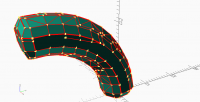
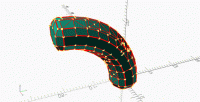
That does produce a broken STL where the lines are on the sides.

[image: image.png]

I expect CGAL produces vertices that are very close together and they
collapse during export to STL.

On Tue, 26 May 2020 at 14:39, Michael Marx michael@marx.id.au wrote:

For consistency please use add_rotate=7, it seems to be worse.


From: Discuss [mailto:discuss-bounces@lists.openscad.org] *On Behalf Of
*nop head
Sent: Tue, 26 May 2020 23:28
To: OpenSCAD general discussion
Subject: Re: [OpenSCAD] rendering problem

I am sure CGAL is used to do 3D Minkowski, that is why it is monumentally
slow.

I get

Total rendering time: 0 hours, 0 minutes, 9 seconds

Top level object is a 3D object:

Simple: yes

Vertices: 359

Halfedges: 1498

Edges: 749

Halffacets: 790

Facets: 395

Volumes: 3

Rendering finished.

NetFabb says there are 906 edges and 604 triangles in the STL. Presumably
that is because CGAL outputs polygons and they have to be broken into
triangles for STL.

[image: image.png]

On Tue, 26 May 2020 at 14:17, arnholm@arnholm.org wrote:

On 2020-05-26 00:06, Ronaldo Persiano wrote:

Congratulations! You have found a bug in the minkowski operator. That
is what I get with Thrown Together:

Could be an intermittent problem, or behaviour depends on version of
OpenSCAD and/or operating system. It is not necessarily minkowski that
fails, since difference is the final operation.

I tried with OpenSCAD 2017.01.20 under Win10 and it shows no obvious
problems (but see below), it is reported as

Total rendering time: 0 hours, 0 minutes, 10 seconds
Top level object is a 3D object:
Simple:        yes
Vertices:      369
Halfedges:    1556
Edges:        778
Halffacets:    826
Facets:        413
Volumes:        3
Rendering finished.
STL export finished.

However, testing the exported STL in polyfix reveals a higher number of
faces (628) compared to what OpenSCAD reports (413), which is kind of
strange.

polyhedron 0 ================= volume=1469.81, dtol=0.01, atol=1e-06,
maxiter=10
iteration 0: vertices=1884 faces=628
warning: 4 zero area faces.
warning: nonmanifold edges: uc(1)=1884
merged 1574 vertices
removed 16 collapsed or zero area faces
removed 2 duplicate faces
removed 2 nonmanifold faces
total changes=1594
no warnings

iteration 1: vertices=310 faces=608
removed 2 unused vertices
total changes=2
no warnings

iteration 2: vertices=308 faces=608
total changes=0
no warnings

Summary:
polyhedron 0: vertices=308 faces=608 : no warnings

When instead exporting the same model from OpenSCAD to OFF format, it
showed an even higher number of faces (710):

polyhedron 0 ================= volume=1469.81, dtol=0.01, atol=1e-06,
maxiter=10
iteration 0: vertices=359 faces=710
warning: 86 zero area faces.
merged 49 vertices
removed 98 collapsed or zero area faces
removed 2 duplicate faces
removed 2 nonmanifold faces
total changes=151
no warnings

iteration 1: vertices=310 faces=608
removed 2 unused vertices
total changes=2
no warnings

iteration 2: vertices=308 faces=608
total changes=0
no warnings

Summary:
polyhedron 0: vertices=308 faces=608 : no warnings

As you can see, polyfix resolved both of the above to vertices=308
faces=608, even if the starting points were different. I think this
shows that at least part of the problems lie in file export code.

It does not make sense that the number of faces exported depends on the
file format chosen. Clearly, there is no check for zero area faces on
file export in OpenSCAD.

I also tried this, which seemed to work
https://gist.github.com/arnholm/de50168cd1a477be1de116e100a8066a

Carsten Arnholm


OpenSCAD mailing list
Discuss@lists.openscad.org
http://lists.openscad.org/mailman/listinfo/discuss_lists.openscad.org
http://www.avg.com/email-signature?utm_medium=email&utm_source=link&utm_campaign=sig-email&utm_content=emailclient Virus-free.
www.avg.com
http://www.avg.com/email-signature?utm_medium=email&utm_source=link&utm_campaign=sig-email&utm_content=emailclient
<#m_4298768374393695056_DAB4FAD8-2DD7-40BB-A1B8-4E2AA1F9FDF2>


OpenSCAD mailing list
Discuss@lists.openscad.org
http://lists.openscad.org/mailman/listinfo/discuss_lists.openscad.org

That does produce a broken STL where the lines are on the sides. [image: image.png] I expect CGAL produces vertices that are very close together and they collapse during export to STL. On Tue, 26 May 2020 at 14:39, Michael Marx <michael@marx.id.au> wrote: > For consistency please use add_rotate=7, it seems to be worse. > > > ------------------------------ > > *From:* Discuss [mailto:discuss-bounces@lists.openscad.org] *On Behalf Of > *nop head > *Sent:* Tue, 26 May 2020 23:28 > *To:* OpenSCAD general discussion > *Subject:* Re: [OpenSCAD] rendering problem > > > > I am sure CGAL is used to do 3D Minkowski, that is why it is monumentally > slow. > > > > I get > > > > Total rendering time: 0 hours, 0 minutes, 9 seconds > > Top level object is a 3D object: > > Simple: yes > > Vertices: 359 > > Halfedges: 1498 > > Edges: 749 > > Halffacets: 790 > > Facets: 395 > > Volumes: 3 > > Rendering finished. > > > > NetFabb says there are 906 edges and 604 triangles in the STL. Presumably > that is because CGAL outputs polygons and they have to be broken into > triangles for STL. > > > > [image: image.png] > > > > On Tue, 26 May 2020 at 14:17, <arnholm@arnholm.org> wrote: > > On 2020-05-26 00:06, Ronaldo Persiano wrote: > > Congratulations! You have found a bug in the minkowski operator. That > > is what I get with Thrown Together: > > Could be an intermittent problem, or behaviour depends on version of > OpenSCAD and/or operating system. It is not necessarily minkowski that > fails, since difference is the final operation. > > I tried with OpenSCAD 2017.01.20 under Win10 and it shows no obvious > problems (but see below), it is reported as > > Total rendering time: 0 hours, 0 minutes, 10 seconds > Top level object is a 3D object: > Simple: yes > Vertices: 369 > Halfedges: 1556 > Edges: 778 > Halffacets: 826 > Facets: 413 > Volumes: 3 > Rendering finished. > STL export finished. > > However, testing the exported STL in polyfix reveals a higher number of > faces (628) compared to what OpenSCAD reports (413), which is kind of > strange. > > polyhedron 0 ================= volume=1469.81, dtol=0.01, atol=1e-06, > maxiter=10 > iteration 0: vertices=1884 faces=628 > warning: 4 zero area faces. > warning: nonmanifold edges: uc(1)=1884 > merged 1574 vertices > removed 16 collapsed or zero area faces > removed 2 duplicate faces > removed 2 nonmanifold faces > total changes=1594 > no warnings > > iteration 1: vertices=310 faces=608 > removed 2 unused vertices > total changes=2 > no warnings > > iteration 2: vertices=308 faces=608 > total changes=0 > no warnings > > Summary: > polyhedron 0: vertices=308 faces=608 : no warnings > > When instead exporting the same model from OpenSCAD to OFF format, it > showed an even higher number of faces (710): > > polyhedron 0 ================= volume=1469.81, dtol=0.01, atol=1e-06, > maxiter=10 > iteration 0: vertices=359 faces=710 > warning: 86 zero area faces. > merged 49 vertices > removed 98 collapsed or zero area faces > removed 2 duplicate faces > removed 2 nonmanifold faces > total changes=151 > no warnings > > iteration 1: vertices=310 faces=608 > removed 2 unused vertices > total changes=2 > no warnings > > iteration 2: vertices=308 faces=608 > total changes=0 > no warnings > > Summary: > polyhedron 0: vertices=308 faces=608 : no warnings > > As you can see, polyfix resolved both of the above to vertices=308 > faces=608, even if the starting points were different. I think this > shows that at least part of the problems lie in file export code. > > It does not make sense that the number of faces exported depends on the > file format chosen. Clearly, there is no check for zero area faces on > file export in OpenSCAD. > > > I also tried this, which seemed to work > https://gist.github.com/arnholm/de50168cd1a477be1de116e100a8066a > > Carsten Arnholm > > > > > > > > _______________________________________________ > OpenSCAD mailing list > Discuss@lists.openscad.org > http://lists.openscad.org/mailman/listinfo/discuss_lists.openscad.org > > > > <http://www.avg.com/email-signature?utm_medium=email&utm_source=link&utm_campaign=sig-email&utm_content=emailclient> Virus-free. > www.avg.com > <http://www.avg.com/email-signature?utm_medium=email&utm_source=link&utm_campaign=sig-email&utm_content=emailclient> > <#m_4298768374393695056_DAB4FAD8-2DD7-40BB-A1B8-4E2AA1F9FDF2> > _______________________________________________ > OpenSCAD mailing list > Discuss@lists.openscad.org > http://lists.openscad.org/mailman/listinfo/discuss_lists.openscad.org >
TP
Torsten Paul
Tue, May 26, 2020 1:55 PM

On 26.05.20 15:28, nop head wrote:

I am sure CGAL is used to do 3D Minkowski, that is
why it is monumentally slow.

Yes, CGAL is quite involved, but not the actual
minkowski implementation.

OpenSCAD normally uses CGAL to (optionally)
deconstruct the object into convex parts and
generates a point cloud based on positioning the
second object on all vertices of the convex parts
and afterwards does a convex hull on those.

Afterwards the separate convex minkowski parts
are unioned together -> this is where the slowness
can come in big time depending on how much parts
were generated.

This can be observed in more detail via

openscad --debug=cgalutils-applyops

Pretty much worst case scenario as this very low
resolution object decomposes into 124 parts.

minkowski(){
difference() {
cube(20, center = true);
sphere(13, $fn = 16);
}
sphere(2);
}

Minkowski: child 0 is nonconvex Nef, decomposing...
Minkowski: decomposed into 124 convex parts
Minkowski: decomposition took 1.029088 s
Minkowski: child 1 is convex and PolySet
Minkowski: Point cloud creation (8 ⨉ 28 -> 224) took 1029.115000 ms
Minkowski: Computing convex hull took 0.000985 s
Minkowski: Point cloud creation (8 ⨉ 28 -> 224) took 0.015000 ms
Minkowski: Computing convex hull took 0.001173 s
[snip...]
Minkowski: Point cloud creation (6 ⨉ 28 -> 168) took 0.057000 ms
Minkowski: Computing convex hull took 0.001939 s
Minkowski: Computing union of 124 parts
Minkowski: Union done: 26.550561 s
Minkowski: Total execution time 28.331127 s

ciao,
Torsten.

On 26.05.20 15:28, nop head wrote: > I am sure CGAL is used to do 3D Minkowski, that is > why it is monumentally slow. Yes, CGAL is quite involved, but not the actual minkowski implementation. OpenSCAD normally uses CGAL to (optionally) deconstruct the object into convex parts and generates a point cloud based on positioning the second object on all vertices of the convex parts and afterwards does a convex hull on those. Afterwards the separate convex minkowski parts are unioned together -> this is where the slowness can come in big time depending on how much parts were generated. This can be observed in more detail via openscad --debug=cgalutils-applyops Pretty much worst case scenario as this very low resolution object decomposes into 124 parts. minkowski(){ difference() { cube(20, center = true); sphere(13, $fn = 16); } sphere(2); } Minkowski: child 0 is nonconvex Nef, decomposing... Minkowski: decomposed into 124 convex parts Minkowski: decomposition took 1.029088 s Minkowski: child 1 is convex and PolySet Minkowski: Point cloud creation (8 ⨉ 28 -> 224) took 1029.115000 ms Minkowski: Computing convex hull took 0.000985 s Minkowski: Point cloud creation (8 ⨉ 28 -> 224) took 0.015000 ms Minkowski: Computing convex hull took 0.001173 s [snip...] Minkowski: Point cloud creation (6 ⨉ 28 -> 168) took 0.057000 ms Minkowski: Computing convex hull took 0.001939 s Minkowski: Computing union of 124 parts Minkowski: Union done: 26.550561 s Minkowski: Total execution time 28.331127 s ciao, Torsten.
RP
Ronaldo Persiano
Tue, May 26, 2020 2:55 PM

Yes, CGAL is quite involved, but not the actual

minkowski implementation.

OpenSCAD normally uses CGAL to (optionally)
deconstruct the object into convex parts and
generates a point cloud based on positioning the
second object on all vertices of the convex parts
and afterwards does a convex hull on those.

Afterwards the separate convex minkowski parts
are unioned together -> this is where the slowness
can come in big time depending on how much parts
were generated.

This quite clarify my understanding. But how preview deals with minkowski?
I imagine that the flow above is pretty much the same except the union in
last step. Preview might just throw the convex parts to the z-buffer
avoiding the union. And this last process seems to be creating a flipped
face.

That is what I get after a fresh F6 followed by a F5:

[image: FlushF6F5.PNG]

and that is what comes out from a fresh F5:

[image: FlushF5.PNG]

and that last one with Throw Together:

[image: FlushF5TT.PNG]

So, it seems there is a bug in the F5 process of minkowski,
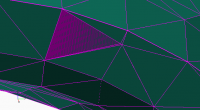
Yes, CGAL is quite involved, but not the actual > minkowski implementation. > > OpenSCAD normally uses CGAL to (optionally) > deconstruct the object into convex parts and > generates a point cloud based on positioning the > second object on all vertices of the convex parts > and afterwards does a convex hull on those. > > Afterwards the separate convex minkowski parts > are unioned together -> this is where the slowness > can come in big time depending on how much parts > were generated. > This quite clarify my understanding. But how preview deals with minkowski? I imagine that the flow above is pretty much the same except the union in last step. Preview might just throw the convex parts to the z-buffer avoiding the union. And this last process seems to be creating a flipped face. That is what I get after a fresh F6 followed by a F5: [image: FlushF6F5.PNG] and that is what comes out from a fresh F5: [image: FlushF5.PNG] and that last one with Throw Together: [image: FlushF5TT.PNG] So, it seems there is a bug in the F5 process of minkowski,

TP
Torsten Paul
Tue, May 26, 2020 4:16 PM

On 26.05.20 16:55, Ronaldo Persiano wrote:

This quite clarify my understanding. But how preview deals
with minkowski? I imagine that the flow above is pretty
much the same except the union in last step. Preview might
just throw the convex parts to the z-buffer avoiding the
union. And this last process seems to be creating a flipped
face.

Hmm, I don't think it's using different path, I believe it
actually does the full processing in preview already. But
that's a good point, in theory it should be possible to skip
the union part for preview.

ciao,
Torsten.

On 26.05.20 16:55, Ronaldo Persiano wrote: > This quite clarify my understanding. But how preview deals > with minkowski? I imagine that the flow above is pretty > much the same except the union in last step. Preview might > just throw the convex parts to the z-buffer avoiding the > union. And this last process seems to be creating a flipped > face. Hmm, I don't think it's using different path, I believe it actually does the full processing in preview already. But that's a good point, in theory it should be possible to skip the union part for preview. ciao, Torsten.
A
arnholm@arnholm.org
Tue, May 26, 2020 4:25 PM

On 2020-05-26 15:55, Torsten Paul wrote:

Yes, CGAL is quite involved, but not the actual
minkowski implementation.

OpenSCAD normally uses CGAL to (optionally)
deconstruct the object into convex parts and
generates a point cloud based on positioning the
second object on all vertices of the convex parts
and afterwards does a convex hull on those.

Afterwards the separate convex minkowski parts
are unioned together -> this is where the slowness
can come in big time depending on how much parts
were generated.

Yes. This illustrates however that the only real problem is the slow
execution of boolean operations in CGAL, not the Minkowski subdivision
as such. The Minkowski subdivision into convex components seems like a
daunting and complicated task, but that is largely an illusion. The
convex subdivision problem is complicated only if you require to
optimize (=minimize) the number of convex components in Minkowski
subdivision on the assumption that booleans are slow.

If you have fast booleans it is possible to implement Minkowski sum
using a much simpler approach with many more, but much simpler convex
components. This is exactly what xcsg ( https://github.com/arnholm/xcsg
) does, and it is at least an order of magnitude faster because carve
booleans are intrinsically quite fast and because one can compute
booleans in multiple threads.

Carsten Arnholm

On 2020-05-26 15:55, Torsten Paul wrote: > Yes, CGAL is quite involved, but not the actual > minkowski implementation. > > OpenSCAD normally uses CGAL to (optionally) > deconstruct the object into convex parts and > generates a point cloud based on positioning the > second object on all vertices of the convex parts > and afterwards does a convex hull on those. > > Afterwards the separate convex minkowski parts > are unioned together -> this is where the slowness > can come in big time depending on how much parts > were generated. Yes. This illustrates however that the only real problem is the slow execution of boolean operations in CGAL, not the Minkowski subdivision as such. The Minkowski subdivision into convex components seems like a daunting and complicated task, but that is largely an illusion. The convex subdivision problem is complicated only if you require to optimize (=minimize) the number of convex components in Minkowski subdivision on the assumption that booleans are slow. If you have fast booleans it is possible to implement Minkowski sum using a much simpler approach with many more, but much simpler convex components. This is exactly what xcsg ( https://github.com/arnholm/xcsg ) does, and it is at least an order of magnitude faster because carve booleans are intrinsically quite fast and because one can compute booleans in multiple threads. Carsten Arnholm