

discuss@lists.openscad.org

OpenSCAD general discussion Mailing-list

View all threads

Re: Merging sub-assemblies?

JB
Jordan Brown
Tue, May 11, 2021 2:22 PM

Without any claim that it's best approach, my first thought on building
a box is to have each of the sides be a cube, pretty much like it would
be if I was building it out of wood.

(The "extrude from 2D" approach seems like a winner because of the ease
of producing rounded corners, though it doesn't explain how to round the
corners at the bottom.)

Without any claim that it's best approach, my first thought on building a box is to have each of the sides be a cube, pretty much like it would be if I was building it out of wood. (The "extrude from 2D" approach seems like a winner because of the ease of producing rounded corners, though it doesn't explain how to round the corners at the bottom.)
L
LenStruttmann
Tue, May 11, 2021 2:42 PM

To get a rounded cube, I put spheres in each of the 8 corners, then use
hull() to form the box.  It's NOT fast, but it's easy.  I use this all the
time.

$fn = 24;

cube_soft( 20, 30, 10, 5 );

//****************************************************************
module cube_soft( x, y, z, r, center=false )
{
if (center==true)
{
whole( x, y, z, r );
}
else
{
translate( [ 0.5x, 0.5y, 0.5*z ] ) whole( x, y, z, r );
}

module whole( x, y, z, r )
{
hull()
for ( i=[-1:2:1],j=[-1:2:1],k=[-1:2:1] )
{
translate( [ i*(0.5x-r),j(0.5y-r),k(0.5z-r) ] )
sphere( r );
}
}
}
//
***************************************************************

--
Sent from: http://forum.openscad.org/

To get a rounded cube, I put spheres in each of the 8 corners, then use hull() to form the box. It's NOT fast, but it's easy. I use this all the time. $fn = 24; cube_soft( 20, 30, 10, 5 ); //**************************************************************** module cube_soft( x, y, z, r, center=false ) { if (center==true) { whole( x, y, z, r ); } else { translate( [ 0.5*x, 0.5*y, 0.5*z ] ) whole( x, y, z, r ); } module whole( x, y, z, r ) { hull() for ( i=[-1:2:1],j=[-1:2:1],k=[-1:2:1] ) { translate( [ i*(0.5*x-r),j*(0.5*y-r),k*(0.5*z-r) ] ) sphere( r ); } } } //**************************************************************** -- Sent from: http://forum.openscad.org/
RW
Ray West
Tue, May 11, 2021 2:44 PM

I found some code on thingiverse that does fillets and chamfers on the
top and/or bottom. Simple in concept, slow to render -
https://www.thingiverse.com/thing:2461392   (I found a slight error in
code, not sure if it has been corrected). But, often don't need the base
rounded, if being screwed to  a wall.

On 11/05/2021 15:22, Jordan Brown wrote:

though it doesn't explain how to round the corners at the bottom.)

I found some code on thingiverse that does fillets and chamfers on the top and/or bottom. Simple in concept, slow to render - https://www.thingiverse.com/thing:2461392   (I found a slight error in code, not sure if it has been corrected). But, often don't need the base rounded, if being screwed to  a wall. On 11/05/2021 15:22, Jordan Brown wrote: > though it doesn't explain how to round the corners at the bottom.)
RW
Rogier Wolff
Tue, May 11, 2021 3:22 PM

On Tue, May 11, 2021 at 02:22:40PM +0000, Jordan Brown wrote:

Without any claim that it's best approach, my first thought on building
a box is to have each of the sides be a cube, pretty much like it would
be if I was building it out of wood.

... extrude ..

I would then first make a module that produces a side with a
specific size and rounding radius:

module qsphere (r)
{
intersection () {
sphere (r);
cube (r+1);
}
}

module side (x, y, r)
{
hull () {
translate ([x-r, y-r,0]) rotate (  0) qsphere (r);
translate ([  r, y-r,0]) rotate ( 90) qsphere (r);
translate ([  r,  r,0]) rotate (180) qsphere (r);
translate ([x-r,  r,0]) rotate (270) qsphere (r);
}
}

side (50,70,10);

then building up a box would be joining 5 of these....

Roger. 

(I named the Eigth-of-a-sphere qsphere for quartersphere. Sue me).

--
** R.E.Wolff@BitWizard.nl ** https://www.BitWizard.nl/ ** +31-15-2049110 **
**    Delftechpark 11 2628 XJ  Delft, The Netherlands.  KVK: 27239233    **
f equals m times a. When your f is steady, and your m is going down
your a is going up.  -- Chris Hadfield about flying up the space shuttle.

On Tue, May 11, 2021 at 02:22:40PM +0000, Jordan Brown wrote: > Without any claim that it's best approach, my first thought on building > a box is to have each of the sides be a cube, pretty much like it would > be if I was building it out of wood. > ... extrude .. I would then first make a module that produces a side with a specific size and rounding radius: module qsphere (r) { intersection () { sphere (r); cube (r+1); } } module side (x, y, r) { hull () { translate ([x-r, y-r,0]) rotate ( 0) qsphere (r); translate ([ r, y-r,0]) rotate ( 90) qsphere (r); translate ([ r, r,0]) rotate (180) qsphere (r); translate ([x-r, r,0]) rotate (270) qsphere (r); } } side (50,70,10); then building up a box would be joining 5 of these.... Roger. (I named the Eigth-of-a-sphere qsphere for quartersphere. Sue me). -- ** R.E.Wolff@BitWizard.nl ** https://www.BitWizard.nl/ ** +31-15-2049110 ** ** Delftechpark 11 2628 XJ Delft, The Netherlands. KVK: 27239233 ** f equals m times a. When your f is steady, and your m is going down your a is going up. -- Chris Hadfield about flying up the space shuttle.
A
adrianv
Tue, May 11, 2021 8:20 PM

It's pretty darn slow, and the output is ugly (stair steps instead of actual
roundovers).  Have you time tested it against minkowski?

BOSL2 has a support for a variety of rounding, either direct rounded cubes
with options to the cuboid() module, or more sophisticated rounding in
rounding.scad.

I usually make boxes with teardrop rounding on the outside bottom (to assure
printability without supports), a big roundover on the vertical edges, a
small roundover on the top, and a small to medium roundover on the bottom
inside by using a combination of offset_sweep and round_corners in BOSL2.
But I wouldn't call this a basic approach.

https://github.com/revarbat/BOSL2/wiki/rounding.scad

mondo wrote

I found some code on thingiverse that does fillets and chamfers on the
top and/or bottom. Simple in concept, slow to render -
https://www.thingiverse.com/thing:2461392   (I found a slight error in
code, not sure if it has been corrected). But, often don't need the base
rounded, if being screwed to  a wall.

On 11/05/2021 15:22, Jordan Brown wrote:

though it doesn't explain how to round the corners at the bottom.)


OpenSCAD mailing list
To unsubscribe send an email to

discuss-leave@.openscad

It's pretty darn slow, and the output is ugly (stair steps instead of actual roundovers). Have you time tested it against minkowski? BOSL2 has a support for a variety of rounding, either direct rounded cubes with options to the cuboid() module, or more sophisticated rounding in rounding.scad. I usually make boxes with teardrop rounding on the outside bottom (to assure printability without supports), a big roundover on the vertical edges, a small roundover on the top, and a small to medium roundover on the bottom inside by using a combination of offset_sweep and round_corners in BOSL2. But I wouldn't call this a basic approach. https://github.com/revarbat/BOSL2/wiki/rounding.scad mondo wrote > I found some code on thingiverse that does fillets and chamfers on the > top and/or bottom. Simple in concept, slow to render - > https://www.thingiverse.com/thing:2461392   (I found a slight error in > code, not sure if it has been corrected). But, often don't need the base > rounded, if being screwed to  a wall. > > On 11/05/2021 15:22, Jordan Brown wrote: >> though it doesn't explain how to round the corners at the bottom.) > _______________________________________________ > OpenSCAD mailing list > To unsubscribe send an email to > discuss-leave@.openscad -- Sent from: http://forum.openscad.org/
T
Terrypin
Tue, May 11, 2021 9:54 PM

Impressive set of responses, thanks all! These will keep me busy for quite
some time and will be a great learning exercise.

I’ve made the box by several of the suggested methods so far, including
minkowski().  I’m finding hull() rather attractive. With a cylinder instead
of a sphere at each of the cube’s four vertical edges it’s also one of the
more intuitive. But I’ve yet to try extruding 2D, which I’m looking forward
to.

And I’ve so far not worked with a library hso I need to study that
thingiverse code. Do I have to just place the downloaded scads in the same
folder as my code to get it working?

BTW, I want this box to have a flat top rim, not rounded, so that the
existing top socket assembly rests on it squarely.

Spent an hour or two working on ways to manipulate the displayed results so
that I could measure the dimensions of my various attempts precisely. Any
consensus on best method please? I zoomed in greatly and rotated so that
axis markings visible (with transparency if necessary).  One odd thing: the
numbering seems to stop at some point around 90 when zoomed near max. So,
for example, I could accurately determine the wall thickness near (0,0,0),
but ensuring the box was 143 long was trickier.

Much appreciate all the generous help, thank you.

--
Sent from: http://forum.openscad.org/

Impressive set of responses, thanks all! These will keep me busy for quite some time and will be a great learning exercise. I’ve made the box by several of the suggested methods so far, including minkowski(). I’m finding hull() rather attractive. With a cylinder instead of a sphere at each of the cube’s four vertical edges it’s also one of the more intuitive. But I’ve yet to try extruding 2D, which I’m looking forward to. And I’ve so far not worked with a library hso I need to study that thingiverse code. Do I have to just place the downloaded scads in the same folder as my code to get it working? BTW, I want this box to have a flat top rim, not rounded, so that the existing top socket assembly rests on it squarely. Spent an hour or two working on ways to manipulate the displayed results so that I could measure the dimensions of my various attempts precisely. Any consensus on best method please? I zoomed in greatly and rotated so that axis markings visible (with transparency if necessary). One odd thing: the numbering seems to stop at some point around 90 when zoomed near max. So, for example, I could accurately determine the wall thickness near (0,0,0), but ensuring the box was 143 long was trickier. Much appreciate all the generous help, thank you. -- Sent from: http://forum.openscad.org/
RW
Ray West
Tue, May 11, 2021 10:54 PM

I said it was slow. For simple shapes, cubes/whatever, then there are
quicker ways, but it is faster if you run the scad script in AngelCAD,
pretty darn fast, in fact. You can control the stair stepping - it makes
no difference in 3d printing, use finer steps. Minkowski does not do
fillets - it adds, not subtracts the rounding, as does offset in 2d.
Hull just wraps the shape, it does not follow indents. In the past, I've
used freecad, which has useful filleting, and for stuff like boxes I've
generated shaped extrusions to round of the corners by differencing, and
you do not need to go back and alter dimensions as you would need to do
for simpler shapes, using hull or minkowski. But using the code I
mentioned, you can  easily round of the bottom or top edge of shapes,
such as below, and afaik, there is no inbuilt method for filleting in
openscad.

On 11/05/2021 21:20, adrianv wrote:

It's pretty darn slow, and the output is ugly (stair steps instead of
actual roundovers).  Have you time tested it against minkowski?

BOSL2 has a support for a variety of rounding, either direct rounded
cubes with options to the cuboid() module, or more sophisticated
rounding in rounding.scad.

I usually make boxes with teardrop rounding on the outside bottom (to
assure printability without supports), a big roundover on the vertical
edges, a small roundover on the top, and a small to medium roundover
on the bottom inside by using a combination of offset_sweep and
round_corners in BOSL2.  But I wouldn't call this a basic approach.

https://github.com/revarbat/BOSL2/wiki/rounding.scad

 mondo wrote
 I found some code on thingiverse that does fillets and chamfers on
 the
 top and/or bottom. Simple in concept, slow to render -
 https://www.thingiverse.com/thing:2461392
 <https://www.thingiverse.com/thing:2461392> (I found a slight
 error in
 code, not sure if it has been corrected). But, often don't need
 the base
 rounded, if being screwed to  a wall.

 On 11/05/2021 15:22, Jordan Brown wrote:

though it doesn't explain how to round the corners at the bottom.)

 _______________________________________________
 OpenSCAD mailing list
 To unsubscribe send an email to [hidden email]
 </user/SendEmail.jtp?type=email&email=discuss-leave%40.openscad>

Sent from the OpenSCAD mailing list archive
http://forum.openscad.org/ at Nabble.com.


OpenSCAD mailing list
To unsubscribe send an email to discuss-leave@lists.openscad.org
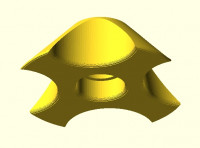
I said it was slow. For simple shapes, cubes/whatever, then there are quicker ways, but it is faster if you run the scad script in AngelCAD, pretty darn fast, in fact. You can control the stair stepping - it makes no difference in 3d printing, use finer steps. Minkowski does not do fillets - it adds, not subtracts the rounding, as does offset in 2d. Hull just wraps the shape, it does not follow indents. In the past, I've used freecad, which has useful filleting, and for stuff like boxes I've generated shaped extrusions to round of the corners by differencing, and you do not need to go back and alter dimensions as you would need to do for simpler shapes, using hull or minkowski. But using the code I mentioned, you can  easily round of the bottom or top edge of shapes, such as below, and afaik, there is no inbuilt method for filleting in openscad. On 11/05/2021 21:20, adrianv wrote: > It's pretty darn slow, and the output is ugly (stair steps instead of > actual roundovers).  Have you time tested it against minkowski? > > BOSL2 has a support for a variety of rounding, either direct rounded > cubes with options to the cuboid() module, or more sophisticated > rounding in rounding.scad. > > I usually make boxes with teardrop rounding on the outside bottom (to > assure printability without supports), a big roundover on the vertical > edges, a small roundover on the top, and a small to medium roundover > on the bottom inside by using a combination of offset_sweep and > round_corners in BOSL2.  But I wouldn't call this a basic approach. > > https://github.com/revarbat/BOSL2/wiki/rounding.scad > <https://github.com/revarbat/BOSL2/wiki/rounding.scad> > > mondo wrote > I found some code on thingiverse that does fillets and chamfers on > the > top and/or bottom. Simple in concept, slow to render - > https://www.thingiverse.com/thing:2461392 > <https://www.thingiverse.com/thing:2461392> (I found a slight > error in > code, not sure if it has been corrected). But, often don't need > the base > rounded, if being screwed to  a wall. > > On 11/05/2021 15:22, Jordan Brown wrote: > > though it doesn't explain how to round the corners at the bottom.) > _______________________________________________ > OpenSCAD mailing list > To unsubscribe send an email to [hidden email] > </user/SendEmail.jtp?type=email&email=discuss-leave%40.openscad> > > > ------------------------------------------------------------------------ > Sent from the OpenSCAD mailing list archive > <http://forum.openscad.org/> at Nabble.com. > > _______________________________________________ > OpenSCAD mailing list > To unsubscribe send an email to discuss-leave@lists.openscad.org
A
adrianv
Tue, May 11, 2021 11:20 PM

If you're going to use AngelCAD then....why not just use AngelCAD?

In principle modeling stair-step style should be OK, but it's hard to view
the models, at least in OpenSCAD, due to the moire patterns---it's hard to
tell what the model actually looks like---and it's just an inelegant
technique.  And you don't even get repaid with decent speed for suffering
the inelegance, so I really don't find it compelling.

You can use multiple applications of minkowski to get inside and outside
rounding if you're willing to wait for it.  In 2d this technique is
practical.  As long as your shape's thinnest part is larger than the inside
rounding radius.

module round2d(r, or, ir)
{
offset(or) offset(-ir-or) offset(delta=ir,chamfer=true) children();
}

A similar scheme with minkowski and differences from a cube larger than your
model can round an arbitrary 3d object.  But it may take hours.

My first model relied on minkowski and takes 20 minutes to preview.  Since
then I've spent a lot of time writing code to round things that actually
runs fast, but doing this in a fully general way isn't feasible.  And
you're right: there's no "fillet" command in OpenSCAD.

mondo wrote

I said it was slow. For simple shapes, cubes/whatever, then there are
quicker ways, but it is faster if you run the scad script in AngelCAD,
pretty darn fast, in fact. You can control the stair stepping - it makes
no difference in 3d printing, use finer steps. Minkowski does not do
fillets - it adds, not subtracts the rounding, as does offset in 2d.
Hull just wraps the shape, it does not follow indents. In the past, I've
used freecad, which has useful filleting, and for stuff like boxes I've
generated shaped extrusions to round of the corners by differencing, and
you do not need to go back and alter dimensions as you would need to do
for simpler shapes, using hull or minkowski. But using the code I
mentioned, you can  easily round of the bottom or top edge of shapes,
such as below, and afaik, there is no inbuilt method for filleting in
openscad.

On 11/05/2021 21:20, adrianv wrote:

It's pretty darn slow, and the output is ugly (stair steps instead of
actual roundovers).  Have you time tested it against minkowski?

BOSL2 has a support for a variety of rounding, either direct rounded
cubes with options to the cuboid() module, or more sophisticated
rounding in rounding.scad.

I usually make boxes with teardrop rounding on the outside bottom (to
assure printability without supports), a big roundover on the vertical
edges, a small roundover on the top, and a small to medium roundover
on the bottom inside by using a combination of offset_sweep and
round_corners in BOSL2.  But I wouldn't call this a basic approach.

https://github.com/revarbat/BOSL2/wiki/rounding.scad
<https://github.com/revarbat/BOSL2/wiki/rounding.scad>

 mondo wrote
 I found some code on thingiverse that does fillets and chamfers on
 the
 top and/or bottom. Simple in concept, slow to render -
 https://www.thingiverse.com/thing:2461392
 &lt;https://www.thingiverse.com/thing:2461392&gt; (I found a slight
 error in
 code, not sure if it has been corrected). But, often don't need
 the base
 rounded, if being screwed to  a wall.

 On 11/05/2021 15:22, Jordan Brown wrote:

though it doesn't explain how to round the corners at the bottom.)

 _______________________________________________
 OpenSCAD mailing list
 To unsubscribe send an email to [hidden email]

</user/SendEmail.jtp?type=email&email=discuss-leave%40.openscad>


Sent from the OpenSCAD mailing list archive
<http://forum.openscad.org/> at Nabble.com.


OpenSCAD mailing list
To unsubscribe send an email to

discuss-leave@.openscad


OpenSCAD mailing list
To unsubscribe send an email to

discuss-leave@.openscad

leoojcjflhpnamdp.jfif (73K)
<http://forum.openscad.org/attachment/33076/0/leoojcjflhpnamdp.jfif>

If you're going to use AngelCAD then....why not just use AngelCAD? In principle modeling stair-step style should be OK, but it's hard to view the models, at least in OpenSCAD, due to the moire patterns---it's hard to tell what the model actually looks like---and it's just an inelegant technique. And you don't even get repaid with decent speed for suffering the inelegance, so I really don't find it compelling. You can use multiple applications of minkowski to get inside and outside rounding if you're willing to wait for it. In 2d this technique is practical. As long as your shape's thinnest part is larger than the inside rounding radius. module round2d(r, or, ir) { offset(or) offset(-ir-or) offset(delta=ir,chamfer=true) children(); } A similar scheme with minkowski and differences from a cube larger than your model can round an arbitrary 3d object. But it may take hours. My first model relied on minkowski and takes 20 minutes to preview. Since then I've spent a lot of time writing code to round things that actually runs fast, but doing this in a fully general way isn't feasible. And you're right: there's no "fillet" command in OpenSCAD. mondo wrote > I said it was slow. For simple shapes, cubes/whatever, then there are > quicker ways, but it is faster if you run the scad script in AngelCAD, > pretty darn fast, in fact. You can control the stair stepping - it makes > no difference in 3d printing, use finer steps. Minkowski does not do > fillets - it adds, not subtracts the rounding, as does offset in 2d. > Hull just wraps the shape, it does not follow indents. In the past, I've > used freecad, which has useful filleting, and for stuff like boxes I've > generated shaped extrusions to round of the corners by differencing, and > you do not need to go back and alter dimensions as you would need to do > for simpler shapes, using hull or minkowski. But using the code I > mentioned, you can  easily round of the bottom or top edge of shapes, > such as below, and afaik, there is no inbuilt method for filleting in > openscad. > > > On 11/05/2021 21:20, adrianv wrote: >> It's pretty darn slow, and the output is ugly (stair steps instead of >> actual roundovers).  Have you time tested it against minkowski? >> >> BOSL2 has a support for a variety of rounding, either direct rounded >> cubes with options to the cuboid() module, or more sophisticated >> rounding in rounding.scad. >> >> I usually make boxes with teardrop rounding on the outside bottom (to >> assure printability without supports), a big roundover on the vertical >> edges, a small roundover on the top, and a small to medium roundover >> on the bottom inside by using a combination of offset_sweep and >> round_corners in BOSL2.  But I wouldn't call this a basic approach. >> >> https://github.com/revarbat/BOSL2/wiki/rounding.scad >> &lt;https://github.com/revarbat/BOSL2/wiki/rounding.scad&gt; >> >> mondo wrote >> I found some code on thingiverse that does fillets and chamfers on >> the >> top and/or bottom. Simple in concept, slow to render - >> https://www.thingiverse.com/thing:2461392 >> &lt;https://www.thingiverse.com/thing:2461392&gt; (I found a slight >> error in >> code, not sure if it has been corrected). But, often don't need >> the base >> rounded, if being screwed to  a wall. >> >> On 11/05/2021 15:22, Jordan Brown wrote: >> > though it doesn't explain how to round the corners at the bottom.) >> _______________________________________________ >> OpenSCAD mailing list >> To unsubscribe send an email to [hidden email] >> >> &lt;/user/SendEmail.jtp?type=email&amp;email=discuss-leave%40.openscad&gt; >> >> >> ------------------------------------------------------------------------ >> Sent from the OpenSCAD mailing list archive >> &lt;http://forum.openscad.org/&gt; at Nabble.com. >> >> _______________________________________________ >> OpenSCAD mailing list >> To unsubscribe send an email to > discuss-leave@.openscad > > _______________________________________________ > OpenSCAD mailing list > To unsubscribe send an email to > discuss-leave@.openscad > > > leoojcjflhpnamdp.jfif (73K) > &lt;http://forum.openscad.org/attachment/33076/0/leoojcjflhpnamdp.jfif&gt; -- Sent from: http://forum.openscad.org/
RW
Ray West
Wed, May 12, 2021 2:30 PM

On 12/05/2021 00:20, adrianv wrote:

If you're going to use AngelCAD then....why not just use AngelCAD?

I have used AngelCAD, in fact I prefer the structure/language to
openscad scripting, however, the quick f5 rendering in openscad is
useful, and there is more activity here, on the openscad mailing list,
always someone/s can help when you get stuck. Unfortunately, there are
very few folk, at least that I know of, who have an active interest in
AngelCAD, which imnsho is a great pity. However, it is easy enough for
anyone using openscad to drop in the openscad script into AngelCAD and
quickly get an stl file - in a few seconds instead of many minutes, in
many cases.

On 12/05/2021 00:20, adrianv wrote: > If you're going to use AngelCAD then....why not just use AngelCAD? I have used AngelCAD, in fact I prefer the structure/language to openscad scripting, however, the quick f5 rendering in openscad is useful, and there is more activity here, on the openscad mailing list, always someone/s can help when you get stuck. Unfortunately, there are very few folk, at least that I know of, who have an active interest in AngelCAD, which imnsho is a great pity. However, it is easy enough for anyone using openscad to drop in the openscad script into AngelCAD and quickly get an stl file - in a few seconds instead of many minutes, in many cases.
J
jon
Wed, May 12, 2021 2:42 PM

I use AngelCAD to process OpenSCAD scripts when processing those scripts
directly in OpenSCAD either takes too long or results in flawed STL files.

I find the F5 function in OpenSCAD to be crucial to my development. 
Being able to highlight a line in the code with a "#", or to change a
color or use "%" is essential.  The lack of that feature in AngelCAD is
a show-stopper for me.  Carsten does not seem to feel that these
functions are as important to him as they are to me.

That said, AngelCAD is a wonderful tool for some specific situations.

Jon

On 5/12/2021 10:30 AM, Ray West wrote:

On 12/05/2021 00:20, adrianv wrote:

If you're going to use AngelCAD then....why not just use AngelCAD?

I have used AngelCAD, in fact I prefer the structure/language to
openscad scripting, however, the quick f5 rendering in openscad is
useful, and there is more activity here, on the openscad mailing list,
always someone/s can help when you get stuck. Unfortunately, there are
very few folk, at least that I know of, who have an active interest in
AngelCAD, which imnsho is a great pity. However, it is easy enough for
anyone using openscad to drop in the openscad script into AngelCAD and
quickly get an stl file - in a few seconds instead of many minutes, in
many cases.


OpenSCAD mailing list
To unsubscribe send an email to discuss-leave@lists.openscad.org

I use AngelCAD to process OpenSCAD scripts when processing those scripts directly in OpenSCAD either takes too long or results in flawed STL files. I find the F5 function in OpenSCAD to be crucial to my development.  Being able to highlight a line in the code with a "#", or to change a color or use "%" is essential.  The lack of that feature in AngelCAD is a show-stopper for me.  Carsten does not seem to feel that these functions are as important to him as they are to me. That said, AngelCAD is a wonderful tool for some specific situations. Jon On 5/12/2021 10:30 AM, Ray West wrote: > On 12/05/2021 00:20, adrianv wrote: >> If you're going to use AngelCAD then....why not just use AngelCAD? > > I have used AngelCAD, in fact I prefer the structure/language to > openscad scripting, however, the quick f5 rendering in openscad is > useful, and there is more activity here, on the openscad mailing list, > always someone/s can help when you get stuck. Unfortunately, there are > very few folk, at least that I know of, who have an active interest in > AngelCAD, which imnsho is a great pity. However, it is easy enough for > anyone using openscad to drop in the openscad script into AngelCAD and > quickly get an stl file - in a few seconds instead of many minutes, in > many cases. > _______________________________________________ > OpenSCAD mailing list > To unsubscribe send an email to discuss-leave@lists.openscad.org >