T
TLC123
Sat, Dec 2, 2017 7:03 AM
nophead
Yes there was a bug with drawing the last segment.
I solved it some where but apparently not where i grabbed this code ;)
Yes AdjustBezier is the only new thing here the other stuff is just
leftovers for showcase.
Yepp the t() strips out other data that i used to store in the vector
radius, color, local scaling etc.
Yepp there are better analytical bezier math . I use the recursive because
- i understand that 2. it handles 2 to n control points without change.
No its not minimal energy witch get obviously when cramming a long strip in
a tight space.
It doesnt out bulge out right to maintain a smooth curvature.
Ronaldo yes the solution depends on the relative length of the /control
handles/.
some other store the middle control points as a relative vector to endpoints
[start,controlstart,controlend,end]
But i just use points
So given a bezier [p0,p1,p2,p3]
As i understand the problem:
The two endpoints are fixed. The initial direction at each end is fixed.
Thus each control point, p1 and p2, live along a vector formed p0 and p1
respectively p2 and p3.
Forming the /control handles/.
Adjusting the handles length change the overall length of the curve.
Both can be changed separately
but in AdjustBezier they are both multiplied by the same length error term
to converge on the desired length.
If its desired to force a uniform look both handles can be normalized
before AdjustBezier
Good Luck
function NormalizeBezierControl(v)=
[v[0],v[0]+UnitNormal (v[1]-v[0]) ,v[3]+UnitNormal (v[2]-v[3]) ,v[3]];
function UnitNormal (v)=v/max(norm(v),1e-32);// div by zero safe
--
Sent from: http://forum.openscad.org/
nophead
Yes there was a bug with drawing the last segment.
I solved it some where but apparently not where i grabbed this code ;)
Yes AdjustBezier is the only new thing here the other stuff is just
leftovers for showcase.
Yepp the t() strips out other data that i used to store in the vector
radius, color, local scaling etc.
Yepp there are better analytical bezier math . I use the recursive because
1. i understand that 2. it handles 2 to n control points without change.
No its not minimal energy witch get obviously when cramming a long strip in
a tight space.
It doesnt out bulge out right to maintain a smooth curvature.
Ronaldo yes the solution depends on the relative length of the /control
handles/.
some other store the middle control points as a relative vector to endpoints
[start,controlstart,controlend,end]
But i just use points
So given a bezier [p0,p1,p2,p3]
As i understand the problem:
The two endpoints are fixed. The initial direction at each end is fixed.
Thus each control point, p1 and p2, live along a vector formed p0 and p1
respectively p2 and p3.
Forming the /control handles/.
Adjusting the handles length change the overall length of the curve.
Both can be changed separately
but in AdjustBezier they are both multiplied by the same length error term
to converge on the desired length.
If its desired to force a uniform look both handles can be normalized
before AdjustBezier
Good Luck
function NormalizeBezierControl(v)=
[v[0],v[0]+UnitNormal (v[1]-v[0]) ,v[3]+UnitNormal (v[2]-v[3]) ,v[3]];
function UnitNormal (v)=v/max(norm(v),1e-32);// div by zero safe
--
Sent from: http://forum.openscad.org/

NH
nop head
Sat, Dec 2, 2017 8:47 AM
Yes it is certainly different from minimum energy when the ends are close
together and parallel, e.g. both pointing down gives a tall thin U but it
would actually look like the cross section of a light bulb.
In the case I am modelling the ends are not close together so perhaps it
will be accurate enough. Now that I know I am looking for a minimum energy
I have found lots of papers about it. Most need to be paid for though.
On 2 December 2017 at 07:03, TLC123 torleif.ceder@gmail.com wrote:
nophead
Yes there was a bug with drawing the last segment.
I solved it some where but apparently not where i grabbed this code ;)
Yes AdjustBezier is the only new thing here the other stuff is just
leftovers for showcase.
Yepp the t() strips out other data that i used to store in the vector
radius, color, local scaling etc.
Yepp there are better analytical bezier math . I use the recursive because
- i understand that 2. it handles 2 to n control points without change.
No its not minimal energy witch get obviously when cramming a long strip in
a tight space.
It doesnt out bulge out right to maintain a smooth curvature.
Ronaldo yes the solution depends on the relative length of the /control
handles/.
some other store the middle control points as a relative vector to
endpoints
[start,controlstart,controlend,end]
But i just use points
So given a bezier [p0,p1,p2,p3]
As i understand the problem:
The two endpoints are fixed. The initial direction at each end is fixed.
Thus each control point, p1 and p2, live along a vector formed p0 and p1
respectively p2 and p3.
Forming the /control handles/.
Adjusting the handles length change the overall length of the curve.
Both can be changed separately
but in AdjustBezier they are both multiplied by the same length error term
to converge on the desired length.
If its desired to force a uniform look both handles can be normalized
before AdjustBezier
Good Luck
function NormalizeBezierControl(v)=
[v[0],v[0]+UnitNormal (v[1]-v[0]) ,v[3]+UnitNormal (v[2]-v[3]) ,v[3]];
function UnitNormal (v)=v/max(norm(v),1e-32);// div by zero safe
--
Sent from: http://forum.openscad.org/
OpenSCAD mailing list
Discuss@lists.openscad.org
http://lists.openscad.org/mailman/listinfo/discuss_lists.openscad.org
Yes it is certainly different from minimum energy when the ends are close
together and parallel, e.g. both pointing down gives a tall thin U but it
would actually look like the cross section of a light bulb.
In the case I am modelling the ends are not close together so perhaps it
will be accurate enough. Now that I know I am looking for a minimum energy
I have found lots of papers about it. Most need to be paid for though.
On 2 December 2017 at 07:03, TLC123 <torleif.ceder@gmail.com> wrote:
> nophead
> Yes there was a bug with drawing the last segment.
> I solved it some where but apparently not where i grabbed this code ;)
>
> Yes AdjustBezier is the only new thing here the other stuff is just
> leftovers for showcase.
>
> Yepp the t() strips out other data that i used to store in the vector
> radius, color, local scaling etc.
>
> Yepp there are better analytical bezier math . I use the recursive because
> 1. i understand that 2. it handles 2 to n control points without change.
>
> No its not minimal energy witch get obviously when cramming a long strip in
> a tight space.
> It doesnt out bulge out right to maintain a smooth curvature.
>
> Ronaldo yes the solution depends on the relative length of the /control
> handles/.
> some other store the middle control points as a relative vector to
> endpoints
> [start,controlstart,controlend,end]
>
> But i just use points
> So given a bezier [p0,p1,p2,p3]
> As i understand the problem:
> The two endpoints are fixed. The initial direction at each end is fixed.
> Thus each control point, p1 and p2, live along a vector formed p0 and p1
> respectively p2 and p3.
> Forming the /control handles/.
> Adjusting the handles length change the overall length of the curve.
> Both can be changed separately
> but in AdjustBezier they are both multiplied by the same length error term
> to converge on the desired length.
>
> If its desired to force a uniform look both handles can be normalized
> before AdjustBezier
>
> Good Luck
>
> function NormalizeBezierControl(v)=
> [v[0],v[0]+UnitNormal (v[1]-v[0]) ,v[3]+UnitNormal (v[2]-v[3]) ,v[3]];
>
> function UnitNormal (v)=v/max(norm(v),1e-32);// div by zero safe
>
>
>
> --
> Sent from: http://forum.openscad.org/
>
> _______________________________________________
> OpenSCAD mailing list
> Discuss@lists.openscad.org
> http://lists.openscad.org/mailman/listinfo/discuss_lists.openscad.org
>

RP
Ronaldo Persiano
Mon, Dec 4, 2017 7:44 PM
Most need to be paid for though.
2017-12-02 6:47 GMT-02:00 nop head <nop.head@gmail.com>:
> Most need to be paid for though.
>
http://sci-hub.bz/
NH
nop head
Tue, Dec 5, 2017 7:49 PM
nophead
Yes there was a bug with drawing the last segment.
I solved it some where but apparently not where i grabbed this code ;)
Yes AdjustBezier is the only new thing here the other stuff is just
leftovers for showcase.
Yepp the t() strips out other data that i used to store in the vector
radius, color, local scaling etc.
Yepp there are better analytical bezier math . I use the recursive because
- i understand that 2. it handles 2 to n control points without change.
No its not minimal energy witch get obviously when cramming a long strip in
a tight space.
It doesnt out bulge out right to maintain a smooth curvature.
Ronaldo yes the solution depends on the relative length of the /control
handles/.
some other store the middle control points as a relative vector to
endpoints
[start,controlstart,controlend,end]
But i just use points
So given a bezier [p0,p1,p2,p3]
As i understand the problem:
The two endpoints are fixed. The initial direction at each end is fixed.
Thus each control point, p1 and p2, live along a vector formed p0 and p1
respectively p2 and p3.
Forming the /control handles/.
Adjusting the handles length change the overall length of the curve.
Both can be changed separately
but in AdjustBezier they are both multiplied by the same length error term
to converge on the desired length.
If its desired to force a uniform look both handles can be normalized
before AdjustBezier
Good Luck
function NormalizeBezierControl(v)=
[v[0],v[0]+UnitNormal (v[1]-v[0]) ,v[3]+UnitNormal (v[2]-v[3]) ,v[3]];
function UnitNormal (v)=v/max(norm(v),1e-32);// div by zero safe
--
Sent from: http://forum.openscad.org/
OpenSCAD mailing list
Discuss@lists.openscad.org
http://lists.openscad.org/mailman/listinfo/discuss_lists.openscad.org
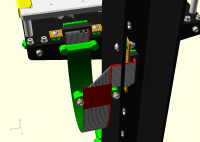
Here is a video of my Z axis cable strip modelled with a Bezier spline.
https://youtu.be/aO12JR44Ets
Although it is not minimum energy it looks quite realistic.
On 2 December 2017 at 07:03, TLC123 <torleif.ceder@gmail.com> wrote:
> nophead
> Yes there was a bug with drawing the last segment.
> I solved it some where but apparently not where i grabbed this code ;)
>
> Yes AdjustBezier is the only new thing here the other stuff is just
> leftovers for showcase.
>
> Yepp the t() strips out other data that i used to store in the vector
> radius, color, local scaling etc.
>
> Yepp there are better analytical bezier math . I use the recursive because
> 1. i understand that 2. it handles 2 to n control points without change.
>
> No its not minimal energy witch get obviously when cramming a long strip in
> a tight space.
> It doesnt out bulge out right to maintain a smooth curvature.
>
> Ronaldo yes the solution depends on the relative length of the /control
> handles/.
> some other store the middle control points as a relative vector to
> endpoints
> [start,controlstart,controlend,end]
>
> But i just use points
> So given a bezier [p0,p1,p2,p3]
> As i understand the problem:
> The two endpoints are fixed. The initial direction at each end is fixed.
> Thus each control point, p1 and p2, live along a vector formed p0 and p1
> respectively p2 and p3.
> Forming the /control handles/.
> Adjusting the handles length change the overall length of the curve.
> Both can be changed separately
> but in AdjustBezier they are both multiplied by the same length error term
> to converge on the desired length.
>
> If its desired to force a uniform look both handles can be normalized
> before AdjustBezier
>
> Good Luck
>
> function NormalizeBezierControl(v)=
> [v[0],v[0]+UnitNormal (v[1]-v[0]) ,v[3]+UnitNormal (v[2]-v[3]) ,v[3]];
>
> function UnitNormal (v)=v/max(norm(v),1e-32);// div by zero safe
>
>
>
> --
> Sent from: http://forum.openscad.org/
>
> _______________________________________________
> OpenSCAD mailing list
> Discuss@lists.openscad.org
> http://lists.openscad.org/mailman/listinfo/discuss_lists.openscad.org
>

GF
Greg Frost
Tue, Dec 5, 2017 9:11 PM
That's pretty cool! As modelled, the bend radius on that strip looks tight at the bottom. Is it slightly too short? Video needs more bps too, and it would look great with a subtly panning camera position.
On 2 December 2017 at 07:03, TLC123 torleif.ceder@gmail.com wrote:
nophead
Yes there was a bug with drawing the last segment.
I solved it some where but apparently not where i grabbed this code ;)
Yes AdjustBezier is the only new thing here the other stuff is just
leftovers for showcase.
Yepp the t() strips out other data that i used to store in the vector
radius, color, local scaling etc.
Yepp there are better analytical bezier math . I use the recursive because
- i understand that 2. it handles 2 to n control points without change.
No its not minimal energy witch get obviously when cramming a long strip in
a tight space.
It doesnt out bulge out right to maintain a smooth curvature.
Ronaldo yes the solution depends on the relative length of the /control
handles/.
some other store the middle control points as a relative vector to endpoints
[start,controlstart,controlend,end]
But i just use points
So given a bezier [p0,p1,p2,p3]
As i understand the problem:
The two endpoints are fixed. The initial direction at each end is fixed.
Thus each control point, p1 and p2, live along a vector formed p0 and p1
respectively p2 and p3.
Forming the /control handles/.
Adjusting the handles length change the overall length of the curve.
Both can be changed separately
but in AdjustBezier they are both multiplied by the same length error term
to converge on the desired length.
If its desired to force a uniform look both handles can be normalized
before AdjustBezier
Good Luck
function NormalizeBezierControl(v)=
[v[0],v[0]+UnitNormal (v[1]-v[0]) ,v[3]+UnitNormal (v[2]-v[3]) ,v[3]];
function UnitNormal (v)=v/max(norm(v),1e-32);// div by zero safe
--
Sent from: http://forum.openscad.org/
OpenSCAD mailing list
Discuss@lists.openscad.org
http://lists.openscad.org/mailman/listinfo/discuss_lists.openscad.org
That's pretty cool! As modelled, the bend radius on that strip looks tight at the bottom. Is it slightly too short? Video needs more bps too, and it would look great with a subtly panning camera position.
> On 6 Dec 2017, at 6:19 am, nop head <nop.head@gmail.com> wrote:
>
> Here is a video of my Z axis cable strip modelled with a Bezier spline. https://youtu.be/aO12JR44Ets
>
> Although it is not minimum energy it looks quite realistic.
>
>> On 2 December 2017 at 07:03, TLC123 <torleif.ceder@gmail.com> wrote:
>> nophead
>> Yes there was a bug with drawing the last segment.
>> I solved it some where but apparently not where i grabbed this code ;)
>>
>> Yes AdjustBezier is the only new thing here the other stuff is just
>> leftovers for showcase.
>>
>> Yepp the t() strips out other data that i used to store in the vector
>> radius, color, local scaling etc.
>>
>> Yepp there are better analytical bezier math . I use the recursive because
>> 1. i understand that 2. it handles 2 to n control points without change.
>>
>> No its not minimal energy witch get obviously when cramming a long strip in
>> a tight space.
>> It doesnt out bulge out right to maintain a smooth curvature.
>>
>> Ronaldo yes the solution depends on the relative length of the /control
>> handles/.
>> some other store the middle control points as a relative vector to endpoints
>> [start,controlstart,controlend,end]
>>
>> But i just use points
>> So given a bezier [p0,p1,p2,p3]
>> As i understand the problem:
>> The two endpoints are fixed. The initial direction at each end is fixed.
>> Thus each control point, p1 and p2, live along a vector formed p0 and p1
>> respectively p2 and p3.
>> Forming the /control handles/.
>> Adjusting the handles length change the overall length of the curve.
>> Both can be changed separately
>> but in AdjustBezier they are both multiplied by the same length error term
>> to converge on the desired length.
>>
>> If its desired to force a uniform look both handles can be normalized
>> before AdjustBezier
>>
>> Good Luck
>>
>> function NormalizeBezierControl(v)=
>> [v[0],v[0]+UnitNormal (v[1]-v[0]) ,v[3]+UnitNormal (v[2]-v[3]) ,v[3]];
>>
>> function UnitNormal (v)=v/max(norm(v),1e-32);// div by zero safe
>>
>>
>>
>> --
>> Sent from: http://forum.openscad.org/
>>
>> _______________________________________________
>> OpenSCAD mailing list
>> Discuss@lists.openscad.org
>> http://lists.openscad.org/mailman/listinfo/discuss_lists.openscad.org
>
> _______________________________________________
> OpenSCAD mailing list
> Discuss@lists.openscad.org
> http://lists.openscad.org/mailman/listinfo/discuss_lists.openscad.org
NH
nop head
Tue, Dec 5, 2017 10:01 PM
Yes it is a bit tight, which is why I modelled it. The problem is it needs
to not hit the shelf below that covers the electronics. It only cycles once
per build so I think I will get away with it. I have used ribbons on X and
Y that move millions of times in a build.
On 5 Dec 2017 9:11 p.m., "Greg Frost" gregorybartonfrost@gmail.com wrote:
That's pretty cool! As modelled, the bend radius on that strip looks tight
at the bottom. Is it slightly too short? Video needs more bps too, and it
would look great with a subtly panning camera position.
On 6 Dec 2017, at 6:19 am, nop head nop.head@gmail.com wrote:
Here is a video of my Z axis cable strip modelled with a Bezier spline.
https://youtu.be/aO12JR44Ets
Although it is not minimum energy it looks quite realistic.
On 2 December 2017 at 07:03, TLC123 torleif.ceder@gmail.com wrote:
nophead
Yes there was a bug with drawing the last segment.
I solved it some where but apparently not where i grabbed this code ;)
Yes AdjustBezier is the only new thing here the other stuff is just
leftovers for showcase.
Yepp the t() strips out other data that i used to store in the vector
radius, color, local scaling etc.
Yepp there are better analytical bezier math . I use the recursive because
- i understand that 2. it handles 2 to n control points without change.
No its not minimal energy witch get obviously when cramming a long strip
in
a tight space.
It doesnt out bulge out right to maintain a smooth curvature.
Ronaldo yes the solution depends on the relative length of the /control
handles/.
some other store the middle control points as a relative vector to
endpoints
[start,controlstart,controlend,end]
But i just use points
So given a bezier [p0,p1,p2,p3]
As i understand the problem:
The two endpoints are fixed. The initial direction at each end is fixed.
Thus each control point, p1 and p2, live along a vector formed p0 and p1
respectively p2 and p3.
Forming the /control handles/.
Adjusting the handles length change the overall length of the curve.
Both can be changed separately
but in AdjustBezier they are both multiplied by the same length error
term
to converge on the desired length.
If its desired to force a uniform look both handles can be normalized
before AdjustBezier
Good Luck
function NormalizeBezierControl(v)=
[v[0],v[0]+UnitNormal (v[1]-v[0]) ,v[3]+UnitNormal (v[2]-v[3]) ,v[3]];
function UnitNormal (v)=v/max(norm(v),1e-32);// div by zero safe
--
Sent from: http://forum.openscad.org/
OpenSCAD mailing list
Discuss@lists.openscad.org
http://lists.openscad.org/mailman/listinfo/discuss_lists.openscad.org
Yes it is a bit tight, which is why I modelled it. The problem is it needs
to not hit the shelf below that covers the electronics. It only cycles once
per build so I think I will get away with it. I have used ribbons on X and
Y that move millions of times in a build.
On 5 Dec 2017 9:11 p.m., "Greg Frost" <gregorybartonfrost@gmail.com> wrote:
> That's pretty cool! As modelled, the bend radius on that strip looks tight
> at the bottom. Is it slightly too short? Video needs more bps too, and it
> would look great with a subtly panning camera position.
>
> On 6 Dec 2017, at 6:19 am, nop head <nop.head@gmail.com> wrote:
>
> Here is a video of my Z axis cable strip modelled with a Bezier spline.
> https://youtu.be/aO12JR44Ets
>
> Although it is not minimum energy it looks quite realistic.
>
> On 2 December 2017 at 07:03, TLC123 <torleif.ceder@gmail.com> wrote:
>
>> nophead
>> Yes there was a bug with drawing the last segment.
>> I solved it some where but apparently not where i grabbed this code ;)
>>
>> Yes AdjustBezier is the only new thing here the other stuff is just
>> leftovers for showcase.
>>
>> Yepp the t() strips out other data that i used to store in the vector
>> radius, color, local scaling etc.
>>
>> Yepp there are better analytical bezier math . I use the recursive because
>> 1. i understand that 2. it handles 2 to n control points without change.
>>
>> No its not minimal energy witch get obviously when cramming a long strip
>> in
>> a tight space.
>> It doesnt out bulge out right to maintain a smooth curvature.
>>
>> Ronaldo yes the solution depends on the relative length of the /control
>> handles/.
>> some other store the middle control points as a relative vector to
>> endpoints
>> [start,controlstart,controlend,end]
>>
>> But i just use points
>> So given a bezier [p0,p1,p2,p3]
>> As i understand the problem:
>> The two endpoints are fixed. The initial direction at each end is fixed.
>> Thus each control point, p1 and p2, live along a vector formed p0 and p1
>> respectively p2 and p3.
>> Forming the /control handles/.
>> Adjusting the handles length change the overall length of the curve.
>> Both can be changed separately
>> but in AdjustBezier they are both multiplied by the same length error
>> term
>> to converge on the desired length.
>>
>> If its desired to force a uniform look both handles can be normalized
>> before AdjustBezier
>>
>> Good Luck
>>
>> function NormalizeBezierControl(v)=
>> [v[0],v[0]+UnitNormal (v[1]-v[0]) ,v[3]+UnitNormal (v[2]-v[3]) ,v[3]];
>>
>> function UnitNormal (v)=v/max(norm(v),1e-32);// div by zero safe
>>
>>
>>
>> --
>> Sent from: http://forum.openscad.org/
>>
>> _______________________________________________
>> OpenSCAD mailing list
>> Discuss@lists.openscad.org
>> http://lists.openscad.org/mailman/listinfo/discuss_lists.openscad.org
>>
>
> _______________________________________________
> OpenSCAD mailing list
> Discuss@lists.openscad.org
> http://lists.openscad.org/mailman/listinfo/discuss_lists.openscad.org
>
>
> _______________________________________________
> OpenSCAD mailing list
> Discuss@lists.openscad.org
> http://lists.openscad.org/mailman/listinfo/discuss_lists.openscad.org
>
>

A
arnholm@arnholm.org
Thu, Dec 7, 2017 10:31 AM
On 2017-12-05 23:01, nop head wrote:
Yes it is a bit tight, which is why I modelled it. The problem is it
needs to not hit the shelf below that covers the electronics. It only
cycles once per build so I think I will get away with it. I have used
ribbons on X and Y that move millions of times in a build.
Nice video, although the cable deformation is somewhat unrealistic.
If knowing the true shape was critical, it would require non-linear
finite element analysis. Someone mentioned a catenary, but this cable is
much stiffer than a catenary (essentially no bending stiffness). The
problem is quite similar to analyzing flexible risers used on the
offshore industry. Non-negligible bending stiffness, large deformations,
boundary conditions at the ends.
Still the simplified approximation was quite ok for a demo.
Carsten Arnholm
On 2017-12-05 23:01, nop head wrote:
> Yes it is a bit tight, which is why I modelled it. The problem is it
> needs to not hit the shelf below that covers the electronics. It only
> cycles once per build so I think I will get away with it. I have used
> ribbons on X and Y that move millions of times in a build.
Nice video, although the cable deformation is somewhat unrealistic.
If knowing the true shape was critical, it would require non-linear
finite element analysis. Someone mentioned a catenary, but this cable is
much stiffer than a catenary (essentially no bending stiffness). The
problem is quite similar to analyzing flexible risers used on the
offshore industry. Non-negligible bending stiffness, large deformations,
boundary conditions at the ends.
Still the simplified approximation was quite ok for a demo.
Carsten Arnholm
NH
nop head
Thu, Dec 7, 2017 12:22 PM
Yes I suspect the bend radius would be a bit bigger in real life, closer to
an arc. The cable is ribbon, so not stiff at all but I bend it around a
0.8mm thick polypropylene strip to distribute the bending. It is the strip
I am trying to model. It works like a cable chain for ribbon but is a lot
more compact and cheaper. Without it ribbon tends to bend too much at the
attachment points.
The model needs to predict the length to make the strip as that goes on the
BOM. The length should be as long as possible without hitting the bottom as
it would buckle if it did. Using Bezier my guess is it is a bit shorter
than it could be. If it is not too much that will be OK but if it is
grossly wrong then the strip is tighter than it needs to be so is not good
for cable life.
When I get home I will mock it up and see if it is accurate enough. If not
I will try to work out a minimum energy solution using finite elements. It
is after all drawn with 100 finite elements so I can easily calculate the
bend at each joint. The tricky bit is moving the joints to minimise the
energy.
On 7 December 2017 at 10:31, arnholm@arnholm.org wrote:
On 2017-12-05 23:01, nop head wrote:
Yes it is a bit tight, which is why I modelled it. The problem is it
needs to not hit the shelf below that covers the electronics. It only
cycles once per build so I think I will get away with it. I have used
ribbons on X and Y that move millions of times in a build.
Nice video, although the cable deformation is somewhat unrealistic.
If knowing the true shape was critical, it would require non-linear finite
element analysis. Someone mentioned a catenary, but this cable is much
stiffer than a catenary (essentially no bending stiffness). The problem is
quite similar to analyzing flexible risers used on the offshore industry.
Non-negligible bending stiffness, large deformations, boundary conditions
at the ends.
Still the simplified approximation was quite ok for a demo.
Carsten Arnholm
OpenSCAD mailing list
Discuss@lists.openscad.org
http://lists.openscad.org/mailman/listinfo/discuss_lists.openscad.org
Yes I suspect the bend radius would be a bit bigger in real life, closer to
an arc. The cable is ribbon, so not stiff at all but I bend it around a
0.8mm thick polypropylene strip to distribute the bending. It is the strip
I am trying to model. It works like a cable chain for ribbon but is a lot
more compact and cheaper. Without it ribbon tends to bend too much at the
attachment points.
The model needs to predict the length to make the strip as that goes on the
BOM. The length should be as long as possible without hitting the bottom as
it would buckle if it did. Using Bezier my guess is it is a bit shorter
than it could be. If it is not too much that will be OK but if it is
grossly wrong then the strip is tighter than it needs to be so is not good
for cable life.
When I get home I will mock it up and see if it is accurate enough. If not
I will try to work out a minimum energy solution using finite elements. It
is after all drawn with 100 finite elements so I can easily calculate the
bend at each joint. The tricky bit is moving the joints to minimise the
energy.
On 7 December 2017 at 10:31, <arnholm@arnholm.org> wrote:
> On 2017-12-05 23:01, nop head wrote:
>
>> Yes it is a bit tight, which is why I modelled it. The problem is it
>> needs to not hit the shelf below that covers the electronics. It only
>> cycles once per build so I think I will get away with it. I have used
>> ribbons on X and Y that move millions of times in a build.
>>
>
> Nice video, although the cable deformation is somewhat unrealistic.
>
> If knowing the true shape was critical, it would require non-linear finite
> element analysis. Someone mentioned a catenary, but this cable is much
> stiffer than a catenary (essentially no bending stiffness). The problem is
> quite similar to analyzing flexible risers used on the offshore industry.
> Non-negligible bending stiffness, large deformations, boundary conditions
> at the ends.
>
> Still the simplified approximation was quite ok for a demo.
>
> Carsten Arnholm
>
>
> _______________________________________________
> OpenSCAD mailing list
> Discuss@lists.openscad.org
> http://lists.openscad.org/mailman/listinfo/discuss_lists.openscad.org
>
RP
Ronaldo Persiano
Mon, Dec 18, 2017 12:23 PM
I have been struggling with this problem for a while. I will not go into
the details of the energy minimizing problem here and will just address the
problem of finding the Bezier arc with a given length, given its end points
and its tangent directions at the endpoints. The function AdjustBezier()
provided by Torleif is inefficient for this task requiring a lot of
adjustment.
The main idea of Torleif solution is to adjust the Bezier arc endpoints
derivatives until the required length is attained. The adjustment is done
by:
function adjust1(p, r) =
[ p[0], p[0]+(p[1]-p[0])*r, p[3]+(p[2]-p[3])*r , p[3] ];
where p is the incoming Bezier control points and r is the adjustment
parameter. So, the problem is to find the parameter r such that:
len3bz(adjust(p,r)) == length
where len3bz() is the function that estimates a Bezier arc length.
I have observed that the length of the Bezier arc is fairly linear with
respect to the parameter r and the following code explores it:
function AdjustBezier(p, l, eps=0.001, r1=10, r2=12, l1, l2)=
let( l1 = l1!=undef? l1: len3bz(adjust1(p,r1), eps),
l2 = l2!=undef? l2: len3bz(adjust1(p,r2), eps) )
abs(l1-l)<eps ?
adjust1(p,r1)
:
let( r = r1 + (l-l1)*(r2-r1)/(l2-l1) )
abs(r-r1)<abs(r-r2) ?
AdjustBezier(p, l, eps, r, r1, undef, l1)
:
AdjustBezier(p, l, eps, r, r2, undef, l2);
This function requires very few steps compared with Torleif's one which is
very lengthy when the solution is almost stretched.
Next, I have considered the time consuming function len3bz(). I approached
this by Bezier subdivision instead of a fixed sample of Bezier evaluations.
The resulting code is a bit longer but it is more efficient.
function len3bz(bz, eps=0.001) =
let( l1 = polygonalLength(bz, ceil(-log(eps))),
l2 = polygonalLength([for(i=[0:3:len(bz)-1]) bz[i]],
ceil(-log(eps))) )
l1-l2<eps ?
(l1+l2)/2
:
len3bz(subdivBezier3(bz, 1), eps);
function polygonalLength(p) =
let( l = [for(i=[1:len(p)-1]) norm(p[i]-p[i-1]) ] )
l*[for(i=[0:len(l)-1]) 1];
function subdivBezier3(p, n=3) =
n==0 ?
p
:
subdivBezier3( concat([for(i=[0:3:len(p)-4],
s=[_subdivB(p,i)],
j=[0:len(s)-2] ) s[j] ],
[p[len(p)-1] ] ),
n-1);
function _subdivB(p, from=0) =
[ [1,0,0,0],
[1/2,1/2,0,0],
[1/4,1/2,1/4,0],
[1/8,3/8, 3/8, 1/8],
[0, 1/4,1/2,1/4],
[0, 0, 1/2,1/2],
[0, 0, 0, 1] ]
* [p[from], p[from+1], p[from+2], p[from+3] ];
I have addressed the problem of finding the minimum energy Bezier arc too.
I have a version that is reasonable fast now requiring between 1 to 2 sec
for each step of an animation similar to nophead's one. I don't believe
that material is of broad interest but anyone interested in it may contact
me by PM.
BTW, I think nophead could reduce the polypropylene strip strain by giving
it a little slope in the table end instead of driving it vertically.
2017-12-07 10:22 GMT-02:00 nop head nop.head@gmail.com:
Yes I suspect the bend radius would be a bit bigger in real life, closer
to an arc. The cable is ribbon, so not stiff at all but I bend it around a
0.8mm thick polypropylene strip to distribute the bending. It is the strip
I am trying to model. It works like a cable chain for ribbon but is a lot
more compact and cheaper. Without it ribbon tends to bend too much at the
attachment points.
The model needs to predict the length to make the strip as that goes on
the BOM. The length should be as long as possible without hitting the
bottom as it would buckle if it did. Using Bezier my guess is it is a bit
shorter than it could be. If it is not too much that will be OK but if it
is grossly wrong then the strip is tighter than it needs to be so is not
good for cable life.
When I get home I will mock it up and see if it is accurate enough. If not
I will try to work out a minimum energy solution using finite elements. It
is after all drawn with 100 finite elements so I can easily calculate the
bend at each joint. The tricky bit is moving the joints to minimise the
energy.
On 7 December 2017 at 10:31, arnholm@arnholm.org wrote:
On 2017-12-05 23:01, nop head wrote:
Yes it is a bit tight, which is why I modelled it. The problem is it
needs to not hit the shelf below that covers the electronics. It only
cycles once per build so I think I will get away with it. I have used
ribbons on X and Y that move millions of times in a build.
Nice video, although the cable deformation is somewhat unrealistic.
If knowing the true shape was critical, it would require non-linear
finite element analysis. Someone mentioned a catenary, but this cable is
much stiffer than a catenary (essentially no bending stiffness). The
problem is quite similar to analyzing flexible risers used on the offshore
industry. Non-negligible bending stiffness, large deformations, boundary
conditions at the ends.
Still the simplified approximation was quite ok for a demo.
Carsten Arnholm
OpenSCAD mailing list
Discuss@lists.openscad.org
http://lists.openscad.org/mailman/listinfo/discuss_lists.openscad.org
I have been struggling with this problem for a while. I will not go into
the details of the energy minimizing problem here and will just address the
problem of finding the Bezier arc with a given length, given its end points
and its tangent directions at the endpoints. The function AdjustBezier()
provided by Torleif is inefficient for this task requiring a lot of
adjustment.
The main idea of Torleif solution is to adjust the Bezier arc endpoints
derivatives until the required length is attained. The adjustment is done
by:
function adjust1(p, r) =
[ p[0], p[0]+(p[1]-p[0])*r, p[3]+(p[2]-p[3])*r , p[3] ];
where p is the incoming Bezier control points and r is the adjustment
parameter. So, the problem is to find the parameter r such that:
len3bz(adjust(p,r)) == length
where len3bz() is the function that estimates a Bezier arc length.
I have observed that the length of the Bezier arc is fairly linear with
respect to the parameter r and the following code explores it:
function AdjustBezier(p, l, eps=0.001, r1=10, r2=12, l1, l2)=
let( l1 = l1!=undef? l1: len3bz(adjust1(p,r1), eps),
l2 = l2!=undef? l2: len3bz(adjust1(p,r2), eps) )
abs(l1-l)<eps ?
adjust1(p,r1)
:
let( r = r1 + (l-l1)*(r2-r1)/(l2-l1) )
abs(r-r1)<abs(r-r2) ?
AdjustBezier(p, l, eps, r, r1, undef, l1)
:
AdjustBezier(p, l, eps, r, r2, undef, l2);
This function requires very few steps compared with Torleif's one which is
very lengthy when the solution is almost stretched.
Next, I have considered the time consuming function len3bz(). I approached
this by Bezier subdivision instead of a fixed sample of Bezier evaluations.
The resulting code is a bit longer but it is more efficient.
function len3bz(bz, eps=0.001) =
let( l1 = polygonalLength(bz, ceil(-log(eps))),
l2 = polygonalLength([for(i=[0:3:len(bz)-1]) bz[i]],
ceil(-log(eps))) )
l1-l2<eps ?
(l1+l2)/2
:
len3bz(subdivBezier3(bz, 1), eps);
function polygonalLength(p) =
let( l = [for(i=[1:len(p)-1]) norm(p[i]-p[i-1]) ] )
l*[for(i=[0:len(l)-1]) 1];
function subdivBezier3(p, n=3) =
n==0 ?
p
:
subdivBezier3( concat([for(i=[0:3:len(p)-4],
s=[_subdivB(p,i)],
j=[0:len(s)-2] ) s[j] ],
[p[len(p)-1] ] ),
n-1);
function _subdivB(p, from=0) =
[ [1,0,0,0],
[1/2,1/2,0,0],
[1/4,1/2,1/4,0],
[1/8,3/8, 3/8, 1/8],
[0, 1/4,1/2,1/4],
[0, 0, 1/2,1/2],
[0, 0, 0, 1] ]
* [p[from], p[from+1], p[from+2], p[from+3] ];
I have addressed the problem of finding the minimum energy Bezier arc too.
I have a version that is reasonable fast now requiring between 1 to 2 sec
for each step of an animation similar to nophead's one. I don't believe
that material is of broad interest but anyone interested in it may contact
me by PM.
BTW, I think nophead could reduce the polypropylene strip strain by giving
it a little slope in the table end instead of driving it vertically.
2017-12-07 10:22 GMT-02:00 nop head <nop.head@gmail.com>:
> Yes I suspect the bend radius would be a bit bigger in real life, closer
> to an arc. The cable is ribbon, so not stiff at all but I bend it around a
> 0.8mm thick polypropylene strip to distribute the bending. It is the strip
> I am trying to model. It works like a cable chain for ribbon but is a lot
> more compact and cheaper. Without it ribbon tends to bend too much at the
> attachment points.
>
> The model needs to predict the length to make the strip as that goes on
> the BOM. The length should be as long as possible without hitting the
> bottom as it would buckle if it did. Using Bezier my guess is it is a bit
> shorter than it could be. If it is not too much that will be OK but if it
> is grossly wrong then the strip is tighter than it needs to be so is not
> good for cable life.
>
> When I get home I will mock it up and see if it is accurate enough. If not
> I will try to work out a minimum energy solution using finite elements. It
> is after all drawn with 100 finite elements so I can easily calculate the
> bend at each joint. The tricky bit is moving the joints to minimise the
> energy.
>
> On 7 December 2017 at 10:31, <arnholm@arnholm.org> wrote:
>
>> On 2017-12-05 23:01, nop head wrote:
>>
>>> Yes it is a bit tight, which is why I modelled it. The problem is it
>>> needs to not hit the shelf below that covers the electronics. It only
>>> cycles once per build so I think I will get away with it. I have used
>>> ribbons on X and Y that move millions of times in a build.
>>>
>>
>> Nice video, although the cable deformation is somewhat unrealistic.
>>
>> If knowing the true shape was critical, it would require non-linear
>> finite element analysis. Someone mentioned a catenary, but this cable is
>> much stiffer than a catenary (essentially no bending stiffness). The
>> problem is quite similar to analyzing flexible risers used on the offshore
>> industry. Non-negligible bending stiffness, large deformations, boundary
>> conditions at the ends.
>>
>> Still the simplified approximation was quite ok for a demo.
>>
>> Carsten Arnholm
>>
>>
>> _______________________________________________
>> OpenSCAD mailing list
>> Discuss@lists.openscad.org
>> http://lists.openscad.org/mailman/listinfo/discuss_lists.openscad.org
>>
>
>
> _______________________________________________
> OpenSCAD mailing list
> Discuss@lists.openscad.org
> http://lists.openscad.org/mailman/listinfo/discuss_lists.openscad.org
>
>
NH
nop head
Tue, Dec 19, 2017 10:19 PM
Hi Ronaldo,
Thanks for your input. I tried dropping in your changes to my code but
didn't see any noticeable speed improvement. I think this is because I had
already made the length function faster by only using 100 segments instead
of 1000. I also calculate the target length to give the minimum z that is
allowed by adjusting the control points until it droops the correct amount.
My code currently takes 20 seconds because I added the ribbon cable and
sweep each wire separately because they take different paths at the fold. I
also model the veroboard terminations including tracks, breaks and solder
menisci! I think the time for the Bezier calculation is swamped by 20
sweeps. I used Frenet-Serret for the strip because it has two vertical
sections that the minimum angle solution doesn't like. I used minimum angle
for the cable because Frenet-Serret goes wild when the at the fold.
Yes I think you are correct saying the optimum starting angle is not
straight down but I am not sure if that is worth changing. I still need to
see how accurate it is against a real strip.
On 18 December 2017 at 12:23, Ronaldo Persiano rcmpersiano@gmail.com
wrote:
I have been struggling with this problem for a while. I will not go into
the details of the energy minimizing problem here and will just address the
problem of finding the Bezier arc with a given length, given its end points
and its tangent directions at the endpoints. The function AdjustBezier()
provided by Torleif is inefficient for this task requiring a lot of
adjustment.
The main idea of Torleif solution is to adjust the Bezier arc endpoints
derivatives until the required length is attained. The adjustment is done
by:
function adjust1(p, r) =
[ p[0], p[0]+(p[1]-p[0])*r, p[3]+(p[2]-p[3])*r , p[3] ];
where p is the incoming Bezier control points and r is the adjustment
parameter. So, the problem is to find the parameter r such that:
len3bz(adjust(p,r)) == length
where len3bz() is the function that estimates a Bezier arc length.
I have observed that the length of the Bezier arc is fairly linear with
respect to the parameter r and the following code explores it:
function AdjustBezier(p, l, eps=0.001, r1=10, r2=12, l1, l2)=
let( l1 = l1!=undef? l1: len3bz(adjust1(p,r1), eps),
l2 = l2!=undef? l2: len3bz(adjust1(p,r2), eps) )
abs(l1-l)<eps ?
adjust1(p,r1)
:
let( r = r1 + (l-l1)*(r2-r1)/(l2-l1) )
abs(r-r1)<abs(r-r2) ?
AdjustBezier(p, l, eps, r, r1, undef, l1)
:
AdjustBezier(p, l, eps, r, r2, undef, l2);
This function requires very few steps compared with Torleif's one which is
very lengthy when the solution is almost stretched.
Next, I have considered the time consuming function len3bz(). I approached
this by Bezier subdivision instead of a fixed sample of Bezier evaluations.
The resulting code is a bit longer but it is more efficient.
function len3bz(bz, eps=0.001) =
let( l1 = polygonalLength(bz, ceil(-log(eps))),
l2 = polygonalLength([for(i=[0:3:len(bz)-1]) bz[i]],
ceil(-log(eps))) )
l1-l2<eps ?
(l1+l2)/2
:
len3bz(subdivBezier3(bz, 1), eps);
function polygonalLength(p) =
let( l = [for(i=[1:len(p)-1]) norm(p[i]-p[i-1]) ] )
l*[for(i=[0:len(l)-1]) 1];
function subdivBezier3(p, n=3) =
n==0 ?
p
:
subdivBezier3( concat([for(i=[0:3:len(p)-4],
s=[_subdivB(p,i)],
j=[0:len(s)-2] ) s[j] ],
[p[len(p)-1] ] ),
n-1);
function _subdivB(p, from=0) =
[ [1,0,0,0],
[1/2,1/2,0,0],
[1/4,1/2,1/4,0],
[1/8,3/8, 3/8, 1/8],
[0, 1/4,1/2,1/4],
[0, 0, 1/2,1/2],
[0, 0, 0, 1] ]
* [p[from], p[from+1], p[from+2], p[from+3] ];
I have addressed the problem of finding the minimum energy Bezier arc too.
I have a version that is reasonable fast now requiring between 1 to 2 sec
for each step of an animation similar to nophead's one. I don't believe
that material is of broad interest but anyone interested in it may contact
me by PM.
BTW, I think nophead could reduce the polypropylene strip strain by
giving it a little slope in the table end instead of driving it vertically.
2017-12-07 10:22 GMT-02:00 nop head nop.head@gmail.com:
Yes I suspect the bend radius would be a bit bigger in real life, closer
to an arc. The cable is ribbon, so not stiff at all but I bend it around a
0.8mm thick polypropylene strip to distribute the bending. It is the strip
I am trying to model. It works like a cable chain for ribbon but is a lot
more compact and cheaper. Without it ribbon tends to bend too much at the
attachment points.
The model needs to predict the length to make the strip as that goes on
the BOM. The length should be as long as possible without hitting the
bottom as it would buckle if it did. Using Bezier my guess is it is a bit
shorter than it could be. If it is not too much that will be OK but if it
is grossly wrong then the strip is tighter than it needs to be so is not
good for cable life.
When I get home I will mock it up and see if it is accurate enough. If
not I will try to work out a minimum energy solution using finite elements.
It is after all drawn with 100 finite elements so I can easily calculate
the bend at each joint. The tricky bit is moving the joints to minimise the
energy.
On 7 December 2017 at 10:31, arnholm@arnholm.org wrote:
On 2017-12-05 23:01, nop head wrote:
Yes it is a bit tight, which is why I modelled it. The problem is it
needs to not hit the shelf below that covers the electronics. It only
cycles once per build so I think I will get away with it. I have used
ribbons on X and Y that move millions of times in a build.
Nice video, although the cable deformation is somewhat unrealistic.
If knowing the true shape was critical, it would require non-linear
finite element analysis. Someone mentioned a catenary, but this cable is
much stiffer than a catenary (essentially no bending stiffness). The
problem is quite similar to analyzing flexible risers used on the offshore
industry. Non-negligible bending stiffness, large deformations, boundary
conditions at the ends.
Still the simplified approximation was quite ok for a demo.
Carsten Arnholm
OpenSCAD mailing list
Discuss@lists.openscad.org
http://lists.openscad.org/mailman/listinfo/discuss_lists.openscad.org
Hi Ronaldo,
Thanks for your input. I tried dropping in your changes to my code but
didn't see any noticeable speed improvement. I think this is because I had
already made the length function faster by only using 100 segments instead
of 1000. I also calculate the target length to give the minimum z that is
allowed by adjusting the control points until it droops the correct amount.
My code currently takes 20 seconds because I added the ribbon cable and
sweep each wire separately because they take different paths at the fold. I
also model the veroboard terminations including tracks, breaks and solder
menisci! I think the time for the Bezier calculation is swamped by 20
sweeps. I used Frenet-Serret for the strip because it has two vertical
sections that the minimum angle solution doesn't like. I used minimum angle
for the cable because Frenet-Serret goes wild when the at the fold.
Yes I think you are correct saying the optimum starting angle is not
straight down but I am not sure if that is worth changing. I still need to
see how accurate it is against a real strip.
On 18 December 2017 at 12:23, Ronaldo Persiano <rcmpersiano@gmail.com>
wrote:
> I have been struggling with this problem for a while. I will not go into
> the details of the energy minimizing problem here and will just address the
> problem of finding the Bezier arc with a given length, given its end points
> and its tangent directions at the endpoints. The function AdjustBezier()
> provided by Torleif is inefficient for this task requiring a lot of
> adjustment.
>
> The main idea of Torleif solution is to adjust the Bezier arc endpoints
> derivatives until the required length is attained. The adjustment is done
> by:
>
> function adjust1(p, r) =
> [ p[0], p[0]+(p[1]-p[0])*r, p[3]+(p[2]-p[3])*r , p[3] ];
>
>
> where p is the incoming Bezier control points and r is the adjustment
> parameter. So, the problem is to find the parameter r such that:
>
> len3bz(adjust(p,r)) == length
>
>
> where len3bz() is the function that estimates a Bezier arc length.
>
> I have observed that the length of the Bezier arc is fairly linear with
> respect to the parameter r and the following code explores it:
>
> function AdjustBezier(p, l, eps=0.001, r1=10, r2=12, l1, l2)=
> let( l1 = l1!=undef? l1: len3bz(adjust1(p,r1), eps),
> l2 = l2!=undef? l2: len3bz(adjust1(p,r2), eps) )
> abs(l1-l)<eps ?
> adjust1(p,r1)
> :
> let( r = r1 + (l-l1)*(r2-r1)/(l2-l1) )
> abs(r-r1)<abs(r-r2) ?
> AdjustBezier(p, l, eps, r, r1, undef, l1)
> :
> AdjustBezier(p, l, eps, r, r2, undef, l2);
>
>
> This function requires very few steps compared with Torleif's one which is
> very lengthy when the solution is almost stretched.
>
> Next, I have considered the time consuming function len3bz(). I approached
> this by Bezier subdivision instead of a fixed sample of Bezier evaluations.
> The resulting code is a bit longer but it is more efficient.
>
> function len3bz(bz, eps=0.001) =
> let( l1 = polygonalLength(bz, ceil(-log(eps))),
> l2 = polygonalLength([for(i=[0:3:len(bz)-1]) bz[i]],
> ceil(-log(eps))) )
> l1-l2<eps ?
> (l1+l2)/2
> :
> len3bz(subdivBezier3(bz, 1), eps);
>
> function polygonalLength(p) =
> let( l = [for(i=[1:len(p)-1]) norm(p[i]-p[i-1]) ] )
> l*[for(i=[0:len(l)-1]) 1];
>
> function subdivBezier3(p, n=3) =
> n==0 ?
> p
> :
> subdivBezier3( concat([for(i=[0:3:len(p)-4],
> s=[_subdivB(p,i)],
> j=[0:len(s)-2] ) s[j] ],
> [p[len(p)-1] ] ),
> n-1);
>
> function _subdivB(p, from=0) =
> [ [1,0,0,0],
> [1/2,1/2,0,0],
> [1/4,1/2,1/4,0],
> [1/8,3/8, 3/8, 1/8],
> [0, 1/4,1/2,1/4],
> [0, 0, 1/2,1/2],
> [0, 0, 0, 1] ]
> * [p[from], p[from+1], p[from+2], p[from+3] ];
>
>
> I have addressed the problem of finding the minimum energy Bezier arc too.
> I have a version that is reasonable fast now requiring between 1 to 2 sec
> for each step of an animation similar to nophead's one. I don't believe
> that material is of broad interest but anyone interested in it may contact
> me by PM.
>
> BTW, I think nophead could reduce the polypropylene strip strain by
> giving it a little slope in the table end instead of driving it vertically.
>
>
> 2017-12-07 10:22 GMT-02:00 nop head <nop.head@gmail.com>:
>
>> Yes I suspect the bend radius would be a bit bigger in real life, closer
>> to an arc. The cable is ribbon, so not stiff at all but I bend it around a
>> 0.8mm thick polypropylene strip to distribute the bending. It is the strip
>> I am trying to model. It works like a cable chain for ribbon but is a lot
>> more compact and cheaper. Without it ribbon tends to bend too much at the
>> attachment points.
>>
>> The model needs to predict the length to make the strip as that goes on
>> the BOM. The length should be as long as possible without hitting the
>> bottom as it would buckle if it did. Using Bezier my guess is it is a bit
>> shorter than it could be. If it is not too much that will be OK but if it
>> is grossly wrong then the strip is tighter than it needs to be so is not
>> good for cable life.
>>
>> When I get home I will mock it up and see if it is accurate enough. If
>> not I will try to work out a minimum energy solution using finite elements.
>> It is after all drawn with 100 finite elements so I can easily calculate
>> the bend at each joint. The tricky bit is moving the joints to minimise the
>> energy.
>>
>> On 7 December 2017 at 10:31, <arnholm@arnholm.org> wrote:
>>
>>> On 2017-12-05 23:01, nop head wrote:
>>>
>>>> Yes it is a bit tight, which is why I modelled it. The problem is it
>>>> needs to not hit the shelf below that covers the electronics. It only
>>>> cycles once per build so I think I will get away with it. I have used
>>>> ribbons on X and Y that move millions of times in a build.
>>>>
>>>
>>> Nice video, although the cable deformation is somewhat unrealistic.
>>>
>>> If knowing the true shape was critical, it would require non-linear
>>> finite element analysis. Someone mentioned a catenary, but this cable is
>>> much stiffer than a catenary (essentially no bending stiffness). The
>>> problem is quite similar to analyzing flexible risers used on the offshore
>>> industry. Non-negligible bending stiffness, large deformations, boundary
>>> conditions at the ends.
>>>
>>> Still the simplified approximation was quite ok for a demo.
>>>
>>> Carsten Arnholm
>>>
>>>
>>> _______________________________________________
>>> OpenSCAD mailing list
>>> Discuss@lists.openscad.org
>>> http://lists.openscad.org/mailman/listinfo/discuss_lists.openscad.org
>>>
>>
>>
>> _______________________________________________
>> OpenSCAD mailing list
>> Discuss@lists.openscad.org
>> http://lists.openscad.org/mailman/listinfo/discuss_lists.openscad.org
>>
>>
>
> _______________________________________________
> OpenSCAD mailing list
> Discuss@lists.openscad.org
> http://lists.openscad.org/mailman/listinfo/discuss_lists.openscad.org
>
>