
NH
nop head
Sun, Jan 6, 2019 12:56 AM
I'm wondering if you keep eps more chunky, say 0.001 you will have a
higher probability of staying away from the grid trip points
I don't have a problem if I use 1/128 as it is much courser than the grid.
I use 1/128 because it is exact in floating point and is a suitable value
to stop Z fighting in OpenCSG when viewed from a typical distance.
Where it goes wrong is when points nearly line up but don't because of
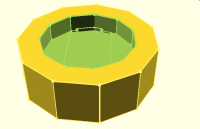
slight floating point inaccuracies. In my example I am rotating a 11 sided
polygon that is rotated 45 degrees one way and then another and stacked on
itself. All the vertices theoretically line up but in practice they are
very slightly off. The grid snaps them together which breaks the topology.
To fix it I make the second polygon smaller by eps so the points remain
distinct and it works but then I have a slightly wonky model. It is too
small to notice when 3D printed but it can be seen with show edges.
[image: image.png]
It would be better if the vertices where snapped together but it would need
to be done after the rotate but before the union. If it is done after the
union then the broken topology needs fixing up. In this case removing a
ring of degenerate triangles. In other cases it seems to be self
intersections as well and whatever this means Expr: e_below !=
SHalfedge_handle()" a hole perhaps?
What does that code do in your instrumented grid?
No collapses, so it works in F5 followed by F6. As rotations by 90 and
cylinder vertices are now accurate after my changes then there are probably
no slightly off vertices to collapse. In the recent past there would have
been. But it seems to need a more complex situation to trigger this bug. In
my example I had to translate the result away from the origin and union
with a cube to get the CGAL error. In one model I had four hanging holes
and only one showed the problem. It had a symmetrical twin that was OK, so
it is very sensitive to numerical changes.
Also what was the typical delta u v's v in your 'Collapsed' results?
Collapsed (2.164763,4.740169,1.750000) by (2.38419e-007,0,0)
Collapsed (4.383843,2.817325,1.750000) by (0,7.15256e-007,0)
Collapsed (4.383843,2.817325,1.750000) by (0,7.15256e-007,0)
Collapsed (4.383843,2.817325,1.750000) by (0,7.15256e-007,0)
Collapsed (2.164763,4.740169,1.750000) by (2.38419e-007,0,0)
Collapsed (4.383843,2.817325,1.750000) by (0,7.15256e-007,0)
Collapsed (2.164763,4.740169,1.750000) by (2.38419e-007,0,0)
Collapsed (2.164763,4.740169,1.750000) by (2.38419e-007,0,0)
Collapsed (2.164763,4.740169,1.750000) by (2.38419e-007,0,0)
Collapsed (2.164763,4.740169,1.750000) by (2.38419e-007,0,0)
Collapsed (4.383843,2.817325,1.750000) by (0,7.15256e-007,0)
Eleven, which matches the polygonal seam that goes wrong. It always seems
to give a CGAL error with an odd number of vertices. Some even numbers
generate collapses but no CGAL error, so I don't understand it completely.
On Sat, 5 Jan 2019 at 22:10, MichaelAtOz oz.at.michael@gmail.com wrote:
Using Grid here is important for performance reasons. See following
minkowski() {
cube([200, 50, 7], center = true);
rotate([90,0,0]) cylinder($fn = 8, h = 1, r = 8.36, center = true);
rotate([0,90,0]) cylinder($fn = 8, h = 1, r = 8.36, center = true);
}
If we don't grid the geometry before converting to a Nef Polyhedron, the
quads
in the cylinders to tessellated into triangles since floating point
incertainty causes the faces to not be 100% planar. The incertainty is
exaggerated
by the transform. This wasn't a problem earlier since we used Nef for
everything,
but optimizations since then has made us keep it in floating point space
longer.
What does that code do in your instrumented grid?
Also what was the typical delta u v's v in your 'Collapsed' results?
Admin - email* me if you need anything, or if I've done something stupid...
- click on my MichaelAtOz label, there is a link to email me.
Unless specifically shown otherwise above, my contribution is in the
Public Domain; to the extent possible under law, I have waived all
copyright and related or neighbouring rights to this work. Obviously
inclusion of works of previous authors is not included in the above.
The TPP is no simple “trade agreement.” Fight it!
http://www.ourfairdeal.org/ time is running out!
Sent from: http://forum.openscad.org/
OpenSCAD mailing list
Discuss@lists.openscad.org
http://lists.openscad.org/mailman/listinfo/discuss_lists.openscad.org
> I'm wondering if you keep eps more chunky, say 0.001 you will have a
higher probability of staying away from the grid trip points
I don't have a problem if I use 1/128 as it is much courser than the grid.
I use 1/128 because it is exact in floating point and is a suitable value
to stop Z fighting in OpenCSG when viewed from a typical distance.
Where it goes wrong is when points nearly line up but don't because of
slight floating point inaccuracies. In my example I am rotating a 11 sided
polygon that is rotated 45 degrees one way and then another and stacked on
itself. All the vertices theoretically line up but in practice they are
very slightly off. The grid snaps them together which breaks the topology.
To fix it I make the second polygon smaller by eps so the points remain
distinct and it works but then I have a slightly wonky model. It is too
small to notice when 3D printed but it can be seen with show edges.
[image: image.png]
It would be better if the vertices where snapped together but it would need
to be done after the rotate but before the union. If it is done after the
union then the broken topology needs fixing up. In this case removing a
ring of degenerate triangles. In other cases it seems to be self
intersections as well and whatever this means Expr: e_below !=
SHalfedge_handle()" a hole perhaps?
> What does that code do in your instrumented grid?
No collapses, so it works in F5 followed by F6. As rotations by 90 and
cylinder vertices are now accurate after my changes then there are probably
no slightly off vertices to collapse. In the recent past there would have
been. But it seems to need a more complex situation to trigger this bug. In
my example I had to translate the result away from the origin and union
with a cube to get the CGAL error. In one model I had four hanging holes
and only one showed the problem. It had a symmetrical twin that was OK, so
it is very sensitive to numerical changes.
> Also what was the typical delta u v's v in your 'Collapsed' results?
Collapsed (2.164763,4.740169,1.750000) by (2.38419e-007,0,0)
Collapsed (4.383843,2.817325,1.750000) by (0,7.15256e-007,0)
Collapsed (4.383843,2.817325,1.750000) by (0,7.15256e-007,0)
Collapsed (4.383843,2.817325,1.750000) by (0,7.15256e-007,0)
Collapsed (2.164763,4.740169,1.750000) by (2.38419e-007,0,0)
Collapsed (4.383843,2.817325,1.750000) by (0,7.15256e-007,0)
Collapsed (2.164763,4.740169,1.750000) by (2.38419e-007,0,0)
Collapsed (2.164763,4.740169,1.750000) by (2.38419e-007,0,0)
Collapsed (2.164763,4.740169,1.750000) by (2.38419e-007,0,0)
Collapsed (2.164763,4.740169,1.750000) by (2.38419e-007,0,0)
Collapsed (4.383843,2.817325,1.750000) by (0,7.15256e-007,0)
Eleven, which matches the polygonal seam that goes wrong. It always seems
to give a CGAL error with an odd number of vertices. Some even numbers
generate collapses but no CGAL error, so I don't understand it completely.
On Sat, 5 Jan 2019 at 22:10, MichaelAtOz <oz.at.michael@gmail.com> wrote:
> I assume you saw this
>
>
> https://github.com/openscad/openscad/blob/548b9c7c932cdc2e709c616a68d5ab377719a916/src/cgalutils.cc#L767
>
> > Using Grid here is important for performance reasons. See following
> model.
> > minkowski() {
> > cube([200, 50, 7], center = true);
> > rotate([90,0,0]) cylinder($fn = 8, h = 1, r = 8.36, center = true);
> > rotate([0,90,0]) cylinder($fn = 8, h = 1, r = 8.36, center = true);
> > }
> >
> > If we don't grid the geometry before converting to a Nef Polyhedron, the
> > quads
> > in the cylinders to tessellated into triangles since floating point
> > incertainty causes the faces to not be 100% planar. The incertainty is
> > exaggerated
> > by the transform. This wasn't a problem earlier since we used Nef for
> > everything,
> > but optimizations since then has made us keep it in floating point space
> > longer.
>
> What does that code do in your instrumented grid?
>
> Also what was the typical delta u v's v in your 'Collapsed' results?
>
>
>
> -----
> Admin - email* me if you need anything, or if I've done something stupid...
>
> * click on my MichaelAtOz label, there is a link to email me.
>
> Unless specifically shown otherwise above, my contribution is in the
> Public Domain; to the extent possible under law, I have waived all
> copyright and related or neighbouring rights to this work. Obviously
> inclusion of works of previous authors is not included in the above.
>
> The TPP is no simple “trade agreement.” Fight it!
> http://www.ourfairdeal.org/ time is running out!
> --
> Sent from: http://forum.openscad.org/
>
> _______________________________________________
> OpenSCAD mailing list
> Discuss@lists.openscad.org
> http://lists.openscad.org/mailman/listinfo/discuss_lists.openscad.org
>

M
MichaelAtOz
Sun, Jan 6, 2019 3:27 AM
It appears that the grid-ness is intended to keep Rationals 'compact' to
speed CGAL processing.
No, that was just a refinement, changing from the arbitrary 0.000001, for
efficiency.
There is also code in grid.h that searches 27 neighbouring grid points and
picks the nearest one that is populated. I.e. deliberately merging
vertices that would otherwise be one grid position apart. Why?
I don't think it is that simple, I haven't fully grasped what it is up to.
'nearest one' - It is taking the Euclidean norm, of the grid points.
I've seen this somewhere recently, I think reading on topology repair.
I'm wondering if the implementation is wrong.
Should it not look for the closest point on the 3x3 grid based on
non-quantised values, ie float vector.
As is d = sqrt((key-k).squaredNorm()) - key & k have both been quantised.
Otherwise the +/-1 grid space Euclidean distance seems sort of pointless (no
pun intended).
So where are all the Topologists? What is it mean to do to refine the
topology into a grid?
Admin - email* me if you need anything, or if I've done something stupid...
- click on my MichaelAtOz label, there is a link to email me.
Unless specifically shown otherwise above, my contribution is in the Public Domain; to the extent possible under law, I have waived all copyright and related or neighbouring rights to this work. Obviously inclusion of works of previous authors is not included in the above.
The TPP is no simple “trade agreement.” Fight it! http://www.ourfairdeal.org/ time is running out!
Sent from: http://forum.openscad.org/
> It appears that the grid-ness is intended to keep Rationals 'compact' to
speed CGAL processing.
No, that was just a refinement, changing from the arbitrary 0.000001, for
efficiency.
> There is also code in grid.h that searches 27 neighbouring grid points and
> picks the nearest one that is populated. I.e. deliberately merging
> vertices that would otherwise be one grid position apart. Why?
I don't think it is that simple, I haven't fully grasped what it is up to.
'nearest one' - It is taking the Euclidean norm, of the grid points.
I've seen this somewhere recently, I think reading on topology repair.
I'm wondering if the implementation is wrong.
Should it not look for the closest point on the 3x3 grid based on
non-quantised values, ie float vector.
As is d = sqrt((key-k).squaredNorm()) - key & k have both been quantised.
Otherwise the +/-1 grid space Euclidean distance seems sort of pointless (no
pun intended).
So where are all the Topologists? What is it mean to do to refine the
topology into a grid?
-----
Admin - email* me if you need anything, or if I've done something stupid...
* click on my MichaelAtOz label, there is a link to email me.
Unless specifically shown otherwise above, my contribution is in the Public Domain; to the extent possible under law, I have waived all copyright and related or neighbouring rights to this work. Obviously inclusion of works of previous authors is not included in the above.
The TPP is no simple “trade agreement.” Fight it! http://www.ourfairdeal.org/ time is running out!
--
Sent from: http://forum.openscad.org/
NH
nop head
Sun, Jan 6, 2019 10:20 AM
The sqrt is pointless as it only needs to know the nearest, so could
compare the squared value. Also the 27 distances are constants, either 0,
1, sqrt(2) or sqrt(3). The 2D version uses the Manhattan distance, which I
think is just as good for +/-1 but abs() might take longer than integer
multiply.
Wouldn't it be roughly the same to make the grid spacing three times bigger?
I had actually removed the neighbour search when I posted the offsets
above. With that code back in more vertices collapse.
Collapsed (2.164763,4.740169,1.750000) by (2.38419e-007,0,0)
Collapsed (-3.412535,-3.938275,1.750000) by (-1.19209e-006,2.38419e-007,0)
Collapsed (-3.412535,-3.938275,1.750000) by (-1.19209e-006,2.38419e-007,0)
Collapsed (4.383843,2.817325,1.750000) by (0,7.15256e-007,0)
Collapsed (4.383843,2.817325,1.750000) by (0,7.15256e-007,0)
Collapsed (4.383843,2.817325,1.750000) by (0,7.15256e-007,0)
Collapsed (2.164763,4.740169,1.750000) by (2.38419e-007,0,0)
Collapsed (4.383843,2.817325,1.750000) by (0,7.15256e-007,0)
Collapsed (2.164763,4.740169,1.750000) by (2.38419e-007,0,0)
Collapsed (2.164763,4.740169,1.750000) by (2.38419e-007,0,0)
Collapsed (2.164762,4.740170,2.000000) by (4.76837e-007,-4.76837e-007,0)
Collapsed (2.164763,4.740169,1.750000) by (2.38419e-007,0,0)
Collapsed (2.164762,4.740170,2.000000) by (4.76837e-007,-4.76837e-007,0)
Collapsed (2.164763,4.740169,1.750000) by (2.38419e-007,0,0)
Collapsed (-5.000000,-1.468132,2.000000) by (4.76837e-007,-4.76837e-007,0)
Collapsed (4.383843,2.817325,1.750000) by (0,7.15256e-007,0)
Collapsed (2.164762,4.740170,2.000000) by (4.76837e-007,-4.76837e-007,0)
Collapsed (-5.000000,-1.468132,2.000000) by (4.76837e-007,-4.76837e-007,0)
Collapsed (-3.412535,-3.938275,1.750000) by (-1.19209e-006,2.38419e-007,0)
Collapsed (-5.000000,-1.468132,2.000000) by (4.76837e-007,-4.76837e-007,0)
Collapsed (-3.412535,-3.938275,1.750000) by (-1.19209e-006,2.38419e-007,0)
Collapsed (2.164762,4.740170,2.000000) by (4.76837e-007,-4.76837e-007,0)
Collapsed (2.164762,4.740170,2.000000) by (4.76837e-007,-4.76837e-007,0)
Collapsed (-5.000000,-1.468132,2.000000) by (4.76837e-007,-4.76837e-007,0)
Collapsed (-5.000000,-1.468132,2.000000) by (4.76837e-007,-4.76837e-007,0)
Collapsed (-5.000000,-1.468132,2.000000) by (4.76837e-007,-4.76837e-007,0)
But the results are the same. Curiously if the number of sides is even F5
works but F6 fails unless the cache is flushed. When it is odd the CGAL
error happens in F5.
It seems that Polyset is only that, a set of polygons, which are lists of
vertices, no edge information. So I think collapsing vertices should be OK
in that format as the edges are implied. That would be as long as all the
faces have exactly the right vertex values, so that each copy of the vertex
in different polygons ends up snapped to the same value. After snapping it
removes duplicate triangles and degenerate triangles here:
https://github.com/openscad/openscad/blob/master/src/polyset.cc#L220.
So there seems to definitely be a bug when it collapses vertices but I no
longer think it is fundamentally wrong to do it while in PolySet format. It
would be for a mesh with edges.
On Sun, 6 Jan 2019 at 03:28, MichaelAtOz oz.at.michael@gmail.com wrote:
It appears that the grid-ness is intended to keep Rationals 'compact' to
speed CGAL processing.
No, that was just a refinement, changing from the arbitrary 0.000001, for
efficiency.
There is also code in grid.h that searches 27 neighbouring grid points
picks the nearest one that is populated. I.e. deliberately merging
vertices that would otherwise be one grid position apart. Why?
I don't think it is that simple, I haven't fully grasped what it is up to.
'nearest one' - It is taking the Euclidean norm, of the grid points.
I've seen this somewhere recently, I think reading on topology repair.
I'm wondering if the implementation is wrong.
Should it not look for the closest point on the 3x3 grid based on
non-quantised values, ie float vector.
As is d = sqrt((key-k).squaredNorm()) - key & k have both been quantised.
Otherwise the +/-1 grid space Euclidean distance seems sort of pointless
(no
pun intended).
So where are all the Topologists? What is it mean to do to refine the
topology into a grid?
Admin - email* me if you need anything, or if I've done something stupid...
- click on my MichaelAtOz label, there is a link to email me.
Unless specifically shown otherwise above, my contribution is in the
Public Domain; to the extent possible under law, I have waived all
copyright and related or neighbouring rights to this work. Obviously
inclusion of works of previous authors is not included in the above.
The TPP is no simple “trade agreement.” Fight it!
http://www.ourfairdeal.org/ time is running out!
Sent from: http://forum.openscad.org/
OpenSCAD mailing list
Discuss@lists.openscad.org
http://lists.openscad.org/mailman/listinfo/discuss_lists.openscad.org
The sqrt is pointless as it only needs to know the nearest, so could
compare the squared value. Also the 27 distances are constants, either 0,
1, sqrt(2) or sqrt(3). The 2D version uses the Manhattan distance, which I
think is just as good for +/-1 but abs() might take longer than integer
multiply.
Wouldn't it be roughly the same to make the grid spacing three times bigger?
I had actually removed the neighbour search when I posted the offsets
above. With that code back in more vertices collapse.
Collapsed (2.164763,4.740169,1.750000) by (2.38419e-007,0,0)
Collapsed (-3.412535,-3.938275,1.750000) by (-1.19209e-006,2.38419e-007,0)
Collapsed (-3.412535,-3.938275,1.750000) by (-1.19209e-006,2.38419e-007,0)
Collapsed (4.383843,2.817325,1.750000) by (0,7.15256e-007,0)
Collapsed (4.383843,2.817325,1.750000) by (0,7.15256e-007,0)
Collapsed (4.383843,2.817325,1.750000) by (0,7.15256e-007,0)
Collapsed (2.164763,4.740169,1.750000) by (2.38419e-007,0,0)
Collapsed (4.383843,2.817325,1.750000) by (0,7.15256e-007,0)
Collapsed (2.164763,4.740169,1.750000) by (2.38419e-007,0,0)
Collapsed (2.164763,4.740169,1.750000) by (2.38419e-007,0,0)
Collapsed (2.164762,4.740170,2.000000) by (4.76837e-007,-4.76837e-007,0)
Collapsed (2.164763,4.740169,1.750000) by (2.38419e-007,0,0)
Collapsed (2.164762,4.740170,2.000000) by (4.76837e-007,-4.76837e-007,0)
Collapsed (2.164763,4.740169,1.750000) by (2.38419e-007,0,0)
Collapsed (-5.000000,-1.468132,2.000000) by (4.76837e-007,-4.76837e-007,0)
Collapsed (4.383843,2.817325,1.750000) by (0,7.15256e-007,0)
Collapsed (2.164762,4.740170,2.000000) by (4.76837e-007,-4.76837e-007,0)
Collapsed (-5.000000,-1.468132,2.000000) by (4.76837e-007,-4.76837e-007,0)
Collapsed (-3.412535,-3.938275,1.750000) by (-1.19209e-006,2.38419e-007,0)
Collapsed (-5.000000,-1.468132,2.000000) by (4.76837e-007,-4.76837e-007,0)
Collapsed (-3.412535,-3.938275,1.750000) by (-1.19209e-006,2.38419e-007,0)
Collapsed (2.164762,4.740170,2.000000) by (4.76837e-007,-4.76837e-007,0)
Collapsed (2.164762,4.740170,2.000000) by (4.76837e-007,-4.76837e-007,0)
Collapsed (-5.000000,-1.468132,2.000000) by (4.76837e-007,-4.76837e-007,0)
Collapsed (-5.000000,-1.468132,2.000000) by (4.76837e-007,-4.76837e-007,0)
Collapsed (-5.000000,-1.468132,2.000000) by (4.76837e-007,-4.76837e-007,0)
But the results are the same. Curiously if the number of sides is even F5
works but F6 fails unless the cache is flushed. When it is odd the CGAL
error happens in F5.
It seems that Polyset is only that, a set of polygons, which are lists of
vertices, no edge information. So I think collapsing vertices should be OK
in that format as the edges are implied. That would be as long as all the
faces have exactly the right vertex values, so that each copy of the vertex
in different polygons ends up snapped to the same value. After snapping it
removes duplicate triangles and degenerate triangles here:
https://github.com/openscad/openscad/blob/master/src/polyset.cc#L220.
So there seems to definitely be a bug when it collapses vertices but I no
longer think it is fundamentally wrong to do it while in PolySet format. It
would be for a mesh with edges.
On Sun, 6 Jan 2019 at 03:28, MichaelAtOz <oz.at.michael@gmail.com> wrote:
> > It appears that the grid-ness is intended to keep Rationals 'compact' to
> speed CGAL processing.
>
> No, that was just a refinement, changing from the arbitrary 0.000001, for
> efficiency.
>
>
> > There is also code in grid.h that searches 27 neighbouring grid points
> and
> > picks the nearest one that is populated. I.e. deliberately merging
> > vertices that would otherwise be one grid position apart. Why?
>
> I don't think it is that simple, I haven't fully grasped what it is up to.
>
> 'nearest one' - It is taking the Euclidean norm, of the grid points.
> I've seen this somewhere recently, I think reading on topology repair.
> I'm wondering if the implementation is wrong.
> Should it not look for the closest point on the 3x3 grid based on
> non-quantised values, ie float vector.
> As is d = sqrt((key-k).squaredNorm()) - key & k have both been quantised.
> Otherwise the +/-1 grid space Euclidean distance seems sort of pointless
> (no
> pun intended).
>
> So where are all the Topologists? What is it mean to do to refine the
> topology into a grid?
>
>
>
>
>
> -----
> Admin - email* me if you need anything, or if I've done something stupid...
>
> * click on my MichaelAtOz label, there is a link to email me.
>
> Unless specifically shown otherwise above, my contribution is in the
> Public Domain; to the extent possible under law, I have waived all
> copyright and related or neighbouring rights to this work. Obviously
> inclusion of works of previous authors is not included in the above.
>
> The TPP is no simple “trade agreement.” Fight it!
> http://www.ourfairdeal.org/ time is running out!
> --
> Sent from: http://forum.openscad.org/
>
> _______________________________________________
> OpenSCAD mailing list
> Discuss@lists.openscad.org
> http://lists.openscad.org/mailman/listinfo/discuss_lists.openscad.org
>
NH
nop head
Sun, Jan 6, 2019 12:43 PM
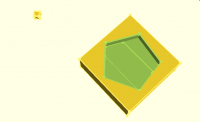
I added some debug to Polyset and simplified my model to be a stacked
pentagon subtracted from a cube to reduce the complexity of the polygons.
It now looks like this:
[image: image.png]
It looks like during F6 the union is never converted to a Polyset, so there
are no near vertices to collapse. F5 converts the union to a Polyset before
feeding it to CGAL and that is were it goes wrong as there are close
vertices in the same Polyset and they do collapse. Here is the Polyset
before, during and after being quantized.
polyset: PolySet:
num polygons: 44
polygon 0: ( -5 -3.63271 2) (-1.29953 -4.83507 2.25) ( -5 -3.63271 2.25)
polygon 1: (-1.29953 -4.83507 2.25) ( -5 -3.63271 2) (-1.29953 -4.83507 2)
polygon 2: (2.09182 5.62736 2.25) (4.83195 1.8559 2) (2.09182 5.62736 1.75)
polygon 3: (5.06738 1.53185 2.25) (4.83195 1.8559 2) (2.09182 5.62736 2.25)
polygon 4: (4.83195 1.8559 2) (5.06738 1.53185 2.25) (5.06738 1.53185 2)
polygon 5: (2.09182 5.62736 1.75) (4.83195 1.8559 2) (4.83195 1.8559 1.75)
polygon 6: ( -5 -3.63271 2) ( -5 -1.46447 2.25) ( -5 -1.46447 2)
polygon 7: ( -5 -1.46447 2.25) ( -5 -3.63271 2) ( -5 -3.63271 2.25)
polygon 8: ( -5 -1.46447 2.25) (5.06738 1.53185 2.25) (2.09182 5.62736 2.25)
polygon 9: (5.06738 1.53185 2.25) ( -5 -1.46447 2.25) (-1.29953 -4.83507
2.25)
polygon 10: (-1.29953 -4.83507 2.25) ( -5 -1.46447 2.25) ( -5 -3.63271 2.25)
polygon 11: ( -5 -1.46447 2) (2.09182 5.62736 2.25) (2.09182 5.62736 2)
polygon 12: (2.09182 5.62736 2.25) ( -5 -1.46447 2) ( -5 -1.46447 2.25)
polygon 13: (2.09182 5.62736 1.75) (2.09182 5.62736 1.75) (2.09182 5.62736
2)
polygon 14: (2.09182 5.62736 2) (2.09182 5.62736 2.25) (2.09182 5.62736
1.75)
polygon 15: (4.83195 1.8559 1.75) (2.09182 5.62736 1.75) (2.09182 5.62736
1.75)
polygon 16: (-1.29953 -4.83507 2) (5.06738 1.53185 2.25) (-1.29953 -4.83507
2.25)
polygon 17: (5.06738 1.53185 2.25) (-1.29953 -4.83507 2) (5.06738 1.53185 2)
polygon 18: ( -5 -3.63271 -0.0078125) ( 1.90983 -5.87785 2) ( -5 -3.63271 2)
polygon 19: ( 1.90983 -5.87785 2) ( -5 -3.63271 -0.0078125) ( 1.90983
-5.87785 -0.0078125)
polygon 20: ( 1.90983 -5.87785 2) ( 6.18034 0 -0.0078125) (6.18034 0 2)
polygon 21: ( 6.18034 0 -0.0078125) ( 1.90983 -5.87785 2) ( 1.90983
-5.87785 -0.0078125)
polygon 22: ( 1.90983 5.87785 -0.0078125) ( -5 3.63271 2) (1.90983 5.87785
2)
polygon 23: ( -5 3.63271 2) ( 1.90983 5.87785 -0.0078125) ( -5 3.63271
-0.0078125)
polygon 24: ( -5 -3.63271 -0.0078125) ( -5 3.63271 2) ( -5 3.63271
-0.0078125)
polygon 25: ( -5 3.63271 2) ( -5 -3.63271 -0.0078125) ( -5 -3.63271 2)
polygon 26: ( -5 3.63271 2) (2.09182 5.62736 2) (1.90983 5.87785 2)
polygon 27: ( -5 -3.63271 2) ( -5 -1.46447 2) ( -5 3.63271 2)
polygon 28: (2.09182 5.62736 2) ( -5 3.63271 2) ( -5 -1.46447 2)
polygon 29: (6.18034 0 2) (4.83195 1.8559 2) (5.06738 1.53185 2)
polygon 30: (5.06738 1.53185 2) ( 1.90983 -5.87785 2) (6.18034 0 2)
polygon 31: (-1.29953 -4.83507 2) ( 1.90983 -5.87785 2) (5.06738 1.53185 2)
polygon 32: ( -5 -3.63271 2) (-1.29953 -4.83507 2) ( -5 -3.63271 2)
polygon 33: (-1.29953 -4.83507 2) ( -5 -3.63271 2) ( 1.90983 -5.87785 2)
polygon 34: ( -5 -1.46447 2) ( -5 -3.63271 2) ( -5 -3.63271 2)
polygon 35: ( 1.90983 -5.87785 -0.0078125) ( 1.90983 5.87785 -0.0078125) (
6.18034 0 -0.0078125)
polygon 36: ( -5 -3.63271 -0.0078125) ( 1.90983 5.87785 -0.0078125) (
1.90983 -5.87785 -0.0078125)
polygon 37: ( 1.90983 5.87785 -0.0078125) ( -5 -3.63271 -0.0078125) ( -5
3.63271 -0.0078125)
polygon 38: (4.83195 1.8559 2) (6.18034 0 2) (4.83195 1.8559 1.75)
polygon 39: (2.09182 5.62736 1.75) (1.90983 5.87785 2) (2.09182 5.62736 2)
polygon 40: (1.90983 5.87785 2) (2.09182 5.62736 1.75) ( 1.90983 5.87785
-0.0078125)
polygon 41: (4.83195 1.8559 1.75) ( 1.90983 5.87785 -0.0078125) (2.09182
5.62736 1.75)
polygon 42: ( 6.18034 0 -0.0078125) (4.83195 1.8559 1.75) (6.18034 0 2)
polygon 43: (4.83195 1.8559 1.75) ( 6.18034 0 -0.0078125) ( 1.90983 5.87785
-0.0078125)
PolySet end
Collapsed (2.091824,5.627358,1.750000) by (2.38419e-007,0,0)
polyset: Removing collapsed vertex 0 out of 3 from polygon 13 due to
quantizing
polyset: Removing collapsed polygon 13 due to quantizing
Collapsed (2.091824,5.627358,1.750000) by (2.38419e-007,0,0)
polyset: Removing collapsed vertex 1 out of 3 from polygon 15 due to
quantizing
polyset: Removing collapsed polygon 15 due to quantizing
Collapsed (-5.000000,-3.632712,2.000000) by (4.76837e-007,0,0)
Collapsed (-5.000000,-3.632712,2.000000) by (4.76837e-007,0,0)
Collapsed (-5.000000,-3.632712,2.000000) by (4.76837e-007,0,0)
Collapsed (-5.000000,-3.632712,2.000000) by (4.76837e-007,0,0)
polyset: Removing collapsed vertex 2 out of 3 from polygon 32 due to
quantizing
polyset: Removing collapsed polygon 32 due to quantizing
Collapsed (-5.000000,-3.632712,2.000000) by (4.76837e-007,0,0)
Collapsed (-5.000000,-3.632712,2.000000) by (4.76837e-007,0,0)
polyset: Removing collapsed vertex 1 out of 3 from polygon 34 due to
quantizing
polyset: Removing collapsed polygon 34 due to quantizing
Collapsed (2.091824,5.627358,1.750000) by (2.38419e-007,0,0)
Collapsed (2.091824,5.627358,1.750000) by (2.38419e-007,0,0)
Collapsed (2.091824,5.627358,1.750000) by (2.38419e-007,0,0)
polyset: PolySet:
num polygons: 40
polygon 0: ( -5 -3.63271 2) (-1.29953 -4.83507 2.25) ( -5 -3.63271 2.25)
polygon 1: (-1.29953 -4.83507 2.25) ( -5 -3.63271 2) (-1.29953 -4.83507 2)
polygon 2: (2.09182 5.62736 2.25) (4.83195 1.8559 2) (2.09182 5.62736 1.75)
polygon 3: (5.06738 1.53185 2.25) (4.83195 1.8559 2) (2.09182 5.62736 2.25)
polygon 4: (4.83195 1.8559 2) (5.06738 1.53185 2.25) (5.06738 1.53185 2)
polygon 5: (2.09182 5.62736 1.75) (4.83195 1.8559 2) (4.83195 1.8559 1.75)
polygon 6: ( -5 -3.63271 2) ( -5 -1.46447 2.25) ( -5 -1.46447 2)
polygon 7: ( -5 -1.46447 2.25) ( -5 -3.63271 2) ( -5 -3.63271 2.25)
polygon 8: ( -5 -1.46447 2.25) (5.06738 1.53185 2.25) (2.09182 5.62736 2.25)
polygon 9: (5.06738 1.53185 2.25) ( -5 -1.46447 2.25) (-1.29953 -4.83507
2.25)
polygon 10: (-1.29953 -4.83507 2.25) ( -5 -1.46447 2.25) ( -5 -3.63271 2.25)
polygon 11: ( -5 -1.46447 2) (2.09182 5.62736 2.25) (2.09182 5.62736 2)
polygon 12: (2.09182 5.62736 2.25) ( -5 -1.46447 2) ( -5 -1.46447 2.25)
polygon 13: (2.09182 5.62736 2) (2.09182 5.62736 2.25) (2.09182 5.62736
1.75)
polygon 14: (-1.29953 -4.83507 2) (5.06738 1.53185 2.25) (-1.29953 -4.83507
2.25)
polygon 15: (5.06738 1.53185 2.25) (-1.29953 -4.83507 2) (5.06738 1.53185 2)
polygon 16: ( -5 -3.63271 -0.0078125) ( 1.90983 -5.87785 2) ( -5 -3.63271 2)
polygon 17: ( 1.90983 -5.87785 2) ( -5 -3.63271 -0.0078125) ( 1.90983
-5.87785 -0.0078125)
polygon 18: ( 1.90983 -5.87785 2) ( 6.18034 0 -0.0078125) (6.18034 0 2)
polygon 19: ( 6.18034 0 -0.0078125) ( 1.90983 -5.87785 2) ( 1.90983
-5.87785 -0.0078125)
polygon 20: ( 1.90983 5.87785 -0.0078125) ( -5 3.63271 2) (1.90983 5.87785
2)
polygon 21: ( -5 3.63271 2) ( 1.90983 5.87785 -0.0078125) ( -5 3.63271
-0.0078125)
polygon 22: ( -5 -3.63271 -0.0078125) ( -5 3.63271 2) ( -5 3.63271
-0.0078125)
polygon 23: ( -5 3.63271 2) ( -5 -3.63271 -0.0078125) ( -5 -3.63271 2)
polygon 24: ( -5 3.63271 2) (2.09182 5.62736 2) (1.90983 5.87785 2)
polygon 25: ( -5 -3.63271 2) ( -5 -1.46447 2) ( -5 3.63271 2)
polygon 26: (2.09182 5.62736 2) ( -5 3.63271 2) ( -5 -1.46447 2)
polygon 27: (6.18034 0 2) (4.83195 1.8559 2) (5.06738 1.53185 2)
polygon 28: (5.06738 1.53185 2) ( 1.90983 -5.87785 2) (6.18034 0 2)
polygon 29: (-1.29953 -4.83507 2) ( 1.90983 -5.87785 2) (5.06738 1.53185 2)
polygon 30: (-1.29953 -4.83507 2) ( -5 -3.63271 2) ( 1.90983 -5.87785 2)
polygon 31: ( 1.90983 -5.87785 -0.0078125) ( 1.90983 5.87785 -0.0078125) (
6.18034 0 -0.0078125)
polygon 32: ( -5 -3.63271 -0.0078125) ( 1.90983 5.87785 -0.0078125) (
1.90983 -5.87785 -0.0078125)
polygon 33: ( 1.90983 5.87785 -0.0078125) ( -5 -3.63271 -0.0078125) ( -5
3.63271 -0.0078125)
polygon 34: (4.83195 1.8559 2) (6.18034 0 2) (4.83195 1.8559 1.75)
polygon 35: (2.09182 5.62736 1.75) (1.90983 5.87785 2) (2.09182 5.62736 2)
polygon 36: (1.90983 5.87785 2) (2.09182 5.62736 1.75) ( 1.90983 5.87785
-0.0078125)
polygon 37: (4.83195 1.8559 1.75) ( 1.90983 5.87785 -0.0078125) (2.09182
5.62736 1.75)
polygon 38: ( 6.18034 0 -0.0078125) (4.83195 1.8559 1.75) (6.18034 0 2)
polygon 39: (4.83195 1.8559 1.75) ( 6.18034 0 -0.0078125) ( 1.90983 5.87785
-0.0078125)
PolySet end
ERROR: CGAL error in CGAL_Nef_polyhedron3(): CGAL ERROR: assertion
violation! Expr: pe_prev->is_border() ||
!internal::Plane_constructor<Plane>::get_plane(pe_prev->facet(),pe_prev->facet()->plane()).is_degenerate()
File: C:/msys64/mingw64/include/CGAL/Nef_3/polyhedron_3_to_nef_3.h Line: 251
On Sun, 6 Jan 2019 at 10:20, nop head nop.head@gmail.com wrote:
The sqrt is pointless as it only needs to know the nearest, so could
compare the squared value. Also the 27 distances are constants, either 0,
1, sqrt(2) or sqrt(3). The 2D version uses the Manhattan distance, which I
think is just as good for +/-1 but abs() might take longer than integer
multiply.
Wouldn't it be roughly the same to make the grid spacing three times
bigger?
I had actually removed the neighbour search when I posted the offsets
above. With that code back in more vertices collapse.
Collapsed (2.164763,4.740169,1.750000) by (2.38419e-007,0,0)
Collapsed (-3.412535,-3.938275,1.750000) by (-1.19209e-006,2.38419e-007,0)
Collapsed (-3.412535,-3.938275,1.750000) by (-1.19209e-006,2.38419e-007,0)
Collapsed (4.383843,2.817325,1.750000) by (0,7.15256e-007,0)
Collapsed (4.383843,2.817325,1.750000) by (0,7.15256e-007,0)
Collapsed (4.383843,2.817325,1.750000) by (0,7.15256e-007,0)
Collapsed (2.164763,4.740169,1.750000) by (2.38419e-007,0,0)
Collapsed (4.383843,2.817325,1.750000) by (0,7.15256e-007,0)
Collapsed (2.164763,4.740169,1.750000) by (2.38419e-007,0,0)
Collapsed (2.164763,4.740169,1.750000) by (2.38419e-007,0,0)
Collapsed (2.164762,4.740170,2.000000) by (4.76837e-007,-4.76837e-007,0)
Collapsed (2.164763,4.740169,1.750000) by (2.38419e-007,0,0)
Collapsed (2.164762,4.740170,2.000000) by (4.76837e-007,-4.76837e-007,0)
Collapsed (2.164763,4.740169,1.750000) by (2.38419e-007,0,0)
Collapsed (-5.000000,-1.468132,2.000000) by (4.76837e-007,-4.76837e-007,0)
Collapsed (4.383843,2.817325,1.750000) by (0,7.15256e-007,0)
Collapsed (2.164762,4.740170,2.000000) by (4.76837e-007,-4.76837e-007,0)
Collapsed (-5.000000,-1.468132,2.000000) by (4.76837e-007,-4.76837e-007,0)
Collapsed (-3.412535,-3.938275,1.750000) by (-1.19209e-006,2.38419e-007,0)
Collapsed (-5.000000,-1.468132,2.000000) by (4.76837e-007,-4.76837e-007,0)
Collapsed (-3.412535,-3.938275,1.750000) by (-1.19209e-006,2.38419e-007,0)
Collapsed (2.164762,4.740170,2.000000) by (4.76837e-007,-4.76837e-007,0)
Collapsed (2.164762,4.740170,2.000000) by (4.76837e-007,-4.76837e-007,0)
Collapsed (-5.000000,-1.468132,2.000000) by (4.76837e-007,-4.76837e-007,0)
Collapsed (-5.000000,-1.468132,2.000000) by (4.76837e-007,-4.76837e-007,0)
Collapsed (-5.000000,-1.468132,2.000000) by (4.76837e-007,-4.76837e-007,0)
But the results are the same. Curiously if the number of sides is even F5
works but F6 fails unless the cache is flushed. When it is odd the CGAL
error happens in F5.
It seems that Polyset is only that, a set of polygons, which are lists of
vertices, no edge information. So I think collapsing vertices should be OK
in that format as the edges are implied. That would be as long as all the
faces have exactly the right vertex values, so that each copy of the vertex
in different polygons ends up snapped to the same value. After snapping it
removes duplicate triangles and degenerate triangles here:
https://github.com/openscad/openscad/blob/master/src/polyset.cc#L220.
So there seems to definitely be a bug when it collapses vertices but I no
longer think it is fundamentally wrong to do it while in PolySet format. It
would be for a mesh with edges.
On Sun, 6 Jan 2019 at 03:28, MichaelAtOz oz.at.michael@gmail.com wrote:
It appears that the grid-ness is intended to keep Rationals 'compact' to
speed CGAL processing.
No, that was just a refinement, changing from the arbitrary 0.000001, for
efficiency.
There is also code in grid.h that searches 27 neighbouring grid points
picks the nearest one that is populated. I.e. deliberately merging
vertices that would otherwise be one grid position apart. Why?
I don't think it is that simple, I haven't fully grasped what it is up
to.
'nearest one' - It is taking the Euclidean norm, of the grid points.
I've seen this somewhere recently, I think reading on topology repair.
I'm wondering if the implementation is wrong.
Should it not look for the closest point on the 3x3 grid based on
non-quantised values, ie float vector.
As is d = sqrt((key-k).squaredNorm()) - key & k have both been quantised.
Otherwise the +/-1 grid space Euclidean distance seems sort of pointless
(no
pun intended).
So where are all the Topologists? What is it mean to do to refine the
topology into a grid?
Admin - email* me if you need anything, or if I've done something
stupid...
- click on my MichaelAtOz label, there is a link to email me.
Unless specifically shown otherwise above, my contribution is in the
Public Domain; to the extent possible under law, I have waived all
copyright and related or neighbouring rights to this work. Obviously
inclusion of works of previous authors is not included in the above.
The TPP is no simple “trade agreement.” Fight it!
http://www.ourfairdeal.org/ time is running out!
Sent from: http://forum.openscad.org/
OpenSCAD mailing list
Discuss@lists.openscad.org
http://lists.openscad.org/mailman/listinfo/discuss_lists.openscad.org
I added some debug to Polyset and simplified my model to be a stacked
pentagon subtracted from a cube to reduce the complexity of the polygons.
It now looks like this:
[image: image.png]
It looks like during F6 the union is never converted to a Polyset, so there
are no near vertices to collapse. F5 converts the union to a Polyset before
feeding it to CGAL and that is were it goes wrong as there are close
vertices in the same Polyset and they do collapse. Here is the Polyset
before, during and after being quantized.
polyset: PolySet:
num polygons: 44
polygon 0: ( -5 -3.63271 2) (-1.29953 -4.83507 2.25) ( -5 -3.63271 2.25)
polygon 1: (-1.29953 -4.83507 2.25) ( -5 -3.63271 2) (-1.29953 -4.83507 2)
polygon 2: (2.09182 5.62736 2.25) (4.83195 1.8559 2) (2.09182 5.62736 1.75)
polygon 3: (5.06738 1.53185 2.25) (4.83195 1.8559 2) (2.09182 5.62736 2.25)
polygon 4: (4.83195 1.8559 2) (5.06738 1.53185 2.25) (5.06738 1.53185 2)
polygon 5: (2.09182 5.62736 1.75) (4.83195 1.8559 2) (4.83195 1.8559 1.75)
polygon 6: ( -5 -3.63271 2) ( -5 -1.46447 2.25) ( -5 -1.46447 2)
polygon 7: ( -5 -1.46447 2.25) ( -5 -3.63271 2) ( -5 -3.63271 2.25)
polygon 8: ( -5 -1.46447 2.25) (5.06738 1.53185 2.25) (2.09182 5.62736 2.25)
polygon 9: (5.06738 1.53185 2.25) ( -5 -1.46447 2.25) (-1.29953 -4.83507
2.25)
polygon 10: (-1.29953 -4.83507 2.25) ( -5 -1.46447 2.25) ( -5 -3.63271 2.25)
polygon 11: ( -5 -1.46447 2) (2.09182 5.62736 2.25) (2.09182 5.62736 2)
polygon 12: (2.09182 5.62736 2.25) ( -5 -1.46447 2) ( -5 -1.46447 2.25)
polygon 13: (2.09182 5.62736 1.75) (2.09182 5.62736 1.75) (2.09182 5.62736
2)
polygon 14: (2.09182 5.62736 2) (2.09182 5.62736 2.25) (2.09182 5.62736
1.75)
polygon 15: (4.83195 1.8559 1.75) (2.09182 5.62736 1.75) (2.09182 5.62736
1.75)
polygon 16: (-1.29953 -4.83507 2) (5.06738 1.53185 2.25) (-1.29953 -4.83507
2.25)
polygon 17: (5.06738 1.53185 2.25) (-1.29953 -4.83507 2) (5.06738 1.53185 2)
polygon 18: ( -5 -3.63271 -0.0078125) ( 1.90983 -5.87785 2) ( -5 -3.63271 2)
polygon 19: ( 1.90983 -5.87785 2) ( -5 -3.63271 -0.0078125) ( 1.90983
-5.87785 -0.0078125)
polygon 20: ( 1.90983 -5.87785 2) ( 6.18034 0 -0.0078125) (6.18034 0 2)
polygon 21: ( 6.18034 0 -0.0078125) ( 1.90983 -5.87785 2) ( 1.90983
-5.87785 -0.0078125)
polygon 22: ( 1.90983 5.87785 -0.0078125) ( -5 3.63271 2) (1.90983 5.87785
2)
polygon 23: ( -5 3.63271 2) ( 1.90983 5.87785 -0.0078125) ( -5 3.63271
-0.0078125)
polygon 24: ( -5 -3.63271 -0.0078125) ( -5 3.63271 2) ( -5 3.63271
-0.0078125)
polygon 25: ( -5 3.63271 2) ( -5 -3.63271 -0.0078125) ( -5 -3.63271 2)
polygon 26: ( -5 3.63271 2) (2.09182 5.62736 2) (1.90983 5.87785 2)
polygon 27: ( -5 -3.63271 2) ( -5 -1.46447 2) ( -5 3.63271 2)
polygon 28: (2.09182 5.62736 2) ( -5 3.63271 2) ( -5 -1.46447 2)
polygon 29: (6.18034 0 2) (4.83195 1.8559 2) (5.06738 1.53185 2)
polygon 30: (5.06738 1.53185 2) ( 1.90983 -5.87785 2) (6.18034 0 2)
polygon 31: (-1.29953 -4.83507 2) ( 1.90983 -5.87785 2) (5.06738 1.53185 2)
polygon 32: ( -5 -3.63271 2) (-1.29953 -4.83507 2) ( -5 -3.63271 2)
polygon 33: (-1.29953 -4.83507 2) ( -5 -3.63271 2) ( 1.90983 -5.87785 2)
polygon 34: ( -5 -1.46447 2) ( -5 -3.63271 2) ( -5 -3.63271 2)
polygon 35: ( 1.90983 -5.87785 -0.0078125) ( 1.90983 5.87785 -0.0078125) (
6.18034 0 -0.0078125)
polygon 36: ( -5 -3.63271 -0.0078125) ( 1.90983 5.87785 -0.0078125) (
1.90983 -5.87785 -0.0078125)
polygon 37: ( 1.90983 5.87785 -0.0078125) ( -5 -3.63271 -0.0078125) ( -5
3.63271 -0.0078125)
polygon 38: (4.83195 1.8559 2) (6.18034 0 2) (4.83195 1.8559 1.75)
polygon 39: (2.09182 5.62736 1.75) (1.90983 5.87785 2) (2.09182 5.62736 2)
polygon 40: (1.90983 5.87785 2) (2.09182 5.62736 1.75) ( 1.90983 5.87785
-0.0078125)
polygon 41: (4.83195 1.8559 1.75) ( 1.90983 5.87785 -0.0078125) (2.09182
5.62736 1.75)
polygon 42: ( 6.18034 0 -0.0078125) (4.83195 1.8559 1.75) (6.18034 0 2)
polygon 43: (4.83195 1.8559 1.75) ( 6.18034 0 -0.0078125) ( 1.90983 5.87785
-0.0078125)
PolySet end
Collapsed (2.091824,5.627358,1.750000) by (2.38419e-007,0,0)
polyset: Removing collapsed vertex 0 out of 3 from polygon 13 due to
quantizing
polyset: Removing collapsed polygon 13 due to quantizing
Collapsed (2.091824,5.627358,1.750000) by (2.38419e-007,0,0)
polyset: Removing collapsed vertex 1 out of 3 from polygon 15 due to
quantizing
polyset: Removing collapsed polygon 15 due to quantizing
Collapsed (-5.000000,-3.632712,2.000000) by (4.76837e-007,0,0)
Collapsed (-5.000000,-3.632712,2.000000) by (4.76837e-007,0,0)
Collapsed (-5.000000,-3.632712,2.000000) by (4.76837e-007,0,0)
Collapsed (-5.000000,-3.632712,2.000000) by (4.76837e-007,0,0)
polyset: Removing collapsed vertex 2 out of 3 from polygon 32 due to
quantizing
polyset: Removing collapsed polygon 32 due to quantizing
Collapsed (-5.000000,-3.632712,2.000000) by (4.76837e-007,0,0)
Collapsed (-5.000000,-3.632712,2.000000) by (4.76837e-007,0,0)
polyset: Removing collapsed vertex 1 out of 3 from polygon 34 due to
quantizing
polyset: Removing collapsed polygon 34 due to quantizing
Collapsed (2.091824,5.627358,1.750000) by (2.38419e-007,0,0)
Collapsed (2.091824,5.627358,1.750000) by (2.38419e-007,0,0)
Collapsed (2.091824,5.627358,1.750000) by (2.38419e-007,0,0)
polyset: PolySet:
num polygons: 40
polygon 0: ( -5 -3.63271 2) (-1.29953 -4.83507 2.25) ( -5 -3.63271 2.25)
polygon 1: (-1.29953 -4.83507 2.25) ( -5 -3.63271 2) (-1.29953 -4.83507 2)
polygon 2: (2.09182 5.62736 2.25) (4.83195 1.8559 2) (2.09182 5.62736 1.75)
polygon 3: (5.06738 1.53185 2.25) (4.83195 1.8559 2) (2.09182 5.62736 2.25)
polygon 4: (4.83195 1.8559 2) (5.06738 1.53185 2.25) (5.06738 1.53185 2)
polygon 5: (2.09182 5.62736 1.75) (4.83195 1.8559 2) (4.83195 1.8559 1.75)
polygon 6: ( -5 -3.63271 2) ( -5 -1.46447 2.25) ( -5 -1.46447 2)
polygon 7: ( -5 -1.46447 2.25) ( -5 -3.63271 2) ( -5 -3.63271 2.25)
polygon 8: ( -5 -1.46447 2.25) (5.06738 1.53185 2.25) (2.09182 5.62736 2.25)
polygon 9: (5.06738 1.53185 2.25) ( -5 -1.46447 2.25) (-1.29953 -4.83507
2.25)
polygon 10: (-1.29953 -4.83507 2.25) ( -5 -1.46447 2.25) ( -5 -3.63271 2.25)
polygon 11: ( -5 -1.46447 2) (2.09182 5.62736 2.25) (2.09182 5.62736 2)
polygon 12: (2.09182 5.62736 2.25) ( -5 -1.46447 2) ( -5 -1.46447 2.25)
polygon 13: (2.09182 5.62736 2) (2.09182 5.62736 2.25) (2.09182 5.62736
1.75)
polygon 14: (-1.29953 -4.83507 2) (5.06738 1.53185 2.25) (-1.29953 -4.83507
2.25)
polygon 15: (5.06738 1.53185 2.25) (-1.29953 -4.83507 2) (5.06738 1.53185 2)
polygon 16: ( -5 -3.63271 -0.0078125) ( 1.90983 -5.87785 2) ( -5 -3.63271 2)
polygon 17: ( 1.90983 -5.87785 2) ( -5 -3.63271 -0.0078125) ( 1.90983
-5.87785 -0.0078125)
polygon 18: ( 1.90983 -5.87785 2) ( 6.18034 0 -0.0078125) (6.18034 0 2)
polygon 19: ( 6.18034 0 -0.0078125) ( 1.90983 -5.87785 2) ( 1.90983
-5.87785 -0.0078125)
polygon 20: ( 1.90983 5.87785 -0.0078125) ( -5 3.63271 2) (1.90983 5.87785
2)
polygon 21: ( -5 3.63271 2) ( 1.90983 5.87785 -0.0078125) ( -5 3.63271
-0.0078125)
polygon 22: ( -5 -3.63271 -0.0078125) ( -5 3.63271 2) ( -5 3.63271
-0.0078125)
polygon 23: ( -5 3.63271 2) ( -5 -3.63271 -0.0078125) ( -5 -3.63271 2)
polygon 24: ( -5 3.63271 2) (2.09182 5.62736 2) (1.90983 5.87785 2)
polygon 25: ( -5 -3.63271 2) ( -5 -1.46447 2) ( -5 3.63271 2)
polygon 26: (2.09182 5.62736 2) ( -5 3.63271 2) ( -5 -1.46447 2)
polygon 27: (6.18034 0 2) (4.83195 1.8559 2) (5.06738 1.53185 2)
polygon 28: (5.06738 1.53185 2) ( 1.90983 -5.87785 2) (6.18034 0 2)
polygon 29: (-1.29953 -4.83507 2) ( 1.90983 -5.87785 2) (5.06738 1.53185 2)
polygon 30: (-1.29953 -4.83507 2) ( -5 -3.63271 2) ( 1.90983 -5.87785 2)
polygon 31: ( 1.90983 -5.87785 -0.0078125) ( 1.90983 5.87785 -0.0078125) (
6.18034 0 -0.0078125)
polygon 32: ( -5 -3.63271 -0.0078125) ( 1.90983 5.87785 -0.0078125) (
1.90983 -5.87785 -0.0078125)
polygon 33: ( 1.90983 5.87785 -0.0078125) ( -5 -3.63271 -0.0078125) ( -5
3.63271 -0.0078125)
polygon 34: (4.83195 1.8559 2) (6.18034 0 2) (4.83195 1.8559 1.75)
polygon 35: (2.09182 5.62736 1.75) (1.90983 5.87785 2) (2.09182 5.62736 2)
polygon 36: (1.90983 5.87785 2) (2.09182 5.62736 1.75) ( 1.90983 5.87785
-0.0078125)
polygon 37: (4.83195 1.8559 1.75) ( 1.90983 5.87785 -0.0078125) (2.09182
5.62736 1.75)
polygon 38: ( 6.18034 0 -0.0078125) (4.83195 1.8559 1.75) (6.18034 0 2)
polygon 39: (4.83195 1.8559 1.75) ( 6.18034 0 -0.0078125) ( 1.90983 5.87785
-0.0078125)
PolySet end
ERROR: CGAL error in CGAL_Nef_polyhedron3(): CGAL ERROR: assertion
violation! Expr: pe_prev->is_border() ||
!internal::Plane_constructor<Plane>::get_plane(pe_prev->facet(),pe_prev->facet()->plane()).is_degenerate()
File: C:/msys64/mingw64/include/CGAL/Nef_3/polyhedron_3_to_nef_3.h Line: 251
On Sun, 6 Jan 2019 at 10:20, nop head <nop.head@gmail.com> wrote:
> The sqrt is pointless as it only needs to know the nearest, so could
> compare the squared value. Also the 27 distances are constants, either 0,
> 1, sqrt(2) or sqrt(3). The 2D version uses the Manhattan distance, which I
> think is just as good for +/-1 but abs() might take longer than integer
> multiply.
>
> Wouldn't it be roughly the same to make the grid spacing three times
> bigger?
>
> I had actually removed the neighbour search when I posted the offsets
> above. With that code back in more vertices collapse.
>
> Collapsed (2.164763,4.740169,1.750000) by (2.38419e-007,0,0)
>
> Collapsed (-3.412535,-3.938275,1.750000) by (-1.19209e-006,2.38419e-007,0)
>
> Collapsed (-3.412535,-3.938275,1.750000) by (-1.19209e-006,2.38419e-007,0)
>
> Collapsed (4.383843,2.817325,1.750000) by (0,7.15256e-007,0)
>
> Collapsed (4.383843,2.817325,1.750000) by (0,7.15256e-007,0)
>
> Collapsed (4.383843,2.817325,1.750000) by (0,7.15256e-007,0)
>
> Collapsed (2.164763,4.740169,1.750000) by (2.38419e-007,0,0)
>
> Collapsed (4.383843,2.817325,1.750000) by (0,7.15256e-007,0)
>
> Collapsed (2.164763,4.740169,1.750000) by (2.38419e-007,0,0)
>
> Collapsed (2.164763,4.740169,1.750000) by (2.38419e-007,0,0)
>
> Collapsed (2.164762,4.740170,2.000000) by (4.76837e-007,-4.76837e-007,0)
>
> Collapsed (2.164763,4.740169,1.750000) by (2.38419e-007,0,0)
>
> Collapsed (2.164762,4.740170,2.000000) by (4.76837e-007,-4.76837e-007,0)
>
> Collapsed (2.164763,4.740169,1.750000) by (2.38419e-007,0,0)
>
> Collapsed (-5.000000,-1.468132,2.000000) by (4.76837e-007,-4.76837e-007,0)
>
> Collapsed (4.383843,2.817325,1.750000) by (0,7.15256e-007,0)
>
> Collapsed (2.164762,4.740170,2.000000) by (4.76837e-007,-4.76837e-007,0)
>
> Collapsed (-5.000000,-1.468132,2.000000) by (4.76837e-007,-4.76837e-007,0)
>
> Collapsed (-3.412535,-3.938275,1.750000) by (-1.19209e-006,2.38419e-007,0)
>
> Collapsed (-5.000000,-1.468132,2.000000) by (4.76837e-007,-4.76837e-007,0)
>
> Collapsed (-3.412535,-3.938275,1.750000) by (-1.19209e-006,2.38419e-007,0)
>
> Collapsed (2.164762,4.740170,2.000000) by (4.76837e-007,-4.76837e-007,0)
>
> Collapsed (2.164762,4.740170,2.000000) by (4.76837e-007,-4.76837e-007,0)
>
> Collapsed (-5.000000,-1.468132,2.000000) by (4.76837e-007,-4.76837e-007,0)
>
> Collapsed (-5.000000,-1.468132,2.000000) by (4.76837e-007,-4.76837e-007,0)
>
> Collapsed (-5.000000,-1.468132,2.000000) by (4.76837e-007,-4.76837e-007,0)
>
>
> But the results are the same. Curiously if the number of sides is even F5
> works but F6 fails unless the cache is flushed. When it is odd the CGAL
> error happens in F5.
>
>
> It seems that Polyset is only that, a set of polygons, which are lists of
> vertices, no edge information. So I think collapsing vertices should be OK
> in that format as the edges are implied. That would be as long as all the
> faces have exactly the right vertex values, so that each copy of the vertex
> in different polygons ends up snapped to the same value. After snapping it
> removes duplicate triangles and degenerate triangles here:
> https://github.com/openscad/openscad/blob/master/src/polyset.cc#L220.
>
> So there seems to definitely be a bug when it collapses vertices but I no
> longer think it is fundamentally wrong to do it while in PolySet format. It
> would be for a mesh with edges.
>
>
>
>
>
>
> On Sun, 6 Jan 2019 at 03:28, MichaelAtOz <oz.at.michael@gmail.com> wrote:
>
>> > It appears that the grid-ness is intended to keep Rationals 'compact' to
>> speed CGAL processing.
>>
>> No, that was just a refinement, changing from the arbitrary 0.000001, for
>> efficiency.
>>
>>
>> > There is also code in grid.h that searches 27 neighbouring grid points
>> and
>> > picks the nearest one that is populated. I.e. deliberately merging
>> > vertices that would otherwise be one grid position apart. Why?
>>
>> I don't think it is that simple, I haven't fully grasped what it is up
>> to.
>>
>> 'nearest one' - It is taking the Euclidean norm, of the grid points.
>> I've seen this somewhere recently, I think reading on topology repair.
>> I'm wondering if the implementation is wrong.
>> Should it not look for the closest point on the 3x3 grid based on
>> non-quantised values, ie float vector.
>> As is d = sqrt((key-k).squaredNorm()) - key & k have both been quantised.
>> Otherwise the +/-1 grid space Euclidean distance seems sort of pointless
>> (no
>> pun intended).
>>
>> So where are all the Topologists? What is it mean to do to refine the
>> topology into a grid?
>>
>>
>>
>>
>>
>> -----
>> Admin - email* me if you need anything, or if I've done something
>> stupid...
>>
>> * click on my MichaelAtOz label, there is a link to email me.
>>
>> Unless specifically shown otherwise above, my contribution is in the
>> Public Domain; to the extent possible under law, I have waived all
>> copyright and related or neighbouring rights to this work. Obviously
>> inclusion of works of previous authors is not included in the above.
>>
>> The TPP is no simple “trade agreement.” Fight it!
>> http://www.ourfairdeal.org/ time is running out!
>> --
>> Sent from: http://forum.openscad.org/
>>
>> _______________________________________________
>> OpenSCAD mailing list
>> Discuss@lists.openscad.org
>> http://lists.openscad.org/mailman/listinfo/discuss_lists.openscad.org
>>
>
NH
nop head
Sun, Jan 6, 2019 5:24 PM
I can get the error with 3 vertices which reduces the number of polygons to
24 and look like this:
[image: image.png]
Now with this no vertices get merged but it still fails with:
ERROR: CGAL error in CGAL_Nef_polyhedron3(): CGAL ERROR: assertion
violation! Expr: pe_prev->is_border() ||
!internal::Plane_constructor<Plane>::get_plane(pe_prev->facet(),pe_prev->facet()->plane()).is_degenerate()
File: C:/msys64/mingw64/include/CGAL/Nef_3/polyhedron_3_to_nef_3.h Line: 251
I notice in the above data there are triangles that are degenerate when
printed as floats. They don't snap to the same indexes though, so perhaps
that is the problem. Not enough points get collapsed. In an attempt to
investigate this I made the grid 32 times larger. The number of polygons
went up to 32 before quantisation and then reduced to 28 due to some
merging but still give the error. And there are still degenerate looking
triangles that don't get snapped.
How can a courser grid lead to more polygons?
Is CGAL's idea of degenerate not absolute? I.e. does a very thin triangle
count as de-generate?
On Sun, 6 Jan 2019 at 12:43, nop head nop.head@gmail.com wrote:
I added some debug to Polyset and simplified my model to be a stacked
pentagon subtracted from a cube to reduce the complexity of the polygons.
It now looks like this:
[image: image.png]
It looks like during F6 the union is never converted to a Polyset, so
there are no near vertices to collapse. F5 converts the union to a Polyset
before feeding it to CGAL and that is were it goes wrong as there are close
vertices in the same Polyset and they do collapse. Here is the Polyset
before, during and after being quantized.
polyset: PolySet:
num polygons: 44
polygon 0: ( -5 -3.63271 2) (-1.29953 -4.83507 2.25) ( -5 -3.63271 2.25)
polygon 1: (-1.29953 -4.83507 2.25) ( -5 -3.63271 2) (-1.29953 -4.83507 2)
polygon 2: (2.09182 5.62736 2.25) (4.83195 1.8559 2) (2.09182 5.62736 1.75)
polygon 3: (5.06738 1.53185 2.25) (4.83195 1.8559 2) (2.09182 5.62736 2.25)
polygon 4: (4.83195 1.8559 2) (5.06738 1.53185 2.25) (5.06738 1.53185 2)
polygon 5: (2.09182 5.62736 1.75) (4.83195 1.8559 2) (4.83195 1.8559 1.75)
polygon 6: ( -5 -3.63271 2) ( -5 -1.46447 2.25) ( -5 -1.46447 2)
polygon 7: ( -5 -1.46447 2.25) ( -5 -3.63271 2) ( -5 -3.63271 2.25)
polygon 8: ( -5 -1.46447 2.25) (5.06738 1.53185 2.25) (2.09182 5.62736
2.25)
polygon 9: (5.06738 1.53185 2.25) ( -5 -1.46447 2.25) (-1.29953 -4.83507
2.25)
polygon 10: (-1.29953 -4.83507 2.25) ( -5 -1.46447 2.25) ( -5 -3.63271
2.25)
polygon 11: ( -5 -1.46447 2) (2.09182 5.62736 2.25) (2.09182 5.62736 2)
polygon 12: (2.09182 5.62736 2.25) ( -5 -1.46447 2) ( -5 -1.46447 2.25)
polygon 13: (2.09182 5.62736 1.75) (2.09182 5.62736 1.75) (2.09182 5.62736
2)
polygon 14: (2.09182 5.62736 2) (2.09182 5.62736 2.25) (2.09182 5.62736
1.75)
polygon 15: (4.83195 1.8559 1.75) (2.09182 5.62736 1.75) (2.09182 5.62736
1.75)
polygon 16: (-1.29953 -4.83507 2) (5.06738 1.53185 2.25) (-1.29953
-4.83507 2.25)
polygon 17: (5.06738 1.53185 2.25) (-1.29953 -4.83507 2) (5.06738 1.53185
2)
polygon 18: ( -5 -3.63271 -0.0078125) ( 1.90983 -5.87785 2) ( -5 -3.63271
2)
polygon 19: ( 1.90983 -5.87785 2) ( -5 -3.63271 -0.0078125) ( 1.90983
-5.87785 -0.0078125)
polygon 20: ( 1.90983 -5.87785 2) ( 6.18034 0 -0.0078125) (6.18034 0 2)
polygon 21: ( 6.18034 0 -0.0078125) ( 1.90983 -5.87785 2) ( 1.90983
-5.87785 -0.0078125)
polygon 22: ( 1.90983 5.87785 -0.0078125) ( -5 3.63271 2) (1.90983 5.87785
2)
polygon 23: ( -5 3.63271 2) ( 1.90983 5.87785 -0.0078125) ( -5 3.63271
-0.0078125)
polygon 24: ( -5 -3.63271 -0.0078125) ( -5 3.63271 2) ( -5 3.63271
-0.0078125)
polygon 25: ( -5 3.63271 2) ( -5 -3.63271 -0.0078125) ( -5 -3.63271 2)
polygon 26: ( -5 3.63271 2) (2.09182 5.62736 2) (1.90983 5.87785 2)
polygon 27: ( -5 -3.63271 2) ( -5 -1.46447 2) ( -5 3.63271 2)
polygon 28: (2.09182 5.62736 2) ( -5 3.63271 2) ( -5 -1.46447 2)
polygon 29: (6.18034 0 2) (4.83195 1.8559 2) (5.06738 1.53185 2)
polygon 30: (5.06738 1.53185 2) ( 1.90983 -5.87785 2) (6.18034 0 2)
polygon 31: (-1.29953 -4.83507 2) ( 1.90983 -5.87785 2) (5.06738 1.53185 2)
polygon 32: ( -5 -3.63271 2) (-1.29953 -4.83507 2) ( -5 -3.63271 2)
polygon 33: (-1.29953 -4.83507 2) ( -5 -3.63271 2) ( 1.90983 -5.87785 2)
polygon 34: ( -5 -1.46447 2) ( -5 -3.63271 2) ( -5 -3.63271 2)
polygon 35: ( 1.90983 -5.87785 -0.0078125) ( 1.90983 5.87785 -0.0078125) (
6.18034 0 -0.0078125)
polygon 36: ( -5 -3.63271 -0.0078125) ( 1.90983 5.87785 -0.0078125) (
1.90983 -5.87785 -0.0078125)
polygon 37: ( 1.90983 5.87785 -0.0078125) ( -5 -3.63271 -0.0078125) ( -5
3.63271 -0.0078125)
polygon 38: (4.83195 1.8559 2) (6.18034 0 2) (4.83195 1.8559 1.75)
polygon 39: (2.09182 5.62736 1.75) (1.90983 5.87785 2) (2.09182 5.62736 2)
polygon 40: (1.90983 5.87785 2) (2.09182 5.62736 1.75) ( 1.90983 5.87785
-0.0078125)
polygon 41: (4.83195 1.8559 1.75) ( 1.90983 5.87785 -0.0078125) (2.09182
5.62736 1.75)
polygon 42: ( 6.18034 0 -0.0078125) (4.83195 1.8559 1.75) (6.18034 0 2)
polygon 43: (4.83195 1.8559 1.75) ( 6.18034 0 -0.0078125) ( 1.90983
5.87785 -0.0078125)
PolySet end
Collapsed (2.091824,5.627358,1.750000) by (2.38419e-007,0,0)
polyset: Removing collapsed vertex 0 out of 3 from polygon 13 due to
quantizing
polyset: Removing collapsed polygon 13 due to quantizing
Collapsed (2.091824,5.627358,1.750000) by (2.38419e-007,0,0)
polyset: Removing collapsed vertex 1 out of 3 from polygon 15 due to
quantizing
polyset: Removing collapsed polygon 15 due to quantizing
Collapsed (-5.000000,-3.632712,2.000000) by (4.76837e-007,0,0)
Collapsed (-5.000000,-3.632712,2.000000) by (4.76837e-007,0,0)
Collapsed (-5.000000,-3.632712,2.000000) by (4.76837e-007,0,0)
Collapsed (-5.000000,-3.632712,2.000000) by (4.76837e-007,0,0)
polyset: Removing collapsed vertex 2 out of 3 from polygon 32 due to
quantizing
polyset: Removing collapsed polygon 32 due to quantizing
Collapsed (-5.000000,-3.632712,2.000000) by (4.76837e-007,0,0)
Collapsed (-5.000000,-3.632712,2.000000) by (4.76837e-007,0,0)
polyset: Removing collapsed vertex 1 out of 3 from polygon 34 due to
quantizing
polyset: Removing collapsed polygon 34 due to quantizing
Collapsed (2.091824,5.627358,1.750000) by (2.38419e-007,0,0)
Collapsed (2.091824,5.627358,1.750000) by (2.38419e-007,0,0)
Collapsed (2.091824,5.627358,1.750000) by (2.38419e-007,0,0)
polyset: PolySet:
num polygons: 40
polygon 0: ( -5 -3.63271 2) (-1.29953 -4.83507 2.25) ( -5 -3.63271 2.25)
polygon 1: (-1.29953 -4.83507 2.25) ( -5 -3.63271 2) (-1.29953 -4.83507 2)
polygon 2: (2.09182 5.62736 2.25) (4.83195 1.8559 2) (2.09182 5.62736 1.75)
polygon 3: (5.06738 1.53185 2.25) (4.83195 1.8559 2) (2.09182 5.62736 2.25)
polygon 4: (4.83195 1.8559 2) (5.06738 1.53185 2.25) (5.06738 1.53185 2)
polygon 5: (2.09182 5.62736 1.75) (4.83195 1.8559 2) (4.83195 1.8559 1.75)
polygon 6: ( -5 -3.63271 2) ( -5 -1.46447 2.25) ( -5 -1.46447 2)
polygon 7: ( -5 -1.46447 2.25) ( -5 -3.63271 2) ( -5 -3.63271 2.25)
polygon 8: ( -5 -1.46447 2.25) (5.06738 1.53185 2.25) (2.09182 5.62736
2.25)
polygon 9: (5.06738 1.53185 2.25) ( -5 -1.46447 2.25) (-1.29953 -4.83507
2.25)
polygon 10: (-1.29953 -4.83507 2.25) ( -5 -1.46447 2.25) ( -5 -3.63271
2.25)
polygon 11: ( -5 -1.46447 2) (2.09182 5.62736 2.25) (2.09182 5.62736 2)
polygon 12: (2.09182 5.62736 2.25) ( -5 -1.46447 2) ( -5 -1.46447 2.25)
polygon 13: (2.09182 5.62736 2) (2.09182 5.62736 2.25) (2.09182 5.62736
1.75)
polygon 14: (-1.29953 -4.83507 2) (5.06738 1.53185 2.25) (-1.29953
-4.83507 2.25)
polygon 15: (5.06738 1.53185 2.25) (-1.29953 -4.83507 2) (5.06738 1.53185
2)
polygon 16: ( -5 -3.63271 -0.0078125) ( 1.90983 -5.87785 2) ( -5 -3.63271
2)
polygon 17: ( 1.90983 -5.87785 2) ( -5 -3.63271 -0.0078125) ( 1.90983
-5.87785 -0.0078125)
polygon 18: ( 1.90983 -5.87785 2) ( 6.18034 0 -0.0078125) (6.18034 0 2)
polygon 19: ( 6.18034 0 -0.0078125) ( 1.90983 -5.87785 2) ( 1.90983
-5.87785 -0.0078125)
polygon 20: ( 1.90983 5.87785 -0.0078125) ( -5 3.63271 2) (1.90983 5.87785
2)
polygon 21: ( -5 3.63271 2) ( 1.90983 5.87785 -0.0078125) ( -5 3.63271
-0.0078125)
polygon 22: ( -5 -3.63271 -0.0078125) ( -5 3.63271 2) ( -5 3.63271
-0.0078125)
polygon 23: ( -5 3.63271 2) ( -5 -3.63271 -0.0078125) ( -5 -3.63271 2)
polygon 24: ( -5 3.63271 2) (2.09182 5.62736 2) (1.90983 5.87785 2)
polygon 25: ( -5 -3.63271 2) ( -5 -1.46447 2) ( -5 3.63271 2)
polygon 26: (2.09182 5.62736 2) ( -5 3.63271 2) ( -5 -1.46447 2)
polygon 27: (6.18034 0 2) (4.83195 1.8559 2) (5.06738 1.53185 2)
polygon 28: (5.06738 1.53185 2) ( 1.90983 -5.87785 2) (6.18034 0 2)
polygon 29: (-1.29953 -4.83507 2) ( 1.90983 -5.87785 2) (5.06738 1.53185 2)
polygon 30: (-1.29953 -4.83507 2) ( -5 -3.63271 2) ( 1.90983 -5.87785 2)
polygon 31: ( 1.90983 -5.87785 -0.0078125) ( 1.90983 5.87785 -0.0078125) (
6.18034 0 -0.0078125)
polygon 32: ( -5 -3.63271 -0.0078125) ( 1.90983 5.87785 -0.0078125) (
1.90983 -5.87785 -0.0078125)
polygon 33: ( 1.90983 5.87785 -0.0078125) ( -5 -3.63271 -0.0078125) ( -5
3.63271 -0.0078125)
polygon 34: (4.83195 1.8559 2) (6.18034 0 2) (4.83195 1.8559 1.75)
polygon 35: (2.09182 5.62736 1.75) (1.90983 5.87785 2) (2.09182 5.62736 2)
polygon 36: (1.90983 5.87785 2) (2.09182 5.62736 1.75) ( 1.90983 5.87785
-0.0078125)
polygon 37: (4.83195 1.8559 1.75) ( 1.90983 5.87785 -0.0078125) (2.09182
5.62736 1.75)
polygon 38: ( 6.18034 0 -0.0078125) (4.83195 1.8559 1.75) (6.18034 0 2)
polygon 39: (4.83195 1.8559 1.75) ( 6.18034 0 -0.0078125) ( 1.90983
5.87785 -0.0078125)
PolySet end
ERROR: CGAL error in CGAL_Nef_polyhedron3(): CGAL ERROR: assertion
violation! Expr: pe_prev->is_border() ||
!internal::Plane_constructor<Plane>::get_plane(pe_prev->facet(),pe_prev->facet()->plane()).is_degenerate()
File: C:/msys64/mingw64/include/CGAL/Nef_3/polyhedron_3_to_nef_3.h Line: 251
On Sun, 6 Jan 2019 at 10:20, nop head nop.head@gmail.com wrote:
The sqrt is pointless as it only needs to know the nearest, so could
compare the squared value. Also the 27 distances are constants, either 0,
1, sqrt(2) or sqrt(3). The 2D version uses the Manhattan distance, which I
think is just as good for +/-1 but abs() might take longer than integer
multiply.
Wouldn't it be roughly the same to make the grid spacing three times
bigger?
I had actually removed the neighbour search when I posted the offsets
above. With that code back in more vertices collapse.
Collapsed (2.164763,4.740169,1.750000) by (2.38419e-007,0,0)
Collapsed (-3.412535,-3.938275,1.750000) by (-1.19209e-006,2.38419e-007,0)
Collapsed (-3.412535,-3.938275,1.750000) by (-1.19209e-006,2.38419e-007,0)
Collapsed (4.383843,2.817325,1.750000) by (0,7.15256e-007,0)
Collapsed (4.383843,2.817325,1.750000) by (0,7.15256e-007,0)
Collapsed (4.383843,2.817325,1.750000) by (0,7.15256e-007,0)
Collapsed (2.164763,4.740169,1.750000) by (2.38419e-007,0,0)
Collapsed (4.383843,2.817325,1.750000) by (0,7.15256e-007,0)
Collapsed (2.164763,4.740169,1.750000) by (2.38419e-007,0,0)
Collapsed (2.164763,4.740169,1.750000) by (2.38419e-007,0,0)
Collapsed (2.164762,4.740170,2.000000) by (4.76837e-007,-4.76837e-007,0)
Collapsed (2.164763,4.740169,1.750000) by (2.38419e-007,0,0)
Collapsed (2.164762,4.740170,2.000000) by (4.76837e-007,-4.76837e-007,0)
Collapsed (2.164763,4.740169,1.750000) by (2.38419e-007,0,0)
Collapsed (-5.000000,-1.468132,2.000000) by (4.76837e-007,-4.76837e-007,0)
Collapsed (4.383843,2.817325,1.750000) by (0,7.15256e-007,0)
Collapsed (2.164762,4.740170,2.000000) by (4.76837e-007,-4.76837e-007,0)
Collapsed (-5.000000,-1.468132,2.000000) by (4.76837e-007,-4.76837e-007,0)
Collapsed (-3.412535,-3.938275,1.750000) by (-1.19209e-006,2.38419e-007,0)
Collapsed (-5.000000,-1.468132,2.000000) by (4.76837e-007,-4.76837e-007,0)
Collapsed (-3.412535,-3.938275,1.750000) by (-1.19209e-006,2.38419e-007,0)
Collapsed (2.164762,4.740170,2.000000) by (4.76837e-007,-4.76837e-007,0)
Collapsed (2.164762,4.740170,2.000000) by (4.76837e-007,-4.76837e-007,0)
Collapsed (-5.000000,-1.468132,2.000000) by (4.76837e-007,-4.76837e-007,0)
Collapsed (-5.000000,-1.468132,2.000000) by (4.76837e-007,-4.76837e-007,0)
Collapsed (-5.000000,-1.468132,2.000000) by (4.76837e-007,-4.76837e-007,0)
But the results are the same. Curiously if the number of sides is even F5
works but F6 fails unless the cache is flushed. When it is odd the CGAL
error happens in F5.
It seems that Polyset is only that, a set of polygons, which are lists of
vertices, no edge information. So I think collapsing vertices should be OK
in that format as the edges are implied. That would be as long as all the
faces have exactly the right vertex values, so that each copy of the vertex
in different polygons ends up snapped to the same value. After snapping it
removes duplicate triangles and degenerate triangles here:
https://github.com/openscad/openscad/blob/master/src/polyset.cc#L220.
So there seems to definitely be a bug when it collapses vertices but I no
longer think it is fundamentally wrong to do it while in PolySet format. It
would be for a mesh with edges.
On Sun, 6 Jan 2019 at 03:28, MichaelAtOz oz.at.michael@gmail.com wrote:
It appears that the grid-ness is intended to keep Rationals 'compact'
to
speed CGAL processing.
No, that was just a refinement, changing from the arbitrary 0.000001, for
efficiency.
There is also code in grid.h that searches 27 neighbouring grid points
picks the nearest one that is populated. I.e. deliberately merging
vertices that would otherwise be one grid position apart. Why?
I don't think it is that simple, I haven't fully grasped what it is up
to.
'nearest one' - It is taking the Euclidean norm, of the grid points.
I've seen this somewhere recently, I think reading on topology repair.
I'm wondering if the implementation is wrong.
Should it not look for the closest point on the 3x3 grid based on
non-quantised values, ie float vector.
As is d = sqrt((key-k).squaredNorm()) - key & k have both been quantised.
Otherwise the +/-1 grid space Euclidean distance seems sort of pointless
(no
pun intended).
So where are all the Topologists? What is it mean to do to refine the
topology into a grid?
Admin - email* me if you need anything, or if I've done something
stupid...
- click on my MichaelAtOz label, there is a link to email me.
Unless specifically shown otherwise above, my contribution is in the
Public Domain; to the extent possible under law, I have waived all
copyright and related or neighbouring rights to this work. Obviously
inclusion of works of previous authors is not included in the above.
The TPP is no simple “trade agreement.” Fight it!
http://www.ourfairdeal.org/ time is running out!
Sent from: http://forum.openscad.org/
OpenSCAD mailing list
Discuss@lists.openscad.org
http://lists.openscad.org/mailman/listinfo/discuss_lists.openscad.org
I can get the error with 3 vertices which reduces the number of polygons to
24 and look like this:
[image: image.png]
Now with this no vertices get merged but it still fails with:
ERROR: CGAL error in CGAL_Nef_polyhedron3(): CGAL ERROR: assertion
violation! Expr: pe_prev->is_border() ||
!internal::Plane_constructor<Plane>::get_plane(pe_prev->facet(),pe_prev->facet()->plane()).is_degenerate()
File: C:/msys64/mingw64/include/CGAL/Nef_3/polyhedron_3_to_nef_3.h Line: 251
I notice in the above data there are triangles that are degenerate when
printed as floats. They don't snap to the same indexes though, so perhaps
that is the problem. Not enough points get collapsed. In an attempt to
investigate this I made the grid 32 times larger. The number of polygons
went up to 32 before quantisation and then reduced to 28 due to some
merging but still give the error. And there are still degenerate looking
triangles that don't get snapped.
How can a courser grid lead to more polygons?
Is CGAL's idea of degenerate not absolute? I.e. does a very thin triangle
count as de-generate?
On Sun, 6 Jan 2019 at 12:43, nop head <nop.head@gmail.com> wrote:
> I added some debug to Polyset and simplified my model to be a stacked
> pentagon subtracted from a cube to reduce the complexity of the polygons.
> It now looks like this:
>
> [image: image.png]
>
> It looks like during F6 the union is never converted to a Polyset, so
> there are no near vertices to collapse. F5 converts the union to a Polyset
> before feeding it to CGAL and that is were it goes wrong as there are close
> vertices in the same Polyset and they do collapse. Here is the Polyset
> before, during and after being quantized.
>
> polyset: PolySet:
> num polygons: 44
> polygon 0: ( -5 -3.63271 2) (-1.29953 -4.83507 2.25) ( -5 -3.63271 2.25)
> polygon 1: (-1.29953 -4.83507 2.25) ( -5 -3.63271 2) (-1.29953 -4.83507 2)
> polygon 2: (2.09182 5.62736 2.25) (4.83195 1.8559 2) (2.09182 5.62736 1.75)
> polygon 3: (5.06738 1.53185 2.25) (4.83195 1.8559 2) (2.09182 5.62736 2.25)
> polygon 4: (4.83195 1.8559 2) (5.06738 1.53185 2.25) (5.06738 1.53185 2)
> polygon 5: (2.09182 5.62736 1.75) (4.83195 1.8559 2) (4.83195 1.8559 1.75)
> polygon 6: ( -5 -3.63271 2) ( -5 -1.46447 2.25) ( -5 -1.46447 2)
> polygon 7: ( -5 -1.46447 2.25) ( -5 -3.63271 2) ( -5 -3.63271 2.25)
> polygon 8: ( -5 -1.46447 2.25) (5.06738 1.53185 2.25) (2.09182 5.62736
> 2.25)
> polygon 9: (5.06738 1.53185 2.25) ( -5 -1.46447 2.25) (-1.29953 -4.83507
> 2.25)
> polygon 10: (-1.29953 -4.83507 2.25) ( -5 -1.46447 2.25) ( -5 -3.63271
> 2.25)
> polygon 11: ( -5 -1.46447 2) (2.09182 5.62736 2.25) (2.09182 5.62736 2)
> polygon 12: (2.09182 5.62736 2.25) ( -5 -1.46447 2) ( -5 -1.46447 2.25)
> polygon 13: (2.09182 5.62736 1.75) (2.09182 5.62736 1.75) (2.09182 5.62736
> 2)
> polygon 14: (2.09182 5.62736 2) (2.09182 5.62736 2.25) (2.09182 5.62736
> 1.75)
> polygon 15: (4.83195 1.8559 1.75) (2.09182 5.62736 1.75) (2.09182 5.62736
> 1.75)
> polygon 16: (-1.29953 -4.83507 2) (5.06738 1.53185 2.25) (-1.29953
> -4.83507 2.25)
> polygon 17: (5.06738 1.53185 2.25) (-1.29953 -4.83507 2) (5.06738 1.53185
> 2)
> polygon 18: ( -5 -3.63271 -0.0078125) ( 1.90983 -5.87785 2) ( -5 -3.63271
> 2)
> polygon 19: ( 1.90983 -5.87785 2) ( -5 -3.63271 -0.0078125) ( 1.90983
> -5.87785 -0.0078125)
> polygon 20: ( 1.90983 -5.87785 2) ( 6.18034 0 -0.0078125) (6.18034 0 2)
> polygon 21: ( 6.18034 0 -0.0078125) ( 1.90983 -5.87785 2) ( 1.90983
> -5.87785 -0.0078125)
> polygon 22: ( 1.90983 5.87785 -0.0078125) ( -5 3.63271 2) (1.90983 5.87785
> 2)
> polygon 23: ( -5 3.63271 2) ( 1.90983 5.87785 -0.0078125) ( -5 3.63271
> -0.0078125)
> polygon 24: ( -5 -3.63271 -0.0078125) ( -5 3.63271 2) ( -5 3.63271
> -0.0078125)
> polygon 25: ( -5 3.63271 2) ( -5 -3.63271 -0.0078125) ( -5 -3.63271 2)
> polygon 26: ( -5 3.63271 2) (2.09182 5.62736 2) (1.90983 5.87785 2)
> polygon 27: ( -5 -3.63271 2) ( -5 -1.46447 2) ( -5 3.63271 2)
> polygon 28: (2.09182 5.62736 2) ( -5 3.63271 2) ( -5 -1.46447 2)
> polygon 29: (6.18034 0 2) (4.83195 1.8559 2) (5.06738 1.53185 2)
> polygon 30: (5.06738 1.53185 2) ( 1.90983 -5.87785 2) (6.18034 0 2)
> polygon 31: (-1.29953 -4.83507 2) ( 1.90983 -5.87785 2) (5.06738 1.53185 2)
> polygon 32: ( -5 -3.63271 2) (-1.29953 -4.83507 2) ( -5 -3.63271 2)
> polygon 33: (-1.29953 -4.83507 2) ( -5 -3.63271 2) ( 1.90983 -5.87785 2)
> polygon 34: ( -5 -1.46447 2) ( -5 -3.63271 2) ( -5 -3.63271 2)
> polygon 35: ( 1.90983 -5.87785 -0.0078125) ( 1.90983 5.87785 -0.0078125) (
> 6.18034 0 -0.0078125)
> polygon 36: ( -5 -3.63271 -0.0078125) ( 1.90983 5.87785 -0.0078125) (
> 1.90983 -5.87785 -0.0078125)
> polygon 37: ( 1.90983 5.87785 -0.0078125) ( -5 -3.63271 -0.0078125) ( -5
> 3.63271 -0.0078125)
> polygon 38: (4.83195 1.8559 2) (6.18034 0 2) (4.83195 1.8559 1.75)
> polygon 39: (2.09182 5.62736 1.75) (1.90983 5.87785 2) (2.09182 5.62736 2)
> polygon 40: (1.90983 5.87785 2) (2.09182 5.62736 1.75) ( 1.90983 5.87785
> -0.0078125)
> polygon 41: (4.83195 1.8559 1.75) ( 1.90983 5.87785 -0.0078125) (2.09182
> 5.62736 1.75)
> polygon 42: ( 6.18034 0 -0.0078125) (4.83195 1.8559 1.75) (6.18034 0 2)
> polygon 43: (4.83195 1.8559 1.75) ( 6.18034 0 -0.0078125) ( 1.90983
> 5.87785 -0.0078125)
> PolySet end
>
> Collapsed (2.091824,5.627358,1.750000) by (2.38419e-007,0,0)
> polyset: Removing collapsed vertex 0 out of 3 from polygon 13 due to
> quantizing
> polyset: Removing collapsed polygon 13 due to quantizing
> Collapsed (2.091824,5.627358,1.750000) by (2.38419e-007,0,0)
> polyset: Removing collapsed vertex 1 out of 3 from polygon 15 due to
> quantizing
> polyset: Removing collapsed polygon 15 due to quantizing
> Collapsed (-5.000000,-3.632712,2.000000) by (4.76837e-007,0,0)
> Collapsed (-5.000000,-3.632712,2.000000) by (4.76837e-007,0,0)
> Collapsed (-5.000000,-3.632712,2.000000) by (4.76837e-007,0,0)
> Collapsed (-5.000000,-3.632712,2.000000) by (4.76837e-007,0,0)
> polyset: Removing collapsed vertex 2 out of 3 from polygon 32 due to
> quantizing
> polyset: Removing collapsed polygon 32 due to quantizing
> Collapsed (-5.000000,-3.632712,2.000000) by (4.76837e-007,0,0)
> Collapsed (-5.000000,-3.632712,2.000000) by (4.76837e-007,0,0)
> polyset: Removing collapsed vertex 1 out of 3 from polygon 34 due to
> quantizing
> polyset: Removing collapsed polygon 34 due to quantizing
> Collapsed (2.091824,5.627358,1.750000) by (2.38419e-007,0,0)
> Collapsed (2.091824,5.627358,1.750000) by (2.38419e-007,0,0)
> Collapsed (2.091824,5.627358,1.750000) by (2.38419e-007,0,0)
>
> polyset: PolySet:
> num polygons: 40
> polygon 0: ( -5 -3.63271 2) (-1.29953 -4.83507 2.25) ( -5 -3.63271 2.25)
> polygon 1: (-1.29953 -4.83507 2.25) ( -5 -3.63271 2) (-1.29953 -4.83507 2)
> polygon 2: (2.09182 5.62736 2.25) (4.83195 1.8559 2) (2.09182 5.62736 1.75)
> polygon 3: (5.06738 1.53185 2.25) (4.83195 1.8559 2) (2.09182 5.62736 2.25)
> polygon 4: (4.83195 1.8559 2) (5.06738 1.53185 2.25) (5.06738 1.53185 2)
> polygon 5: (2.09182 5.62736 1.75) (4.83195 1.8559 2) (4.83195 1.8559 1.75)
> polygon 6: ( -5 -3.63271 2) ( -5 -1.46447 2.25) ( -5 -1.46447 2)
> polygon 7: ( -5 -1.46447 2.25) ( -5 -3.63271 2) ( -5 -3.63271 2.25)
> polygon 8: ( -5 -1.46447 2.25) (5.06738 1.53185 2.25) (2.09182 5.62736
> 2.25)
> polygon 9: (5.06738 1.53185 2.25) ( -5 -1.46447 2.25) (-1.29953 -4.83507
> 2.25)
> polygon 10: (-1.29953 -4.83507 2.25) ( -5 -1.46447 2.25) ( -5 -3.63271
> 2.25)
> polygon 11: ( -5 -1.46447 2) (2.09182 5.62736 2.25) (2.09182 5.62736 2)
> polygon 12: (2.09182 5.62736 2.25) ( -5 -1.46447 2) ( -5 -1.46447 2.25)
> polygon 13: (2.09182 5.62736 2) (2.09182 5.62736 2.25) (2.09182 5.62736
> 1.75)
> polygon 14: (-1.29953 -4.83507 2) (5.06738 1.53185 2.25) (-1.29953
> -4.83507 2.25)
> polygon 15: (5.06738 1.53185 2.25) (-1.29953 -4.83507 2) (5.06738 1.53185
> 2)
> polygon 16: ( -5 -3.63271 -0.0078125) ( 1.90983 -5.87785 2) ( -5 -3.63271
> 2)
> polygon 17: ( 1.90983 -5.87785 2) ( -5 -3.63271 -0.0078125) ( 1.90983
> -5.87785 -0.0078125)
> polygon 18: ( 1.90983 -5.87785 2) ( 6.18034 0 -0.0078125) (6.18034 0 2)
> polygon 19: ( 6.18034 0 -0.0078125) ( 1.90983 -5.87785 2) ( 1.90983
> -5.87785 -0.0078125)
> polygon 20: ( 1.90983 5.87785 -0.0078125) ( -5 3.63271 2) (1.90983 5.87785
> 2)
> polygon 21: ( -5 3.63271 2) ( 1.90983 5.87785 -0.0078125) ( -5 3.63271
> -0.0078125)
> polygon 22: ( -5 -3.63271 -0.0078125) ( -5 3.63271 2) ( -5 3.63271
> -0.0078125)
> polygon 23: ( -5 3.63271 2) ( -5 -3.63271 -0.0078125) ( -5 -3.63271 2)
> polygon 24: ( -5 3.63271 2) (2.09182 5.62736 2) (1.90983 5.87785 2)
> polygon 25: ( -5 -3.63271 2) ( -5 -1.46447 2) ( -5 3.63271 2)
> polygon 26: (2.09182 5.62736 2) ( -5 3.63271 2) ( -5 -1.46447 2)
> polygon 27: (6.18034 0 2) (4.83195 1.8559 2) (5.06738 1.53185 2)
> polygon 28: (5.06738 1.53185 2) ( 1.90983 -5.87785 2) (6.18034 0 2)
> polygon 29: (-1.29953 -4.83507 2) ( 1.90983 -5.87785 2) (5.06738 1.53185 2)
> polygon 30: (-1.29953 -4.83507 2) ( -5 -3.63271 2) ( 1.90983 -5.87785 2)
> polygon 31: ( 1.90983 -5.87785 -0.0078125) ( 1.90983 5.87785 -0.0078125) (
> 6.18034 0 -0.0078125)
> polygon 32: ( -5 -3.63271 -0.0078125) ( 1.90983 5.87785 -0.0078125) (
> 1.90983 -5.87785 -0.0078125)
> polygon 33: ( 1.90983 5.87785 -0.0078125) ( -5 -3.63271 -0.0078125) ( -5
> 3.63271 -0.0078125)
> polygon 34: (4.83195 1.8559 2) (6.18034 0 2) (4.83195 1.8559 1.75)
> polygon 35: (2.09182 5.62736 1.75) (1.90983 5.87785 2) (2.09182 5.62736 2)
> polygon 36: (1.90983 5.87785 2) (2.09182 5.62736 1.75) ( 1.90983 5.87785
> -0.0078125)
> polygon 37: (4.83195 1.8559 1.75) ( 1.90983 5.87785 -0.0078125) (2.09182
> 5.62736 1.75)
> polygon 38: ( 6.18034 0 -0.0078125) (4.83195 1.8559 1.75) (6.18034 0 2)
> polygon 39: (4.83195 1.8559 1.75) ( 6.18034 0 -0.0078125) ( 1.90983
> 5.87785 -0.0078125)
> PolySet end
> ERROR: CGAL error in CGAL_Nef_polyhedron3(): CGAL ERROR: assertion
> violation! Expr: pe_prev->is_border() ||
> !internal::Plane_constructor<Plane>::get_plane(pe_prev->facet(),pe_prev->facet()->plane()).is_degenerate()
> File: C:/msys64/mingw64/include/CGAL/Nef_3/polyhedron_3_to_nef_3.h Line: 251
>
>
>
>
> On Sun, 6 Jan 2019 at 10:20, nop head <nop.head@gmail.com> wrote:
>
>> The sqrt is pointless as it only needs to know the nearest, so could
>> compare the squared value. Also the 27 distances are constants, either 0,
>> 1, sqrt(2) or sqrt(3). The 2D version uses the Manhattan distance, which I
>> think is just as good for +/-1 but abs() might take longer than integer
>> multiply.
>>
>> Wouldn't it be roughly the same to make the grid spacing three times
>> bigger?
>>
>> I had actually removed the neighbour search when I posted the offsets
>> above. With that code back in more vertices collapse.
>>
>> Collapsed (2.164763,4.740169,1.750000) by (2.38419e-007,0,0)
>>
>> Collapsed (-3.412535,-3.938275,1.750000) by (-1.19209e-006,2.38419e-007,0)
>>
>> Collapsed (-3.412535,-3.938275,1.750000) by (-1.19209e-006,2.38419e-007,0)
>>
>> Collapsed (4.383843,2.817325,1.750000) by (0,7.15256e-007,0)
>>
>> Collapsed (4.383843,2.817325,1.750000) by (0,7.15256e-007,0)
>>
>> Collapsed (4.383843,2.817325,1.750000) by (0,7.15256e-007,0)
>>
>> Collapsed (2.164763,4.740169,1.750000) by (2.38419e-007,0,0)
>>
>> Collapsed (4.383843,2.817325,1.750000) by (0,7.15256e-007,0)
>>
>> Collapsed (2.164763,4.740169,1.750000) by (2.38419e-007,0,0)
>>
>> Collapsed (2.164763,4.740169,1.750000) by (2.38419e-007,0,0)
>>
>> Collapsed (2.164762,4.740170,2.000000) by (4.76837e-007,-4.76837e-007,0)
>>
>> Collapsed (2.164763,4.740169,1.750000) by (2.38419e-007,0,0)
>>
>> Collapsed (2.164762,4.740170,2.000000) by (4.76837e-007,-4.76837e-007,0)
>>
>> Collapsed (2.164763,4.740169,1.750000) by (2.38419e-007,0,0)
>>
>> Collapsed (-5.000000,-1.468132,2.000000) by (4.76837e-007,-4.76837e-007,0)
>>
>> Collapsed (4.383843,2.817325,1.750000) by (0,7.15256e-007,0)
>>
>> Collapsed (2.164762,4.740170,2.000000) by (4.76837e-007,-4.76837e-007,0)
>>
>> Collapsed (-5.000000,-1.468132,2.000000) by (4.76837e-007,-4.76837e-007,0)
>>
>> Collapsed (-3.412535,-3.938275,1.750000) by (-1.19209e-006,2.38419e-007,0)
>>
>> Collapsed (-5.000000,-1.468132,2.000000) by (4.76837e-007,-4.76837e-007,0)
>>
>> Collapsed (-3.412535,-3.938275,1.750000) by (-1.19209e-006,2.38419e-007,0)
>>
>> Collapsed (2.164762,4.740170,2.000000) by (4.76837e-007,-4.76837e-007,0)
>>
>> Collapsed (2.164762,4.740170,2.000000) by (4.76837e-007,-4.76837e-007,0)
>>
>> Collapsed (-5.000000,-1.468132,2.000000) by (4.76837e-007,-4.76837e-007,0)
>>
>> Collapsed (-5.000000,-1.468132,2.000000) by (4.76837e-007,-4.76837e-007,0)
>>
>> Collapsed (-5.000000,-1.468132,2.000000) by (4.76837e-007,-4.76837e-007,0)
>>
>>
>> But the results are the same. Curiously if the number of sides is even F5
>> works but F6 fails unless the cache is flushed. When it is odd the CGAL
>> error happens in F5.
>>
>>
>> It seems that Polyset is only that, a set of polygons, which are lists of
>> vertices, no edge information. So I think collapsing vertices should be OK
>> in that format as the edges are implied. That would be as long as all the
>> faces have exactly the right vertex values, so that each copy of the vertex
>> in different polygons ends up snapped to the same value. After snapping it
>> removes duplicate triangles and degenerate triangles here:
>> https://github.com/openscad/openscad/blob/master/src/polyset.cc#L220.
>>
>> So there seems to definitely be a bug when it collapses vertices but I no
>> longer think it is fundamentally wrong to do it while in PolySet format. It
>> would be for a mesh with edges.
>>
>>
>>
>>
>>
>>
>> On Sun, 6 Jan 2019 at 03:28, MichaelAtOz <oz.at.michael@gmail.com> wrote:
>>
>>> > It appears that the grid-ness is intended to keep Rationals 'compact'
>>> to
>>> speed CGAL processing.
>>>
>>> No, that was just a refinement, changing from the arbitrary 0.000001, for
>>> efficiency.
>>>
>>>
>>> > There is also code in grid.h that searches 27 neighbouring grid points
>>> and
>>> > picks the nearest one that is populated. I.e. deliberately merging
>>> > vertices that would otherwise be one grid position apart. Why?
>>>
>>> I don't think it is that simple, I haven't fully grasped what it is up
>>> to.
>>>
>>> 'nearest one' - It is taking the Euclidean norm, of the grid points.
>>> I've seen this somewhere recently, I think reading on topology repair.
>>> I'm wondering if the implementation is wrong.
>>> Should it not look for the closest point on the 3x3 grid based on
>>> non-quantised values, ie float vector.
>>> As is d = sqrt((key-k).squaredNorm()) - key & k have both been quantised.
>>> Otherwise the +/-1 grid space Euclidean distance seems sort of pointless
>>> (no
>>> pun intended).
>>>
>>> So where are all the Topologists? What is it mean to do to refine the
>>> topology into a grid?
>>>
>>>
>>>
>>>
>>>
>>> -----
>>> Admin - email* me if you need anything, or if I've done something
>>> stupid...
>>>
>>> * click on my MichaelAtOz label, there is a link to email me.
>>>
>>> Unless specifically shown otherwise above, my contribution is in the
>>> Public Domain; to the extent possible under law, I have waived all
>>> copyright and related or neighbouring rights to this work. Obviously
>>> inclusion of works of previous authors is not included in the above.
>>>
>>> The TPP is no simple “trade agreement.” Fight it!
>>> http://www.ourfairdeal.org/ time is running out!
>>> --
>>> Sent from: http://forum.openscad.org/
>>>
>>> _______________________________________________
>>> OpenSCAD mailing list
>>> Discuss@lists.openscad.org
>>> http://lists.openscad.org/mailman/listinfo/discuss_lists.openscad.org
>>>
>>
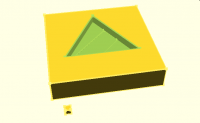
NH
nop head
Sun, Jan 6, 2019 6:32 PM
Actually no, there aren't any degenerate or nearly degenerate triangles
after Polyset::quantize(). I was missing a minus sign.
The 28 polygon Polyset that is the last to be quantized is actually the
inner render(). It is a negative volume that looks like this:
[image: image.png]
I wonder why the top level render doesn't get quantized. Perhaps CGAL fails
before.
On Sun, 6 Jan 2019 at 17:24, nop head nop.head@gmail.com wrote:
I can get the error with 3 vertices which reduces the number of polygons
to 24 and look like this:
[image: image.png]
Now with this no vertices get merged but it still fails with:
ERROR: CGAL error in CGAL_Nef_polyhedron3(): CGAL ERROR: assertion
violation! Expr: pe_prev->is_border() ||
!internal::Plane_constructor<Plane>::get_plane(pe_prev->facet(),pe_prev->facet()->plane()).is_degenerate()
File: C:/msys64/mingw64/include/CGAL/Nef_3/polyhedron_3_to_nef_3.h Line: 251
I notice in the above data there are triangles that are degenerate when
printed as floats. They don't snap to the same indexes though, so perhaps
that is the problem. Not enough points get collapsed. In an attempt to
investigate this I made the grid 32 times larger. The number of polygons
went up to 32 before quantisation and then reduced to 28 due to some
merging but still give the error. And there are still degenerate looking
triangles that don't get snapped.
How can a courser grid lead to more polygons?
Is CGAL's idea of degenerate not absolute? I.e. does a very thin triangle
count as de-generate?
On Sun, 6 Jan 2019 at 12:43, nop head nop.head@gmail.com wrote:
I added some debug to Polyset and simplified my model to be a stacked
pentagon subtracted from a cube to reduce the complexity of the polygons.
It now looks like this:
[image: image.png]
It looks like during F6 the union is never converted to a Polyset, so
there are no near vertices to collapse. F5 converts the union to a Polyset
before feeding it to CGAL and that is were it goes wrong as there are close
vertices in the same Polyset and they do collapse. Here is the Polyset
before, during and after being quantized.
polyset: PolySet:
num polygons: 44
polygon 0: ( -5 -3.63271 2) (-1.29953 -4.83507 2.25) ( -5 -3.63271 2.25)
polygon 1: (-1.29953 -4.83507 2.25) ( -5 -3.63271 2) (-1.29953 -4.83507 2)
polygon 2: (2.09182 5.62736 2.25) (4.83195 1.8559 2) (2.09182 5.62736
1.75)
polygon 3: (5.06738 1.53185 2.25) (4.83195 1.8559 2) (2.09182 5.62736
2.25)
polygon 4: (4.83195 1.8559 2) (5.06738 1.53185 2.25) (5.06738 1.53185 2)
polygon 5: (2.09182 5.62736 1.75) (4.83195 1.8559 2) (4.83195 1.8559 1.75)
polygon 6: ( -5 -3.63271 2) ( -5 -1.46447 2.25) ( -5 -1.46447 2)
polygon 7: ( -5 -1.46447 2.25) ( -5 -3.63271 2) ( -5 -3.63271 2.25)
polygon 8: ( -5 -1.46447 2.25) (5.06738 1.53185 2.25) (2.09182 5.62736
2.25)
polygon 9: (5.06738 1.53185 2.25) ( -5 -1.46447 2.25) (-1.29953 -4.83507
2.25)
polygon 10: (-1.29953 -4.83507 2.25) ( -5 -1.46447 2.25) ( -5 -3.63271
2.25)
polygon 11: ( -5 -1.46447 2) (2.09182 5.62736 2.25) (2.09182 5.62736 2)
polygon 12: (2.09182 5.62736 2.25) ( -5 -1.46447 2) ( -5 -1.46447 2.25)
polygon 13: (2.09182 5.62736 1.75) (2.09182 5.62736 1.75) (2.09182
5.62736 2)
polygon 14: (2.09182 5.62736 2) (2.09182 5.62736 2.25) (2.09182 5.62736
1.75)
polygon 15: (4.83195 1.8559 1.75) (2.09182 5.62736 1.75) (2.09182 5.62736
1.75)
polygon 16: (-1.29953 -4.83507 2) (5.06738 1.53185 2.25) (-1.29953
-4.83507 2.25)
polygon 17: (5.06738 1.53185 2.25) (-1.29953 -4.83507 2) (5.06738 1.53185
2)
polygon 18: ( -5 -3.63271 -0.0078125) ( 1.90983 -5.87785 2) ( -5 -3.63271
2)
polygon 19: ( 1.90983 -5.87785 2) ( -5 -3.63271 -0.0078125) ( 1.90983
-5.87785 -0.0078125)
polygon 20: ( 1.90983 -5.87785 2) ( 6.18034 0 -0.0078125) (6.18034 0 2)
polygon 21: ( 6.18034 0 -0.0078125) ( 1.90983 -5.87785 2) ( 1.90983
-5.87785 -0.0078125)
polygon 22: ( 1.90983 5.87785 -0.0078125) ( -5 3.63271 2) (1.90983
5.87785 2)
polygon 23: ( -5 3.63271 2) ( 1.90983 5.87785 -0.0078125) ( -5 3.63271
-0.0078125)
polygon 24: ( -5 -3.63271 -0.0078125) ( -5 3.63271 2) ( -5 3.63271
-0.0078125)
polygon 25: ( -5 3.63271 2) ( -5 -3.63271 -0.0078125) ( -5 -3.63271 2)
polygon 26: ( -5 3.63271 2) (2.09182 5.62736 2) (1.90983 5.87785 2)
polygon 27: ( -5 -3.63271 2) ( -5 -1.46447 2) ( -5 3.63271 2)
polygon 28: (2.09182 5.62736 2) ( -5 3.63271 2) ( -5 -1.46447 2)
polygon 29: (6.18034 0 2) (4.83195 1.8559 2) (5.06738 1.53185 2)
polygon 30: (5.06738 1.53185 2) ( 1.90983 -5.87785 2) (6.18034 0 2)
polygon 31: (-1.29953 -4.83507 2) ( 1.90983 -5.87785 2) (5.06738 1.53185
2)
polygon 32: ( -5 -3.63271 2) (-1.29953 -4.83507 2) ( -5 -3.63271 2)
polygon 33: (-1.29953 -4.83507 2) ( -5 -3.63271 2) ( 1.90983 -5.87785 2)
polygon 34: ( -5 -1.46447 2) ( -5 -3.63271 2) ( -5 -3.63271 2)
polygon 35: ( 1.90983 -5.87785 -0.0078125) ( 1.90983 5.87785 -0.0078125)
( 6.18034 0 -0.0078125)
polygon 36: ( -5 -3.63271 -0.0078125) ( 1.90983 5.87785 -0.0078125) (
1.90983 -5.87785 -0.0078125)
polygon 37: ( 1.90983 5.87785 -0.0078125) ( -5 -3.63271 -0.0078125) ( -5
3.63271 -0.0078125)
polygon 38: (4.83195 1.8559 2) (6.18034 0 2) (4.83195 1.8559 1.75)
polygon 39: (2.09182 5.62736 1.75) (1.90983 5.87785 2) (2.09182 5.62736 2)
polygon 40: (1.90983 5.87785 2) (2.09182 5.62736 1.75) ( 1.90983 5.87785
-0.0078125)
polygon 41: (4.83195 1.8559 1.75) ( 1.90983 5.87785 -0.0078125) (2.09182
5.62736 1.75)
polygon 42: ( 6.18034 0 -0.0078125) (4.83195 1.8559 1.75) (6.18034 0 2)
polygon 43: (4.83195 1.8559 1.75) ( 6.18034 0 -0.0078125) ( 1.90983
5.87785 -0.0078125)
PolySet end
Collapsed (2.091824,5.627358,1.750000) by (2.38419e-007,0,0)
polyset: Removing collapsed vertex 0 out of 3 from polygon 13 due to
quantizing
polyset: Removing collapsed polygon 13 due to quantizing
Collapsed (2.091824,5.627358,1.750000) by (2.38419e-007,0,0)
polyset: Removing collapsed vertex 1 out of 3 from polygon 15 due to
quantizing
polyset: Removing collapsed polygon 15 due to quantizing
Collapsed (-5.000000,-3.632712,2.000000) by (4.76837e-007,0,0)
Collapsed (-5.000000,-3.632712,2.000000) by (4.76837e-007,0,0)
Collapsed (-5.000000,-3.632712,2.000000) by (4.76837e-007,0,0)
Collapsed (-5.000000,-3.632712,2.000000) by (4.76837e-007,0,0)
polyset: Removing collapsed vertex 2 out of 3 from polygon 32 due to
quantizing
polyset: Removing collapsed polygon 32 due to quantizing
Collapsed (-5.000000,-3.632712,2.000000) by (4.76837e-007,0,0)
Collapsed (-5.000000,-3.632712,2.000000) by (4.76837e-007,0,0)
polyset: Removing collapsed vertex 1 out of 3 from polygon 34 due to
quantizing
polyset: Removing collapsed polygon 34 due to quantizing
Collapsed (2.091824,5.627358,1.750000) by (2.38419e-007,0,0)
Collapsed (2.091824,5.627358,1.750000) by (2.38419e-007,0,0)
Collapsed (2.091824,5.627358,1.750000) by (2.38419e-007,0,0)
polyset: PolySet:
num polygons: 40
polygon 0: ( -5 -3.63271 2) (-1.29953 -4.83507 2.25) ( -5 -3.63271 2.25)
polygon 1: (-1.29953 -4.83507 2.25) ( -5 -3.63271 2) (-1.29953 -4.83507 2)
polygon 2: (2.09182 5.62736 2.25) (4.83195 1.8559 2) (2.09182 5.62736
1.75)
polygon 3: (5.06738 1.53185 2.25) (4.83195 1.8559 2) (2.09182 5.62736
2.25)
polygon 4: (4.83195 1.8559 2) (5.06738 1.53185 2.25) (5.06738 1.53185 2)
polygon 5: (2.09182 5.62736 1.75) (4.83195 1.8559 2) (4.83195 1.8559 1.75)
polygon 6: ( -5 -3.63271 2) ( -5 -1.46447 2.25) ( -5 -1.46447 2)
polygon 7: ( -5 -1.46447 2.25) ( -5 -3.63271 2) ( -5 -3.63271 2.25)
polygon 8: ( -5 -1.46447 2.25) (5.06738 1.53185 2.25) (2.09182 5.62736
2.25)
polygon 9: (5.06738 1.53185 2.25) ( -5 -1.46447 2.25) (-1.29953 -4.83507
2.25)
polygon 10: (-1.29953 -4.83507 2.25) ( -5 -1.46447 2.25) ( -5 -3.63271
2.25)
polygon 11: ( -5 -1.46447 2) (2.09182 5.62736 2.25) (2.09182 5.62736 2)
polygon 12: (2.09182 5.62736 2.25) ( -5 -1.46447 2) ( -5 -1.46447 2.25)
polygon 13: (2.09182 5.62736 2) (2.09182 5.62736 2.25) (2.09182 5.62736
1.75)
polygon 14: (-1.29953 -4.83507 2) (5.06738 1.53185 2.25) (-1.29953
-4.83507 2.25)
polygon 15: (5.06738 1.53185 2.25) (-1.29953 -4.83507 2) (5.06738 1.53185
2)
polygon 16: ( -5 -3.63271 -0.0078125) ( 1.90983 -5.87785 2) ( -5 -3.63271
2)
polygon 17: ( 1.90983 -5.87785 2) ( -5 -3.63271 -0.0078125) ( 1.90983
-5.87785 -0.0078125)
polygon 18: ( 1.90983 -5.87785 2) ( 6.18034 0 -0.0078125) (6.18034 0 2)
polygon 19: ( 6.18034 0 -0.0078125) ( 1.90983 -5.87785 2) ( 1.90983
-5.87785 -0.0078125)
polygon 20: ( 1.90983 5.87785 -0.0078125) ( -5 3.63271 2) (1.90983
5.87785 2)
polygon 21: ( -5 3.63271 2) ( 1.90983 5.87785 -0.0078125) ( -5 3.63271
-0.0078125)
polygon 22: ( -5 -3.63271 -0.0078125) ( -5 3.63271 2) ( -5 3.63271
-0.0078125)
polygon 23: ( -5 3.63271 2) ( -5 -3.63271 -0.0078125) ( -5 -3.63271 2)
polygon 24: ( -5 3.63271 2) (2.09182 5.62736 2) (1.90983 5.87785 2)
polygon 25: ( -5 -3.63271 2) ( -5 -1.46447 2) ( -5 3.63271 2)
polygon 26: (2.09182 5.62736 2) ( -5 3.63271 2) ( -5 -1.46447 2)
polygon 27: (6.18034 0 2) (4.83195 1.8559 2) (5.06738 1.53185 2)
polygon 28: (5.06738 1.53185 2) ( 1.90983 -5.87785 2) (6.18034 0 2)
polygon 29: (-1.29953 -4.83507 2) ( 1.90983 -5.87785 2) (5.06738 1.53185
2)
polygon 30: (-1.29953 -4.83507 2) ( -5 -3.63271 2) ( 1.90983 -5.87785 2)
polygon 31: ( 1.90983 -5.87785 -0.0078125) ( 1.90983 5.87785 -0.0078125)
( 6.18034 0 -0.0078125)
polygon 32: ( -5 -3.63271 -0.0078125) ( 1.90983 5.87785 -0.0078125) (
1.90983 -5.87785 -0.0078125)
polygon 33: ( 1.90983 5.87785 -0.0078125) ( -5 -3.63271 -0.0078125) ( -5
3.63271 -0.0078125)
polygon 34: (4.83195 1.8559 2) (6.18034 0 2) (4.83195 1.8559 1.75)
polygon 35: (2.09182 5.62736 1.75) (1.90983 5.87785 2) (2.09182 5.62736 2)
polygon 36: (1.90983 5.87785 2) (2.09182 5.62736 1.75) ( 1.90983 5.87785
-0.0078125)
polygon 37: (4.83195 1.8559 1.75) ( 1.90983 5.87785 -0.0078125) (2.09182
5.62736 1.75)
polygon 38: ( 6.18034 0 -0.0078125) (4.83195 1.8559 1.75) (6.18034 0 2)
polygon 39: (4.83195 1.8559 1.75) ( 6.18034 0 -0.0078125) ( 1.90983
5.87785 -0.0078125)
PolySet end
ERROR: CGAL error in CGAL_Nef_polyhedron3(): CGAL ERROR: assertion
violation! Expr: pe_prev->is_border() ||
!internal::Plane_constructor<Plane>::get_plane(pe_prev->facet(),pe_prev->facet()->plane()).is_degenerate()
File: C:/msys64/mingw64/include/CGAL/Nef_3/polyhedron_3_to_nef_3.h Line: 251
On Sun, 6 Jan 2019 at 10:20, nop head nop.head@gmail.com wrote:
The sqrt is pointless as it only needs to know the nearest, so could
compare the squared value. Also the 27 distances are constants, either 0,
1, sqrt(2) or sqrt(3). The 2D version uses the Manhattan distance, which I
think is just as good for +/-1 but abs() might take longer than integer
multiply.
Wouldn't it be roughly the same to make the grid spacing three times
bigger?
I had actually removed the neighbour search when I posted the offsets
above. With that code back in more vertices collapse.
Collapsed (2.164763,4.740169,1.750000) by (2.38419e-007,0,0)
Collapsed (-3.412535,-3.938275,1.750000) by
(-1.19209e-006,2.38419e-007,0)
Collapsed (-3.412535,-3.938275,1.750000) by
(-1.19209e-006,2.38419e-007,0)
Collapsed (4.383843,2.817325,1.750000) by (0,7.15256e-007,0)
Collapsed (4.383843,2.817325,1.750000) by (0,7.15256e-007,0)
Collapsed (4.383843,2.817325,1.750000) by (0,7.15256e-007,0)
Collapsed (2.164763,4.740169,1.750000) by (2.38419e-007,0,0)
Collapsed (4.383843,2.817325,1.750000) by (0,7.15256e-007,0)
Collapsed (2.164763,4.740169,1.750000) by (2.38419e-007,0,0)
Collapsed (2.164763,4.740169,1.750000) by (2.38419e-007,0,0)
Collapsed (2.164762,4.740170,2.000000) by (4.76837e-007,-4.76837e-007,0)
Collapsed (2.164763,4.740169,1.750000) by (2.38419e-007,0,0)
Collapsed (2.164762,4.740170,2.000000) by (4.76837e-007,-4.76837e-007,0)
Collapsed (2.164763,4.740169,1.750000) by (2.38419e-007,0,0)
Collapsed (-5.000000,-1.468132,2.000000) by
(4.76837e-007,-4.76837e-007,0)
Collapsed (4.383843,2.817325,1.750000) by (0,7.15256e-007,0)
Collapsed (2.164762,4.740170,2.000000) by (4.76837e-007,-4.76837e-007,0)
Collapsed (-5.000000,-1.468132,2.000000) by
(4.76837e-007,-4.76837e-007,0)
Collapsed (-3.412535,-3.938275,1.750000) by
(-1.19209e-006,2.38419e-007,0)
Collapsed (-5.000000,-1.468132,2.000000) by
(4.76837e-007,-4.76837e-007,0)
Collapsed (-3.412535,-3.938275,1.750000) by
(-1.19209e-006,2.38419e-007,0)
Collapsed (2.164762,4.740170,2.000000) by (4.76837e-007,-4.76837e-007,0)
Collapsed (2.164762,4.740170,2.000000) by (4.76837e-007,-4.76837e-007,0)
Collapsed (-5.000000,-1.468132,2.000000) by
(4.76837e-007,-4.76837e-007,0)
Collapsed (-5.000000,-1.468132,2.000000) by
(4.76837e-007,-4.76837e-007,0)
Collapsed (-5.000000,-1.468132,2.000000) by
(4.76837e-007,-4.76837e-007,0)
But the results are the same. Curiously if the number of sides is even
F5 works but F6 fails unless the cache is flushed. When it is odd the CGAL
error happens in F5.
It seems that Polyset is only that, a set of polygons, which are lists
of vertices, no edge information. So I think collapsing vertices should be
OK in that format as the edges are implied. That would be as long as all
the faces have exactly the right vertex values, so that each copy of the
vertex in different polygons ends up snapped to the same value. After
snapping it removes duplicate triangles and degenerate triangles here:
https://github.com/openscad/openscad/blob/master/src/polyset.cc#L220.
So there seems to definitely be a bug when it collapses vertices but I
no longer think it is fundamentally wrong to do it while in PolySet format.
It would be for a mesh with edges.
On Sun, 6 Jan 2019 at 03:28, MichaelAtOz oz.at.michael@gmail.com
wrote:
It appears that the grid-ness is intended to keep Rationals 'compact'
to
speed CGAL processing.
No, that was just a refinement, changing from the arbitrary 0.000001,
for
efficiency.
There is also code in grid.h that searches 27 neighbouring grid
picks the nearest one that is populated. I.e. deliberately merging
vertices that would otherwise be one grid position apart. Why?
I don't think it is that simple, I haven't fully grasped what it is up
to.
'nearest one' - It is taking the Euclidean norm, of the grid points.
I've seen this somewhere recently, I think reading on topology repair.
I'm wondering if the implementation is wrong.
Should it not look for the closest point on the 3x3 grid based on
non-quantised values, ie float vector.
As is d = sqrt((key-k).squaredNorm()) - key & k have both been
quantised.
Otherwise the +/-1 grid space Euclidean distance seems sort of
pointless (no
pun intended).
So where are all the Topologists? What is it mean to do to refine the
topology into a grid?
Admin - email* me if you need anything, or if I've done something
stupid...
- click on my MichaelAtOz label, there is a link to email me.
Unless specifically shown otherwise above, my contribution is in the
Public Domain; to the extent possible under law, I have waived all
copyright and related or neighbouring rights to this work. Obviously
inclusion of works of previous authors is not included in the above.
The TPP is no simple “trade agreement.” Fight it!
http://www.ourfairdeal.org/ time is running out!
Sent from: http://forum.openscad.org/
OpenSCAD mailing list
Discuss@lists.openscad.org
http://lists.openscad.org/mailman/listinfo/discuss_lists.openscad.org
Actually no, there aren't any degenerate or nearly degenerate triangles
after Polyset::quantize(). I was missing a minus sign.
The 28 polygon Polyset that is the last to be quantized is actually the
inner render(). It is a negative volume that looks like this:
[image: image.png]
I wonder why the top level render doesn't get quantized. Perhaps CGAL fails
before.
On Sun, 6 Jan 2019 at 17:24, nop head <nop.head@gmail.com> wrote:
> I can get the error with 3 vertices which reduces the number of polygons
> to 24 and look like this:
>
> [image: image.png]
>
> Now with this no vertices get merged but it still fails with:
>
> ERROR: CGAL error in CGAL_Nef_polyhedron3(): CGAL ERROR: assertion
> violation! Expr: pe_prev->is_border() ||
> !internal::Plane_constructor<Plane>::get_plane(pe_prev->facet(),pe_prev->facet()->plane()).is_degenerate()
> File: C:/msys64/mingw64/include/CGAL/Nef_3/polyhedron_3_to_nef_3.h Line: 251
>
>
> I notice in the above data there are triangles that are degenerate when
> printed as floats. They don't snap to the same indexes though, so perhaps
> that is the problem. Not enough points get collapsed. In an attempt to
> investigate this I made the grid 32 times larger. The number of polygons
> went up to 32 before quantisation and then reduced to 28 due to some
> merging but still give the error. And there are still degenerate looking
> triangles that don't get snapped.
>
>
> How can a courser grid lead to more polygons?
>
>
> Is CGAL's idea of degenerate not absolute? I.e. does a very thin triangle
> count as de-generate?
>
>
>
>
> On Sun, 6 Jan 2019 at 12:43, nop head <nop.head@gmail.com> wrote:
>
>> I added some debug to Polyset and simplified my model to be a stacked
>> pentagon subtracted from a cube to reduce the complexity of the polygons.
>> It now looks like this:
>>
>> [image: image.png]
>>
>> It looks like during F6 the union is never converted to a Polyset, so
>> there are no near vertices to collapse. F5 converts the union to a Polyset
>> before feeding it to CGAL and that is were it goes wrong as there are close
>> vertices in the same Polyset and they do collapse. Here is the Polyset
>> before, during and after being quantized.
>>
>> polyset: PolySet:
>> num polygons: 44
>> polygon 0: ( -5 -3.63271 2) (-1.29953 -4.83507 2.25) ( -5 -3.63271 2.25)
>> polygon 1: (-1.29953 -4.83507 2.25) ( -5 -3.63271 2) (-1.29953 -4.83507 2)
>> polygon 2: (2.09182 5.62736 2.25) (4.83195 1.8559 2) (2.09182 5.62736
>> 1.75)
>> polygon 3: (5.06738 1.53185 2.25) (4.83195 1.8559 2) (2.09182 5.62736
>> 2.25)
>> polygon 4: (4.83195 1.8559 2) (5.06738 1.53185 2.25) (5.06738 1.53185 2)
>> polygon 5: (2.09182 5.62736 1.75) (4.83195 1.8559 2) (4.83195 1.8559 1.75)
>> polygon 6: ( -5 -3.63271 2) ( -5 -1.46447 2.25) ( -5 -1.46447 2)
>> polygon 7: ( -5 -1.46447 2.25) ( -5 -3.63271 2) ( -5 -3.63271 2.25)
>> polygon 8: ( -5 -1.46447 2.25) (5.06738 1.53185 2.25) (2.09182 5.62736
>> 2.25)
>> polygon 9: (5.06738 1.53185 2.25) ( -5 -1.46447 2.25) (-1.29953 -4.83507
>> 2.25)
>> polygon 10: (-1.29953 -4.83507 2.25) ( -5 -1.46447 2.25) ( -5 -3.63271
>> 2.25)
>> polygon 11: ( -5 -1.46447 2) (2.09182 5.62736 2.25) (2.09182 5.62736 2)
>> polygon 12: (2.09182 5.62736 2.25) ( -5 -1.46447 2) ( -5 -1.46447 2.25)
>> polygon 13: (2.09182 5.62736 1.75) (2.09182 5.62736 1.75) (2.09182
>> 5.62736 2)
>> polygon 14: (2.09182 5.62736 2) (2.09182 5.62736 2.25) (2.09182 5.62736
>> 1.75)
>> polygon 15: (4.83195 1.8559 1.75) (2.09182 5.62736 1.75) (2.09182 5.62736
>> 1.75)
>> polygon 16: (-1.29953 -4.83507 2) (5.06738 1.53185 2.25) (-1.29953
>> -4.83507 2.25)
>> polygon 17: (5.06738 1.53185 2.25) (-1.29953 -4.83507 2) (5.06738 1.53185
>> 2)
>> polygon 18: ( -5 -3.63271 -0.0078125) ( 1.90983 -5.87785 2) ( -5 -3.63271
>> 2)
>> polygon 19: ( 1.90983 -5.87785 2) ( -5 -3.63271 -0.0078125) ( 1.90983
>> -5.87785 -0.0078125)
>> polygon 20: ( 1.90983 -5.87785 2) ( 6.18034 0 -0.0078125) (6.18034 0 2)
>> polygon 21: ( 6.18034 0 -0.0078125) ( 1.90983 -5.87785 2) ( 1.90983
>> -5.87785 -0.0078125)
>> polygon 22: ( 1.90983 5.87785 -0.0078125) ( -5 3.63271 2) (1.90983
>> 5.87785 2)
>> polygon 23: ( -5 3.63271 2) ( 1.90983 5.87785 -0.0078125) ( -5 3.63271
>> -0.0078125)
>> polygon 24: ( -5 -3.63271 -0.0078125) ( -5 3.63271 2) ( -5 3.63271
>> -0.0078125)
>> polygon 25: ( -5 3.63271 2) ( -5 -3.63271 -0.0078125) ( -5 -3.63271 2)
>> polygon 26: ( -5 3.63271 2) (2.09182 5.62736 2) (1.90983 5.87785 2)
>> polygon 27: ( -5 -3.63271 2) ( -5 -1.46447 2) ( -5 3.63271 2)
>> polygon 28: (2.09182 5.62736 2) ( -5 3.63271 2) ( -5 -1.46447 2)
>> polygon 29: (6.18034 0 2) (4.83195 1.8559 2) (5.06738 1.53185 2)
>> polygon 30: (5.06738 1.53185 2) ( 1.90983 -5.87785 2) (6.18034 0 2)
>> polygon 31: (-1.29953 -4.83507 2) ( 1.90983 -5.87785 2) (5.06738 1.53185
>> 2)
>> polygon 32: ( -5 -3.63271 2) (-1.29953 -4.83507 2) ( -5 -3.63271 2)
>> polygon 33: (-1.29953 -4.83507 2) ( -5 -3.63271 2) ( 1.90983 -5.87785 2)
>> polygon 34: ( -5 -1.46447 2) ( -5 -3.63271 2) ( -5 -3.63271 2)
>> polygon 35: ( 1.90983 -5.87785 -0.0078125) ( 1.90983 5.87785 -0.0078125)
>> ( 6.18034 0 -0.0078125)
>> polygon 36: ( -5 -3.63271 -0.0078125) ( 1.90983 5.87785 -0.0078125) (
>> 1.90983 -5.87785 -0.0078125)
>> polygon 37: ( 1.90983 5.87785 -0.0078125) ( -5 -3.63271 -0.0078125) ( -5
>> 3.63271 -0.0078125)
>> polygon 38: (4.83195 1.8559 2) (6.18034 0 2) (4.83195 1.8559 1.75)
>> polygon 39: (2.09182 5.62736 1.75) (1.90983 5.87785 2) (2.09182 5.62736 2)
>> polygon 40: (1.90983 5.87785 2) (2.09182 5.62736 1.75) ( 1.90983 5.87785
>> -0.0078125)
>> polygon 41: (4.83195 1.8559 1.75) ( 1.90983 5.87785 -0.0078125) (2.09182
>> 5.62736 1.75)
>> polygon 42: ( 6.18034 0 -0.0078125) (4.83195 1.8559 1.75) (6.18034 0 2)
>> polygon 43: (4.83195 1.8559 1.75) ( 6.18034 0 -0.0078125) ( 1.90983
>> 5.87785 -0.0078125)
>> PolySet end
>>
>> Collapsed (2.091824,5.627358,1.750000) by (2.38419e-007,0,0)
>> polyset: Removing collapsed vertex 0 out of 3 from polygon 13 due to
>> quantizing
>> polyset: Removing collapsed polygon 13 due to quantizing
>> Collapsed (2.091824,5.627358,1.750000) by (2.38419e-007,0,0)
>> polyset: Removing collapsed vertex 1 out of 3 from polygon 15 due to
>> quantizing
>> polyset: Removing collapsed polygon 15 due to quantizing
>> Collapsed (-5.000000,-3.632712,2.000000) by (4.76837e-007,0,0)
>> Collapsed (-5.000000,-3.632712,2.000000) by (4.76837e-007,0,0)
>> Collapsed (-5.000000,-3.632712,2.000000) by (4.76837e-007,0,0)
>> Collapsed (-5.000000,-3.632712,2.000000) by (4.76837e-007,0,0)
>> polyset: Removing collapsed vertex 2 out of 3 from polygon 32 due to
>> quantizing
>> polyset: Removing collapsed polygon 32 due to quantizing
>> Collapsed (-5.000000,-3.632712,2.000000) by (4.76837e-007,0,0)
>> Collapsed (-5.000000,-3.632712,2.000000) by (4.76837e-007,0,0)
>> polyset: Removing collapsed vertex 1 out of 3 from polygon 34 due to
>> quantizing
>> polyset: Removing collapsed polygon 34 due to quantizing
>> Collapsed (2.091824,5.627358,1.750000) by (2.38419e-007,0,0)
>> Collapsed (2.091824,5.627358,1.750000) by (2.38419e-007,0,0)
>> Collapsed (2.091824,5.627358,1.750000) by (2.38419e-007,0,0)
>>
>> polyset: PolySet:
>> num polygons: 40
>> polygon 0: ( -5 -3.63271 2) (-1.29953 -4.83507 2.25) ( -5 -3.63271 2.25)
>> polygon 1: (-1.29953 -4.83507 2.25) ( -5 -3.63271 2) (-1.29953 -4.83507 2)
>> polygon 2: (2.09182 5.62736 2.25) (4.83195 1.8559 2) (2.09182 5.62736
>> 1.75)
>> polygon 3: (5.06738 1.53185 2.25) (4.83195 1.8559 2) (2.09182 5.62736
>> 2.25)
>> polygon 4: (4.83195 1.8559 2) (5.06738 1.53185 2.25) (5.06738 1.53185 2)
>> polygon 5: (2.09182 5.62736 1.75) (4.83195 1.8559 2) (4.83195 1.8559 1.75)
>> polygon 6: ( -5 -3.63271 2) ( -5 -1.46447 2.25) ( -5 -1.46447 2)
>> polygon 7: ( -5 -1.46447 2.25) ( -5 -3.63271 2) ( -5 -3.63271 2.25)
>> polygon 8: ( -5 -1.46447 2.25) (5.06738 1.53185 2.25) (2.09182 5.62736
>> 2.25)
>> polygon 9: (5.06738 1.53185 2.25) ( -5 -1.46447 2.25) (-1.29953 -4.83507
>> 2.25)
>> polygon 10: (-1.29953 -4.83507 2.25) ( -5 -1.46447 2.25) ( -5 -3.63271
>> 2.25)
>> polygon 11: ( -5 -1.46447 2) (2.09182 5.62736 2.25) (2.09182 5.62736 2)
>> polygon 12: (2.09182 5.62736 2.25) ( -5 -1.46447 2) ( -5 -1.46447 2.25)
>> polygon 13: (2.09182 5.62736 2) (2.09182 5.62736 2.25) (2.09182 5.62736
>> 1.75)
>> polygon 14: (-1.29953 -4.83507 2) (5.06738 1.53185 2.25) (-1.29953
>> -4.83507 2.25)
>> polygon 15: (5.06738 1.53185 2.25) (-1.29953 -4.83507 2) (5.06738 1.53185
>> 2)
>> polygon 16: ( -5 -3.63271 -0.0078125) ( 1.90983 -5.87785 2) ( -5 -3.63271
>> 2)
>> polygon 17: ( 1.90983 -5.87785 2) ( -5 -3.63271 -0.0078125) ( 1.90983
>> -5.87785 -0.0078125)
>> polygon 18: ( 1.90983 -5.87785 2) ( 6.18034 0 -0.0078125) (6.18034 0 2)
>> polygon 19: ( 6.18034 0 -0.0078125) ( 1.90983 -5.87785 2) ( 1.90983
>> -5.87785 -0.0078125)
>> polygon 20: ( 1.90983 5.87785 -0.0078125) ( -5 3.63271 2) (1.90983
>> 5.87785 2)
>> polygon 21: ( -5 3.63271 2) ( 1.90983 5.87785 -0.0078125) ( -5 3.63271
>> -0.0078125)
>> polygon 22: ( -5 -3.63271 -0.0078125) ( -5 3.63271 2) ( -5 3.63271
>> -0.0078125)
>> polygon 23: ( -5 3.63271 2) ( -5 -3.63271 -0.0078125) ( -5 -3.63271 2)
>> polygon 24: ( -5 3.63271 2) (2.09182 5.62736 2) (1.90983 5.87785 2)
>> polygon 25: ( -5 -3.63271 2) ( -5 -1.46447 2) ( -5 3.63271 2)
>> polygon 26: (2.09182 5.62736 2) ( -5 3.63271 2) ( -5 -1.46447 2)
>> polygon 27: (6.18034 0 2) (4.83195 1.8559 2) (5.06738 1.53185 2)
>> polygon 28: (5.06738 1.53185 2) ( 1.90983 -5.87785 2) (6.18034 0 2)
>> polygon 29: (-1.29953 -4.83507 2) ( 1.90983 -5.87785 2) (5.06738 1.53185
>> 2)
>> polygon 30: (-1.29953 -4.83507 2) ( -5 -3.63271 2) ( 1.90983 -5.87785 2)
>> polygon 31: ( 1.90983 -5.87785 -0.0078125) ( 1.90983 5.87785 -0.0078125)
>> ( 6.18034 0 -0.0078125)
>> polygon 32: ( -5 -3.63271 -0.0078125) ( 1.90983 5.87785 -0.0078125) (
>> 1.90983 -5.87785 -0.0078125)
>> polygon 33: ( 1.90983 5.87785 -0.0078125) ( -5 -3.63271 -0.0078125) ( -5
>> 3.63271 -0.0078125)
>> polygon 34: (4.83195 1.8559 2) (6.18034 0 2) (4.83195 1.8559 1.75)
>> polygon 35: (2.09182 5.62736 1.75) (1.90983 5.87785 2) (2.09182 5.62736 2)
>> polygon 36: (1.90983 5.87785 2) (2.09182 5.62736 1.75) ( 1.90983 5.87785
>> -0.0078125)
>> polygon 37: (4.83195 1.8559 1.75) ( 1.90983 5.87785 -0.0078125) (2.09182
>> 5.62736 1.75)
>> polygon 38: ( 6.18034 0 -0.0078125) (4.83195 1.8559 1.75) (6.18034 0 2)
>> polygon 39: (4.83195 1.8559 1.75) ( 6.18034 0 -0.0078125) ( 1.90983
>> 5.87785 -0.0078125)
>> PolySet end
>> ERROR: CGAL error in CGAL_Nef_polyhedron3(): CGAL ERROR: assertion
>> violation! Expr: pe_prev->is_border() ||
>> !internal::Plane_constructor<Plane>::get_plane(pe_prev->facet(),pe_prev->facet()->plane()).is_degenerate()
>> File: C:/msys64/mingw64/include/CGAL/Nef_3/polyhedron_3_to_nef_3.h Line: 251
>>
>>
>>
>>
>> On Sun, 6 Jan 2019 at 10:20, nop head <nop.head@gmail.com> wrote:
>>
>>> The sqrt is pointless as it only needs to know the nearest, so could
>>> compare the squared value. Also the 27 distances are constants, either 0,
>>> 1, sqrt(2) or sqrt(3). The 2D version uses the Manhattan distance, which I
>>> think is just as good for +/-1 but abs() might take longer than integer
>>> multiply.
>>>
>>> Wouldn't it be roughly the same to make the grid spacing three times
>>> bigger?
>>>
>>> I had actually removed the neighbour search when I posted the offsets
>>> above. With that code back in more vertices collapse.
>>>
>>> Collapsed (2.164763,4.740169,1.750000) by (2.38419e-007,0,0)
>>>
>>> Collapsed (-3.412535,-3.938275,1.750000) by
>>> (-1.19209e-006,2.38419e-007,0)
>>>
>>> Collapsed (-3.412535,-3.938275,1.750000) by
>>> (-1.19209e-006,2.38419e-007,0)
>>>
>>> Collapsed (4.383843,2.817325,1.750000) by (0,7.15256e-007,0)
>>>
>>> Collapsed (4.383843,2.817325,1.750000) by (0,7.15256e-007,0)
>>>
>>> Collapsed (4.383843,2.817325,1.750000) by (0,7.15256e-007,0)
>>>
>>> Collapsed (2.164763,4.740169,1.750000) by (2.38419e-007,0,0)
>>>
>>> Collapsed (4.383843,2.817325,1.750000) by (0,7.15256e-007,0)
>>>
>>> Collapsed (2.164763,4.740169,1.750000) by (2.38419e-007,0,0)
>>>
>>> Collapsed (2.164763,4.740169,1.750000) by (2.38419e-007,0,0)
>>>
>>> Collapsed (2.164762,4.740170,2.000000) by (4.76837e-007,-4.76837e-007,0)
>>>
>>> Collapsed (2.164763,4.740169,1.750000) by (2.38419e-007,0,0)
>>>
>>> Collapsed (2.164762,4.740170,2.000000) by (4.76837e-007,-4.76837e-007,0)
>>>
>>> Collapsed (2.164763,4.740169,1.750000) by (2.38419e-007,0,0)
>>>
>>> Collapsed (-5.000000,-1.468132,2.000000) by
>>> (4.76837e-007,-4.76837e-007,0)
>>>
>>> Collapsed (4.383843,2.817325,1.750000) by (0,7.15256e-007,0)
>>>
>>> Collapsed (2.164762,4.740170,2.000000) by (4.76837e-007,-4.76837e-007,0)
>>>
>>> Collapsed (-5.000000,-1.468132,2.000000) by
>>> (4.76837e-007,-4.76837e-007,0)
>>>
>>> Collapsed (-3.412535,-3.938275,1.750000) by
>>> (-1.19209e-006,2.38419e-007,0)
>>>
>>> Collapsed (-5.000000,-1.468132,2.000000) by
>>> (4.76837e-007,-4.76837e-007,0)
>>>
>>> Collapsed (-3.412535,-3.938275,1.750000) by
>>> (-1.19209e-006,2.38419e-007,0)
>>>
>>> Collapsed (2.164762,4.740170,2.000000) by (4.76837e-007,-4.76837e-007,0)
>>>
>>> Collapsed (2.164762,4.740170,2.000000) by (4.76837e-007,-4.76837e-007,0)
>>>
>>> Collapsed (-5.000000,-1.468132,2.000000) by
>>> (4.76837e-007,-4.76837e-007,0)
>>>
>>> Collapsed (-5.000000,-1.468132,2.000000) by
>>> (4.76837e-007,-4.76837e-007,0)
>>>
>>> Collapsed (-5.000000,-1.468132,2.000000) by
>>> (4.76837e-007,-4.76837e-007,0)
>>>
>>>
>>> But the results are the same. Curiously if the number of sides is even
>>> F5 works but F6 fails unless the cache is flushed. When it is odd the CGAL
>>> error happens in F5.
>>>
>>>
>>> It seems that Polyset is only that, a set of polygons, which are lists
>>> of vertices, no edge information. So I think collapsing vertices should be
>>> OK in that format as the edges are implied. That would be as long as all
>>> the faces have exactly the right vertex values, so that each copy of the
>>> vertex in different polygons ends up snapped to the same value. After
>>> snapping it removes duplicate triangles and degenerate triangles here:
>>> https://github.com/openscad/openscad/blob/master/src/polyset.cc#L220.
>>>
>>> So there seems to definitely be a bug when it collapses vertices but I
>>> no longer think it is fundamentally wrong to do it while in PolySet format.
>>> It would be for a mesh with edges.
>>>
>>>
>>>
>>>
>>>
>>>
>>> On Sun, 6 Jan 2019 at 03:28, MichaelAtOz <oz.at.michael@gmail.com>
>>> wrote:
>>>
>>>> > It appears that the grid-ness is intended to keep Rationals 'compact'
>>>> to
>>>> speed CGAL processing.
>>>>
>>>> No, that was just a refinement, changing from the arbitrary 0.000001,
>>>> for
>>>> efficiency.
>>>>
>>>>
>>>> > There is also code in grid.h that searches 27 neighbouring grid
>>>> points and
>>>> > picks the nearest one that is populated. I.e. deliberately merging
>>>> > vertices that would otherwise be one grid position apart. Why?
>>>>
>>>> I don't think it is that simple, I haven't fully grasped what it is up
>>>> to.
>>>>
>>>> 'nearest one' - It is taking the Euclidean norm, of the grid points.
>>>> I've seen this somewhere recently, I think reading on topology repair.
>>>> I'm wondering if the implementation is wrong.
>>>> Should it not look for the closest point on the 3x3 grid based on
>>>> non-quantised values, ie float vector.
>>>> As is d = sqrt((key-k).squaredNorm()) - key & k have both been
>>>> quantised.
>>>> Otherwise the +/-1 grid space Euclidean distance seems sort of
>>>> pointless (no
>>>> pun intended).
>>>>
>>>> So where are all the Topologists? What is it mean to do to refine the
>>>> topology into a grid?
>>>>
>>>>
>>>>
>>>>
>>>>
>>>> -----
>>>> Admin - email* me if you need anything, or if I've done something
>>>> stupid...
>>>>
>>>> * click on my MichaelAtOz label, there is a link to email me.
>>>>
>>>> Unless specifically shown otherwise above, my contribution is in the
>>>> Public Domain; to the extent possible under law, I have waived all
>>>> copyright and related or neighbouring rights to this work. Obviously
>>>> inclusion of works of previous authors is not included in the above.
>>>>
>>>> The TPP is no simple “trade agreement.” Fight it!
>>>> http://www.ourfairdeal.org/ time is running out!
>>>> --
>>>> Sent from: http://forum.openscad.org/
>>>>
>>>> _______________________________________________
>>>> OpenSCAD mailing list
>>>> Discuss@lists.openscad.org
>>>> http://lists.openscad.org/mailman/listinfo/discuss_lists.openscad.org
>>>>
>>>
NH
nop head
Sun, Jan 6, 2019 8:25 PM
Actually there are degenerate triangles with zero area caused by quantising
the vertices of very thin ones. With a larger grid I can see this:
polygon 15: ( -5 -1.46447 2) (-5.00001 -1.46447 1.75) (-5.00001 -1.46447
2.25)
After quantization it becomes this:
polygon 11: ( -5 -1.46445 2) ( -5 -1.46445 1.75) ( -5 -1.46445 2.25)
So the bug is that quantisation can make very thin triangles into
degenerate triangles and these are not removed because they still have
three unique vertices. So we need mesh repair during quantization, even
though PolySet is not really a mesh format. It seems to be just a polygon
soup and they all seem to be triangles so it is just like STL but with
doubles instead of floats.
If this is fixed perhaps we could change grid to snap to values that are
distinguishable as ascii floats by using that as the key. Then STL export
would work I think.
On Sun, 6 Jan 2019 at 18:32, nop head nop.head@gmail.com wrote:
Actually no, there aren't any degenerate or nearly degenerate triangles
after Polyset::quantize(). I was missing a minus sign.
The 28 polygon Polyset that is the last to be quantized is actually the
inner render(). It is a negative volume that looks like this:
[image: image.png]
I wonder why the top level render doesn't get quantized. Perhaps CGAL
fails before.
On Sun, 6 Jan 2019 at 17:24, nop head nop.head@gmail.com wrote:
I can get the error with 3 vertices which reduces the number of polygons
to 24 and look like this:
[image: image.png]
Now with this no vertices get merged but it still fails with:
ERROR: CGAL error in CGAL_Nef_polyhedron3(): CGAL ERROR: assertion
violation! Expr: pe_prev->is_border() ||
!internal::Plane_constructor<Plane>::get_plane(pe_prev->facet(),pe_prev->facet()->plane()).is_degenerate()
File: C:/msys64/mingw64/include/CGAL/Nef_3/polyhedron_3_to_nef_3.h Line: 251
I notice in the above data there are triangles that are degenerate when
printed as floats. They don't snap to the same indexes though, so perhaps
that is the problem. Not enough points get collapsed. In an attempt to
investigate this I made the grid 32 times larger. The number of polygons
went up to 32 before quantisation and then reduced to 28 due to some
merging but still give the error. And there are still degenerate looking
triangles that don't get snapped.
How can a courser grid lead to more polygons?
Is CGAL's idea of degenerate not absolute? I.e. does a very thin triangle
count as de-generate?
On Sun, 6 Jan 2019 at 12:43, nop head nop.head@gmail.com wrote:
I added some debug to Polyset and simplified my model to be a stacked
pentagon subtracted from a cube to reduce the complexity of the polygons.
It now looks like this:
[image: image.png]
It looks like during F6 the union is never converted to a Polyset, so
there are no near vertices to collapse. F5 converts the union to a Polyset
before feeding it to CGAL and that is were it goes wrong as there are close
vertices in the same Polyset and they do collapse. Here is the Polyset
before, during and after being quantized.
polyset: PolySet:
num polygons: 44
polygon 0: ( -5 -3.63271 2) (-1.29953 -4.83507 2.25) ( -5 -3.63271 2.25)
polygon 1: (-1.29953 -4.83507 2.25) ( -5 -3.63271 2) (-1.29953 -4.83507
2)
polygon 2: (2.09182 5.62736 2.25) (4.83195 1.8559 2) (2.09182 5.62736
1.75)
polygon 3: (5.06738 1.53185 2.25) (4.83195 1.8559 2) (2.09182 5.62736
2.25)
polygon 4: (4.83195 1.8559 2) (5.06738 1.53185 2.25) (5.06738 1.53185 2)
polygon 5: (2.09182 5.62736 1.75) (4.83195 1.8559 2) (4.83195 1.8559
1.75)
polygon 6: ( -5 -3.63271 2) ( -5 -1.46447 2.25) ( -5 -1.46447 2)
polygon 7: ( -5 -1.46447 2.25) ( -5 -3.63271 2) ( -5 -3.63271 2.25)
polygon 8: ( -5 -1.46447 2.25) (5.06738 1.53185 2.25) (2.09182 5.62736
2.25)
polygon 9: (5.06738 1.53185 2.25) ( -5 -1.46447 2.25) (-1.29953 -4.83507
2.25)
polygon 10: (-1.29953 -4.83507 2.25) ( -5 -1.46447 2.25) ( -5 -3.63271
2.25)
polygon 11: ( -5 -1.46447 2) (2.09182 5.62736 2.25) (2.09182 5.62736 2)
polygon 12: (2.09182 5.62736 2.25) ( -5 -1.46447 2) ( -5 -1.46447 2.25)
polygon 13: (2.09182 5.62736 1.75) (2.09182 5.62736 1.75) (2.09182
5.62736 2)
polygon 14: (2.09182 5.62736 2) (2.09182 5.62736 2.25) (2.09182 5.62736
1.75)
polygon 15: (4.83195 1.8559 1.75) (2.09182 5.62736 1.75) (2.09182
5.62736 1.75)
polygon 16: (-1.29953 -4.83507 2) (5.06738 1.53185 2.25) (-1.29953
-4.83507 2.25)
polygon 17: (5.06738 1.53185 2.25) (-1.29953 -4.83507 2) (5.06738
1.53185 2)
polygon 18: ( -5 -3.63271 -0.0078125) ( 1.90983 -5.87785 2) ( -5
-3.63271 2)
polygon 19: ( 1.90983 -5.87785 2) ( -5 -3.63271 -0.0078125) ( 1.90983
-5.87785 -0.0078125)
polygon 20: ( 1.90983 -5.87785 2) ( 6.18034 0 -0.0078125) (6.18034 0 2)
polygon 21: ( 6.18034 0 -0.0078125) ( 1.90983 -5.87785 2) ( 1.90983
-5.87785 -0.0078125)
polygon 22: ( 1.90983 5.87785 -0.0078125) ( -5 3.63271 2) (1.90983
5.87785 2)
polygon 23: ( -5 3.63271 2) ( 1.90983 5.87785 -0.0078125) ( -5 3.63271
-0.0078125)
polygon 24: ( -5 -3.63271 -0.0078125) ( -5 3.63271 2) ( -5 3.63271
-0.0078125)
polygon 25: ( -5 3.63271 2) ( -5 -3.63271 -0.0078125) ( -5 -3.63271 2)
polygon 26: ( -5 3.63271 2) (2.09182 5.62736 2) (1.90983 5.87785 2)
polygon 27: ( -5 -3.63271 2) ( -5 -1.46447 2) ( -5 3.63271 2)
polygon 28: (2.09182 5.62736 2) ( -5 3.63271 2) ( -5 -1.46447 2)
polygon 29: (6.18034 0 2) (4.83195 1.8559 2) (5.06738 1.53185 2)
polygon 30: (5.06738 1.53185 2) ( 1.90983 -5.87785 2) (6.18034 0 2)
polygon 31: (-1.29953 -4.83507 2) ( 1.90983 -5.87785 2) (5.06738 1.53185
2)
polygon 32: ( -5 -3.63271 2) (-1.29953 -4.83507 2) ( -5 -3.63271 2)
polygon 33: (-1.29953 -4.83507 2) ( -5 -3.63271 2) ( 1.90983 -5.87785 2)
polygon 34: ( -5 -1.46447 2) ( -5 -3.63271 2) ( -5 -3.63271 2)
polygon 35: ( 1.90983 -5.87785 -0.0078125) ( 1.90983 5.87785 -0.0078125)
( 6.18034 0 -0.0078125)
polygon 36: ( -5 -3.63271 -0.0078125) ( 1.90983 5.87785 -0.0078125) (
1.90983 -5.87785 -0.0078125)
polygon 37: ( 1.90983 5.87785 -0.0078125) ( -5 -3.63271 -0.0078125) ( -5
3.63271 -0.0078125)
polygon 38: (4.83195 1.8559 2) (6.18034 0 2) (4.83195 1.8559 1.75)
polygon 39: (2.09182 5.62736 1.75) (1.90983 5.87785 2) (2.09182 5.62736
2)
polygon 40: (1.90983 5.87785 2) (2.09182 5.62736 1.75) ( 1.90983 5.87785
-0.0078125)
polygon 41: (4.83195 1.8559 1.75) ( 1.90983 5.87785 -0.0078125) (2.09182
5.62736 1.75)
polygon 42: ( 6.18034 0 -0.0078125) (4.83195 1.8559 1.75) (6.18034 0 2)
polygon 43: (4.83195 1.8559 1.75) ( 6.18034 0 -0.0078125) ( 1.90983
5.87785 -0.0078125)
PolySet end
Collapsed (2.091824,5.627358,1.750000) by (2.38419e-007,0,0)
polyset: Removing collapsed vertex 0 out of 3 from polygon 13 due to
quantizing
polyset: Removing collapsed polygon 13 due to quantizing
Collapsed (2.091824,5.627358,1.750000) by (2.38419e-007,0,0)
polyset: Removing collapsed vertex 1 out of 3 from polygon 15 due to
quantizing
polyset: Removing collapsed polygon 15 due to quantizing
Collapsed (-5.000000,-3.632712,2.000000) by (4.76837e-007,0,0)
Collapsed (-5.000000,-3.632712,2.000000) by (4.76837e-007,0,0)
Collapsed (-5.000000,-3.632712,2.000000) by (4.76837e-007,0,0)
Collapsed (-5.000000,-3.632712,2.000000) by (4.76837e-007,0,0)
polyset: Removing collapsed vertex 2 out of 3 from polygon 32 due to
quantizing
polyset: Removing collapsed polygon 32 due to quantizing
Collapsed (-5.000000,-3.632712,2.000000) by (4.76837e-007,0,0)
Collapsed (-5.000000,-3.632712,2.000000) by (4.76837e-007,0,0)
polyset: Removing collapsed vertex 1 out of 3 from polygon 34 due to
quantizing
polyset: Removing collapsed polygon 34 due to quantizing
Collapsed (2.091824,5.627358,1.750000) by (2.38419e-007,0,0)
Collapsed (2.091824,5.627358,1.750000) by (2.38419e-007,0,0)
Collapsed (2.091824,5.627358,1.750000) by (2.38419e-007,0,0)
polyset: PolySet:
num polygons: 40
polygon 0: ( -5 -3.63271 2) (-1.29953 -4.83507 2.25) ( -5 -3.63271 2.25)
polygon 1: (-1.29953 -4.83507 2.25) ( -5 -3.63271 2) (-1.29953 -4.83507
2)
polygon 2: (2.09182 5.62736 2.25) (4.83195 1.8559 2) (2.09182 5.62736
1.75)
polygon 3: (5.06738 1.53185 2.25) (4.83195 1.8559 2) (2.09182 5.62736
2.25)
polygon 4: (4.83195 1.8559 2) (5.06738 1.53185 2.25) (5.06738 1.53185 2)
polygon 5: (2.09182 5.62736 1.75) (4.83195 1.8559 2) (4.83195 1.8559
1.75)
polygon 6: ( -5 -3.63271 2) ( -5 -1.46447 2.25) ( -5 -1.46447 2)
polygon 7: ( -5 -1.46447 2.25) ( -5 -3.63271 2) ( -5 -3.63271 2.25)
polygon 8: ( -5 -1.46447 2.25) (5.06738 1.53185 2.25) (2.09182 5.62736
2.25)
polygon 9: (5.06738 1.53185 2.25) ( -5 -1.46447 2.25) (-1.29953 -4.83507
2.25)
polygon 10: (-1.29953 -4.83507 2.25) ( -5 -1.46447 2.25) ( -5 -3.63271
2.25)
polygon 11: ( -5 -1.46447 2) (2.09182 5.62736 2.25) (2.09182 5.62736 2)
polygon 12: (2.09182 5.62736 2.25) ( -5 -1.46447 2) ( -5 -1.46447 2.25)
polygon 13: (2.09182 5.62736 2) (2.09182 5.62736 2.25) (2.09182 5.62736
1.75)
polygon 14: (-1.29953 -4.83507 2) (5.06738 1.53185 2.25) (-1.29953
-4.83507 2.25)
polygon 15: (5.06738 1.53185 2.25) (-1.29953 -4.83507 2) (5.06738
1.53185 2)
polygon 16: ( -5 -3.63271 -0.0078125) ( 1.90983 -5.87785 2) ( -5
-3.63271 2)
polygon 17: ( 1.90983 -5.87785 2) ( -5 -3.63271 -0.0078125) ( 1.90983
-5.87785 -0.0078125)
polygon 18: ( 1.90983 -5.87785 2) ( 6.18034 0 -0.0078125) (6.18034 0 2)
polygon 19: ( 6.18034 0 -0.0078125) ( 1.90983 -5.87785 2) ( 1.90983
-5.87785 -0.0078125)
polygon 20: ( 1.90983 5.87785 -0.0078125) ( -5 3.63271 2) (1.90983
5.87785 2)
polygon 21: ( -5 3.63271 2) ( 1.90983 5.87785 -0.0078125) ( -5 3.63271
-0.0078125)
polygon 22: ( -5 -3.63271 -0.0078125) ( -5 3.63271 2) ( -5 3.63271
-0.0078125)
polygon 23: ( -5 3.63271 2) ( -5 -3.63271 -0.0078125) ( -5 -3.63271 2)
polygon 24: ( -5 3.63271 2) (2.09182 5.62736 2) (1.90983 5.87785 2)
polygon 25: ( -5 -3.63271 2) ( -5 -1.46447 2) ( -5 3.63271 2)
polygon 26: (2.09182 5.62736 2) ( -5 3.63271 2) ( -5 -1.46447 2)
polygon 27: (6.18034 0 2) (4.83195 1.8559 2) (5.06738 1.53185 2)
polygon 28: (5.06738 1.53185 2) ( 1.90983 -5.87785 2) (6.18034 0 2)
polygon 29: (-1.29953 -4.83507 2) ( 1.90983 -5.87785 2) (5.06738 1.53185
2)
polygon 30: (-1.29953 -4.83507 2) ( -5 -3.63271 2) ( 1.90983 -5.87785 2)
polygon 31: ( 1.90983 -5.87785 -0.0078125) ( 1.90983 5.87785 -0.0078125)
( 6.18034 0 -0.0078125)
polygon 32: ( -5 -3.63271 -0.0078125) ( 1.90983 5.87785 -0.0078125) (
1.90983 -5.87785 -0.0078125)
polygon 33: ( 1.90983 5.87785 -0.0078125) ( -5 -3.63271 -0.0078125) ( -5
3.63271 -0.0078125)
polygon 34: (4.83195 1.8559 2) (6.18034 0 2) (4.83195 1.8559 1.75)
polygon 35: (2.09182 5.62736 1.75) (1.90983 5.87785 2) (2.09182 5.62736
2)
polygon 36: (1.90983 5.87785 2) (2.09182 5.62736 1.75) ( 1.90983 5.87785
-0.0078125)
polygon 37: (4.83195 1.8559 1.75) ( 1.90983 5.87785 -0.0078125) (2.09182
5.62736 1.75)
polygon 38: ( 6.18034 0 -0.0078125) (4.83195 1.8559 1.75) (6.18034 0 2)
polygon 39: (4.83195 1.8559 1.75) ( 6.18034 0 -0.0078125) ( 1.90983
5.87785 -0.0078125)
PolySet end
ERROR: CGAL error in CGAL_Nef_polyhedron3(): CGAL ERROR: assertion
violation! Expr: pe_prev->is_border() ||
!internal::Plane_constructor<Plane>::get_plane(pe_prev->facet(),pe_prev->facet()->plane()).is_degenerate()
File: C:/msys64/mingw64/include/CGAL/Nef_3/polyhedron_3_to_nef_3.h Line: 251
On Sun, 6 Jan 2019 at 10:20, nop head nop.head@gmail.com wrote:
The sqrt is pointless as it only needs to know the nearest, so could
compare the squared value. Also the 27 distances are constants, either 0,
1, sqrt(2) or sqrt(3). The 2D version uses the Manhattan distance, which I
think is just as good for +/-1 but abs() might take longer than integer
multiply.
Wouldn't it be roughly the same to make the grid spacing three times
bigger?
I had actually removed the neighbour search when I posted the offsets
above. With that code back in more vertices collapse.
Collapsed (2.164763,4.740169,1.750000) by (2.38419e-007,0,0)
Collapsed (-3.412535,-3.938275,1.750000) by
(-1.19209e-006,2.38419e-007,0)
Collapsed (-3.412535,-3.938275,1.750000) by
(-1.19209e-006,2.38419e-007,0)
Collapsed (4.383843,2.817325,1.750000) by (0,7.15256e-007,0)
Collapsed (4.383843,2.817325,1.750000) by (0,7.15256e-007,0)
Collapsed (4.383843,2.817325,1.750000) by (0,7.15256e-007,0)
Collapsed (2.164763,4.740169,1.750000) by (2.38419e-007,0,0)
Collapsed (4.383843,2.817325,1.750000) by (0,7.15256e-007,0)
Collapsed (2.164763,4.740169,1.750000) by (2.38419e-007,0,0)
Collapsed (2.164763,4.740169,1.750000) by (2.38419e-007,0,0)
Collapsed (2.164762,4.740170,2.000000) by (4.76837e-007,-4.76837e-007,0)
Collapsed (2.164763,4.740169,1.750000) by (2.38419e-007,0,0)
Collapsed (2.164762,4.740170,2.000000) by (4.76837e-007,-4.76837e-007,0)
Collapsed (2.164763,4.740169,1.750000) by (2.38419e-007,0,0)
Collapsed (-5.000000,-1.468132,2.000000) by
(4.76837e-007,-4.76837e-007,0)
Collapsed (4.383843,2.817325,1.750000) by (0,7.15256e-007,0)
Collapsed (2.164762,4.740170,2.000000) by (4.76837e-007,-4.76837e-007,0)
Collapsed (-5.000000,-1.468132,2.000000) by
(4.76837e-007,-4.76837e-007,0)
Collapsed (-3.412535,-3.938275,1.750000) by
(-1.19209e-006,2.38419e-007,0)
Collapsed (-5.000000,-1.468132,2.000000) by
(4.76837e-007,-4.76837e-007,0)
Collapsed (-3.412535,-3.938275,1.750000) by
(-1.19209e-006,2.38419e-007,0)
Collapsed (2.164762,4.740170,2.000000) by (4.76837e-007,-4.76837e-007,0)
Collapsed (2.164762,4.740170,2.000000) by (4.76837e-007,-4.76837e-007,0)
Collapsed (-5.000000,-1.468132,2.000000) by
(4.76837e-007,-4.76837e-007,0)
Collapsed (-5.000000,-1.468132,2.000000) by
(4.76837e-007,-4.76837e-007,0)
Collapsed (-5.000000,-1.468132,2.000000) by
(4.76837e-007,-4.76837e-007,0)
But the results are the same. Curiously if the number of sides is even
F5 works but F6 fails unless the cache is flushed. When it is odd the CGAL
error happens in F5.
It seems that Polyset is only that, a set of polygons, which are lists
of vertices, no edge information. So I think collapsing vertices should be
OK in that format as the edges are implied. That would be as long as all
the faces have exactly the right vertex values, so that each copy of the
vertex in different polygons ends up snapped to the same value. After
snapping it removes duplicate triangles and degenerate triangles here:
https://github.com/openscad/openscad/blob/master/src/polyset.cc#L220.
So there seems to definitely be a bug when it collapses vertices but I
no longer think it is fundamentally wrong to do it while in PolySet format.
It would be for a mesh with edges.
On Sun, 6 Jan 2019 at 03:28, MichaelAtOz oz.at.michael@gmail.com
wrote:
It appears that the grid-ness is intended to keep Rationals
'compact' to
speed CGAL processing.
No, that was just a refinement, changing from the arbitrary 0.000001,
for
efficiency.
There is also code in grid.h that searches 27 neighbouring grid
picks the nearest one that is populated. I.e. deliberately merging
vertices that would otherwise be one grid position apart. Why?
I don't think it is that simple, I haven't fully grasped what it is up
to.
'nearest one' - It is taking the Euclidean norm, of the grid points.
I've seen this somewhere recently, I think reading on topology repair.
I'm wondering if the implementation is wrong.
Should it not look for the closest point on the 3x3 grid based on
non-quantised values, ie float vector.
As is d = sqrt((key-k).squaredNorm()) - key & k have both been
quantised.
Otherwise the +/-1 grid space Euclidean distance seems sort of
pointless (no
pun intended).
So where are all the Topologists? What is it mean to do to refine the
topology into a grid?
Admin - email* me if you need anything, or if I've done something
stupid...
- click on my MichaelAtOz label, there is a link to email me.
Unless specifically shown otherwise above, my contribution is in the
Public Domain; to the extent possible under law, I have waived all
copyright and related or neighbouring rights to this work. Obviously
inclusion of works of previous authors is not included in the above.
The TPP is no simple “trade agreement.” Fight it!
http://www.ourfairdeal.org/ time is running out!
Sent from: http://forum.openscad.org/
OpenSCAD mailing list
Discuss@lists.openscad.org
http://lists.openscad.org/mailman/listinfo/discuss_lists.openscad.org
Actually there are degenerate triangles with zero area caused by quantising
the vertices of very thin ones. With a larger grid I can see this:
polygon 15: ( -5 -1.46447 2) (-5.00001 -1.46447 1.75) (-5.00001 -1.46447
2.25)
After quantization it becomes this:
polygon 11: ( -5 -1.46445 2) ( -5 -1.46445 1.75) ( -5 -1.46445 2.25)
So the bug is that quantisation can make very thin triangles into
degenerate triangles and these are not removed because they still have
three unique vertices. So we need mesh repair during quantization, even
though PolySet is not really a mesh format. It seems to be just a polygon
soup and they all seem to be triangles so it is just like STL but with
doubles instead of floats.
If this is fixed perhaps we could change grid to snap to values that are
distinguishable as ascii floats by using that as the key. Then STL export
would work I think.
On Sun, 6 Jan 2019 at 18:32, nop head <nop.head@gmail.com> wrote:
> Actually no, there aren't any degenerate or nearly degenerate triangles
> after Polyset::quantize(). I was missing a minus sign.
>
> The 28 polygon Polyset that is the last to be quantized is actually the
> inner render(). It is a negative volume that looks like this:
>
> [image: image.png]
>
> I wonder why the top level render doesn't get quantized. Perhaps CGAL
> fails before.
>
>
>
> On Sun, 6 Jan 2019 at 17:24, nop head <nop.head@gmail.com> wrote:
>
>> I can get the error with 3 vertices which reduces the number of polygons
>> to 24 and look like this:
>>
>> [image: image.png]
>>
>> Now with this no vertices get merged but it still fails with:
>>
>> ERROR: CGAL error in CGAL_Nef_polyhedron3(): CGAL ERROR: assertion
>> violation! Expr: pe_prev->is_border() ||
>> !internal::Plane_constructor<Plane>::get_plane(pe_prev->facet(),pe_prev->facet()->plane()).is_degenerate()
>> File: C:/msys64/mingw64/include/CGAL/Nef_3/polyhedron_3_to_nef_3.h Line: 251
>>
>>
>> I notice in the above data there are triangles that are degenerate when
>> printed as floats. They don't snap to the same indexes though, so perhaps
>> that is the problem. Not enough points get collapsed. In an attempt to
>> investigate this I made the grid 32 times larger. The number of polygons
>> went up to 32 before quantisation and then reduced to 28 due to some
>> merging but still give the error. And there are still degenerate looking
>> triangles that don't get snapped.
>>
>>
>> How can a courser grid lead to more polygons?
>>
>>
>> Is CGAL's idea of degenerate not absolute? I.e. does a very thin triangle
>> count as de-generate?
>>
>>
>>
>>
>> On Sun, 6 Jan 2019 at 12:43, nop head <nop.head@gmail.com> wrote:
>>
>>> I added some debug to Polyset and simplified my model to be a stacked
>>> pentagon subtracted from a cube to reduce the complexity of the polygons.
>>> It now looks like this:
>>>
>>> [image: image.png]
>>>
>>> It looks like during F6 the union is never converted to a Polyset, so
>>> there are no near vertices to collapse. F5 converts the union to a Polyset
>>> before feeding it to CGAL and that is were it goes wrong as there are close
>>> vertices in the same Polyset and they do collapse. Here is the Polyset
>>> before, during and after being quantized.
>>>
>>> polyset: PolySet:
>>> num polygons: 44
>>> polygon 0: ( -5 -3.63271 2) (-1.29953 -4.83507 2.25) ( -5 -3.63271 2.25)
>>> polygon 1: (-1.29953 -4.83507 2.25) ( -5 -3.63271 2) (-1.29953 -4.83507
>>> 2)
>>> polygon 2: (2.09182 5.62736 2.25) (4.83195 1.8559 2) (2.09182 5.62736
>>> 1.75)
>>> polygon 3: (5.06738 1.53185 2.25) (4.83195 1.8559 2) (2.09182 5.62736
>>> 2.25)
>>> polygon 4: (4.83195 1.8559 2) (5.06738 1.53185 2.25) (5.06738 1.53185 2)
>>> polygon 5: (2.09182 5.62736 1.75) (4.83195 1.8559 2) (4.83195 1.8559
>>> 1.75)
>>> polygon 6: ( -5 -3.63271 2) ( -5 -1.46447 2.25) ( -5 -1.46447 2)
>>> polygon 7: ( -5 -1.46447 2.25) ( -5 -3.63271 2) ( -5 -3.63271 2.25)
>>> polygon 8: ( -5 -1.46447 2.25) (5.06738 1.53185 2.25) (2.09182 5.62736
>>> 2.25)
>>> polygon 9: (5.06738 1.53185 2.25) ( -5 -1.46447 2.25) (-1.29953 -4.83507
>>> 2.25)
>>> polygon 10: (-1.29953 -4.83507 2.25) ( -5 -1.46447 2.25) ( -5 -3.63271
>>> 2.25)
>>> polygon 11: ( -5 -1.46447 2) (2.09182 5.62736 2.25) (2.09182 5.62736 2)
>>> polygon 12: (2.09182 5.62736 2.25) ( -5 -1.46447 2) ( -5 -1.46447 2.25)
>>> polygon 13: (2.09182 5.62736 1.75) (2.09182 5.62736 1.75) (2.09182
>>> 5.62736 2)
>>> polygon 14: (2.09182 5.62736 2) (2.09182 5.62736 2.25) (2.09182 5.62736
>>> 1.75)
>>> polygon 15: (4.83195 1.8559 1.75) (2.09182 5.62736 1.75) (2.09182
>>> 5.62736 1.75)
>>> polygon 16: (-1.29953 -4.83507 2) (5.06738 1.53185 2.25) (-1.29953
>>> -4.83507 2.25)
>>> polygon 17: (5.06738 1.53185 2.25) (-1.29953 -4.83507 2) (5.06738
>>> 1.53185 2)
>>> polygon 18: ( -5 -3.63271 -0.0078125) ( 1.90983 -5.87785 2) ( -5
>>> -3.63271 2)
>>> polygon 19: ( 1.90983 -5.87785 2) ( -5 -3.63271 -0.0078125) ( 1.90983
>>> -5.87785 -0.0078125)
>>> polygon 20: ( 1.90983 -5.87785 2) ( 6.18034 0 -0.0078125) (6.18034 0 2)
>>> polygon 21: ( 6.18034 0 -0.0078125) ( 1.90983 -5.87785 2) ( 1.90983
>>> -5.87785 -0.0078125)
>>> polygon 22: ( 1.90983 5.87785 -0.0078125) ( -5 3.63271 2) (1.90983
>>> 5.87785 2)
>>> polygon 23: ( -5 3.63271 2) ( 1.90983 5.87785 -0.0078125) ( -5 3.63271
>>> -0.0078125)
>>> polygon 24: ( -5 -3.63271 -0.0078125) ( -5 3.63271 2) ( -5 3.63271
>>> -0.0078125)
>>> polygon 25: ( -5 3.63271 2) ( -5 -3.63271 -0.0078125) ( -5 -3.63271 2)
>>> polygon 26: ( -5 3.63271 2) (2.09182 5.62736 2) (1.90983 5.87785 2)
>>> polygon 27: ( -5 -3.63271 2) ( -5 -1.46447 2) ( -5 3.63271 2)
>>> polygon 28: (2.09182 5.62736 2) ( -5 3.63271 2) ( -5 -1.46447 2)
>>> polygon 29: (6.18034 0 2) (4.83195 1.8559 2) (5.06738 1.53185 2)
>>> polygon 30: (5.06738 1.53185 2) ( 1.90983 -5.87785 2) (6.18034 0 2)
>>> polygon 31: (-1.29953 -4.83507 2) ( 1.90983 -5.87785 2) (5.06738 1.53185
>>> 2)
>>> polygon 32: ( -5 -3.63271 2) (-1.29953 -4.83507 2) ( -5 -3.63271 2)
>>> polygon 33: (-1.29953 -4.83507 2) ( -5 -3.63271 2) ( 1.90983 -5.87785 2)
>>> polygon 34: ( -5 -1.46447 2) ( -5 -3.63271 2) ( -5 -3.63271 2)
>>> polygon 35: ( 1.90983 -5.87785 -0.0078125) ( 1.90983 5.87785 -0.0078125)
>>> ( 6.18034 0 -0.0078125)
>>> polygon 36: ( -5 -3.63271 -0.0078125) ( 1.90983 5.87785 -0.0078125) (
>>> 1.90983 -5.87785 -0.0078125)
>>> polygon 37: ( 1.90983 5.87785 -0.0078125) ( -5 -3.63271 -0.0078125) ( -5
>>> 3.63271 -0.0078125)
>>> polygon 38: (4.83195 1.8559 2) (6.18034 0 2) (4.83195 1.8559 1.75)
>>> polygon 39: (2.09182 5.62736 1.75) (1.90983 5.87785 2) (2.09182 5.62736
>>> 2)
>>> polygon 40: (1.90983 5.87785 2) (2.09182 5.62736 1.75) ( 1.90983 5.87785
>>> -0.0078125)
>>> polygon 41: (4.83195 1.8559 1.75) ( 1.90983 5.87785 -0.0078125) (2.09182
>>> 5.62736 1.75)
>>> polygon 42: ( 6.18034 0 -0.0078125) (4.83195 1.8559 1.75) (6.18034 0 2)
>>> polygon 43: (4.83195 1.8559 1.75) ( 6.18034 0 -0.0078125) ( 1.90983
>>> 5.87785 -0.0078125)
>>> PolySet end
>>>
>>> Collapsed (2.091824,5.627358,1.750000) by (2.38419e-007,0,0)
>>> polyset: Removing collapsed vertex 0 out of 3 from polygon 13 due to
>>> quantizing
>>> polyset: Removing collapsed polygon 13 due to quantizing
>>> Collapsed (2.091824,5.627358,1.750000) by (2.38419e-007,0,0)
>>> polyset: Removing collapsed vertex 1 out of 3 from polygon 15 due to
>>> quantizing
>>> polyset: Removing collapsed polygon 15 due to quantizing
>>> Collapsed (-5.000000,-3.632712,2.000000) by (4.76837e-007,0,0)
>>> Collapsed (-5.000000,-3.632712,2.000000) by (4.76837e-007,0,0)
>>> Collapsed (-5.000000,-3.632712,2.000000) by (4.76837e-007,0,0)
>>> Collapsed (-5.000000,-3.632712,2.000000) by (4.76837e-007,0,0)
>>> polyset: Removing collapsed vertex 2 out of 3 from polygon 32 due to
>>> quantizing
>>> polyset: Removing collapsed polygon 32 due to quantizing
>>> Collapsed (-5.000000,-3.632712,2.000000) by (4.76837e-007,0,0)
>>> Collapsed (-5.000000,-3.632712,2.000000) by (4.76837e-007,0,0)
>>> polyset: Removing collapsed vertex 1 out of 3 from polygon 34 due to
>>> quantizing
>>> polyset: Removing collapsed polygon 34 due to quantizing
>>> Collapsed (2.091824,5.627358,1.750000) by (2.38419e-007,0,0)
>>> Collapsed (2.091824,5.627358,1.750000) by (2.38419e-007,0,0)
>>> Collapsed (2.091824,5.627358,1.750000) by (2.38419e-007,0,0)
>>>
>>> polyset: PolySet:
>>> num polygons: 40
>>> polygon 0: ( -5 -3.63271 2) (-1.29953 -4.83507 2.25) ( -5 -3.63271 2.25)
>>> polygon 1: (-1.29953 -4.83507 2.25) ( -5 -3.63271 2) (-1.29953 -4.83507
>>> 2)
>>> polygon 2: (2.09182 5.62736 2.25) (4.83195 1.8559 2) (2.09182 5.62736
>>> 1.75)
>>> polygon 3: (5.06738 1.53185 2.25) (4.83195 1.8559 2) (2.09182 5.62736
>>> 2.25)
>>> polygon 4: (4.83195 1.8559 2) (5.06738 1.53185 2.25) (5.06738 1.53185 2)
>>> polygon 5: (2.09182 5.62736 1.75) (4.83195 1.8559 2) (4.83195 1.8559
>>> 1.75)
>>> polygon 6: ( -5 -3.63271 2) ( -5 -1.46447 2.25) ( -5 -1.46447 2)
>>> polygon 7: ( -5 -1.46447 2.25) ( -5 -3.63271 2) ( -5 -3.63271 2.25)
>>> polygon 8: ( -5 -1.46447 2.25) (5.06738 1.53185 2.25) (2.09182 5.62736
>>> 2.25)
>>> polygon 9: (5.06738 1.53185 2.25) ( -5 -1.46447 2.25) (-1.29953 -4.83507
>>> 2.25)
>>> polygon 10: (-1.29953 -4.83507 2.25) ( -5 -1.46447 2.25) ( -5 -3.63271
>>> 2.25)
>>> polygon 11: ( -5 -1.46447 2) (2.09182 5.62736 2.25) (2.09182 5.62736 2)
>>> polygon 12: (2.09182 5.62736 2.25) ( -5 -1.46447 2) ( -5 -1.46447 2.25)
>>> polygon 13: (2.09182 5.62736 2) (2.09182 5.62736 2.25) (2.09182 5.62736
>>> 1.75)
>>> polygon 14: (-1.29953 -4.83507 2) (5.06738 1.53185 2.25) (-1.29953
>>> -4.83507 2.25)
>>> polygon 15: (5.06738 1.53185 2.25) (-1.29953 -4.83507 2) (5.06738
>>> 1.53185 2)
>>> polygon 16: ( -5 -3.63271 -0.0078125) ( 1.90983 -5.87785 2) ( -5
>>> -3.63271 2)
>>> polygon 17: ( 1.90983 -5.87785 2) ( -5 -3.63271 -0.0078125) ( 1.90983
>>> -5.87785 -0.0078125)
>>> polygon 18: ( 1.90983 -5.87785 2) ( 6.18034 0 -0.0078125) (6.18034 0 2)
>>> polygon 19: ( 6.18034 0 -0.0078125) ( 1.90983 -5.87785 2) ( 1.90983
>>> -5.87785 -0.0078125)
>>> polygon 20: ( 1.90983 5.87785 -0.0078125) ( -5 3.63271 2) (1.90983
>>> 5.87785 2)
>>> polygon 21: ( -5 3.63271 2) ( 1.90983 5.87785 -0.0078125) ( -5 3.63271
>>> -0.0078125)
>>> polygon 22: ( -5 -3.63271 -0.0078125) ( -5 3.63271 2) ( -5 3.63271
>>> -0.0078125)
>>> polygon 23: ( -5 3.63271 2) ( -5 -3.63271 -0.0078125) ( -5 -3.63271 2)
>>> polygon 24: ( -5 3.63271 2) (2.09182 5.62736 2) (1.90983 5.87785 2)
>>> polygon 25: ( -5 -3.63271 2) ( -5 -1.46447 2) ( -5 3.63271 2)
>>> polygon 26: (2.09182 5.62736 2) ( -5 3.63271 2) ( -5 -1.46447 2)
>>> polygon 27: (6.18034 0 2) (4.83195 1.8559 2) (5.06738 1.53185 2)
>>> polygon 28: (5.06738 1.53185 2) ( 1.90983 -5.87785 2) (6.18034 0 2)
>>> polygon 29: (-1.29953 -4.83507 2) ( 1.90983 -5.87785 2) (5.06738 1.53185
>>> 2)
>>> polygon 30: (-1.29953 -4.83507 2) ( -5 -3.63271 2) ( 1.90983 -5.87785 2)
>>> polygon 31: ( 1.90983 -5.87785 -0.0078125) ( 1.90983 5.87785 -0.0078125)
>>> ( 6.18034 0 -0.0078125)
>>> polygon 32: ( -5 -3.63271 -0.0078125) ( 1.90983 5.87785 -0.0078125) (
>>> 1.90983 -5.87785 -0.0078125)
>>> polygon 33: ( 1.90983 5.87785 -0.0078125) ( -5 -3.63271 -0.0078125) ( -5
>>> 3.63271 -0.0078125)
>>> polygon 34: (4.83195 1.8559 2) (6.18034 0 2) (4.83195 1.8559 1.75)
>>> polygon 35: (2.09182 5.62736 1.75) (1.90983 5.87785 2) (2.09182 5.62736
>>> 2)
>>> polygon 36: (1.90983 5.87785 2) (2.09182 5.62736 1.75) ( 1.90983 5.87785
>>> -0.0078125)
>>> polygon 37: (4.83195 1.8559 1.75) ( 1.90983 5.87785 -0.0078125) (2.09182
>>> 5.62736 1.75)
>>> polygon 38: ( 6.18034 0 -0.0078125) (4.83195 1.8559 1.75) (6.18034 0 2)
>>> polygon 39: (4.83195 1.8559 1.75) ( 6.18034 0 -0.0078125) ( 1.90983
>>> 5.87785 -0.0078125)
>>> PolySet end
>>> ERROR: CGAL error in CGAL_Nef_polyhedron3(): CGAL ERROR: assertion
>>> violation! Expr: pe_prev->is_border() ||
>>> !internal::Plane_constructor<Plane>::get_plane(pe_prev->facet(),pe_prev->facet()->plane()).is_degenerate()
>>> File: C:/msys64/mingw64/include/CGAL/Nef_3/polyhedron_3_to_nef_3.h Line: 251
>>>
>>>
>>>
>>>
>>> On Sun, 6 Jan 2019 at 10:20, nop head <nop.head@gmail.com> wrote:
>>>
>>>> The sqrt is pointless as it only needs to know the nearest, so could
>>>> compare the squared value. Also the 27 distances are constants, either 0,
>>>> 1, sqrt(2) or sqrt(3). The 2D version uses the Manhattan distance, which I
>>>> think is just as good for +/-1 but abs() might take longer than integer
>>>> multiply.
>>>>
>>>> Wouldn't it be roughly the same to make the grid spacing three times
>>>> bigger?
>>>>
>>>> I had actually removed the neighbour search when I posted the offsets
>>>> above. With that code back in more vertices collapse.
>>>>
>>>> Collapsed (2.164763,4.740169,1.750000) by (2.38419e-007,0,0)
>>>>
>>>> Collapsed (-3.412535,-3.938275,1.750000) by
>>>> (-1.19209e-006,2.38419e-007,0)
>>>>
>>>> Collapsed (-3.412535,-3.938275,1.750000) by
>>>> (-1.19209e-006,2.38419e-007,0)
>>>>
>>>> Collapsed (4.383843,2.817325,1.750000) by (0,7.15256e-007,0)
>>>>
>>>> Collapsed (4.383843,2.817325,1.750000) by (0,7.15256e-007,0)
>>>>
>>>> Collapsed (4.383843,2.817325,1.750000) by (0,7.15256e-007,0)
>>>>
>>>> Collapsed (2.164763,4.740169,1.750000) by (2.38419e-007,0,0)
>>>>
>>>> Collapsed (4.383843,2.817325,1.750000) by (0,7.15256e-007,0)
>>>>
>>>> Collapsed (2.164763,4.740169,1.750000) by (2.38419e-007,0,0)
>>>>
>>>> Collapsed (2.164763,4.740169,1.750000) by (2.38419e-007,0,0)
>>>>
>>>> Collapsed (2.164762,4.740170,2.000000) by (4.76837e-007,-4.76837e-007,0)
>>>>
>>>> Collapsed (2.164763,4.740169,1.750000) by (2.38419e-007,0,0)
>>>>
>>>> Collapsed (2.164762,4.740170,2.000000) by (4.76837e-007,-4.76837e-007,0)
>>>>
>>>> Collapsed (2.164763,4.740169,1.750000) by (2.38419e-007,0,0)
>>>>
>>>> Collapsed (-5.000000,-1.468132,2.000000) by
>>>> (4.76837e-007,-4.76837e-007,0)
>>>>
>>>> Collapsed (4.383843,2.817325,1.750000) by (0,7.15256e-007,0)
>>>>
>>>> Collapsed (2.164762,4.740170,2.000000) by (4.76837e-007,-4.76837e-007,0)
>>>>
>>>> Collapsed (-5.000000,-1.468132,2.000000) by
>>>> (4.76837e-007,-4.76837e-007,0)
>>>>
>>>> Collapsed (-3.412535,-3.938275,1.750000) by
>>>> (-1.19209e-006,2.38419e-007,0)
>>>>
>>>> Collapsed (-5.000000,-1.468132,2.000000) by
>>>> (4.76837e-007,-4.76837e-007,0)
>>>>
>>>> Collapsed (-3.412535,-3.938275,1.750000) by
>>>> (-1.19209e-006,2.38419e-007,0)
>>>>
>>>> Collapsed (2.164762,4.740170,2.000000) by (4.76837e-007,-4.76837e-007,0)
>>>>
>>>> Collapsed (2.164762,4.740170,2.000000) by (4.76837e-007,-4.76837e-007,0)
>>>>
>>>> Collapsed (-5.000000,-1.468132,2.000000) by
>>>> (4.76837e-007,-4.76837e-007,0)
>>>>
>>>> Collapsed (-5.000000,-1.468132,2.000000) by
>>>> (4.76837e-007,-4.76837e-007,0)
>>>>
>>>> Collapsed (-5.000000,-1.468132,2.000000) by
>>>> (4.76837e-007,-4.76837e-007,0)
>>>>
>>>>
>>>> But the results are the same. Curiously if the number of sides is even
>>>> F5 works but F6 fails unless the cache is flushed. When it is odd the CGAL
>>>> error happens in F5.
>>>>
>>>>
>>>> It seems that Polyset is only that, a set of polygons, which are lists
>>>> of vertices, no edge information. So I think collapsing vertices should be
>>>> OK in that format as the edges are implied. That would be as long as all
>>>> the faces have exactly the right vertex values, so that each copy of the
>>>> vertex in different polygons ends up snapped to the same value. After
>>>> snapping it removes duplicate triangles and degenerate triangles here:
>>>> https://github.com/openscad/openscad/blob/master/src/polyset.cc#L220.
>>>>
>>>> So there seems to definitely be a bug when it collapses vertices but I
>>>> no longer think it is fundamentally wrong to do it while in PolySet format.
>>>> It would be for a mesh with edges.
>>>>
>>>>
>>>>
>>>>
>>>>
>>>>
>>>> On Sun, 6 Jan 2019 at 03:28, MichaelAtOz <oz.at.michael@gmail.com>
>>>> wrote:
>>>>
>>>>> > It appears that the grid-ness is intended to keep Rationals
>>>>> 'compact' to
>>>>> speed CGAL processing.
>>>>>
>>>>> No, that was just a refinement, changing from the arbitrary 0.000001,
>>>>> for
>>>>> efficiency.
>>>>>
>>>>>
>>>>> > There is also code in grid.h that searches 27 neighbouring grid
>>>>> points and
>>>>> > picks the nearest one that is populated. I.e. deliberately merging
>>>>> > vertices that would otherwise be one grid position apart. Why?
>>>>>
>>>>> I don't think it is that simple, I haven't fully grasped what it is up
>>>>> to.
>>>>>
>>>>> 'nearest one' - It is taking the Euclidean norm, of the grid points.
>>>>> I've seen this somewhere recently, I think reading on topology repair.
>>>>> I'm wondering if the implementation is wrong.
>>>>> Should it not look for the closest point on the 3x3 grid based on
>>>>> non-quantised values, ie float vector.
>>>>> As is d = sqrt((key-k).squaredNorm()) - key & k have both been
>>>>> quantised.
>>>>> Otherwise the +/-1 grid space Euclidean distance seems sort of
>>>>> pointless (no
>>>>> pun intended).
>>>>>
>>>>> So where are all the Topologists? What is it mean to do to refine the
>>>>> topology into a grid?
>>>>>
>>>>>
>>>>>
>>>>>
>>>>>
>>>>> -----
>>>>> Admin - email* me if you need anything, or if I've done something
>>>>> stupid...
>>>>>
>>>>> * click on my MichaelAtOz label, there is a link to email me.
>>>>>
>>>>> Unless specifically shown otherwise above, my contribution is in the
>>>>> Public Domain; to the extent possible under law, I have waived all
>>>>> copyright and related or neighbouring rights to this work. Obviously
>>>>> inclusion of works of previous authors is not included in the above.
>>>>>
>>>>> The TPP is no simple “trade agreement.” Fight it!
>>>>> http://www.ourfairdeal.org/ time is running out!
>>>>> --
>>>>> Sent from: http://forum.openscad.org/
>>>>>
>>>>> _______________________________________________
>>>>> OpenSCAD mailing list
>>>>> Discuss@lists.openscad.org
>>>>> http://lists.openscad.org/mailman/listinfo/discuss_lists.openscad.org
>>>>>
>>>>
NH
nop head
Mon, Jan 7, 2019 9:03 AM
When I compile my own version with MSYS2 I get
ERROR: CGAL error in CGAL_Nef_polyhedron3(): CGAL ERROR: assertion
violation! Expr: pe_prev->is_border() ||
!internal::Plane_constructor<Plane>::get_plane(pe_prev->facet(),pe_prev->facet()->plane()).is_degenerate()
File: C:/msys64/mingw64/include/CGAL/Nef_3/polyhedron_3_to_nef_3.h Line: 251
but when I download an MXE version I get
ERROR: CGAL error in CGAL_Nef_polyhedron3(): CGAL ERROR: assertion
violation! Expr: e_below != SHalfedge_handle() File:
/mxe/usr/x86_64-w64-mingw32.static.posix/include/CGAL/Nef_3/SNC_FM_decorator.h
Line: 426
That prompted me to look at the library info and I find I am using
different versions of every library!
I don't know what e_below != SHalfedge_handle() means but I have worked out
on paper that as well as degenerate triangles you can also get flipped
triangles when they are thin and the vertices are snapped. So it looks like
we need general mesh repair after quantisation.
On Sun, 6 Jan 2019 at 20:25, nop head nop.head@gmail.com wrote:
Actually there are degenerate triangles with zero area caused by
quantising the vertices of very thin ones. With a larger grid I can see
this:
polygon 15: ( -5 -1.46447 2) (-5.00001 -1.46447 1.75) (-5.00001 -1.46447
2.25)
After quantization it becomes this:
polygon 11: ( -5 -1.46445 2) ( -5 -1.46445 1.75) ( -5 -1.46445 2.25)
So the bug is that quantisation can make very thin triangles into
degenerate triangles and these are not removed because they still have
three unique vertices. So we need mesh repair during quantization, even
though PolySet is not really a mesh format. It seems to be just a polygon
soup and they all seem to be triangles so it is just like STL but with
doubles instead of floats.
If this is fixed perhaps we could change grid to snap to values that are
distinguishable as ascii floats by using that as the key. Then STL export
would work I think.
On Sun, 6 Jan 2019 at 18:32, nop head nop.head@gmail.com wrote:
Actually no, there aren't any degenerate or nearly degenerate triangles
after Polyset::quantize(). I was missing a minus sign.
The 28 polygon Polyset that is the last to be quantized is actually the
inner render(). It is a negative volume that looks like this:
[image: image.png]
I wonder why the top level render doesn't get quantized. Perhaps CGAL
fails before.
On Sun, 6 Jan 2019 at 17:24, nop head nop.head@gmail.com wrote:
I can get the error with 3 vertices which reduces the number of polygons
to 24 and look like this:
[image: image.png]
Now with this no vertices get merged but it still fails with:
ERROR: CGAL error in CGAL_Nef_polyhedron3(): CGAL ERROR: assertion
violation! Expr: pe_prev->is_border() ||
!internal::Plane_constructor<Plane>::get_plane(pe_prev->facet(),pe_prev->facet()->plane()).is_degenerate()
File: C:/msys64/mingw64/include/CGAL/Nef_3/polyhedron_3_to_nef_3.h Line: 251
I notice in the above data there are triangles that are degenerate when
printed as floats. They don't snap to the same indexes though, so perhaps
that is the problem. Not enough points get collapsed. In an attempt to
investigate this I made the grid 32 times larger. The number of polygons
went up to 32 before quantisation and then reduced to 28 due to some
merging but still give the error. And there are still degenerate looking
triangles that don't get snapped.
How can a courser grid lead to more polygons?
Is CGAL's idea of degenerate not absolute? I.e. does a very thin
triangle count as de-generate?
On Sun, 6 Jan 2019 at 12:43, nop head nop.head@gmail.com wrote:
I added some debug to Polyset and simplified my model to be a stacked
pentagon subtracted from a cube to reduce the complexity of the polygons.
It now looks like this:
[image: image.png]
It looks like during F6 the union is never converted to a Polyset, so
there are no near vertices to collapse. F5 converts the union to a Polyset
before feeding it to CGAL and that is were it goes wrong as there are close
vertices in the same Polyset and they do collapse. Here is the Polyset
before, during and after being quantized.
polyset: PolySet:
num polygons: 44
polygon 0: ( -5 -3.63271 2) (-1.29953 -4.83507 2.25) ( -5 -3.63271 2.25)
polygon 1: (-1.29953 -4.83507 2.25) ( -5 -3.63271 2) (-1.29953 -4.83507
2)
polygon 2: (2.09182 5.62736 2.25) (4.83195 1.8559 2) (2.09182 5.62736
1.75)
polygon 3: (5.06738 1.53185 2.25) (4.83195 1.8559 2) (2.09182 5.62736
2.25)
polygon 4: (4.83195 1.8559 2) (5.06738 1.53185 2.25) (5.06738 1.53185 2)
polygon 5: (2.09182 5.62736 1.75) (4.83195 1.8559 2) (4.83195 1.8559
1.75)
polygon 6: ( -5 -3.63271 2) ( -5 -1.46447 2.25) ( -5 -1.46447 2)
polygon 7: ( -5 -1.46447 2.25) ( -5 -3.63271 2) ( -5 -3.63271 2.25)
polygon 8: ( -5 -1.46447 2.25) (5.06738 1.53185 2.25) (2.09182 5.62736
2.25)
polygon 9: (5.06738 1.53185 2.25) ( -5 -1.46447 2.25) (-1.29953
-4.83507 2.25)
polygon 10: (-1.29953 -4.83507 2.25) ( -5 -1.46447 2.25) ( -5 -3.63271
2.25)
polygon 11: ( -5 -1.46447 2) (2.09182 5.62736 2.25) (2.09182 5.62736 2)
polygon 12: (2.09182 5.62736 2.25) ( -5 -1.46447 2) ( -5 -1.46447 2.25)
polygon 13: (2.09182 5.62736 1.75) (2.09182 5.62736 1.75) (2.09182
5.62736 2)
polygon 14: (2.09182 5.62736 2) (2.09182 5.62736 2.25) (2.09182 5.62736
1.75)
polygon 15: (4.83195 1.8559 1.75) (2.09182 5.62736 1.75) (2.09182
5.62736 1.75)
polygon 16: (-1.29953 -4.83507 2) (5.06738 1.53185 2.25) (-1.29953
-4.83507 2.25)
polygon 17: (5.06738 1.53185 2.25) (-1.29953 -4.83507 2) (5.06738
1.53185 2)
polygon 18: ( -5 -3.63271 -0.0078125) ( 1.90983 -5.87785 2) ( -5
-3.63271 2)
polygon 19: ( 1.90983 -5.87785 2) ( -5 -3.63271 -0.0078125) ( 1.90983
-5.87785 -0.0078125)
polygon 20: ( 1.90983 -5.87785 2) ( 6.18034 0 -0.0078125) (6.18034 0 2)
polygon 21: ( 6.18034 0 -0.0078125) ( 1.90983 -5.87785 2) ( 1.90983
-5.87785 -0.0078125)
polygon 22: ( 1.90983 5.87785 -0.0078125) ( -5 3.63271 2) (1.90983
5.87785 2)
polygon 23: ( -5 3.63271 2) ( 1.90983 5.87785 -0.0078125) ( -5 3.63271
-0.0078125)
polygon 24: ( -5 -3.63271 -0.0078125) ( -5 3.63271 2) ( -5 3.63271
-0.0078125)
polygon 25: ( -5 3.63271 2) ( -5 -3.63271 -0.0078125) ( -5 -3.63271 2)
polygon 26: ( -5 3.63271 2) (2.09182 5.62736 2) (1.90983 5.87785 2)
polygon 27: ( -5 -3.63271 2) ( -5 -1.46447 2) ( -5 3.63271 2)
polygon 28: (2.09182 5.62736 2) ( -5 3.63271 2) ( -5 -1.46447 2)
polygon 29: (6.18034 0 2) (4.83195 1.8559 2) (5.06738 1.53185 2)
polygon 30: (5.06738 1.53185 2) ( 1.90983 -5.87785 2) (6.18034 0 2)
polygon 31: (-1.29953 -4.83507 2) ( 1.90983 -5.87785 2) (5.06738
1.53185 2)
polygon 32: ( -5 -3.63271 2) (-1.29953 -4.83507 2) ( -5 -3.63271 2)
polygon 33: (-1.29953 -4.83507 2) ( -5 -3.63271 2) ( 1.90983 -5.87785 2)
polygon 34: ( -5 -1.46447 2) ( -5 -3.63271 2) ( -5 -3.63271 2)
polygon 35: ( 1.90983 -5.87785 -0.0078125) ( 1.90983 5.87785
-0.0078125) ( 6.18034 0 -0.0078125)
polygon 36: ( -5 -3.63271 -0.0078125) ( 1.90983 5.87785 -0.0078125) (
1.90983 -5.87785 -0.0078125)
polygon 37: ( 1.90983 5.87785 -0.0078125) ( -5 -3.63271 -0.0078125) (
-5 3.63271 -0.0078125)
polygon 38: (4.83195 1.8559 2) (6.18034 0 2) (4.83195 1.8559 1.75)
polygon 39: (2.09182 5.62736 1.75) (1.90983 5.87785 2) (2.09182 5.62736
2)
polygon 40: (1.90983 5.87785 2) (2.09182 5.62736 1.75) ( 1.90983
5.87785 -0.0078125)
polygon 41: (4.83195 1.8559 1.75) ( 1.90983 5.87785 -0.0078125)
(2.09182 5.62736 1.75)
polygon 42: ( 6.18034 0 -0.0078125) (4.83195 1.8559 1.75) (6.18034 0 2)
polygon 43: (4.83195 1.8559 1.75) ( 6.18034 0 -0.0078125) ( 1.90983
5.87785 -0.0078125)
PolySet end
Collapsed (2.091824,5.627358,1.750000) by (2.38419e-007,0,0)
polyset: Removing collapsed vertex 0 out of 3 from polygon 13 due to
quantizing
polyset: Removing collapsed polygon 13 due to quantizing
Collapsed (2.091824,5.627358,1.750000) by (2.38419e-007,0,0)
polyset: Removing collapsed vertex 1 out of 3 from polygon 15 due to
quantizing
polyset: Removing collapsed polygon 15 due to quantizing
Collapsed (-5.000000,-3.632712,2.000000) by (4.76837e-007,0,0)
Collapsed (-5.000000,-3.632712,2.000000) by (4.76837e-007,0,0)
Collapsed (-5.000000,-3.632712,2.000000) by (4.76837e-007,0,0)
Collapsed (-5.000000,-3.632712,2.000000) by (4.76837e-007,0,0)
polyset: Removing collapsed vertex 2 out of 3 from polygon 32 due to
quantizing
polyset: Removing collapsed polygon 32 due to quantizing
Collapsed (-5.000000,-3.632712,2.000000) by (4.76837e-007,0,0)
Collapsed (-5.000000,-3.632712,2.000000) by (4.76837e-007,0,0)
polyset: Removing collapsed vertex 1 out of 3 from polygon 34 due to
quantizing
polyset: Removing collapsed polygon 34 due to quantizing
Collapsed (2.091824,5.627358,1.750000) by (2.38419e-007,0,0)
Collapsed (2.091824,5.627358,1.750000) by (2.38419e-007,0,0)
Collapsed (2.091824,5.627358,1.750000) by (2.38419e-007,0,0)
polyset: PolySet:
num polygons: 40
polygon 0: ( -5 -3.63271 2) (-1.29953 -4.83507 2.25) ( -5 -3.63271 2.25)
polygon 1: (-1.29953 -4.83507 2.25) ( -5 -3.63271 2) (-1.29953 -4.83507
2)
polygon 2: (2.09182 5.62736 2.25) (4.83195 1.8559 2) (2.09182 5.62736
1.75)
polygon 3: (5.06738 1.53185 2.25) (4.83195 1.8559 2) (2.09182 5.62736
2.25)
polygon 4: (4.83195 1.8559 2) (5.06738 1.53185 2.25) (5.06738 1.53185 2)
polygon 5: (2.09182 5.62736 1.75) (4.83195 1.8559 2) (4.83195 1.8559
1.75)
polygon 6: ( -5 -3.63271 2) ( -5 -1.46447 2.25) ( -5 -1.46447 2)
polygon 7: ( -5 -1.46447 2.25) ( -5 -3.63271 2) ( -5 -3.63271 2.25)
polygon 8: ( -5 -1.46447 2.25) (5.06738 1.53185 2.25) (2.09182 5.62736
2.25)
polygon 9: (5.06738 1.53185 2.25) ( -5 -1.46447 2.25) (-1.29953
-4.83507 2.25)
polygon 10: (-1.29953 -4.83507 2.25) ( -5 -1.46447 2.25) ( -5 -3.63271
2.25)
polygon 11: ( -5 -1.46447 2) (2.09182 5.62736 2.25) (2.09182 5.62736 2)
polygon 12: (2.09182 5.62736 2.25) ( -5 -1.46447 2) ( -5 -1.46447 2.25)
polygon 13: (2.09182 5.62736 2) (2.09182 5.62736 2.25) (2.09182 5.62736
1.75)
polygon 14: (-1.29953 -4.83507 2) (5.06738 1.53185 2.25) (-1.29953
-4.83507 2.25)
polygon 15: (5.06738 1.53185 2.25) (-1.29953 -4.83507 2) (5.06738
1.53185 2)
polygon 16: ( -5 -3.63271 -0.0078125) ( 1.90983 -5.87785 2) ( -5
-3.63271 2)
polygon 17: ( 1.90983 -5.87785 2) ( -5 -3.63271 -0.0078125) ( 1.90983
-5.87785 -0.0078125)
polygon 18: ( 1.90983 -5.87785 2) ( 6.18034 0 -0.0078125) (6.18034 0 2)
polygon 19: ( 6.18034 0 -0.0078125) ( 1.90983 -5.87785 2) ( 1.90983
-5.87785 -0.0078125)
polygon 20: ( 1.90983 5.87785 -0.0078125) ( -5 3.63271 2) (1.90983
5.87785 2)
polygon 21: ( -5 3.63271 2) ( 1.90983 5.87785 -0.0078125) ( -5 3.63271
-0.0078125)
polygon 22: ( -5 -3.63271 -0.0078125) ( -5 3.63271 2) ( -5 3.63271
-0.0078125)
polygon 23: ( -5 3.63271 2) ( -5 -3.63271 -0.0078125) ( -5 -3.63271 2)
polygon 24: ( -5 3.63271 2) (2.09182 5.62736 2) (1.90983 5.87785 2)
polygon 25: ( -5 -3.63271 2) ( -5 -1.46447 2) ( -5 3.63271 2)
polygon 26: (2.09182 5.62736 2) ( -5 3.63271 2) ( -5 -1.46447 2)
polygon 27: (6.18034 0 2) (4.83195 1.8559 2) (5.06738 1.53185 2)
polygon 28: (5.06738 1.53185 2) ( 1.90983 -5.87785 2) (6.18034 0 2)
polygon 29: (-1.29953 -4.83507 2) ( 1.90983 -5.87785 2) (5.06738
1.53185 2)
polygon 30: (-1.29953 -4.83507 2) ( -5 -3.63271 2) ( 1.90983 -5.87785 2)
polygon 31: ( 1.90983 -5.87785 -0.0078125) ( 1.90983 5.87785
-0.0078125) ( 6.18034 0 -0.0078125)
polygon 32: ( -5 -3.63271 -0.0078125) ( 1.90983 5.87785 -0.0078125) (
1.90983 -5.87785 -0.0078125)
polygon 33: ( 1.90983 5.87785 -0.0078125) ( -5 -3.63271 -0.0078125) (
-5 3.63271 -0.0078125)
polygon 34: (4.83195 1.8559 2) (6.18034 0 2) (4.83195 1.8559 1.75)
polygon 35: (2.09182 5.62736 1.75) (1.90983 5.87785 2) (2.09182 5.62736
2)
polygon 36: (1.90983 5.87785 2) (2.09182 5.62736 1.75) ( 1.90983
5.87785 -0.0078125)
polygon 37: (4.83195 1.8559 1.75) ( 1.90983 5.87785 -0.0078125)
(2.09182 5.62736 1.75)
polygon 38: ( 6.18034 0 -0.0078125) (4.83195 1.8559 1.75) (6.18034 0 2)
polygon 39: (4.83195 1.8559 1.75) ( 6.18034 0 -0.0078125) ( 1.90983
5.87785 -0.0078125)
PolySet end
ERROR: CGAL error in CGAL_Nef_polyhedron3(): CGAL ERROR: assertion
violation! Expr: pe_prev->is_border() ||
!internal::Plane_constructor<Plane>::get_plane(pe_prev->facet(),pe_prev->facet()->plane()).is_degenerate()
File: C:/msys64/mingw64/include/CGAL/Nef_3/polyhedron_3_to_nef_3.h Line: 251
On Sun, 6 Jan 2019 at 10:20, nop head nop.head@gmail.com wrote:
The sqrt is pointless as it only needs to know the nearest, so could
compare the squared value. Also the 27 distances are constants, either 0,
1, sqrt(2) or sqrt(3). The 2D version uses the Manhattan distance, which I
think is just as good for +/-1 but abs() might take longer than integer
multiply.
Wouldn't it be roughly the same to make the grid spacing three times
bigger?
I had actually removed the neighbour search when I posted the offsets
above. With that code back in more vertices collapse.
Collapsed (2.164763,4.740169,1.750000) by (2.38419e-007,0,0)
Collapsed (-3.412535,-3.938275,1.750000) by
(-1.19209e-006,2.38419e-007,0)
Collapsed (-3.412535,-3.938275,1.750000) by
(-1.19209e-006,2.38419e-007,0)
Collapsed (4.383843,2.817325,1.750000) by (0,7.15256e-007,0)
Collapsed (4.383843,2.817325,1.750000) by (0,7.15256e-007,0)
Collapsed (4.383843,2.817325,1.750000) by (0,7.15256e-007,0)
Collapsed (2.164763,4.740169,1.750000) by (2.38419e-007,0,0)
Collapsed (4.383843,2.817325,1.750000) by (0,7.15256e-007,0)
Collapsed (2.164763,4.740169,1.750000) by (2.38419e-007,0,0)
Collapsed (2.164763,4.740169,1.750000) by (2.38419e-007,0,0)
Collapsed (2.164762,4.740170,2.000000) by
(4.76837e-007,-4.76837e-007,0)
Collapsed (2.164763,4.740169,1.750000) by (2.38419e-007,0,0)
Collapsed (2.164762,4.740170,2.000000) by
(4.76837e-007,-4.76837e-007,0)
Collapsed (2.164763,4.740169,1.750000) by (2.38419e-007,0,0)
Collapsed (-5.000000,-1.468132,2.000000) by
(4.76837e-007,-4.76837e-007,0)
Collapsed (4.383843,2.817325,1.750000) by (0,7.15256e-007,0)
Collapsed (2.164762,4.740170,2.000000) by
(4.76837e-007,-4.76837e-007,0)
Collapsed (-5.000000,-1.468132,2.000000) by
(4.76837e-007,-4.76837e-007,0)
Collapsed (-3.412535,-3.938275,1.750000) by
(-1.19209e-006,2.38419e-007,0)
Collapsed (-5.000000,-1.468132,2.000000) by
(4.76837e-007,-4.76837e-007,0)
Collapsed (-3.412535,-3.938275,1.750000) by
(-1.19209e-006,2.38419e-007,0)
Collapsed (2.164762,4.740170,2.000000) by
(4.76837e-007,-4.76837e-007,0)
Collapsed (2.164762,4.740170,2.000000) by
(4.76837e-007,-4.76837e-007,0)
Collapsed (-5.000000,-1.468132,2.000000) by
(4.76837e-007,-4.76837e-007,0)
Collapsed (-5.000000,-1.468132,2.000000) by
(4.76837e-007,-4.76837e-007,0)
Collapsed (-5.000000,-1.468132,2.000000) by
(4.76837e-007,-4.76837e-007,0)
But the results are the same. Curiously if the number of sides is even
F5 works but F6 fails unless the cache is flushed. When it is odd the CGAL
error happens in F5.
It seems that Polyset is only that, a set of polygons, which are lists
of vertices, no edge information. So I think collapsing vertices should be
OK in that format as the edges are implied. That would be as long as all
the faces have exactly the right vertex values, so that each copy of the
vertex in different polygons ends up snapped to the same value. After
snapping it removes duplicate triangles and degenerate triangles here:
https://github.com/openscad/openscad/blob/master/src/polyset.cc#L220.
So there seems to definitely be a bug when it collapses vertices but I
no longer think it is fundamentally wrong to do it while in PolySet format.
It would be for a mesh with edges.
On Sun, 6 Jan 2019 at 03:28, MichaelAtOz oz.at.michael@gmail.com
wrote:
It appears that the grid-ness is intended to keep Rationals
'compact' to
speed CGAL processing.
No, that was just a refinement, changing from the arbitrary 0.000001,
for
efficiency.
There is also code in grid.h that searches 27 neighbouring grid
picks the nearest one that is populated. I.e. deliberately merging
vertices that would otherwise be one grid position apart. Why?
I don't think it is that simple, I haven't fully grasped what it is
up to.
'nearest one' - It is taking the Euclidean norm, of the grid points.
I've seen this somewhere recently, I think reading on topology repair.
I'm wondering if the implementation is wrong.
Should it not look for the closest point on the 3x3 grid based on
non-quantised values, ie float vector.
As is d = sqrt((key-k).squaredNorm()) - key & k have both been
quantised.
Otherwise the +/-1 grid space Euclidean distance seems sort of
pointless (no
pun intended).
So where are all the Topologists? What is it mean to do to refine the
topology into a grid?
Admin - email* me if you need anything, or if I've done something
stupid...
- click on my MichaelAtOz label, there is a link to email me.
Unless specifically shown otherwise above, my contribution is in the
Public Domain; to the extent possible under law, I have waived all
copyright and related or neighbouring rights to this work. Obviously
inclusion of works of previous authors is not included in the above.
The TPP is no simple “trade agreement.” Fight it!
http://www.ourfairdeal.org/ time is running out!
Sent from: http://forum.openscad.org/
OpenSCAD mailing list
Discuss@lists.openscad.org
http://lists.openscad.org/mailman/listinfo/discuss_lists.openscad.org
When I compile my own version with MSYS2 I get
ERROR: CGAL error in CGAL_Nef_polyhedron3(): CGAL ERROR: assertion
violation! Expr: pe_prev->is_border() ||
!internal::Plane_constructor<Plane>::get_plane(pe_prev->facet(),pe_prev->facet()->plane()).is_degenerate()
File: C:/msys64/mingw64/include/CGAL/Nef_3/polyhedron_3_to_nef_3.h Line: 251
but when I download an MXE version I get
ERROR: CGAL error in CGAL_Nef_polyhedron3(): CGAL ERROR: assertion
violation! Expr: e_below != SHalfedge_handle() File:
/mxe/usr/x86_64-w64-mingw32.static.posix/include/CGAL/Nef_3/SNC_FM_decorator.h
Line: 426
That prompted me to look at the library info and I find I am using
different versions of every library!
I don't know what e_below != SHalfedge_handle() means but I have worked out
on paper that as well as degenerate triangles you can also get flipped
triangles when they are thin and the vertices are snapped. So it looks like
we need general mesh repair after quantisation.
On Sun, 6 Jan 2019 at 20:25, nop head <nop.head@gmail.com> wrote:
> Actually there are degenerate triangles with zero area caused by
> quantising the vertices of very thin ones. With a larger grid I can see
> this:
>
> polygon 15: ( -5 -1.46447 2) (-5.00001 -1.46447 1.75) (-5.00001 -1.46447
> 2.25)
>
>
> After quantization it becomes this:
>
>
> polygon 11: ( -5 -1.46445 2) ( -5 -1.46445 1.75) ( -5 -1.46445 2.25)
>
>
> So the bug is that quantisation can make very thin triangles into
> degenerate triangles and these are not removed because they still have
> three unique vertices. So we need mesh repair during quantization, even
> though PolySet is not really a mesh format. It seems to be just a polygon
> soup and they all seem to be triangles so it is just like STL but with
> doubles instead of floats.
>
>
> If this is fixed perhaps we could change grid to snap to values that are
> distinguishable as ascii floats by using that as the key. Then STL export
> would work I think.
>
>
>
>
> On Sun, 6 Jan 2019 at 18:32, nop head <nop.head@gmail.com> wrote:
>
>> Actually no, there aren't any degenerate or nearly degenerate triangles
>> after Polyset::quantize(). I was missing a minus sign.
>>
>> The 28 polygon Polyset that is the last to be quantized is actually the
>> inner render(). It is a negative volume that looks like this:
>>
>> [image: image.png]
>>
>> I wonder why the top level render doesn't get quantized. Perhaps CGAL
>> fails before.
>>
>>
>>
>> On Sun, 6 Jan 2019 at 17:24, nop head <nop.head@gmail.com> wrote:
>>
>>> I can get the error with 3 vertices which reduces the number of polygons
>>> to 24 and look like this:
>>>
>>> [image: image.png]
>>>
>>> Now with this no vertices get merged but it still fails with:
>>>
>>> ERROR: CGAL error in CGAL_Nef_polyhedron3(): CGAL ERROR: assertion
>>> violation! Expr: pe_prev->is_border() ||
>>> !internal::Plane_constructor<Plane>::get_plane(pe_prev->facet(),pe_prev->facet()->plane()).is_degenerate()
>>> File: C:/msys64/mingw64/include/CGAL/Nef_3/polyhedron_3_to_nef_3.h Line: 251
>>>
>>>
>>> I notice in the above data there are triangles that are degenerate when
>>> printed as floats. They don't snap to the same indexes though, so perhaps
>>> that is the problem. Not enough points get collapsed. In an attempt to
>>> investigate this I made the grid 32 times larger. The number of polygons
>>> went up to 32 before quantisation and then reduced to 28 due to some
>>> merging but still give the error. And there are still degenerate looking
>>> triangles that don't get snapped.
>>>
>>>
>>> How can a courser grid lead to more polygons?
>>>
>>>
>>> Is CGAL's idea of degenerate not absolute? I.e. does a very thin
>>> triangle count as de-generate?
>>>
>>>
>>>
>>>
>>> On Sun, 6 Jan 2019 at 12:43, nop head <nop.head@gmail.com> wrote:
>>>
>>>> I added some debug to Polyset and simplified my model to be a stacked
>>>> pentagon subtracted from a cube to reduce the complexity of the polygons.
>>>> It now looks like this:
>>>>
>>>> [image: image.png]
>>>>
>>>> It looks like during F6 the union is never converted to a Polyset, so
>>>> there are no near vertices to collapse. F5 converts the union to a Polyset
>>>> before feeding it to CGAL and that is were it goes wrong as there are close
>>>> vertices in the same Polyset and they do collapse. Here is the Polyset
>>>> before, during and after being quantized.
>>>>
>>>> polyset: PolySet:
>>>> num polygons: 44
>>>> polygon 0: ( -5 -3.63271 2) (-1.29953 -4.83507 2.25) ( -5 -3.63271 2.25)
>>>> polygon 1: (-1.29953 -4.83507 2.25) ( -5 -3.63271 2) (-1.29953 -4.83507
>>>> 2)
>>>> polygon 2: (2.09182 5.62736 2.25) (4.83195 1.8559 2) (2.09182 5.62736
>>>> 1.75)
>>>> polygon 3: (5.06738 1.53185 2.25) (4.83195 1.8559 2) (2.09182 5.62736
>>>> 2.25)
>>>> polygon 4: (4.83195 1.8559 2) (5.06738 1.53185 2.25) (5.06738 1.53185 2)
>>>> polygon 5: (2.09182 5.62736 1.75) (4.83195 1.8559 2) (4.83195 1.8559
>>>> 1.75)
>>>> polygon 6: ( -5 -3.63271 2) ( -5 -1.46447 2.25) ( -5 -1.46447 2)
>>>> polygon 7: ( -5 -1.46447 2.25) ( -5 -3.63271 2) ( -5 -3.63271 2.25)
>>>> polygon 8: ( -5 -1.46447 2.25) (5.06738 1.53185 2.25) (2.09182 5.62736
>>>> 2.25)
>>>> polygon 9: (5.06738 1.53185 2.25) ( -5 -1.46447 2.25) (-1.29953
>>>> -4.83507 2.25)
>>>> polygon 10: (-1.29953 -4.83507 2.25) ( -5 -1.46447 2.25) ( -5 -3.63271
>>>> 2.25)
>>>> polygon 11: ( -5 -1.46447 2) (2.09182 5.62736 2.25) (2.09182 5.62736 2)
>>>> polygon 12: (2.09182 5.62736 2.25) ( -5 -1.46447 2) ( -5 -1.46447 2.25)
>>>> polygon 13: (2.09182 5.62736 1.75) (2.09182 5.62736 1.75) (2.09182
>>>> 5.62736 2)
>>>> polygon 14: (2.09182 5.62736 2) (2.09182 5.62736 2.25) (2.09182 5.62736
>>>> 1.75)
>>>> polygon 15: (4.83195 1.8559 1.75) (2.09182 5.62736 1.75) (2.09182
>>>> 5.62736 1.75)
>>>> polygon 16: (-1.29953 -4.83507 2) (5.06738 1.53185 2.25) (-1.29953
>>>> -4.83507 2.25)
>>>> polygon 17: (5.06738 1.53185 2.25) (-1.29953 -4.83507 2) (5.06738
>>>> 1.53185 2)
>>>> polygon 18: ( -5 -3.63271 -0.0078125) ( 1.90983 -5.87785 2) ( -5
>>>> -3.63271 2)
>>>> polygon 19: ( 1.90983 -5.87785 2) ( -5 -3.63271 -0.0078125) ( 1.90983
>>>> -5.87785 -0.0078125)
>>>> polygon 20: ( 1.90983 -5.87785 2) ( 6.18034 0 -0.0078125) (6.18034 0 2)
>>>> polygon 21: ( 6.18034 0 -0.0078125) ( 1.90983 -5.87785 2) ( 1.90983
>>>> -5.87785 -0.0078125)
>>>> polygon 22: ( 1.90983 5.87785 -0.0078125) ( -5 3.63271 2) (1.90983
>>>> 5.87785 2)
>>>> polygon 23: ( -5 3.63271 2) ( 1.90983 5.87785 -0.0078125) ( -5 3.63271
>>>> -0.0078125)
>>>> polygon 24: ( -5 -3.63271 -0.0078125) ( -5 3.63271 2) ( -5 3.63271
>>>> -0.0078125)
>>>> polygon 25: ( -5 3.63271 2) ( -5 -3.63271 -0.0078125) ( -5 -3.63271 2)
>>>> polygon 26: ( -5 3.63271 2) (2.09182 5.62736 2) (1.90983 5.87785 2)
>>>> polygon 27: ( -5 -3.63271 2) ( -5 -1.46447 2) ( -5 3.63271 2)
>>>> polygon 28: (2.09182 5.62736 2) ( -5 3.63271 2) ( -5 -1.46447 2)
>>>> polygon 29: (6.18034 0 2) (4.83195 1.8559 2) (5.06738 1.53185 2)
>>>> polygon 30: (5.06738 1.53185 2) ( 1.90983 -5.87785 2) (6.18034 0 2)
>>>> polygon 31: (-1.29953 -4.83507 2) ( 1.90983 -5.87785 2) (5.06738
>>>> 1.53185 2)
>>>> polygon 32: ( -5 -3.63271 2) (-1.29953 -4.83507 2) ( -5 -3.63271 2)
>>>> polygon 33: (-1.29953 -4.83507 2) ( -5 -3.63271 2) ( 1.90983 -5.87785 2)
>>>> polygon 34: ( -5 -1.46447 2) ( -5 -3.63271 2) ( -5 -3.63271 2)
>>>> polygon 35: ( 1.90983 -5.87785 -0.0078125) ( 1.90983 5.87785
>>>> -0.0078125) ( 6.18034 0 -0.0078125)
>>>> polygon 36: ( -5 -3.63271 -0.0078125) ( 1.90983 5.87785 -0.0078125) (
>>>> 1.90983 -5.87785 -0.0078125)
>>>> polygon 37: ( 1.90983 5.87785 -0.0078125) ( -5 -3.63271 -0.0078125) (
>>>> -5 3.63271 -0.0078125)
>>>> polygon 38: (4.83195 1.8559 2) (6.18034 0 2) (4.83195 1.8559 1.75)
>>>> polygon 39: (2.09182 5.62736 1.75) (1.90983 5.87785 2) (2.09182 5.62736
>>>> 2)
>>>> polygon 40: (1.90983 5.87785 2) (2.09182 5.62736 1.75) ( 1.90983
>>>> 5.87785 -0.0078125)
>>>> polygon 41: (4.83195 1.8559 1.75) ( 1.90983 5.87785 -0.0078125)
>>>> (2.09182 5.62736 1.75)
>>>> polygon 42: ( 6.18034 0 -0.0078125) (4.83195 1.8559 1.75) (6.18034 0 2)
>>>> polygon 43: (4.83195 1.8559 1.75) ( 6.18034 0 -0.0078125) ( 1.90983
>>>> 5.87785 -0.0078125)
>>>> PolySet end
>>>>
>>>> Collapsed (2.091824,5.627358,1.750000) by (2.38419e-007,0,0)
>>>> polyset: Removing collapsed vertex 0 out of 3 from polygon 13 due to
>>>> quantizing
>>>> polyset: Removing collapsed polygon 13 due to quantizing
>>>> Collapsed (2.091824,5.627358,1.750000) by (2.38419e-007,0,0)
>>>> polyset: Removing collapsed vertex 1 out of 3 from polygon 15 due to
>>>> quantizing
>>>> polyset: Removing collapsed polygon 15 due to quantizing
>>>> Collapsed (-5.000000,-3.632712,2.000000) by (4.76837e-007,0,0)
>>>> Collapsed (-5.000000,-3.632712,2.000000) by (4.76837e-007,0,0)
>>>> Collapsed (-5.000000,-3.632712,2.000000) by (4.76837e-007,0,0)
>>>> Collapsed (-5.000000,-3.632712,2.000000) by (4.76837e-007,0,0)
>>>> polyset: Removing collapsed vertex 2 out of 3 from polygon 32 due to
>>>> quantizing
>>>> polyset: Removing collapsed polygon 32 due to quantizing
>>>> Collapsed (-5.000000,-3.632712,2.000000) by (4.76837e-007,0,0)
>>>> Collapsed (-5.000000,-3.632712,2.000000) by (4.76837e-007,0,0)
>>>> polyset: Removing collapsed vertex 1 out of 3 from polygon 34 due to
>>>> quantizing
>>>> polyset: Removing collapsed polygon 34 due to quantizing
>>>> Collapsed (2.091824,5.627358,1.750000) by (2.38419e-007,0,0)
>>>> Collapsed (2.091824,5.627358,1.750000) by (2.38419e-007,0,0)
>>>> Collapsed (2.091824,5.627358,1.750000) by (2.38419e-007,0,0)
>>>>
>>>> polyset: PolySet:
>>>> num polygons: 40
>>>> polygon 0: ( -5 -3.63271 2) (-1.29953 -4.83507 2.25) ( -5 -3.63271 2.25)
>>>> polygon 1: (-1.29953 -4.83507 2.25) ( -5 -3.63271 2) (-1.29953 -4.83507
>>>> 2)
>>>> polygon 2: (2.09182 5.62736 2.25) (4.83195 1.8559 2) (2.09182 5.62736
>>>> 1.75)
>>>> polygon 3: (5.06738 1.53185 2.25) (4.83195 1.8559 2) (2.09182 5.62736
>>>> 2.25)
>>>> polygon 4: (4.83195 1.8559 2) (5.06738 1.53185 2.25) (5.06738 1.53185 2)
>>>> polygon 5: (2.09182 5.62736 1.75) (4.83195 1.8559 2) (4.83195 1.8559
>>>> 1.75)
>>>> polygon 6: ( -5 -3.63271 2) ( -5 -1.46447 2.25) ( -5 -1.46447 2)
>>>> polygon 7: ( -5 -1.46447 2.25) ( -5 -3.63271 2) ( -5 -3.63271 2.25)
>>>> polygon 8: ( -5 -1.46447 2.25) (5.06738 1.53185 2.25) (2.09182 5.62736
>>>> 2.25)
>>>> polygon 9: (5.06738 1.53185 2.25) ( -5 -1.46447 2.25) (-1.29953
>>>> -4.83507 2.25)
>>>> polygon 10: (-1.29953 -4.83507 2.25) ( -5 -1.46447 2.25) ( -5 -3.63271
>>>> 2.25)
>>>> polygon 11: ( -5 -1.46447 2) (2.09182 5.62736 2.25) (2.09182 5.62736 2)
>>>> polygon 12: (2.09182 5.62736 2.25) ( -5 -1.46447 2) ( -5 -1.46447 2.25)
>>>> polygon 13: (2.09182 5.62736 2) (2.09182 5.62736 2.25) (2.09182 5.62736
>>>> 1.75)
>>>> polygon 14: (-1.29953 -4.83507 2) (5.06738 1.53185 2.25) (-1.29953
>>>> -4.83507 2.25)
>>>> polygon 15: (5.06738 1.53185 2.25) (-1.29953 -4.83507 2) (5.06738
>>>> 1.53185 2)
>>>> polygon 16: ( -5 -3.63271 -0.0078125) ( 1.90983 -5.87785 2) ( -5
>>>> -3.63271 2)
>>>> polygon 17: ( 1.90983 -5.87785 2) ( -5 -3.63271 -0.0078125) ( 1.90983
>>>> -5.87785 -0.0078125)
>>>> polygon 18: ( 1.90983 -5.87785 2) ( 6.18034 0 -0.0078125) (6.18034 0 2)
>>>> polygon 19: ( 6.18034 0 -0.0078125) ( 1.90983 -5.87785 2) ( 1.90983
>>>> -5.87785 -0.0078125)
>>>> polygon 20: ( 1.90983 5.87785 -0.0078125) ( -5 3.63271 2) (1.90983
>>>> 5.87785 2)
>>>> polygon 21: ( -5 3.63271 2) ( 1.90983 5.87785 -0.0078125) ( -5 3.63271
>>>> -0.0078125)
>>>> polygon 22: ( -5 -3.63271 -0.0078125) ( -5 3.63271 2) ( -5 3.63271
>>>> -0.0078125)
>>>> polygon 23: ( -5 3.63271 2) ( -5 -3.63271 -0.0078125) ( -5 -3.63271 2)
>>>> polygon 24: ( -5 3.63271 2) (2.09182 5.62736 2) (1.90983 5.87785 2)
>>>> polygon 25: ( -5 -3.63271 2) ( -5 -1.46447 2) ( -5 3.63271 2)
>>>> polygon 26: (2.09182 5.62736 2) ( -5 3.63271 2) ( -5 -1.46447 2)
>>>> polygon 27: (6.18034 0 2) (4.83195 1.8559 2) (5.06738 1.53185 2)
>>>> polygon 28: (5.06738 1.53185 2) ( 1.90983 -5.87785 2) (6.18034 0 2)
>>>> polygon 29: (-1.29953 -4.83507 2) ( 1.90983 -5.87785 2) (5.06738
>>>> 1.53185 2)
>>>> polygon 30: (-1.29953 -4.83507 2) ( -5 -3.63271 2) ( 1.90983 -5.87785 2)
>>>> polygon 31: ( 1.90983 -5.87785 -0.0078125) ( 1.90983 5.87785
>>>> -0.0078125) ( 6.18034 0 -0.0078125)
>>>> polygon 32: ( -5 -3.63271 -0.0078125) ( 1.90983 5.87785 -0.0078125) (
>>>> 1.90983 -5.87785 -0.0078125)
>>>> polygon 33: ( 1.90983 5.87785 -0.0078125) ( -5 -3.63271 -0.0078125) (
>>>> -5 3.63271 -0.0078125)
>>>> polygon 34: (4.83195 1.8559 2) (6.18034 0 2) (4.83195 1.8559 1.75)
>>>> polygon 35: (2.09182 5.62736 1.75) (1.90983 5.87785 2) (2.09182 5.62736
>>>> 2)
>>>> polygon 36: (1.90983 5.87785 2) (2.09182 5.62736 1.75) ( 1.90983
>>>> 5.87785 -0.0078125)
>>>> polygon 37: (4.83195 1.8559 1.75) ( 1.90983 5.87785 -0.0078125)
>>>> (2.09182 5.62736 1.75)
>>>> polygon 38: ( 6.18034 0 -0.0078125) (4.83195 1.8559 1.75) (6.18034 0 2)
>>>> polygon 39: (4.83195 1.8559 1.75) ( 6.18034 0 -0.0078125) ( 1.90983
>>>> 5.87785 -0.0078125)
>>>> PolySet end
>>>> ERROR: CGAL error in CGAL_Nef_polyhedron3(): CGAL ERROR: assertion
>>>> violation! Expr: pe_prev->is_border() ||
>>>> !internal::Plane_constructor<Plane>::get_plane(pe_prev->facet(),pe_prev->facet()->plane()).is_degenerate()
>>>> File: C:/msys64/mingw64/include/CGAL/Nef_3/polyhedron_3_to_nef_3.h Line: 251
>>>>
>>>>
>>>>
>>>>
>>>> On Sun, 6 Jan 2019 at 10:20, nop head <nop.head@gmail.com> wrote:
>>>>
>>>>> The sqrt is pointless as it only needs to know the nearest, so could
>>>>> compare the squared value. Also the 27 distances are constants, either 0,
>>>>> 1, sqrt(2) or sqrt(3). The 2D version uses the Manhattan distance, which I
>>>>> think is just as good for +/-1 but abs() might take longer than integer
>>>>> multiply.
>>>>>
>>>>> Wouldn't it be roughly the same to make the grid spacing three times
>>>>> bigger?
>>>>>
>>>>> I had actually removed the neighbour search when I posted the offsets
>>>>> above. With that code back in more vertices collapse.
>>>>>
>>>>> Collapsed (2.164763,4.740169,1.750000) by (2.38419e-007,0,0)
>>>>>
>>>>> Collapsed (-3.412535,-3.938275,1.750000) by
>>>>> (-1.19209e-006,2.38419e-007,0)
>>>>>
>>>>> Collapsed (-3.412535,-3.938275,1.750000) by
>>>>> (-1.19209e-006,2.38419e-007,0)
>>>>>
>>>>> Collapsed (4.383843,2.817325,1.750000) by (0,7.15256e-007,0)
>>>>>
>>>>> Collapsed (4.383843,2.817325,1.750000) by (0,7.15256e-007,0)
>>>>>
>>>>> Collapsed (4.383843,2.817325,1.750000) by (0,7.15256e-007,0)
>>>>>
>>>>> Collapsed (2.164763,4.740169,1.750000) by (2.38419e-007,0,0)
>>>>>
>>>>> Collapsed (4.383843,2.817325,1.750000) by (0,7.15256e-007,0)
>>>>>
>>>>> Collapsed (2.164763,4.740169,1.750000) by (2.38419e-007,0,0)
>>>>>
>>>>> Collapsed (2.164763,4.740169,1.750000) by (2.38419e-007,0,0)
>>>>>
>>>>> Collapsed (2.164762,4.740170,2.000000) by
>>>>> (4.76837e-007,-4.76837e-007,0)
>>>>>
>>>>> Collapsed (2.164763,4.740169,1.750000) by (2.38419e-007,0,0)
>>>>>
>>>>> Collapsed (2.164762,4.740170,2.000000) by
>>>>> (4.76837e-007,-4.76837e-007,0)
>>>>>
>>>>> Collapsed (2.164763,4.740169,1.750000) by (2.38419e-007,0,0)
>>>>>
>>>>> Collapsed (-5.000000,-1.468132,2.000000) by
>>>>> (4.76837e-007,-4.76837e-007,0)
>>>>>
>>>>> Collapsed (4.383843,2.817325,1.750000) by (0,7.15256e-007,0)
>>>>>
>>>>> Collapsed (2.164762,4.740170,2.000000) by
>>>>> (4.76837e-007,-4.76837e-007,0)
>>>>>
>>>>> Collapsed (-5.000000,-1.468132,2.000000) by
>>>>> (4.76837e-007,-4.76837e-007,0)
>>>>>
>>>>> Collapsed (-3.412535,-3.938275,1.750000) by
>>>>> (-1.19209e-006,2.38419e-007,0)
>>>>>
>>>>> Collapsed (-5.000000,-1.468132,2.000000) by
>>>>> (4.76837e-007,-4.76837e-007,0)
>>>>>
>>>>> Collapsed (-3.412535,-3.938275,1.750000) by
>>>>> (-1.19209e-006,2.38419e-007,0)
>>>>>
>>>>> Collapsed (2.164762,4.740170,2.000000) by
>>>>> (4.76837e-007,-4.76837e-007,0)
>>>>>
>>>>> Collapsed (2.164762,4.740170,2.000000) by
>>>>> (4.76837e-007,-4.76837e-007,0)
>>>>>
>>>>> Collapsed (-5.000000,-1.468132,2.000000) by
>>>>> (4.76837e-007,-4.76837e-007,0)
>>>>>
>>>>> Collapsed (-5.000000,-1.468132,2.000000) by
>>>>> (4.76837e-007,-4.76837e-007,0)
>>>>>
>>>>> Collapsed (-5.000000,-1.468132,2.000000) by
>>>>> (4.76837e-007,-4.76837e-007,0)
>>>>>
>>>>>
>>>>> But the results are the same. Curiously if the number of sides is even
>>>>> F5 works but F6 fails unless the cache is flushed. When it is odd the CGAL
>>>>> error happens in F5.
>>>>>
>>>>>
>>>>> It seems that Polyset is only that, a set of polygons, which are lists
>>>>> of vertices, no edge information. So I think collapsing vertices should be
>>>>> OK in that format as the edges are implied. That would be as long as all
>>>>> the faces have exactly the right vertex values, so that each copy of the
>>>>> vertex in different polygons ends up snapped to the same value. After
>>>>> snapping it removes duplicate triangles and degenerate triangles here:
>>>>> https://github.com/openscad/openscad/blob/master/src/polyset.cc#L220.
>>>>>
>>>>> So there seems to definitely be a bug when it collapses vertices but I
>>>>> no longer think it is fundamentally wrong to do it while in PolySet format.
>>>>> It would be for a mesh with edges.
>>>>>
>>>>>
>>>>>
>>>>>
>>>>>
>>>>>
>>>>> On Sun, 6 Jan 2019 at 03:28, MichaelAtOz <oz.at.michael@gmail.com>
>>>>> wrote:
>>>>>
>>>>>> > It appears that the grid-ness is intended to keep Rationals
>>>>>> 'compact' to
>>>>>> speed CGAL processing.
>>>>>>
>>>>>> No, that was just a refinement, changing from the arbitrary 0.000001,
>>>>>> for
>>>>>> efficiency.
>>>>>>
>>>>>>
>>>>>> > There is also code in grid.h that searches 27 neighbouring grid
>>>>>> points and
>>>>>> > picks the nearest one that is populated. I.e. deliberately merging
>>>>>> > vertices that would otherwise be one grid position apart. Why?
>>>>>>
>>>>>> I don't think it is that simple, I haven't fully grasped what it is
>>>>>> up to.
>>>>>>
>>>>>> 'nearest one' - It is taking the Euclidean norm, of the grid points.
>>>>>> I've seen this somewhere recently, I think reading on topology repair.
>>>>>> I'm wondering if the implementation is wrong.
>>>>>> Should it not look for the closest point on the 3x3 grid based on
>>>>>> non-quantised values, ie float vector.
>>>>>> As is d = sqrt((key-k).squaredNorm()) - key & k have both been
>>>>>> quantised.
>>>>>> Otherwise the +/-1 grid space Euclidean distance seems sort of
>>>>>> pointless (no
>>>>>> pun intended).
>>>>>>
>>>>>> So where are all the Topologists? What is it mean to do to refine the
>>>>>> topology into a grid?
>>>>>>
>>>>>>
>>>>>>
>>>>>>
>>>>>>
>>>>>> -----
>>>>>> Admin - email* me if you need anything, or if I've done something
>>>>>> stupid...
>>>>>>
>>>>>> * click on my MichaelAtOz label, there is a link to email me.
>>>>>>
>>>>>> Unless specifically shown otherwise above, my contribution is in the
>>>>>> Public Domain; to the extent possible under law, I have waived all
>>>>>> copyright and related or neighbouring rights to this work. Obviously
>>>>>> inclusion of works of previous authors is not included in the above.
>>>>>>
>>>>>> The TPP is no simple “trade agreement.” Fight it!
>>>>>> http://www.ourfairdeal.org/ time is running out!
>>>>>> --
>>>>>> Sent from: http://forum.openscad.org/
>>>>>>
>>>>>> _______________________________________________
>>>>>> OpenSCAD mailing list
>>>>>> Discuss@lists.openscad.org
>>>>>> http://lists.openscad.org/mailman/listinfo/discuss_lists.openscad.org
>>>>>>
>>>>>
M
MichaelAtOz
Mon, Jan 7, 2019 9:38 AM
The more I look into topology, as an initiate, the more the grid algorithm,
particularly the historical versions, resemble more complex solutions than
just chunkying it. Such as Discrete Spaces.
This discretisation https://en.wikipedia.org/wiki/Discretizationhttp://
is not a new challenge
https://smartech.gatech.edu/bitstream/handle/1853/3239/03-28.pdf (one
random link on my browsing).
Marius, do you recall where you got the original grid algorithm?
Below is just some random observations.
Have a look at this https://zeuxcg.org/2010/12/14/quantizing-floats/ .
Do you think floor() may make a difference?
Looking at the history of grid shows this explanation:
"Reinstate Grid to fix problems introduced due to floating point inaccuracy.
Grid does a certain job at vertex melding across objects and also help
keeping plans planar"
I can't see how the 3x3 part helps with keeping things planar...
Admin - email* me if you need anything, or if I've done something stupid...
- click on my MichaelAtOz label, there is a link to email me.
Unless specifically shown otherwise above, my contribution is in the Public Domain; to the extent possible under law, I have waived all copyright and related or neighbouring rights to this work. Obviously inclusion of works of previous authors is not included in the above.
The TPP is no simple “trade agreement.” Fight it! http://www.ourfairdeal.org/ time is running out!
Sent from: http://forum.openscad.org/
The more I look into topology, as an initiate, the more the grid algorithm,
particularly the historical versions, resemble more complex solutions than
just chunkying it. Such as Discrete Spaces.
This discretisation <https://en.wikipedia.org/wiki/Discretizationhttp://>
is not a new challenge
<https://smartech.gatech.edu/bitstream/handle/1853/3239/03-28.pdf> (one
random link on my browsing).
Marius, do you recall where you got the original grid algorithm?
Below is just some random observations.
Have a look at this <https://zeuxcg.org/2010/12/14/quantizing-floats/> .
Do you think floor() may make a difference?
Looking at the history of grid shows this explanation:
"Reinstate Grid to fix problems introduced due to floating point inaccuracy.
Grid does a certain job at vertex melding across objects and also help
keeping plans planar"
I can't see how the 3x3 part helps with keeping things planar...
-----
Admin - email* me if you need anything, or if I've done something stupid...
* click on my MichaelAtOz label, there is a link to email me.
Unless specifically shown otherwise above, my contribution is in the Public Domain; to the extent possible under law, I have waived all copyright and related or neighbouring rights to this work. Obviously inclusion of works of previous authors is not included in the above.
The TPP is no simple “trade agreement.” Fight it! http://www.ourfairdeal.org/ time is running out!
--
Sent from: http://forum.openscad.org/
NH
nop head
Mon, Jan 7, 2019 9:43 AM
I think the 3x3 is there because two extremely close points can snap to
adjacent grid cells if they happen to straddle a boundary. This is very
likely with a fine grid and even with a course one it could happen.
On Mon, 7 Jan 2019 at 09:39, MichaelAtOz oz.at.michael@gmail.com wrote:
The more I look into topology, as an initiate, the more the grid algorithm,
particularly the historical versions, resemble more complex solutions than
just chunkying it. Such as Discrete Spaces.
This discretisation https://en.wikipedia.org/wiki/Discretizationhttp://
is not a new challenge
https://smartech.gatech.edu/bitstream/handle/1853/3239/03-28.pdf (one
random link on my browsing).
Marius, do you recall where you got the original grid algorithm?
Below is just some random observations.
Have a look at this https://zeuxcg.org/2010/12/14/quantizing-floats/ .
Do you think floor() may make a difference?
Looking at the history of grid shows this explanation:
"Reinstate Grid to fix problems introduced due to floating point
inaccuracy.
Grid does a certain job at vertex melding across objects and also help
keeping plans planar"
I can't see how the 3x3 part helps with keeping things planar...
Admin - email* me if you need anything, or if I've done something stupid...
- click on my MichaelAtOz label, there is a link to email me.
Unless specifically shown otherwise above, my contribution is in the
Public Domain; to the extent possible under law, I have waived all
copyright and related or neighbouring rights to this work. Obviously
inclusion of works of previous authors is not included in the above.
The TPP is no simple “trade agreement.” Fight it!
http://www.ourfairdeal.org/ time is running out!
Sent from: http://forum.openscad.org/
OpenSCAD mailing list
Discuss@lists.openscad.org
http://lists.openscad.org/mailman/listinfo/discuss_lists.openscad.org
I think the 3x3 is there because two extremely close points can snap to
adjacent grid cells if they happen to straddle a boundary. This is very
likely with a fine grid and even with a course one it could happen.
On Mon, 7 Jan 2019 at 09:39, MichaelAtOz <oz.at.michael@gmail.com> wrote:
> The more I look into topology, as an initiate, the more the grid algorithm,
> particularly the historical versions, resemble more complex solutions than
> just chunkying it. Such as Discrete Spaces.
> This discretisation <https://en.wikipedia.org/wiki/Discretizationhttp://>
>
> is not a new challenge
> <https://smartech.gatech.edu/bitstream/handle/1853/3239/03-28.pdf> (one
> random link on my browsing).
>
> Marius, do you recall where you got the original grid algorithm?
>
>
> Below is just some random observations.
>
> Have a look at this <https://zeuxcg.org/2010/12/14/quantizing-floats/> .
> Do you think floor() may make a difference?
>
> Looking at the history of grid shows this explanation:
>
> "Reinstate Grid to fix problems introduced due to floating point
> inaccuracy.
> Grid does a certain job at vertex melding across objects and also help
> keeping plans planar"
>
> I can't see how the 3x3 part helps with keeping things planar...
>
>
>
>
> -----
> Admin - email* me if you need anything, or if I've done something stupid...
>
> * click on my MichaelAtOz label, there is a link to email me.
>
> Unless specifically shown otherwise above, my contribution is in the
> Public Domain; to the extent possible under law, I have waived all
> copyright and related or neighbouring rights to this work. Obviously
> inclusion of works of previous authors is not included in the above.
>
> The TPP is no simple “trade agreement.” Fight it!
> http://www.ourfairdeal.org/ time is running out!
> --
> Sent from: http://forum.openscad.org/
>
> _______________________________________________
> OpenSCAD mailing list
> Discuss@lists.openscad.org
> http://lists.openscad.org/mailman/listinfo/discuss_lists.openscad.org
>

