

Display label options?

I've tried to collect all the programmatic G-Code stuff at:
https://wiki.shapeoko.com/index.php/Programmatic_G-Code_Generators
You might find something more comfortable there.
For G-Code itself, the basics are covered at:
https://wiki.shapeoko.com/index.php/G-Code --- but that's from a
Grbl-perspective, so no variables, loops, or other niceties.
William
On Tue, Feb 12, 2019 at 3:15 PM Kevin Toppenberg kdtop3@gmail.com wrote:
I had not heard of TPL / TPLANG before. Looks very interesting. I am in
a class right now that is doing some teaching on this. The teacher wants
me to be able to read the Gcodes. I feel like I am looking at assembly
language! :-)
Thanks!
Kevin T
On Tue, Feb 12, 2019 at 8:54 AM William Adams will.adams@frycomm.com
wrote:
Neat!
FWIW, I've been working on a system where I preserve the critical
dimensions of a piece (in the JSON file generated by the OpenSCAD
customizer), then create a PDF drawing using LuaLaTeX/METAPOST, and am
working on a similar technique which instead uses TPL (Tool Path Language,
see tplang.org)
Alternately, you could just export an STL and use a traditional 3D CAM
tool such as pyCAM (my current project has geometry which I can't find a
traditional tool to do G-Code for reasonably).
William
On Tue, Feb 12, 2019 at 8:18 AM nop head nop.head@gmail.com wrote:
You can add things to the display without them being part of the object
with the % operator.
You can make things always face the camera using $vpr and fix the size
with $vpd.
So I think you can do what you want in user space, without any mods to
OpenSCAD.
Another way is to export an STL and measure it with NetFabb studio.
I haven't done it myself because my lathe and mill are CNC.
On Tue, 12 Feb 2019 at 12:26, Kevin Toppenberg kdtop3@gmail.com wrote:
Hey all,
I have recently been working on a project where I created an object
with OpenSCAD and then printed it out with my 3D printer. But my ultimate
goal was to use traditional metal machining techniques (i.e. milling
machine and lathe) to create a metal version of the part.
I then realized OpenSCAD's shortcoming in creating paper plans that I
could use when machining. There are no visible dimensions of key points.
And using the scale on the axes is not precise enough. What I ended up
doing was to echo all the information I needed to the console log, and then
printing out a screen capture of the display and manually drawing the
coordinates by hand. It seems so me that the computer should be able to
help me do this. Perhaps I am trying to make the application do something
it is not designed for, but to me it does seem in the scope of the
program. And maybe this has already been solved. If so, please let me
know.
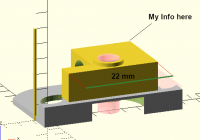
Here is my idea. I would like to change OpenSCAD such that there is a
way to add a display label. Perhaps like this:
DisplayLabel([x,y,z],"My Text", <color>, <
font>, <size>);
This would not put anything into the 3D object (and thus would not be
output when exporting an .STL file), but would just be visible on the
screen. The text would always face the camera. I have seen some
libraries that insert text rendered in 3D shapes (though I can't remember
where). But that 3D text object is actually part of the design, and
flipping the view around to the back would show the backside of the text.
To me is seems less professional to do things that way.
Another helpful tool would be:
DisplayLine(Points = [v1,v2,v3], <color>, <thickness>);
This would just draw a line on the display screen -- not added to the
3D object. This would allow, for example, one to draw a line between a
key point on the design and the Display label above.
An example of how I would use this is as below, made by altering a
screen shot.
[image: Screen Shot 2019-02-12 at 7.09.16 AM.png]
The downside of this approach is that the designer has to manually set
up everything they want output on the design display. But it seems much
easier (from an OpenSCAD programming change approach) than trying to figure
out how to have the program output schematics like Fusion 360 does.
I know that the usual way to go about this, in an open source
situation, would be to make the change myself. I don't have the bandwidth,
however, to learn out how to make the changes myself. So I would have to
depend on others.
Has this problem already been solved?
Would there be any support for such a change? Does anyone else think
it would be helpful?
Thanks in advance,
K. Toppenberg
OpenSCAD mailing list
Discuss@lists.openscad.org
http://lists.openscad.org/mailman/listinfo/discuss_lists.openscad.org

I don't know how good your programming skills are, but the kind of logic you
seem to be looking for was already answered by nophead. In the following
code the labels are only visible in F5 (provided you use a newer snapshot of
OpenSCAD):
cube([10, 10, 20]);
if ($preview) labels();
module labels()
{
label("A", pos = [0, 10, 20], dpos=[-10, 0, 10]);
label("B", pos = [0, 0, 20], dpos=[-10, 0, 10]);
label("C", pos = [10, 0, 20]);
label("D", pos = [10, 10, 20]);
}
module label (text = "label", textsize = 3, pos=[0,0,0], dpos=[10,0,10],
linesize = .2, length =20, anglexyz=[0,45,90])
{
p1 = pos + dpos;
line(pos, p1, linesize);
translate(p1)rotate([90,0,$vpr[2]])text(text, size = textsize);
}
module line(p1=[0,0,0], p2=[0,0,10], r=.1)
hull()
{
translate(p1) sphere(r);
translate(p2) sphere(r);
}
--
Sent from: http://forum.openscad.org/

Yes I should of mentioned that as I was the one that added $preview!
On Tue, 12 Feb 2019 at 22:37, Parkinbot rudolf@digitaldocument.de wrote:
I don't know how good your programming skills are, but the kind of logic
you
seem to be looking for was already answered by nophead. In the following
code the labels are only visible in F5 (provided you use a newer snapshot
of
OpenSCAD):
cube([10, 10, 20]);
if ($preview) labels();
module labels()
{
label("A", pos = [0, 10, 20], dpos=[-10, 0, 10]);
label("B", pos = [0, 0, 20], dpos=[-10, 0, 10]);
label("C", pos = [10, 0, 20]);
label("D", pos = [10, 10, 20]);
}
module label (text = "label", textsize = 3, pos=[0,0,0], dpos=[10,0,10],
linesize = .2, length =20, anglexyz=[0,45,90])
{
p1 = pos + dpos;
line(pos, p1, linesize);
translate(p1)rotate([90,0,$vpr[2]])text(text, size = textsize);
}
module line(p1=[0,0,0], p2=[0,0,10], r=.1)
hull()
{
translate(p1) sphere(r);
translate(p2) sphere(r);
}
--
Sent from: http://forum.openscad.org/
OpenSCAD mailing list
Discuss@lists.openscad.org
http://lists.openscad.org/mailman/listinfo/discuss_lists.openscad.org