

avoiding assertion violation

Ok, I guess I made multiple errors.
For some reason I assumed that (if I input a curve or a line) I'd get the
whole volume from the y axis out to the points.
Obviously, what I actually get is just a shell of zero thickness for that
curve or line.
Is it better for me to get a full volume by adding one point to the polygon
[0.0001, 0] and then if I want a non-zero thickness shell doing subtract
with an offset of the solid. Or is it better for me to make the polygon
with twice as many points (each point has a corresponding double that is
offset by the thickness)? I ask because elsewhere it seemed like
difference() {} might be something one wants to avoid in OpenSCAD for
performance reasons.
https://www.avast.com/sig-email?utm_medium=email&utm_source=link&utm_campaign=sig-email&utm_content=webmail&utm_term=icon
Virus-free.
www.avast.com
https://www.avast.com/sig-email?utm_medium=email&utm_source=link&utm_campaign=sig-email&utm_content=webmail&utm_term=link
<#DAB4FAD8-2DD7-40BB-A1B8-4E2AA1F9FDF2>
On Wed, Jul 17, 2019 at 11:19 AM Parkinbot rudolf@digitaldocument.de
wrote:
So your problem is clear. You try to rotate around a single vertex and get
a
singularity.
The following modification avoids this problem by introducing another point
on the y axis and creating an edge on the y axis.
function coshPolygon(multiplier, power, domain, flip, steps) =
let (flipValue = flip ? cosh( ( multiplier *(pow(domain,power))) ) : 0)
let (result = [for(i = [0.0001: (domain / steps) : domain]) [i,
flipValue - cosh( ( multiplier *(pow(i,power))) )] ])
concat(result, [[0, result[len(result)-1][1]]]);
--
Sent from: http://forum.openscad.org/
OpenSCAD mailing list
Discuss@lists.openscad.org
http://lists.openscad.org/mailman/listinfo/discuss_lists.openscad.org

You don't get a shell, you get a 3D solid who's cross section is the 2D
shape. The problem is if that 2D shape only touches the Y axis at a single
point then the 3D shape has a pinch point there where it has zero thickness
in the Z direction.
If you want to make a shell then the 2D shape should be the cross section
of a shell and yes that is faster made in 2D before the extrude than in 3D
with a differences after.
On Wed, 17 Jul 2019 at 16:58, Dan Shriver tabbydan@gmail.com wrote:
Ok, I guess I made multiple errors.
For some reason I assumed that (if I input a curve or a line) I'd get the
whole volume from the y axis out to the points.
Obviously, what I actually get is just a shell of zero thickness for that
curve or line.
Is it better for me to get a full volume by adding one point to the
polygon [0.0001, 0] and then if I want a non-zero thickness shell doing
subtract with an offset of the solid. Or is it better for me to make the
polygon with twice as many points (each point has a corresponding double
that is offset by the thickness)? I ask because elsewhere it seemed like
difference() {} might be something one wants to avoid in OpenSCAD for
performance reasons.
https://www.avast.com/sig-email?utm_medium=email&utm_source=link&utm_campaign=sig-email&utm_content=webmail&utm_term=icon Virus-free.
www.avast.com
https://www.avast.com/sig-email?utm_medium=email&utm_source=link&utm_campaign=sig-email&utm_content=webmail&utm_term=link
<#m_2910737154312055855_DAB4FAD8-2DD7-40BB-A1B8-4E2AA1F9FDF2>
On Wed, Jul 17, 2019 at 11:19 AM Parkinbot rudolf@digitaldocument.de
wrote:
So your problem is clear. You try to rotate around a single vertex and
get a
singularity.
The following modification avoids this problem by introducing another
point
on the y axis and creating an edge on the y axis.
function coshPolygon(multiplier, power, domain, flip, steps) =
let (flipValue = flip ? cosh( ( multiplier *(pow(domain,power))) ) :
0)
let (result = [for(i = [0.0001: (domain / steps) : domain]) [i,
flipValue - cosh( ( multiplier *(pow(i,power))) )] ])
concat(result, [[0, result[len(result)-1][1]]]);
--
Sent from: http://forum.openscad.org/
OpenSCAD mailing list
Discuss@lists.openscad.org
http://lists.openscad.org/mailman/listinfo/discuss_lists.openscad.org

On 2019-07-17 17:32, Bruno Boettcher wrote:
heh happily swimming in my ignorance and incompetence......
still..... you mention a tool polyfix that repairs the stl??
some pointer please?
thanks!
Bruno
It is bundled with AngelCAD, to get a binary use the downloads link at
https://arnholm.github.io/angelcad-docs/
Regards
Carsten Arnholm
Nop_head: when I did my original hypDome() {code given earlier in the
thread} it looked hollow but that could be some weird artifact. I am using
the 2018 release of OpenSCAD (not the latest one) and I see this:
[image: image.png]
For a shell with thickness I simply make a new function that assigns
coshPolygon() to a vector, then I make a second vector taking the elements
of the first vector (in reverse order) and subtracting the "thickness" from
the y value (which isn't exactly correct as it should be on an angle with
both x & y values altered).
On Wed, Jul 17, 2019 at 12:20 PM nop head nop.head@gmail.com wrote:
You don't get a shell, you get a 3D solid who's cross section is the 2D
shape. The problem is if that 2D shape only touches the Y axis at a single
point then the 3D shape has a pinch point there where it has zero thickness
in the Z direction.
If you want to make a shell then the 2D shape should be the cross section
of a shell and yes that is faster made in 2D before the extrude than in 3D
with a differences after.
On Wed, 17 Jul 2019 at 16:58, Dan Shriver tabbydan@gmail.com wrote:
Ok, I guess I made multiple errors.
For some reason I assumed that (if I input a curve or a line) I'd get the
whole volume from the y axis out to the points.
Obviously, what I actually get is just a shell of zero thickness for that
curve or line.
Is it better for me to get a full volume by adding one point to the
polygon [0.0001, 0] and then if I want a non-zero thickness shell doing
subtract with an offset of the solid. Or is it better for me to make the
polygon with twice as many points (each point has a corresponding double
that is offset by the thickness)? I ask because elsewhere it seemed like
difference() {} might be something one wants to avoid in OpenSCAD for
performance reasons.
https://www.avast.com/sig-email?utm_medium=email&utm_source=link&utm_campaign=sig-email&utm_content=webmail&utm_term=icon Virus-free.
www.avast.com
https://www.avast.com/sig-email?utm_medium=email&utm_source=link&utm_campaign=sig-email&utm_content=webmail&utm_term=link
<#m_8551169469257401297_m_2910737154312055855_DAB4FAD8-2DD7-40BB-A1B8-4E2AA1F9FDF2>
On Wed, Jul 17, 2019 at 11:19 AM Parkinbot rudolf@digitaldocument.de
wrote:
So your problem is clear. You try to rotate around a single vertex and
get a
singularity.
The following modification avoids this problem by introducing another
point
on the y axis and creating an edge on the y axis.
function coshPolygon(multiplier, power, domain, flip, steps) =
let (flipValue = flip ? cosh( ( multiplier *(pow(domain,power))) ) :
0)
let (result = [for(i = [0.0001: (domain / steps) : domain]) [i,
flipValue - cosh( ( multiplier *(pow(i,power))) )] ])
concat(result, [[0, result[len(result)-1][1]]]);
--
Sent from: http://forum.openscad.org/
OpenSCAD mailing list
Discuss@lists.openscad.org
http://lists.openscad.org/mailman/listinfo/discuss_lists.openscad.org
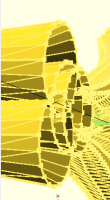

Em qua, 17 de jul de 2019 às 15:00, Carsten Arnholm arnholm@arnholm.org
escreveu:
Therefore, the problem seen in OpenSCAD is not really in rotate_extrude,
but how the model is interpreted when subject to union using CGAL. The
same union using Carve works fine as should be expected.
CGAL seems to be very strict: it doesn't do boolean operations with a
non-manifold. Considering your experiment, I am led to believe that Carve
is complacent with some non-manifoldness when doing boolean operations.
To confirm it, I have examined the OFF file exported by OpenSCAD for your
rotate_extrude() example (without the cube(), of course). The topological
information in the OFF file indicates that there are 12 faces incident to
vertex index 0. Those faces are the triangles pointing to [0,0,0] from the
top (6) and from the bottom (6). So no neighborhood of the vertex 0 is
homeomorphic to a disc in the plane. So, the topology represented in the
OFF file generated by OpenSCAD is not of a manifold.
Summarizing, OpenSCAD may generate and export non-manifold objects. CGAL
doesn't accept to do boolean operations involving non-manifold. Carve seems
to be complacent with some non-manifoldness even in boolean operations. It
is worth to observe that the union of the cube to the rotate_extrude is
still a non-manifold object.