

discuss@lists.openscad.org

OpenSCAD general discussion Mailing-list

View all threads

Managed to model a finger joint box with relieved fingers --- now how to actually cut it? Allow OpenSCAD to write out files?

RW
Ray West
Fri, Aug 14, 2020 7:59 PM

Hi, William,

On 14/08/2020 19:10, William F. Adams via Discuss wrote:

Have you actually made a sketch of how a couple of the fingers,
say, actually mesh together, when prepared by what ever router bits

you can use?

Yes, see the links in my previous message.

Please give a link to where you have sketched the shape of the fingers,
and how they mesh, being capable of being produced by standard router
bits, perpendicular to the surface of the wood. i.e. in the sort of
machine that i thought you were intending to use - a flat bed cnc
router. I am not talking about your openscad drawing showing a few sides
that seem to be able to interlock, but where you have actually looked at
the final detailed shape of the individual fingers, and how you will
machine them. Afaik, this is not possible on a flat bed router, unless
you mess around standing them on edge, in which case it then becomes a
trivial problem (other than the work holding), or you're happy to use
gap filling glue.

You say you have designed a joinery system, well if it involves a four
or five axis bed/spindle, you will be in with a chance, but if only
three, then no chance, unless you go for two or more operations. I
suppose a cnc version of the edge milling box joint jigs may do, but
that is not a challenge. There is probably a reason why there is no cam
programs that will do what you want, after all, finger joints are pretty
popular, but already covered by various mechanical jigs. There are,
however, laser cutting cnc systems for finger joints, if you want to see
burn marks on the edges.

If you were to standardise on the minimum gap between the fingers, then
a design for a small mortiser would be interesting, and you'd get square
corners.

Best wishes,

Ray

Hi, William, On 14/08/2020 19:10, William F. Adams via Discuss wrote: > >Have you actually made a sketch of how a couple of the fingers, > >say, actually mesh together, when prepared by what ever router bits > you can use? > > Yes, see the links in my previous message. Please give a link to where you have sketched the shape of the fingers, and how they mesh, being capable of being produced by standard router bits, perpendicular to the surface of the wood. i.e. in the sort of machine that i thought you were intending to use - a flat bed cnc router. I am not talking about your openscad drawing showing a few sides that seem to be able to interlock, but where you have actually looked at the final detailed shape of the individual fingers, and how you will machine them. Afaik, this is not possible on a flat bed router, unless you mess around standing them on edge, in which case it then becomes a trivial problem (other than the work holding), or you're happy to use gap filling glue. You say you have designed a joinery system, well if it involves a four or five axis bed/spindle, you will be in with a chance, but if only three, then no chance, unless you go for two or more operations. I suppose a cnc version of the edge milling box joint jigs may do, but that is not a challenge. There is probably a reason why there is no cam programs that will do what you want, after all, finger joints are pretty popular, but already covered by various mechanical jigs. There are, however, laser cutting cnc systems for finger joints, if you want to see burn marks on the edges. If you were to standardise on the minimum gap between the fingers, then a design for a small mortiser would be interesting, and you'd get square corners. Best wishes, Ray
WF
William F. Adams
Fri, Aug 14, 2020 8:37 PM

Ray West asked:

Please give a link to where you have sketched the shape of the fingers, and how they mesh,
being capable of being produced by standard router bits, perpendicular to the surface of the wood.
i.e. in the sort of machine that i thought you were intending to use - a flat bed cnc router.

Please see: https://community.carbide3d.com/t/cnc-finger-joint-box/8880/113?u=willadams and the posts above/below that.
You can see the details of the radiusing tool definition at: https://community.carbide3d.com/t/design-into-3d-boxes-magazine-storage/16238/54?u=willadams
I've also done a diagonal relief using a V endmill which worked surprisingly well:
https://community.carbide3d.com/t/design-into-3d-boxes-magazine-storage/16238/16?u=willadams

I am not talking about your openscad drawing showing a few sides that seem to be able to interlock,
but where you have actually looked at the final detailed shape of the individual fingers, and how you will machine them.
Afaik, this is not possible on a flat bed router, unless you mess around standing them on edge,
in which case it then becomes a trivial problem (other than the work holding), or you're happy to use gap filling glue.

I've done them standing on edge. It's a tedious pain.

You say you have designed a joinery system, well if it involves a four or five axis bed/spindle, >you will be in with a chance, but if only three, then no chance, unless you go for two or more operations.

Yes, to two or more operations if you consider a tool change an operation, but only one setup.

I suppose a cnc version of the edge milling box joint jigs may do, but that is not a challenge.

Agreed, been there done that.

There is probably a reason why there is no cam programs that will do what you want, after all, >finger joints are pretty popular, but already covered by various mechanical jigs. >There are, however, laser cutting cnc systems for finger joints, if you want to see burn marks on the edges.

I've used generators intended for lasers as a starting point for some projects, but no interest in a laser --- agree that the burn marks look ghastly.

If you were to standardise on the minimum gap between the fingers, then a design for a small mortiser would be interesting, >and you'd get square corners.

Not sure what you mean by that.
William

Ray West asked: >Please give a link to where you have sketched the shape of the fingers, and how they mesh, >being capable of being produced by standard router bits, perpendicular to the surface of the wood. >i.e. in the sort of machine that i thought you were intending to use - a flat bed cnc router. Please see: https://community.carbide3d.com/t/cnc-finger-joint-box/8880/113?u=willadams and the posts above/below that. You can see the details of the radiusing tool definition at: https://community.carbide3d.com/t/design-into-3d-boxes-magazine-storage/16238/54?u=willadams I've also done a diagonal relief using a V endmill which worked surprisingly well: https://community.carbide3d.com/t/design-into-3d-boxes-magazine-storage/16238/16?u=willadams >I am not talking about your openscad drawing showing a few sides that seem to be able to interlock, >but where you have actually looked at the final detailed shape of the individual fingers, and how you will machine them. >Afaik, this is not possible on a flat bed router, unless you mess around standing them on edge, >in which case it then becomes a trivial problem (other than the work holding), or you're happy to use gap filling glue. I've done them standing on edge. It's a tedious pain. >You say you have designed a joinery system, well if it involves a four or five axis bed/spindle, >you will be in with a chance, but if only three, then no chance, unless you go for two or more operations. Yes, to two or more operations if you consider a tool change an operation, but only one setup. >I suppose a cnc version of the edge milling box joint jigs may do, but that is not a challenge. Agreed, been there done that. >There is probably a reason why there is no cam programs that will do what you want, after all, >finger joints are pretty popular, but already covered by various mechanical jigs. >There are, however, laser cutting cnc systems for finger joints, if you want to see burn marks on the edges. I've used generators intended for lasers as a starting point for some projects, but no interest in a laser --- agree that the burn marks look ghastly. >If you were to standardise on the minimum gap between the fingers, then a design for a small mortiser would be interesting, >and you'd get square corners. Not sure what you mean by that. William
NH
nop head
Fri, Aug 14, 2020 9:01 PM

I have a CNC router with a tool changer operated by compressed air but I
have never got around to setting up the tool changer. It would be ideal for
that sort of job but would require accurate tool Z height calibration but I
have solved that problem before.
https://hydraraptor.blogspot.com/2007/05/how-long-is-your-tool.html

I have also never used it with wood but someday I will get around to it.

On Fri, 14 Aug 2020 at 21:38, William F. Adams via Discuss <
discuss@lists.openscad.org> wrote:

Ray West asked:

Please give a link to where you have sketched the shape of the fingers,

and how they mesh,

being capable of being produced by standard router bits, perpendicular

to the surface of the wood.

i.e. in the sort of machine that i thought you were intending to use - a

flat bed cnc router.

Please see:
https://community.carbide3d.com/t/cnc-finger-joint-box/8880/113?u=willadams
and the posts above/below that.

You can see the details of the radiusing tool definition at:
https://community.carbide3d.com/t/design-into-3d-boxes-magazine-storage/16238/54?u=willadams

I've also done a diagonal relief using a V endmill which worked
surprisingly well:

https://community.carbide3d.com/t/design-into-3d-boxes-magazine-storage/16238/16?u=willadams

I am not talking about your openscad drawing showing a few sides that

seem to be able to interlock,

but where you have actually looked at the final detailed shape of the

individual fingers, and how you will machine them.

Afaik, this is not possible on a flat bed router, unless you mess around

standing them on edge,

in which case it then becomes a trivial problem (other than the work

holding), or you're happy to use gap filling glue.

I've done them standing on edge. It's a tedious pain.

You say you have designed a joinery system, well if it involves a four or

five axis bed/spindle,

you will be in with a chance, but if only three, then no chance, unless

you go for two or more operations.

Yes, to two or more operations if you consider a tool change an operation,
but only one setup.

I suppose a cnc version of the edge milling box joint jigs may do, but

that is not a challenge.

Agreed, been there done that.

There is probably a reason why there is no cam programs that will do what

you want, after all,

finger joints are pretty popular, but already covered by various

mechanical jigs.

There are, however, laser cutting cnc systems for finger joints, if you

want to see burn marks on the edges.

I've used generators intended for lasers as a starting point for some
projects, but no interest in a laser --- agree that the burn marks look
ghastly.

If you were to standardise on the minimum gap between the fingers, then a

design for a small mortiser would be interesting,

and you'd get square corners.

Not sure what you mean by that.

William


OpenSCAD mailing list
Discuss@lists.openscad.org
http://lists.openscad.org/mailman/listinfo/discuss_lists.openscad.org

I have a CNC router with a tool changer operated by compressed air but I have never got around to setting up the tool changer. It would be ideal for that sort of job but would require accurate tool Z height calibration but I have solved that problem before. https://hydraraptor.blogspot.com/2007/05/how-long-is-your-tool.html I have also never used it with wood but someday I will get around to it. On Fri, 14 Aug 2020 at 21:38, William F. Adams via Discuss < discuss@lists.openscad.org> wrote: > Ray West asked: > > >Please give a link to where you have sketched the shape of the fingers, > and how they mesh, > >being capable of being produced by standard router bits, perpendicular > to the surface of the wood. > >i.e. in the sort of machine that i thought you were intending to use - a > flat bed cnc router. > > Please see: > https://community.carbide3d.com/t/cnc-finger-joint-box/8880/113?u=willadams > and the posts above/below that. > > You can see the details of the radiusing tool definition at: > https://community.carbide3d.com/t/design-into-3d-boxes-magazine-storage/16238/54?u=willadams > > I've also done a diagonal relief using a V endmill which worked > surprisingly well: > > > https://community.carbide3d.com/t/design-into-3d-boxes-magazine-storage/16238/16?u=willadams > > >I am not talking about your openscad drawing showing a few sides that > seem to be able to interlock, > >but where you have actually looked at the final detailed shape of the > individual fingers, and how you will machine them. > >Afaik, this is not possible on a flat bed router, unless you mess around > standing them on edge, > >in which case it then becomes a trivial problem (other than the work > holding), or you're happy to use gap filling glue. > > I've done them standing on edge. It's a tedious pain. > > >You say you have designed a joinery system, well if it involves a four or > five axis bed/spindle, > >you will be in with a chance, but if only three, then no chance, unless > you go for two or more operations. > > Yes, to two or more operations if you consider a tool change an operation, > but only one setup. > > >I suppose a cnc version of the edge milling box joint jigs may do, but > that is not a challenge. > > Agreed, been there done that. > > >There is probably a reason why there is no cam programs that will do what > you want, after all, > >finger joints are pretty popular, but already covered by various > mechanical jigs. > >There are, however, laser cutting cnc systems for finger joints, if you > want to see burn marks on the edges. > > I've used generators intended for lasers as a starting point for some > projects, but no interest in a laser --- agree that the burn marks look > ghastly. > > >If you were to standardise on the minimum gap between the fingers, then a > design for a small mortiser would be interesting, > >and you'd get square corners. > > Not sure what you mean by that. > > William > _______________________________________________ > OpenSCAD mailing list > Discuss@lists.openscad.org > http://lists.openscad.org/mailman/listinfo/discuss_lists.openscad.org >
RW
Ray West
Fri, Aug 14, 2020 10:12 PM

Thanks, William. I now see we are both right. Your quadrant table is the
fourth axis, in effect. Seems you've had a few arguments elsewhere, too.

A mortiser tool bit is basically a square tube, with sharp edge at the
bottom, and a drill running through the centre. The drill clears the
majority of the chips, leaving a thin ridge and corners for the tube to
shave off. It basically drills square holes in wood. If you rigged up a
similar unit, but with a cnc controlled x/y table to move the wood
around, then it could profile nice square notches. It would most likely
need more pressure than is capable to be exerted by the z axis drive of
the usual cnc routers, however, but there are ways around that.

If you knew someone who could harden and temper tool steel (It is quite
easy), then drill a  hole lengthwise through a steel bar, and
countersink the end (It'll give a sharp edge), then use an ordinary
auger bit in the centrer. You will need to cut away part of the side of
the bar, to let the chips escape. Or you can buy them ready made, of course.

If you limit the size of material you want to process, then you can
build a sturdy gantry type flat bed cnc router, with a beefier z drive
stepper and ball screw. A sharp bit, say 0.25 inch square will not take
much force to push it through most woods. It will not be particularly
fast, especially if you are doing all the cutting with the mortise bit,
but there should be little further processing required.

A bonus would be that you could use openscad to design the machine.

Best wishes,

Ray

On 14/08/2020 21:37, William F. Adams via Discuss wrote:

Ray West asked:

Please give a link to where you have sketched the shape of the

fingers, and how they mesh,

being capable of being produced by standard router bits,

perpendicular to the surface of the wood.

i.e. in the sort of machine that i thought you were intending to use

  • a flat bed cnc router.

Please
see: https://community.carbide3d.com/t/cnc-finger-joint-box/8880/113?u=willadams
and the posts above/below that.

You can see the details of the radiusing tool definition
at: https://community.carbide3d.com/t/design-into-3d-boxes-magazine-storage/16238/54?u=willadams

I've also done a diagonal relief using a V endmill which worked
surprisingly well:

https://community.carbide3d.com/t/design-into-3d-boxes-magazine-storage/16238/16?u=willadams

I am not talking about your openscad drawing showing a few sides that

seem to be able to interlock,

but where you have actually looked at the final detailed shape of the

individual fingers, and how you will machine them.

Afaik, this is not possible on a flat bed router, unless you mess

around standing them on edge,

in which case it then becomes a trivial problem (other than the work

holding), or you're happy to use gap filling glue.

I've done them standing on edge. It's a tedious pain.

You say you have designed a joinery system, well if it involves a

four or five axis bed/spindle,

you will be in with a chance, but if only three, then no chance,

unless you go for two or more operations.

Yes, to two or more operations if you consider a tool change an
operation, but only one setup.

I suppose a cnc version of the edge milling box joint jigs may do,

but that is not a challenge.

Agreed, been there done that.

There is probably a reason why there is no cam programs that will do

what you want, after all,

finger joints are pretty popular, but already covered by various

mechanical jigs.

There are, however, laser cutting cnc systems for finger joints, if

you want to see burn marks on the edges.

I've used generators intended for lasers as a starting point for some
projects, but no interest in a laser --- agree that the burn marks
look ghastly.

If you were to standardise on the minimum gap between the fingers,

then a design for a small mortiser would be interesting,

and you'd get square corners.

Not sure what you mean by that.

William


OpenSCAD mailing list
Discuss@lists.openscad.org
http://lists.openscad.org/mailman/listinfo/discuss_lists.openscad.org

Thanks, William. I now see we are both right. Your quadrant table is the fourth axis, in effect. Seems you've had a few arguments elsewhere, too. A mortiser tool bit is basically a square tube, with sharp edge at the bottom, and a drill running through the centre. The drill clears the majority of the chips, leaving a thin ridge and corners for the tube to shave off. It basically drills square holes in wood. If you rigged up a similar unit, but with a cnc controlled x/y table to move the wood around, then it could profile nice square notches. It would most likely need more pressure than is capable to be exerted by the z axis drive of the usual cnc routers, however, but there are ways around that. If you knew someone who could harden and temper tool steel (It is quite easy), then drill a  hole lengthwise through a steel bar, and countersink the end (It'll give a sharp edge), then use an ordinary auger bit in the centrer. You will need to cut away part of the side of the bar, to let the chips escape. Or you can buy them ready made, of course. If you limit the size of material you want to process, then you can build a sturdy gantry type flat bed cnc router, with a beefier z drive stepper and ball screw. A sharp bit, say 0.25 inch square will not take much force to push it through most woods. It will not be particularly fast, especially if you are doing all the cutting with the mortise bit, but there should be little further processing required. A bonus would be that you could use openscad to design the machine. Best wishes, Ray On 14/08/2020 21:37, William F. Adams via Discuss wrote: > Ray West asked: > > >Please give a link to where you have sketched the shape of the > fingers, and how they mesh, > >being capable of being produced by standard router bits, > perpendicular to the surface of the wood. > >i.e. in the sort of machine that i thought you were intending to use > - a flat bed cnc router. > > Please > see: https://community.carbide3d.com/t/cnc-finger-joint-box/8880/113?u=willadams > and the posts above/below that. > > You can see the details of the radiusing tool definition > at: https://community.carbide3d.com/t/design-into-3d-boxes-magazine-storage/16238/54?u=willadams > > I've also done a diagonal relief using a V endmill which worked > surprisingly well: > > https://community.carbide3d.com/t/design-into-3d-boxes-magazine-storage/16238/16?u=willadams > > >I am not talking about your openscad drawing showing a few sides that > seem to be able to interlock, > >but where you have actually looked at the final detailed shape of the > individual fingers, and how you will machine them. > >Afaik, this is not possible on a flat bed router, unless you mess > around standing them on edge, > >in which case it then becomes a trivial problem (other than the work > holding), or you're happy to use gap filling glue. > > I've done them standing on edge. It's a tedious pain. > > >You say you have designed a joinery system, well if it involves a > four or five axis bed/spindle, > >you will be in with a chance, but if only three, then no chance, > unless you go for two or more operations. > > Yes, to two or more operations if you consider a tool change an > operation, but only one setup. > > >I suppose a cnc version of the edge milling box joint jigs may do, > but that is not a challenge. > > Agreed, been there done that. > > >There is probably a reason why there is no cam programs that will do > what you want, after all, > >finger joints are pretty popular, but already covered by various > mechanical jigs. > >There are, however, laser cutting cnc systems for finger joints, if > you want to see burn marks on the edges. > > I've used generators intended for lasers as a starting point for some > projects, but no interest in a laser --- agree that the burn marks > look ghastly. > > >If you were to standardise on the minimum gap between the fingers, > then a design for a small mortiser would be interesting, > >and you'd get square corners. > > Not sure what you mean by that. > > William > > _______________________________________________ > OpenSCAD mailing list > Discuss@lists.openscad.org > http://lists.openscad.org/mailman/listinfo/discuss_lists.openscad.org
WF
William F. Adams
Sat, Aug 15, 2020 4:16 AM

Proof of concept for this: https://community.carbide3d.com/uploads/short-url/Av8DyvPseArwbfWZcxKOLhoFQBW.zip
Parsing design (AST generation)...Saved backup file: C:/Users/willa/OneDrive/Documents/OpenSCAD/backups/Design into 3D_ Fingerjoint-backup-vaTVHyKD.scad
Compiling design (CSG Tree generation)...
ECHO: "G0 X,", 0, " Y", 0, " Z", 8ECHO: "G1 Z", -3.175, " F", 150ECHO: "G1 X", 0, " Y", 4.20625, " F", 600ECHO: "G0 Z", 8ECHO: "G0 X,", 9.5875, " Y", 0, " Z", 8ECHO: "G1 Z", -3.175, " F", 150ECHO: "G1 X", 9.5875, " Y", 4.20625, " F", 600
&c.
see the post at: https://community.carbide3d.com/t/cnc-finger-joint-box/8880/126
So if we just had a command which would write out only the echoed text less the clutter, we'd have a CAM solution for OpenSCAD files which are coded in a style where a declared piece of stock is subtracted from in a fashion which matches how one wants the CNC machine to cut things out.
William

Proof of concept for this: https://community.carbide3d.com/uploads/short-url/Av8DyvPseArwbfWZcxKOLhoFQBW.zip Parsing design (AST generation)...Saved backup file: C:/Users/willa/OneDrive/Documents/OpenSCAD/backups/Design into 3D_ Fingerjoint-backup-vaTVHyKD.scad Compiling design (CSG Tree generation)... ECHO: "G0 X,", 0, " Y", 0, " Z", 8ECHO: "G1 Z", -3.175, " F", 150ECHO: "G1 X", 0, " Y", 4.20625, " F", 600ECHO: "G0 Z", 8ECHO: "G0 X,", 9.5875, " Y", 0, " Z", 8ECHO: "G1 Z", -3.175, " F", 150ECHO: "G1 X", 9.5875, " Y", 4.20625, " F", 600 &c. see the post at: https://community.carbide3d.com/t/cnc-finger-joint-box/8880/126 So if we just had a command which would write out only the echoed text less the clutter, we'd have a CAM solution for OpenSCAD files which are coded in a style where a declared piece of stock is subtracted from in a fashion which matches how one wants the CNC machine to cut things out. William
RW
Ray West
Sat, Aug 15, 2020 10:59 AM

Hi William,

for the purpose of testing that the gcode generated is the gcode you can
use, it is simple to open it in any text editor, e.g. notepad, and do
search and replace a few times.

so search for 'echo' and replace with 'space', then same for double
quotes and commas. Finally search for spaces repeatedly replacing two
spaces with one,  this results in

 G0 X 0 Y 0 Z 8
 G1 Z -3.175 F 150
 G1 X 0 Y 4.20625 F 600
 G0 Z 8
 G0 X 9.5875 Y 0 Z 8
 G1 Z -3.175 F 150
 G1 X 9.5875 Y 4.20625 F 600

which is valid gcode, at least for my machines. That will allow you to
break out of the theory, and you can attempt to machine the pieces, and
see if they fit together as expected.

On 15/08/2020 05:16, William F. Adams via Discuss wrote:

ECHO: "G0 X,", 0, " Y", 0, " Z", 8
ECHO: "G1 Z", -3.175, " F", 150
ECHO: "G1 X", 0, " Y", 4.20625, " F", 600
ECHO: "G0 Z", 8
ECHO: "G0 X,", 9.5875, " Y", 0, " Z", 8
ECHO: "G1 Z", -3.175, " F", 150
ECHO: "G1 X", 9.5875, " Y", 4.20625, " F", 600

Hi William, for the purpose of testing that the gcode generated is the gcode you can use, it is simple to open it in any text editor, e.g. notepad, and do search and replace a few times. so search for 'echo' and replace with 'space', then same for double quotes and commas. Finally search for spaces repeatedly replacing two spaces with one,  this results in  G0 X 0 Y 0 Z 8  G1 Z -3.175 F 150  G1 X 0 Y 4.20625 F 600  G0 Z 8  G0 X 9.5875 Y 0 Z 8  G1 Z -3.175 F 150  G1 X 9.5875 Y 4.20625 F 600 which is valid gcode, at least for my machines. That will allow you to break out of the theory, and you can attempt to machine the pieces, and see if they fit together as expected. On 15/08/2020 05:16, William F. Adams via Discuss wrote: > ECHO: "G0 X,", 0, " Y", 0, " Z", 8 > ECHO: "G1 Z", -3.175, " F", 150 > ECHO: "G1 X", 0, " Y", 4.20625, " F", 600 > ECHO: "G0 Z", 8 > ECHO: "G0 X,", 9.5875, " Y", 0, " Z", 8 > ECHO: "G1 Z", -3.175, " F", 150 > ECHO: "G1 X", 9.5875, " Y", 4.20625, " F", 600
WF
William F. Adams
Sat, Aug 15, 2020 12:20 PM

Yes, as noted, that was just a proof of concept. I'll be doing some actual cutting/testing with this today.
I've since found that wrapping things up in str() so as to convert to a string as part of the echo() command cleans up the internal double quotes and commas, so the find-replace and filtering is now trivial (parse each line and only write out those which begin w/ ECHO, just without that text or the colon or the quotes).
So, could we please just get a command which would do that with a user configurable file extension?
William

Yes, as noted, that was just a proof of concept. I'll be doing some actual cutting/testing with this today. I've since found that wrapping things up in str() so as to convert to a string as part of the echo() command cleans up the internal double quotes and commas, so the find-replace and filtering is now trivial (parse each line and only write out those which begin w/ ECHO, just without that text or the colon or the quotes). So, could we please just get a command which would do that with a user configurable file extension? William
JB
Jordan Brown
Sun, Aug 16, 2020 12:48 AM

What does your input OpenSCAD look like, that emits proto-gcode?  I
don't see that in any of the pages you've posted.

I'd like to figure out how to drive my CNC machine from an OpenSCAD
model... so far, I'm not seeing how, other than some tool chains that
seem fragile, unpleasant, or both.

What does your input OpenSCAD look like, that emits proto-gcode?  I don't see that in any of the pages you've posted. I'd like to figure out how to drive my CNC machine from an OpenSCAD model... so far, I'm not seeing how, other than some tool chains that seem fragile, unpleasant, or both.
WF
William F. Adams
Sun, Aug 16, 2020 12:59 AM

Jordan Brown wrote:

What does your input OpenSCAD look like, that emits proto-gcode?  I don't see that in any of the pages you've posted.

I posted my source code at:
https://community.carbide3d.com/uploads/short-url/36SA8hMSvesRwUOKFocbbdxQmrl.zip
in the message: https://community.carbide3d.com/t/cnc-finger-joint-box/8880/126
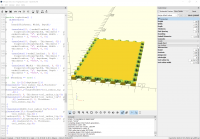
and I've attached the current copy to this message.
Current settings are:

I'd like to figure out how to drive my CNC machine from an OpenSCAD model... >so far, I'm not seeing how, other than some tool chains that seem fragile, unpleasant, or both.

This is just a proof of concept so far, but I think it shows progress.
Just to review --- which CAM options have you looked at or considered? Thus far I've tried or worked with:
 - export STL --- process in a 3D CAM tool such as MeshCAM or pyCAM - export DXF or SVG --- process using a tool such as MakerCAM or Carbide Create
the other thing I've considered is:
 - opening the .scad file in FreeCAD and using its CAM workbench
Curious if there are any other options to try.
William
Jordan Brown wrote: >What does your input OpenSCAD look like, that emits proto-gcode?  I don't see that in any of the pages you've posted. I posted my source code at: https://community.carbide3d.com/uploads/short-url/36SA8hMSvesRwUOKFocbbdxQmrl.zip in the message: https://community.carbide3d.com/t/cnc-finger-joint-box/8880/126 and I've attached the current copy to this message. Current settings are: >I'd like to figure out how to drive my CNC machine from an OpenSCAD model... >so far, I'm not seeing how, other than some tool chains that seem fragile, unpleasant, or both. This is just a proof of concept so far, but I think it shows progress. Just to review --- which CAM options have you looked at or considered? Thus far I've tried or worked with:  - export STL --- process in a 3D CAM tool such as MeshCAM or pyCAM - export DXF or SVG --- process using a tool such as MakerCAM or Carbide Create the other thing I've considered is:  - opening the .scad file in FreeCAD and using its CAM workbench Curious if there are any other options to try. William
JB
Jordan Brown
Sun, Aug 16, 2020 1:02 AM

On 8/15/2020 5:20 AM, William F. Adams via Discuss wrote:

So, could we please just get a command which would do that with a user
configurable file extension?

Remember that the people doing the work are volunteers, working in their
spare time on things that interest them.

It does seem pretty simple.  I'd offer to do it myself, but ... I got
OpenSCAD to build successfully in December, and since then I've found
the time to spend maybe two or three hours on the features that I want.

On 8/15/2020 5:20 AM, William F. Adams via Discuss wrote: > So, could we please just get a command which would do that with a user > configurable file extension? Remember that the people doing the work are volunteers, working in their spare time on things that interest them. It does seem pretty simple.  I'd offer to do it myself, but ... I got OpenSCAD to build successfully in December, and since then I've found the time to spend maybe two or three hours on the features that *I* want.