discuss@lists.openscad.org

OpenSCAD general discussion Mailing-list

View all threads

very unpleasant effect in current openscad 2018.06.14 (git master)

P
pproj@posteo.de
Wed, Jun 20, 2018 1:10 PM

Hello everybody
i need help with this:

with openscad 2018.06.14 from github

this code:

h=9.2-4+.3;

difference()
{
    cube([20,2h,2h]);   
    cylinder(d=15,h=h);

        translate([0,0,h])
        {
            cube([17,20,4]);
            cylinder(d=15,h=h);
        }
}
produces this after rendering:

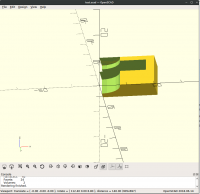
but if you change  the value of h at the first line to

h=5.2+.3; 

(which is still the same number as above h=9.2-4+.3 and still equals to
5.5 )

restart openscad to reset cache, and rerender, you will get a different
picture:

anybody knows which version(revision) of openscad is last to be known to
not have this effect?

why do i get 2 volumes anyway?

Thanks for advice. Peter
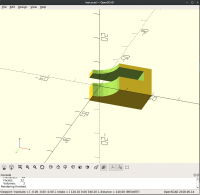
Hello everybody i need help with this: with openscad 2018.06.14 from github this code: h=9.2-4+.3; difference() {     cube([20,2*h,2*h]);        cylinder(d=15,h=h);         translate([0,0,h])         {             cube([17,20,4]);             cylinder(d=15,h=h);         } } produces this after rendering: but if you change  the value of h at the first line to h=5.2+.3;  (which is still the same number as above h=9.2-4+.3 and still equals to 5.5 ) restart openscad to reset cache, and rerender, you will get a different picture: anybody knows which version(revision) of openscad is last to be known to not have this effect? why do i get 2 volumes anyway? Thanks for advice. Peter
M
MichaelAtOz
Wed, Jun 20, 2018 1:43 PM

Try this

h=9.2-4+.3;
h2=5.2+.3;
h3=5.2+.3+0.000005;
echo(h=h,h2=h2,h3=h3);
echo( (h==h2) ? "EQ" : "NEQ" );
echo( h-h2);

Floating point plays tricks, compounded, AGAIN, by echo rounding results.


Admin - PM me if you need anything, or if I've done something stupid...

Unless specifically shown otherwise above, my contribution is in the Public Domain; to the extent possible under law, I have waived all copyright and related or neighbouring rights to this work. Obviously inclusion of works of previous authors is not included in the above.

The TPP is no simple “trade agreement.”  Fight it! http://www.ourfairdeal.org/  time is running out!

Sent from: http://forum.openscad.org/

Try this h=9.2-4+.3; h2=5.2+.3; h3=5.2+.3+0.000005; echo(h=h,h2=h2,h3=h3); echo( (h==h2) ? "EQ" : "NEQ" ); echo( h-h2); Floating point plays tricks, compounded, AGAIN, by echo rounding results. ----- Admin - PM me if you need anything, or if I've done something stupid... Unless specifically shown otherwise above, my contribution is in the Public Domain; to the extent possible under law, I have waived all copyright and related or neighbouring rights to this work. Obviously inclusion of works of previous authors is not included in the above. The TPP is no simple “trade agreement.” Fight it! http://www.ourfairdeal.org/ time is running out! -- Sent from: http://forum.openscad.org/
NH
nop head
Wed, Jun 20, 2018 3:22 PM

You get two volumes for a single object because the outside universe counts
as a volume. So you always need to subtract one from what OpenSCAD reports.

Also internal cavities count as volumes, so a hollow sphere would report 3
volumes.

On 20 June 2018 at 14:43, MichaelAtOz oz.at.michael@gmail.com wrote:

Try this

h=9.2-4+.3;
h2=5.2+.3;
h3=5.2+.3+0.000005;
echo(h=h,h2=h2,h3=h3);
echo( (h==h2) ? "EQ" : "NEQ" );
echo( h-h2);

Floating point plays tricks, compounded, AGAIN, by echo rounding results.


Admin - PM me if you need anything, or if I've done something stupid...

Unless specifically shown otherwise above, my contribution is in the
Public Domain; to the extent possible under law, I have waived all
copyright and related or neighbouring rights to this work. Obviously
inclusion of works of previous authors is not included in the above.

The TPP is no simple “trade agreement.”  Fight it!
http://www.ourfairdeal.org/  time is running out!

Sent from: http://forum.openscad.org/


OpenSCAD mailing list
Discuss@lists.openscad.org
http://lists.openscad.org/mailman/listinfo/discuss_lists.openscad.org

You get two volumes for a single object because the outside universe counts as a volume. So you always need to subtract one from what OpenSCAD reports. Also internal cavities count as volumes, so a hollow sphere would report 3 volumes. On 20 June 2018 at 14:43, MichaelAtOz <oz.at.michael@gmail.com> wrote: > Try this > > h=9.2-4+.3; > h2=5.2+.3; > h3=5.2+.3+0.000005; > echo(h=h,h2=h2,h3=h3); > echo( (h==h2) ? "EQ" : "NEQ" ); > echo( h-h2); > > Floating point plays tricks, compounded, AGAIN, by echo rounding results. > > > > ----- > Admin - PM me if you need anything, or if I've done something stupid... > > Unless specifically shown otherwise above, my contribution is in the > Public Domain; to the extent possible under law, I have waived all > copyright and related or neighbouring rights to this work. Obviously > inclusion of works of previous authors is not included in the above. > > The TPP is no simple “trade agreement.” Fight it! > http://www.ourfairdeal.org/ time is running out! > -- > Sent from: http://forum.openscad.org/ > > _______________________________________________ > OpenSCAD mailing list > Discuss@lists.openscad.org > http://lists.openscad.org/mailman/listinfo/discuss_lists.openscad.org >