

Getting more information

Is the base of the whole arch structure (left side) supposed to be coplanar?
It doesn't look coplanar in your image.
Can you reduce the transition steps to 2 or 1 (I'm not sure how you are
counting so I don't know what is the minimum sensible option here). The
point is to really push things to the minimal example that triggers your
problem, so that you can really inspect the example carefully---for example
look at every vertex coordinate in your polyhedron and every face list by
hand and see if you notice anything odd.
Are you generating this by using the skin() module from
list-comprehension-demos?
DanS wrote
So I was taking your idea of doing less. Instead of 105 transition steps
I
did 15.
If I union it with a cube it only works if they don't touch at all, if
they
do touch it seems to blow up and render nothing.
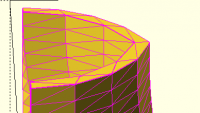
If I take the more simple version and do Preview -> Thrown together I
don't
see any pink / purple facets (but the edges are all pink purple) the one
thing that strikes me as very odd is that each arch should be planar. I
would intuitively expect no triangles on the ends yet all the vertices on
the ends are part of triangles. Of course, it might also do those
triangles if all the vertexes are planar, I just don't know.
[image: image.png]
On Thu, Jul 4, 2019 at 6:39 PM adrianv <
avm4@
> wrote:
DanS wrote
yes, I've simplified it to where it seems to work. So I know it breaks
down where I do "wave" which interpolates between one curve and another
using sin() (to give a smooth curve rather than a linear transition).
Is it possible that you have very skinny facets showing up in pink
between
larger facets? It just takes a single bad facet to ruin your entire
model.
If the interpolation process is at fault can you use a simpler polygon as
the base for the interpolation?
--
Sent from: http://forum.openscad.org/
OpenSCAD mailing list
Discuss@.openscad
Discuss@.openscad
http://lists.openscad.org/mailman/listinfo/discuss_lists.openscad.org
image.png (13K)
<http://forum.openscad.org/attachment/26727/0/image.png>
--
Sent from: http://forum.openscad.org/

If there is a hole I don't seem to be able to see into it. I think what
you are implying is that each of the "edges" I see is actually a
rectangular hole. That is possible but I can't prove or disprove it.
I'm trying to do the interpolations with the case that each arch segment is
also on an arched pathway. Maybe I'll see if I can get an error on
interpolated arches on a straight line path, might be easier for me to view
in preview.
On Thu, Jul 4, 2019 at 7:03 PM nop head nop.head@gmail.com wrote:
I don't think you should see purple edges. Do they meet or is there a hole
through which you can see the purple interior?
On Thu, 4 Jul 2019, 23:51 Dan Shriver, tabbydan@gmail.com wrote:
So I was taking your idea of doing less. Instead of 105 transition steps
I did 15.
If I union it with a cube it only works if they don't touch at all, if
they do touch it seems to blow up and render nothing.
If I take the more simple version and do Preview -> Thrown together I
don't see any pink / purple facets (but the edges are all pink purple) the
one thing that strikes me as very odd is that each arch should be planar.
I would intuitively expect no triangles on the ends yet all the vertices on
the ends are part of triangles. Of course, it might also do those
triangles if all the vertexes are planar, I just don't know.
[image: image.png]
On Thu, Jul 4, 2019 at 6:39 PM adrianv avm4@cornell.edu wrote:
DanS wrote
yes, I've simplified it to where it seems to work. So I know it breaks
down where I do "wave" which interpolates between one curve and another
using sin() (to give a smooth curve rather than a linear transition).
Is it possible that you have very skinny facets showing up in pink
between
larger facets? It just takes a single bad facet to ruin your entire
model.
If the interpolation process is at fault can you use a simpler polygon as
the base for the interpolation?
--
Sent from: http://forum.openscad.org/
OpenSCAD mailing list
Discuss@lists.openscad.org
http://lists.openscad.org/mailman/listinfo/discuss_lists.openscad.org
ERROR: CGAL error
Any CGAL error is almost guaranteed to be either bad polygon/polyhedron, or
import() of a bad .stl file.
In Thrown-together any purple is bad.
It is difficult to debug without seeing your code.
Admin - email* me if you need anything, or if I've done something stupid...
- click on my MichaelAtOz label, there is a link to email me.
Unless specifically shown otherwise above, my contribution is in the Public Domain; to the extent possible under law, I have waived all copyright and related or neighbouring rights to this work. Obviously inclusion of works of previous authors is not included in the above.
The TPP is no simple “trade agreement.” Fight it! http://www.ourfairdeal.org/ time is running out!
Sent from: http://forum.openscad.org/
Yes, skin is from list comprehension. Or at least I believe so.
Each arch is supposed to be coplanar.
I created a new function (that I felt would help me view things) by not
centering each arch on top of a path that is itself an arch. When I do
that I can render a union with a cube. This is starting to suggest the
problem comes about when putting each arch on a path that is itself an arch
(but I thought I tested and cleared that earlier :( ).
Even in this case (where I can render a union with the cube, preview ->
thrown together shows pink purple edges)
Nop / MichaelAtOz:
I only see the pink/purple color in throw together either on the edges or
if I am already inside of something (that is the viewpoint is partway
inside the arch)
MichaelAtOz:
I can show the code to people but it isn't pretty and rightfully people
have said in the past "I don't want to debug that"
On Thu, Jul 4, 2019 at 7:13 PM adrianv avm4@cornell.edu wrote:
Is the base of the whole arch structure (left side) supposed to be
coplanar?
It doesn't look coplanar in your image.
Can you reduce the transition steps to 2 or 1 (I'm not sure how you are
counting so I don't know what is the minimum sensible option here). The
point is to really push things to the minimal example that triggers your
problem, so that you can really inspect the example carefully---for example
look at every vertex coordinate in your polyhedron and every face list by
hand and see if you notice anything odd.
Are you generating this by using the skin() module from
list-comprehension-demos?
DanS wrote
So I was taking your idea of doing less. Instead of 105 transition steps
I
did 15.
If I union it with a cube it only works if they don't touch at all, if
they
do touch it seems to blow up and render nothing.
If I take the more simple version and do Preview -> Thrown together I
don't
see any pink / purple facets (but the edges are all pink purple) the one
thing that strikes me as very odd is that each arch should be planar. I
would intuitively expect no triangles on the ends yet all the vertices on
the ends are part of triangles. Of course, it might also do those
triangles if all the vertexes are planar, I just don't know.
[image: image.png]
On Thu, Jul 4, 2019 at 6:39 PM adrianv <
avm4@
> wrote:
DanS wrote
yes, I've simplified it to where it seems to work. So I know it
breaks
down where I do "wave" which interpolates between one curve and
another
using sin() (to give a smooth curve rather than a linear transition).
Is it possible that you have very skinny facets showing up in pink
between
larger facets? It just takes a single bad facet to ruin your entire
model.
If the interpolation process is at fault can you use a simpler polygon
as
Discuss@.openscad
Discuss@.openscad
http://lists.openscad.org/mailman/listinfo/discuss_lists.openscad.org
image.png (13K)
<http://forum.openscad.org/attachment/26727/0/image.png>
--
Sent from: http://forum.openscad.org/
OpenSCAD mailing list
Discuss@lists.openscad.org
http://lists.openscad.org/mailman/listinfo/discuss_lists.openscad.org
MichaelAtOz wrote
ERROR: CGAL error
Any CGAL error is almost guaranteed to be either bad polygon/polyhedron,
or
import() of a bad .stl file.
In Thrown-together any purple is bad.
It is difficult to debug without seeing your code.
I think he posted the code before and it was several hundred lines and
pretty chaotic. That's why I'm pushing for simplifications instead.
For curiosity I was able to get pink "edges" by leaving a small gap. One
of the octahedra has gaps along four of its edges (not all) and this shows
up as pink "edges" in the thrown together view.
vertices = [[0,0,-1], //0
[0,0,1], // 1
[1,0,0], // 2
[0,1,0], // 3
[-1,0,0],// 4
[0,-1,0], //5
[1,0,.01], // 6
[0,1,.01], // 7
[-1,0,.01],//8
[0,-1,.01]]; //9
goodfaces = [[2,5,1], [5,2,0],
[3,2,1], [2,3,0],
[4,3,1], [3,4,0],
[5,4,1], [4,5,0]];
badfaces = [[6,9,1], [5,2,0],
[7,6,1], [2,3,0],
[8,7,1], [3,4,0],
[9,8,1], [4,5,0]];
polyhedron(vertices,faces=goodfaces);
translate([4,0,0]) polyhedron(vertices,faces=badfaces);
--
Sent from: http://forum.openscad.org/
So here's the thing that has me real confused now. I thought that union()
with a cube was guaranteed to not work if things are bad.
If I do the interpolation of arch types (using sin() to make it curved) but
I put all the arches along a linear path (not a path that is part of an
arch), I can union it with a cube and get it to render fine.
Then if I do preview -> thrown together I get the pink / purple (should I
say magenta?) edges.
So if union with a cube only renders if things are good, then that would
imply magenta edges in preview -> thrown together do not necessarily imply
a problem in my version of openscad (I think I have some 2018 release). I
can easily believe that magenta edges could also (under some cases) be
rectangular holes or rectangular magenta facets.
On Thu, Jul 4, 2019 at 7:52 PM adrianv avm4@cornell.edu wrote:
MichaelAtOz wrote
ERROR: CGAL error
Any CGAL error is almost guaranteed to be either bad polygon/polyhedron,
or
import() of a bad .stl file.
In Thrown-together any purple is bad.
It is difficult to debug without seeing your code.
I think he posted the code before and it was several hundred lines and
pretty chaotic. That's why I'm pushing for simplifications instead.
For curiosity I was able to get pink "edges" by leaving a small gap. One
of the octahedra has gaps along four of its edges (not all) and this shows
up as pink "edges" in the thrown together view.
vertices = [[0,0,-1], //0
[0,0,1], // 1
[1,0,0], // 2
[0,1,0], // 3
[-1,0,0],// 4
[0,-1,0], //5
[1,0,.01], // 6
[0,1,.01], // 7
[-1,0,.01],//8
[0,-1,.01]]; //9
goodfaces = [[2,5,1], [5,2,0],
[3,2,1], [2,3,0],
[4,3,1], [3,4,0],
[5,4,1], [4,5,0]];
badfaces = [[6,9,1], [5,2,0],
[7,6,1], [2,3,0],
[8,7,1], [3,4,0],
[9,8,1], [4,5,0]];
polyhedron(vertices,faces=goodfaces);
translate([4,0,0]) polyhedron(vertices,faces=badfaces);
--
Sent from: http://forum.openscad.org/
OpenSCAD mailing list
Discuss@lists.openscad.org
http://lists.openscad.org/mailman/listinfo/discuss_lists.openscad.org
DanS wrote
MichaelAtOz:
I can show the code to people but it isn't pretty and rightfully people
have said in the past "I don't want to debug that"
I'll have a first look, no guarantees tho.
Admin - email* me if you need anything, or if I've done something stupid...
- click on my MichaelAtOz label, there is a link to email me.
Unless specifically shown otherwise above, my contribution is in the Public Domain; to the extent possible under law, I have waived all copyright and related or neighbouring rights to this work. Obviously inclusion of works of previous authors is not included in the above.
The TPP is no simple “trade agreement.” Fight it! http://www.ourfairdeal.org/ time is running out!
Sent from: http://forum.openscad.org/
use <list-comprehension/skin.scad>;
use <nSpline/splines.scad>;
use <scad-utils/transformations.scad>
use <scad-utils/lists.scad>
function echoit(x) = echo(x) x;
//function echoit2(y,x) = echo(y,x) x; //debug version
function echoit2(y,x) = x; //debug off
function echoit3(y,x) = x; //debug off
//function echoit4(y,x) = echo(y,x) x; //debug version
function echoit4(y,x) = x; //debug off
function echoit5(y,x) = echo(y,x) x; //debug
function innerAngle(radius, thickness, angle) =
atan(((radius-thickness)*sin(angle))/((radius-thickness)*cos(angle)));
function partitionNum(pn,points) =
(pn < (points-2)/4) ? 0 : //OUTER RIGHT
(pn < (points-2)/4 + 1) ? 1 : //OUTER TOP
(pn < (points-2)/2 + 1) ? 2: //OUTER LEFT
(pn < (3*(points-2))/4 + 1) ? 3: //INNER LEFT
(pn < (3*(points-2))/4 + 2) ? 4: //INNER TOP
5; // INNER RIGHT
function subPointNum(points, pointNum, partition) =
[pointNum,
1, //doesn't matter
((points-2)/2) - pointNum,
pointNum - points/2,
1, //doesn't matter
((points-1) - pointNum)]
[partition];
//one more point in the outer arcs one less in the inner
function partitionNumNc(pn,points,solid) = (solid) ? (pn < (points)/2) ? 0
: //OUTER RIGHT
(pn == (points)/2) ? 1 : //OUTER TOP
2 :
(pn < (points)/4) ? 0 : //OUTER RIGHT
(pn == (points)/4) ? 1 : //OUTER TOP
(pn < ((points)/2)+1) ? 2: //OUTER LEFT
(pn < (3points)/4) ? 3: //INNER LEFT
(pn == (3points)/4) ? 4: //INNER TOP
5 // INNER RIGHT
;
function subPointNumNc(points, pointNum, partition) =
[pointNum,
1, //doesn't matter
((points)/2) - pointNum,
pointNum - (points/2+1),
1, //doesn't matter
((points-1) - pointNum)]
[partition];
//a roman arch with 4n + 4 points to match an ogee
//no cap arch with 8n points
//use a number of points that is a multiple of 8
function archXNc(radius, thickness, angle, pointNum, points, solid) =
let(inner = innerAngle(radius, thickness, angle),
partition = partitionNumNc(pointNum,points,solid),
subPoint = subPointNumNc(points, pointNum, partition),
steps = (pointNum < (points/2)) ? (((points)/4)) : (((points)/4) - 1))
[radius * cos(angle/steps * pointNum) - radius * (cos(angle)),
0,
-(radius * cos(angle/steps * subPoint) - radius * (cos(angle))), //
PTS - 2 EXP + 1
-(((radius - thickness) * cos((angle/steps) * subPoint)) - ((radius -
thickness)*cos(angle))), //PTS -2 EXP +1
0,
(radius - thickness) * cos((angle/steps) * subPoint) -
(radius-thickness)*cos(angle) //PTS - 2 EXP +2
]
[partition];
function archYNc(radius, thickness, angle, pointNum, points, solid) =
let(inner = innerAngle(radius, thickness, angle),
partition = partitionNumNc(pointNum,points,solid),
subPoint = subPointNumNc(points, pointNum, partition),
steps = (pointNum < (points/2)) ? ((points)/4) : ((points)/4) - 1)
[radius * sin(angle/steps * pointNum),
radius * sin(angle),
(radius * sin(angle/steps * subPoint)),
(radius - thickness) * sin( angle/steps * subPoint),
(radius - thickness) * sin(angle),
(radius - thickness) * sin((angle*subPoint)/steps)
]
[partition];
//use this with a no-cap ogee as this works out to
//be 4n + 4 points which meshes with 8n of a no cap ogee
// 8, 12, 16, 20,....
// you will have to use ODD N values to match with
// a linear progression of 8n
// (4m)+ 4 = 8n for 1 on both sides 3m=2n; 5m = 3n etc
// This function actuall works on ugly numbers 6 + 4(n) points: 10, 14, 18,
22 ...
function romanArchNc(radius, thickness, angle, pointCnt, solid = false)
= (solid) ? [ for (i = [0:1:(pointCnt/2 -1)]) [archXNc(radius, thickness,
angle, i, pointCnt, solid), archYNc(radius, thickness, angle, i, pointCnt,
solid)] ] : [ for (i = [0:1:(pointCnt-1)]) [archXNc(radius, thickness,
angle, i, pointCnt, solid), archYNc(radius, thickness, angle, i, pointCnt,
solid)] ];
//the second half is missing one point, figure it out...
//romanArch(20, 1, 70, 200);
//8n (if capwidth = 0); 8n + 2 otherwise
function ogeepoly(width, thickness, lowerradius, upperradius, points, solid
= false, capwidth = 0.0, apexangle = 45.0) =
let(
// Angle extended by the arcs
lowerphi = 180.0 - acos((0.5*(width - capwidth) - lowerradius -
thickness - upperradius * cos(0.5*apexangle)) / (lowerradius + thickness +
upperradius)),
upperphi = lowerphi - 0.5 * apexangle,
apexhalf = 0.5 * apexangle,
// Number of points per lower arc
lowerpoints = echoit2("lowerpoints ",round((capwidth > 0.0) ?
lowerphi*(points-4)/(8lowerphi-4apexangle) :
lowerphi*(points-2)/(8lowerphi-4apexangle))),
// Actual number of points in the upper arc
uppertemp = echoit2("uppertemp ",round((capwidth > 0.0) ?
(lowerphi-apexangle)(points-4)/(8lowerphi-4apexangle) :
(lowerphi-apexangle)(points-2)/(8lowerphi-4apexangle))),
targetpoints = echoit2("targetpoints ", (apexangle > 0.0) ? points - 5
: points - 2),
upperpoints = echoit2("upperpoints ",(targetpoints - 4*(lowerpoints +
uppertemp) >= -1) ? uppertemp + 1 : uppertemp),
// Key horizontal coordinates. Note: w0=x1, w6=x2
w0 = 0.5*width - thickness - lowerradius,
w1 = 0.5*capwidth,
w2 = w0 + lowerradius * cos(lowerphi),
w3 = w0 + (lowerradius + thickness) * cos(lowerphi),
w4 = w0 + lowerradius,
w5 = w0 + lowerradius + thickness,
w6 = w0 + (lowerradius + thickness + upperradius) * cos(lowerphi),

// Key vertical coordinates. Note: y1=h0=0, y2=h6
h6 = (lowerradius + thickness + upperradius) * sin(lowerphi),
h5 = h6 - upperradius * sin(apexhalf),
h4 = h5 - 0.5*capwidth * tan(apexhalf),
h3 = h6 - (upperradius + thickness) * sqrt(1.0 - w6*w6 / ((upperradius
-
thickness) * (upperradius + thickness))),
h2 = (lowerradius + thickness) * sin(lowerphi),
h1 = lowerradius * sin(lowerphi),
h0 = 0.0,
height = (apexangle > 0.0) ? (h5 + 0.5*capwidth / tan(apexhalf)) : h5,// We use the same number of points for the upper inner arc,
// even though it is a bit smaller angle.
innertheta = acos(w6 / (upperradius + thickness)),
innerphi = lowerphi - innertheta,// Lower Right Outer arc
lro = echoit3("lro ",[ for (i = [0:1:lowerpoints-1]) [ w0 +
(lowerradius + thickness) * cos(i * lowerphi / lowerpoints), h0 +
(lowerradius + thickness) * sin(i * lowerphi / lowerpoints) ] ]),
// Upper Right Outer arc
uro = echoit3("uro ",[ for (i = [upperpoints-1:-1:0]) [ w6 -
upperradius * cos(apexhalf + i * upperphi / upperpoints), h6 - upperradius
- sin(apexhalf + i * upperphi / upperpoints) ] ]),
// Cap
cap = (capwidth > 0.0) ? [ [ w1, h5 ], [ 0, height ] ] : [],
// Upper Left Outer arc
ulo = echoit3("ulo ",[ for (i = [0:1:upperpoints-1]) [ -w6 +
upperradius * cos(apexhalf + i * upperphi / upperpoints), h6 - upperradius - sin(apexhalf + i * upperphi / upperpoints) ] ]),
// Lower Left Outer arc
//incorrectly 4 pts
//changing loop first contition to lowerpoints-1 from "lowerpoints"
llo = echoit3("llo ",[ for (i = [lowerpoints-1:-1:0]) [ -w0 -
(lowerradius + thickness) * cos(i * lowerphi / lowerpoints), h0 +
(lowerradius + thickness) * sin(i * lowerphi / lowerpoints) ] ]),
// Lower Left Inner arc
lli = (solid) ? [] : [ for (i = [0:1:lowerpoints-1]) [ -w0 -
lowerradius * cos(i * lowerphi / lowerpoints), h0 + lowerradius * sin(i *
lowerphi / lowerpoints) ] ],
// Upper Left Inner arc
uli = (solid) ? [] : [ for (i = [upperpoints-1:-1:0]) [ -w6 +
(upperradius + thickness) * cos(innertheta + i * innerphi / upperpoints),
h6 - (upperradius + thickness) * sin(innertheta + i * innerphi /
upperpoints) ] ],
// Upper Right Inner arc
uri = (solid) ? [] : [ for (i = [0:1:upperpoints-1]) [ w6 -
(upperradius + thickness) * cos(innertheta + i * innerphi / upperpoints),
h6 - (upperradius + thickness) * sin(innertheta + i * innerphi /
upperpoints) ] ],
// Lower Right Inner arc
lri = (solid) ? [] : [ for (i = [lowerpoints-1:-1:0]) [ w0 +
lowerradius * cos(i * lowerphi / lowerpoints), h0 + lowerradius * sin(i *
lowerphi / lowerpoints) ] ]
)
concat(lro, uro, cap, ulo, llo, lli, uli, uri, lri);
//this is used to make half of an ogee arch
// it is a "pathway" on which the real arches are
// centered on in arch2()
function ogeepolyPath(width, thickness, lowerradius, upperradius, points,
capwidth = 0.0, apexangle = 45.0) =
let(
// Angle extended by the arcs
lowerphi = 180.0 - acos((0.5*(width - capwidth) - lowerradius -
thickness - upperradius * cos(0.5*apexangle)) / (lowerradius + thickness +
upperradius)),
upperphi = lowerphi - 0.5 * apexangle,
apexhalf = 0.5 * apexangle,
// Number of points per lower arc
lowerpoints = round((capwidth > 0.0) ?
lowerphi*(points-4)/(8lowerphi-4apexangle) :
lowerphi*(points-2)/(8lowerphi-4apexangle)),
// Actual number of points in the upper arc
uppertemp = round((capwidth > 0.0) ?
(lowerphi-apexangle)(points-4)/(8lowerphi-4apexangle) :
(lowerphi-apexangle)(points-2)/(8lowerphi-4apexangle)),
targetpoints = (apexangle > 0.0) ? points - 5 : points - 2,
upperpoints = (targetpoints - 4*(lowerpoints + uppertemp) >= -1) ?
uppertemp + 1 : uppertemp,
// Key horizontal coordinates. Note: w0=x1, w6=x2
w0 = 0.5*width - thickness - lowerradius,
w1 = 0.5*capwidth,
w2 = w0 + lowerradius * cos(lowerphi),
w3 = w0 + (lowerradius + thickness) * cos(lowerphi),
w4 = w0 + lowerradius,
w5 = w0 + lowerradius + thickness,
w6 = w0 + (lowerradius + thickness + upperradius) * cos(lowerphi),

// Key vertical coordinates. Note: y1=h0=0, y2=h6
h6 = (lowerradius + thickness + upperradius) * sin(lowerphi),
h5 = h6 - upperradius * sin(apexhalf),
h4 = h5 - 0.5*capwidth * tan(apexhalf),
h3 = h6 - (upperradius + thickness) * sqrt(1.0 - w6*w6 / ((upperradius
-
thickness) * (upperradius + thickness))),
h2 = (lowerradius + thickness) * sin(lowerphi),
h1 = lowerradius * sin(lowerphi),
h0 = 0.0,
height = (apexangle > 0.0) ? (h5 + 0.5*capwidth / tan(apexhalf)) : h5,// We use the same number of points for the upper inner arc,
// even though it is a bit smaller angle.
innertheta = acos(w6 / (upperradius + thickness)),
innerphi = lowerphi - innertheta,// Lower Right Outer arc
lro = [ for (i = [0:1:lowerpoints-1]) [ w0 + (lowerradius + thickness)
- cos(i * lowerphi / lowerpoints), 0, h0 + (lowerradius + thickness) *
sin(i * lowerphi / lowerpoints) ] ],
// Upper Right Outer arc
uro = [ for (i = [upperpoints-1:-1:0]) [ w6 - upperradius *
cos(apexhalf + i * upperphi / upperpoints), 0, h6 - upperradius *
sin(apexhalf + i * upperphi / upperpoints) ] ],
// Cap
cap = (capwidth > 0.0) ? [ [ w1, 0, h5 ], [ 0, 0, height ] ] : [],
// Upper Left Outer arc
ulo = [ for (i = [0:1:upperpoints-1]) [ -w6 + upperradius *
cos(apexhalf + i * upperphi / upperpoints), 0, h6 - upperradius *
sin(apexhalf + i * upperphi / upperpoints) ] ],
// Lower Left Outer arc
llo = [ for (i = [lowerpoints:-1:0]) [ -w0 - (lowerradius + thickness) - cos(i * lowerphi / lowerpoints), 0, h0 + (lowerradius + thickness) *
sin(i * lowerphi / lowerpoints) ] ]
)
concat(lro, uro, cap, ulo, llo);
function stupid(i) = (i==1) ? ogeepoly(65,3,60,60,100,1,10) : romanArch(70,
3, 62, 200);
//makes an arch interpolation between a wider roman
//arch and ogee arch, uses sin() so the transition
//is curved
function waveOut(i,verticies,thickness,solid) = abs(sin(i)) *
romanArchNc(65, thickness, 70, echoit5("verticies",verticies),solid) + (1 -
abs(sin(i))) *
ogeepoly(65,thickness,60,60,echoit5("verticies",verticies),solid,0.0,0);//was
1,10 at end
//makes an arch interpolation between a narrow roman
//arch and ogee arch, uses sin() so the transition
//is curved
function waveIn(i,verticies,thickness,solid) = abs(sin(i)) *
romanArchNc(95, thickness, 40, echoit5("verticies",verticies),solid) + (1 -
abs(sin(i))) *
ogeepoly(65,thickness,60,60,echoit5("verticies",verticies),solid,0.0,0);//was
1,10 at end
//alternates wave in and wave out...
function wave(i,verticies=200,thickness,solid) = (i < 31) ?
waveOut(echoit4("<31",(i*6)),echoit5("verticies",verticies),thickness,solid)
:
(i < 61) ?
waveIn(echoit4("<61",(180-((i-30)*6))),verticies,thickness,solid) :
(i < 91) ?
waveOut(echoit4("<91",(i-60)*6),verticies,thickness,solid) :
waveIn(echoit4("last",180-((i-90)*6)),verticies,thickness,solid);
function archselect(i,verticies=160,thickness,solid) = (i == 0) ?
romanArchNc(95, thickness, 40, verticies,solid) + (1 - abs(sin(i))) *
ogeepoly(65,thickness,60,60,verticies,solid,0.0,0)
:ogeepoly(65,thickness,60,60,verticies,solid,0.0,0);
//this makes the shape I want a transtion between
//roman and ogee arches on a pathway that is half
//an ogee arch
//I'd use 6 of these to make the hallways I want
//16 verticies simplifies things
module arches2(verticies=192, thickness = 8, solid = false) {
yxzpath = ogeepolyPath(650, 3, 600, 600, 420, 1, 10);

//echo(yxzpath);
//echo("blah");
//echo(yxzpath[10]);

skin([
       for (i=[1 : 1 :  105])
transform(translation(yxzpath[i]) * rotation([0,0,0]),
wave(i,verticies,thickness,solid))
]);
}
//this does one fully roman arch and one fully
// ogee arch (or it should) for testing
module arches5(verticies=160, thickness = 4, solid = false) {
skin([
for (i=[0 : 1 : 1])
transform(translation([0,0,(i*90)]) * rotation([0,0,0]),
archselect(i, verticies, thickness, solid))
]);
}
//for testing, does the arches transitioning
//but on a linear path
module arches6(verticies=192, thickness = 8, solid = false) {
skin([
for (i=[1 : 1 : 105])
transform(translation([0,0,i]) * rotation([0,0,0]),
wave(i,verticies,thickness,solid))
]);
}
//for testing
//do fewer interpolations to find where it goes wrong
module arches7(verticies=192, thickness = 8, solid = false) {
yxzpath = ogeepolyPath(650, 3, 600, 600, 420, 1, 10);

//echo(yxzpath);
//echo("blah");
//echo(yxzpath[10]);

skin([
       for (i=[90 : 1 :  105])
transform(translation(yxzpath[i]) * rotation([0,0,0]),
wave(i,verticies,thickness,solid))
]);
}
//for testing
/*uses wave but on a linear path to make it easier to view
allows you to select how many slices to use
*/
module arches8(verticies=192, thickness = 8, solid = false, start = 0, end
= 105) {
skin([
       for (i=[start : 1 :  end])
transform(translation([0,0,(i-start)]) * rotation([0,0,0]),
wave(i,verticies,thickness,solid))
]);
}
//for testing
//another linear path with wave in and out
module arches4(verticies=190) {
skin([
       for (i=[1 : 1 : 90])
transform(translation([0,0,i*0.5]) * rotation([0,0,0]), wave(i,verticies))
]);
}
//for testing
//another linear path this one with just wave out
module arches3(start,end,verticies=190) {
skin([
       for (i=[start : 1 : end])
transform(translation([0,0,i*0.5]) * rotation([0,0,0]),
waveOut(i,verticies))
]);
}
//polygon test of roman arch or ogee poly
//they both look ok with the same number of verticies
//(10,14,18,22,26.... 6+4(n))
//but the verticies must not be in the same order
//or number because if you do "arches3(0,90,22);"
//there is a twist...
//pts = romanArch(65, 3, 70, 22);
//pts = ogeepoly(65,3,60,60,22,0.0,0);
//polygon(pts);
//pts = romanArchNc(65, 3, 70, 24);
//polygon(pts);
//90 goes from ogee to roman completely
//arches3(0,90,24);
//half the passageway
//arches2(64,4);
//arches5(16,2);
//polygon(romanArchNc(65, 3, 70, 16));
//polygon(ogeepoly(65,3,60,60,16,0,10));
//this test case works
/*
union () {
arches5(48);
translate([0,0,90]) {cube([80,80,80], true); }
}
*/
/*this test case seems to work:
does give the disturbing warning
"DEPRECATED: Using ranges of the form [begin:end] with begin value greater
than the end value is deprecated.
Rendering Polygon Mesh using CGAL...
ERROR: Unable to convert point at index 1 to a vec3 of numbers
PolySet has nonplanar faces. Attempting alternate construction"
/
/
difference() {
arches5(24);
mirror([1,0,1]) {
arches5(24,true); //subtract a SOLID version
}
}
mirror([1,0,1]) {
arches5(24);
}
*/
//works
//arches6(8,2);
//works
/*
union () {
arches6(8,2);
translate([0,0,90]) {cube([80,80,80], true); }
}
*/
//this test case says non-planiar facets, but renders
//24 verticies try lower
/*
difference() {
arches6(24,2);
mirror([1,0,1]) {
arches6(24,2,true); //subtract a SOLID version
}
}
mirror([1,0,1]) {
arches6(24,2);
}
*/
//translate([0,0,750]) {cube([80,80,80], true); }
//a test of unioning half the passageway with a cube
//gets errors
//works
//arches2(24,2);
//does not work
/* "
Rendering Polygon Mesh using CGAL...
ERROR: CGAL error in CGAL_Nef_polyhedron3(): CGAL ERROR: assertion
violation! Expr: e_below != SHalfedge_handle() File:
/opt/mxe/usr/x86_64-w64-mingw32.static.posix/include/CGAL/Nef_3/SNC_FM_decorator.h
Line: 426
Geometries in cache: 17
Geometry cache size in bytes: 2167192
CGAL Polyhedrons in cache: 4
CGAL cache size in bytes: 11344
Total rendering time: 0 hours, 0 minutes, 4 seconds
Top level object is a 3D object:
Simple: yes
Vertices: 8
Halfedges: 24
Edges: 12
Halffacets: 12
Facets: 6
Volumes: 2
Rendering finished.
"
/
/
union () {
arches2(16,4);
translate([0,0,750]) {cube([80,80,80], true); }
}
*/
//arches7(16);
//arches8(16,8,false,1,3);
//this works odd
/*
union() {
arches8(16,8,false,0,105);
translate([0,20,00]) {cube([50,50,50], true); }
}
*/
//blows up:
/*
union() {
arches7(16,4);
//for the first 15 translate 300, 0, 10 works nice
translate([0,0,600]) {cube([40,40,40], true); }
}
*/
//arches2(16,4);
//translate([0,0,600]) {cube([80,80,80], true); }
//arches2(16,2);
//does not work
/*
Rendering Polygon Mesh using CGAL...
ERROR: CGAL error in CGAL_Nef_polyhedron3(): CGAL ERROR: assertion
violation! Expr: e_below != SHalfedge_handle() File:
/opt/mxe/usr/x86_64-w64-mingw32.static.posix/include/CGAL/Nef_3/SNC_FM_decorator.h
Line: 426
ERROR: CGAL error in CGAL_Nef_polyhedron3(): CGAL ERROR: assertion
violation! Expr: e_below != SHalfedge_handle() File:
/opt/mxe/usr/x86_64-w64-mingw32.static.posix/include/CGAL/Nef_3/SNC_FM_decorator.h
Line: 426
Geometries in cache: 21
Geometry cache size in bytes: 3129336
CGAL Polyhedrons in cache: 5
CGAL cache size in bytes: 11344
Total rendering time: 0 hours, 0 minutes, 8 seconds
Rendering finished.
/
/
arches2(16,2);
mirror([0,0,1]) {
arches2(16,2);
}
*/
//does not work either
/*
difference() {
arches2(16,4);
mirror([0,0,1]) {
arches2(16,4,true); //subtract a SOLID version
}
}
*/
//arches2(16);
//making a full passageway, gets errors
/*
gets "
DEPRECATED: Using ranges of the form [begin:end] with begin value greater
than the end value is deprecated. "
partway through the verticies calculation
then at the end it has "
Rendering Polygon Mesh using CGAL...
Geometries in cache: 21
Geometry cache size in bytes: 3129336
CGAL Polyhedrons in cache: 5
CGAL cache size in bytes: 11344
Total rendering time: 0 hours, 0 minutes, 6 second
"
/
/
difference() {
arches2(16);
mirror([0,0,1]) {
arches2(16,true); //subtract a SOLID version
}
}
mirror([0,0,1]) {
arches2(16);
}
*/
//polygon(ogeepoly(65,3,60,60,200,0.0,0));
/*
polygon(ogeepoly(65,3,60,60,200,1,10));
polygon(romanArch(65, 3, 70, 200));
polygon(romanArch(95, 3, 40, 200));
*/
On Thu, Jul 4, 2019 at 11:44 PM MichaelAtOz oz.at.michael@gmail.com wrote:
DanS wrote
MichaelAtOz:
I can show the code to people but it isn't pretty and rightfully people
have said in the past "I don't want to debug that"
I'll have a first look, no guarantees tho.
Admin - email* me if you need anything, or if I've done something stupid...
- click on my MichaelAtOz label, there is a link to email me.
Unless specifically shown otherwise above, my contribution is in the
Public Domain; to the extent possible under law, I have waived all
copyright and related or neighbouring rights to this work. Obviously
inclusion of works of previous authors is not included in the above.
The TPP is no simple “trade agreement.” Fight it!
http://www.ourfairdeal.org/ time is running out!
Sent from: http://forum.openscad.org/
OpenSCAD mailing list
Discuss@lists.openscad.org
http://lists.openscad.org/mailman/listinfo/discuss_lists.openscad.org
Which commented out call should I use?
Admin - email* me if you need anything, or if I've done something stupid...
- click on my MichaelAtOz label, there is a link to email me.
Unless specifically shown otherwise above, my contribution is in the Public Domain; to the extent possible under law, I have waived all copyright and related or neighbouring rights to this work. Obviously inclusion of works of previous authors is not included in the above.
The TPP is no simple “trade agreement.” Fight it! http://www.ourfairdeal.org/ time is running out!
Sent from: http://forum.openscad.org/
It depends what you want to test.
My end goal is to make six passageways that interconnect with arches2().
So far, for whatever reason, I can't even join 2. My idea was to take one,
and subtract the solid mirror version of it, then re-add a mirror version
(not solid). The interior would not be correct but the exterior would be
correct.
arches2() alternates between a roman arch and an ogee arch. One transition
goes from a fat roman arch to a thinner ogee, then it goes from that
thinner ogee to an even thinner roman arch and then the cycle restarts. It
does this on a path that is itself one half of an ogee arch.
All the other arch#() ones are just for testing. I tried to put comments
before them to give an idea of what they do, also I have commented out
example tests with comments that showed my console results (some of the
tests involve union with a cube, others involve intersecting these arch
sets). O
echoit() routines at the start are for debugging, they can be turned off by
just having them return the input value or turned on to enable where they
are used to output messages
arches8() can take start and end arguments that specify how many iterations
to do (another person on the list was suggesting fewer iterations)
On Fri, Jul 5, 2019 at 7:04 PM MichaelAtOz oz.at.michael@gmail.com wrote:
Which commented out call should I use?
Admin - email* me if you need anything, or if I've done something stupid...
- click on my MichaelAtOz label, there is a link to email me.
Unless specifically shown otherwise above, my contribution is in the
Public Domain; to the extent possible under law, I have waived all
copyright and related or neighbouring rights to this work. Obviously
inclusion of works of previous authors is not included in the above.
The TPP is no simple “trade agreement.” Fight it!
http://www.ourfairdeal.org/ time is running out!
Sent from: http://forum.openscad.org/
OpenSCAD mailing list
Discuss@lists.openscad.org
http://lists.openscad.org/mailman/listinfo/discuss_lists.openscad.org