

Undersized Spheres

Hulling the spheres gives the good merging
[image: Screenshot 2026-07-05 at 5.21.13 PM.png]
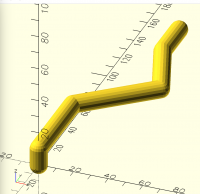

There is Doug Moen's "curv" program. https://curv3d.org/ I think he got
inspired to write it because he didn't like the way OpenSCAD handled
curves.
On Sun, Jul 5, 2026 at 7:27 AM Leonard Martin Struttmann via Discuss <
discuss@lists.openscad.org> wrote:
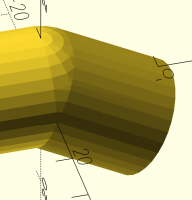
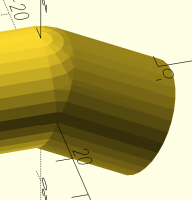
When I use rotate_extruded spheres, and then hull() each sphere-cylinder
combination, I get a "reasonably" good transition:
[image: Screenshot 2026-07-05 at 06.15.28.png]
However, I agree with Raymond. Since OpenSCAD approximates arcs with
segments, I doubt that there is a general solution. We could "What if..."
this to death.
Which begs the question: Could there ever be an evolutionary change to
OpenSCAD to optionally allow for purely mathematically derived arcs?
SIDE QUESTIONS PROBABLY APPROPRIATE FOR ANOTHER FORUM
Are there other serious CAD programs that use purely mathematically
derived arcs? I imagine that there are. Once I found OpenSCAD I stopped
looking at other programs.
Are there CNC machines that use smooth motion motors (rather than stepper
motors) that could realize such models?
OpenSCAD mailing list
To unsubscribe send an email to discuss-leave@lists.openscad.org

What i was trying to say, without using some sort of
blending/hull/whatever for a coarsely segmented sphere and cylinders,
you cannot get the edges to match. For manifold spheres, you can get a
match for 90 deg. I'm not sure if there is any other construction of a
sphere that allows, say, 45 deg angles as well, without other manipulation.
Hulling is OK, but it distorts the facets of the sphere, but depending
on the ultimate objective of using faceted cylinders, then that may not
matter.
On 05/07/2026 14:41, Adrian Mariano via Discuss wrote:
There is Doug Moen's "curv" program. https://curv3d.org/ I think he
got inspired to write it because he didn't like the way OpenSCAD
handled curves.
On Sun, Jul 5, 2026 at 7:27 AM Leonard Martin Struttmann via Discuss
discuss@lists.openscad.org wrote:
 When I use rotate_extruded spheres, and then hull() each
 sphere-cylinder combination, I get a "reasonably" good transition:

 Screenshot 2026-07-05 at 06.15.28.png

 However, I agree with Raymond. Since OpenSCAD approximates arcs
 with segments, I doubt that there is a general solution.  We could
 "What if..." this to death.

 Which begs the question: Could there ever be an evolutionary
 change to OpenSCAD to optionally allow for purely mathematically
 derived arcs?

 SIDE QUESTIONS PROBABLY APPROPRIATE FOR ANOTHER FORUM
 Are there other serious CAD programs that use purely
 mathematically derived arcs? I imagine that there are. Once I
 found OpenSCAD I stopped looking at other programs.

 Are there CNC machines that use smooth motion motors (rather than
 stepper motors) that could realize such models?


 _______________________________________________
 OpenSCAD mailing list
 To unsubscribe send an email to discuss-leave@lists.openscad.org
OpenSCAD mailing list
To unsubscribe send an email todiscuss-leave@lists.openscad.org

On Jul 5, 2026, at 3:38 AM, Raymond West via Discuss discuss@lists.openscad.org wrote:
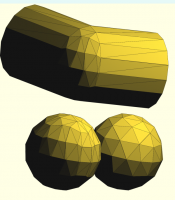
What happens if you add another cylinder at a different angle? Depending on the number of segments and the angle, it may all match up nicely, (90 degree is OK for manifold) but, afaik, there is no general solution, unless near enough is good enough. (angle= 120 deg for image below)
It’s not a sphere, but I think you can always precisely fill the gap using an appropriate less-than-360° rotational extrusion of an appropriate semicircle.