discuss@lists.openscad.org

OpenSCAD general discussion Mailing-list

View all threads

About projection()

RP
Ronaldo Persiano
Wed, Feb 26, 2020 1:29 PM

Thank you Carsten for spending your time to check my example, showing the
Boolean operation is the main culprit for the long running time. Your
analysis almost makes me complacent with the projection() low performance.
But at the end, I have decided to investigate what makes it stuck.

As a test case, I took a torus knot generated by sweeping a circle. To
simplify I have chosen a knot (3,2) which has only 4 areas of projection
overlapping (see attached image).

My test main code was simply:

// geometric data
n = 20;  // section discretization
m = 40 ;  // path discretization
d = 20;  // section radius
R = 400;  // knot major radius
r = 150;  // knot minor radius

p  = 3;
q  = 2;
to = true;
echo(p=p, q=q);
echo(n=n, m=m);

if(to) {
echo("only knot");
sweep(sections(p,q,n,m,d));
}
else{
echo("knot projection");
projection()
sweep(sections(p,q,n,m,d));
}

where sections() generates m circular sections with n points each along a
(3,2) knot path. The full code I have used in my tests is attached. Note
that the circular sections have a radius d very small compared to the torus
major radius. I have ran three cases with 20000 vertices and I got these
time results:

                    just the knot           knot projection

n =  50, m = 400          6 sec                    12 sec
n = 100, m = 200          6 sec                    16 sec
n = 500, m =  40          6 sec                  2 min 45 sec

What makes the last projection so slow? The last one is the case whose
projected polygon has the least number of vertices, estimated as something
near 2*m = 80 point. The reason might be the number of triangles that have
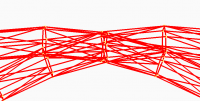
intersection after the projection. My second image shows the detail of one
of those intersections in wireframe view for n=6 and m=40. With n=500, more
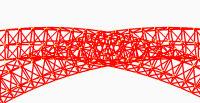
than 2000 triangles overlap at each of the 4 intersections. The third image
shows the detail of the same knot intersections in wireframe view for n=6
and m=200 and it seems that much more triangles overlap when m is
increased. So, the number of overlapping triangles doesn't seem to be the
reason for a long run time of the projection. Two additional tests have
shown the puzzle complexity: with 25000 points (n=500, m=50) the projection
required 2 min and 2 sec and with n=500 and m=80 (40000 vertices) the
projection time was nearly the same: 2 min and 43 sec..

The torus knot seems to be easy to project by silhouette computation
followed by the sweep line algorithm: it may have a lot of silhouette
segments but a few intersections between them. A much harder case for that
algorithm would be a linear_extrusion of a circle with a cleverly chosen
twist and a scale a slightly less than 1.

OpenSCAD projection() performance is still a mystery.
Thank you Carsten for spending your time to check my example, showing the Boolean operation is the main culprit for the long running time. Your analysis almost makes me complacent with the projection() low performance. But at the end, I have decided to investigate what makes it stuck. As a test case, I took a torus knot generated by sweeping a circle. To simplify I have chosen a knot (3,2) which has only 4 areas of projection overlapping (see attached image). My test main code was simply: // geometric data n = 20; // section discretization m = 40 ; // path discretization d = 20; // section radius R = 400; // knot major radius r = 150; // knot minor radius p = 3; q = 2; to = true; echo(p=p, q=q); echo(n=n, m=m); if(to) { echo("only knot"); sweep(sections(p,q,n,m,d)); } else{ echo("knot projection"); projection() sweep(sections(p,q,n,m,d)); } where sections() generates m circular sections with n points each along a (3,2) knot path. The full code I have used in my tests is attached. Note that the circular sections have a radius d very small compared to the torus major radius. I have ran three cases with 20000 vertices and I got these time results: just the knot knot projection n = 50, m = 400 6 sec 12 sec n = 100, m = 200 6 sec 16 sec n = 500, m = 40 6 sec 2 min 45 sec What makes the last projection so slow? The last one is the case whose projected polygon has the least number of vertices, estimated as something near 2*m = 80 point. The reason might be the number of triangles that have intersection after the projection. My second image shows the detail of one of those intersections in wireframe view for n=6 and m=40. With n=500, more than 2000 triangles overlap at each of the 4 intersections. The third image shows the detail of the same knot intersections in wireframe view for n=6 and m=200 and it seems that much more triangles overlap when m is increased. So, the number of overlapping triangles doesn't seem to be the reason for a long run time of the projection. Two additional tests have shown the puzzle complexity: with 25000 points (n=500, m=50) the projection required 2 min and 2 sec and with n=500 and m=80 (40000 vertices) the projection time was nearly the same: 2 min and 43 sec.. The torus knot seems to be easy to project by silhouette computation followed by the sweep line algorithm: it may have a lot of silhouette segments but a few intersections between them. A much harder case for that algorithm would be a linear_extrusion of a circle with a cleverly chosen twist and a scale a slightly less than 1. OpenSCAD projection() performance is still a mystery.