

discuss@lists.openscad.org

OpenSCAD general discussion Mailing-list

View all threads

Set Equal edge length

U
unkerjay
Sun, Dec 23, 2018 11:41 AM

I'm trying to marry equilateral triangles against the sides of a cubic plane.

ALL edges SHOULD be the same length if the base of the triangle, the length
of it's two sides and the cubic plane are all set to the same length.

The problem is, I'm not exactly sure how to go about that.

What would be the easiest way to do that?

I'm trying to test a theory of pattern that builds out equilateral triangles
against cubic planes to see if its possible to build out a fully symmetrical
pattern (or the ways in which it can be done).

But, to do that, I need to know that I'm working with sides of equal length
all around.

I'm not sure, but, I don't think bisecting a square is the same thing?  Is
it?

--
Sent from: http://forum.openscad.org/

I'm trying to marry equilateral triangles against the sides of a cubic plane. ALL edges SHOULD be the same length if the base of the triangle, the length of it's two sides and the cubic plane are all set to the same length. The problem is, I'm not exactly sure how to go about that. What would be the easiest way to do that? I'm trying to test a theory of pattern that builds out equilateral triangles against cubic planes to see if its possible to build out a fully symmetrical pattern (or the ways in which it can be done). But, to do that, I need to know that I'm working with sides of equal length all around. I'm not sure, but, I don't think bisecting a square is the same thing? Is it? -- Sent from: http://forum.openscad.org/
JB
Jordan Brown
Sun, Dec 23, 2018 9:23 PM

On 12/23/2018 3:41 AM, unkerjay wrote:

I'm trying to marry equilateral triangles against the sides of a cubic plane.

What do you mean by "a cubic plane"?

I'm not sure, but, I don't think bisecting a square is the same thing?  Is
it?

No.  An equilateral triangle has angles 60,60,60 and sides 1,1,1.  A
bisected square has angles 45,45,90 and sides 1,1,sqrt(2).  A bisected
square is isoceles (two sides the same) but not equilateral (all three
sides the same).

On 12/23/2018 3:41 AM, unkerjay wrote: > I'm trying to marry equilateral triangles against the sides of a cubic plane. What do you mean by "a cubic plane"? > I'm not sure, but, I don't think bisecting a square is the same thing? Is > it? No.  An equilateral triangle has angles 60,60,60 and sides 1,1,1.  A bisected square has angles 45,45,90 and sides 1,1,sqrt(2).  A bisected square is isoceles (two sides the same) but not equilateral (all three sides the same).
U
unkerjay
Sun, Dec 23, 2018 9:35 PM

Excellent question.

After (not much) careful consideration, I've concluded I meant "square"
rather than "cubic" and
have edited my original post accordingly.

Kind of confirms my thoughts about a bisected square.

I found this for Blender:

https://blender.stackexchange.com/questions/56353/subdivide-hexagon-surface-into-equilateral-triangles

an easy way to generate equilateral triangles and an addon that makes it
easier to adjust edge lengths.

But, it's still a bit of a royal pain trying to move things around and line
them up.  Snapping is an option.

For me, it's a mixed bag trying to use it.

I came up with a bit of an abstract sea turtle playing around with it.

Seems like with all sides the same lengths, there are design possibilities.

Maybe Inkscape?

--
Sent from: http://forum.openscad.org/

Excellent question. After (not much) careful consideration, I've concluded I meant "square" rather than "cubic" and have edited my original post accordingly. Kind of confirms my thoughts about a bisected square. I found this for Blender: https://blender.stackexchange.com/questions/56353/subdivide-hexagon-surface-into-equilateral-triangles an easy way to generate equilateral triangles and an addon that makes it easier to adjust edge lengths. But, it's still a bit of a royal pain trying to move things around and line them up. Snapping is an option. For me, it's a mixed bag trying to use it. I came up with a bit of an abstract sea turtle playing around with it. Seems like with all sides the same lengths, there are design possibilities. Maybe Inkscape? -- Sent from: http://forum.openscad.org/
JB
Jordan Brown
Sun, Dec 23, 2018 9:56 PM

On 12/23/2018 1:35 PM, unkerjay wrote:

After (not much) careful consideration, I've concluded I meant "square"
rather than "cubic" and
have edited my original post accordingly.

Are you looking for something like this?

Here's the OpenSCAD program that generated that:

// Create an equilateral triangle of the specified size.
// [0,0,0] is at the center of the base.
module eqtriangle(side) {
    polygon([
        [-side/2, 0],
        [0, side*sin(60)],
        [side/2, 0]
    ]);
}

side = 10;

color("blue")
    square(side, center=true);

for (a=[0:90:270]) {
    rotate(a)
        translate([0,side/2, 0])
        eqtriangle(side);
}

But note:  you talked, I think, about filling the plane with those
equilateral triangles.  That can never work with a square in the mix,
because each vertex needs 360° and squares have 90° corners while
equilateral triangles have 60° corners.  To fill triangles around the
corner of the square you'd need to fill 270°, but 270 is not a multiple
of 60.  Similarly, if you were talking about putting triangles inside
the square, the corners of the square are 90° and the corners of the
triangles are 60°.
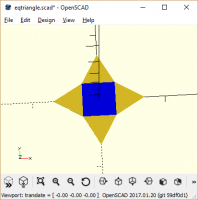
On 12/23/2018 1:35 PM, unkerjay wrote: > After (not much) careful consideration, I've concluded I meant "square" > rather than "cubic" and > have edited my original post accordingly. Are you looking for something like this? Here's the OpenSCAD program that generated that: // Create an equilateral triangle of the specified size. // [0,0,0] is at the center of the base. module eqtriangle(side) { polygon([ [-side/2, 0], [0, side*sin(60)], [side/2, 0] ]); } side = 10; color("blue") square(side, center=true); for (a=[0:90:270]) { rotate(a) translate([0,side/2, 0]) eqtriangle(side); } But note:  you talked, I think, about filling the plane with those equilateral triangles.  That can never work with a square in the mix, because each vertex needs 360° and squares have 90° corners while equilateral triangles have 60° corners.  To fill triangles around the corner of the square you'd need to fill 270°, but 270 is not a multiple of 60.  Similarly, if you were talking about putting triangles inside the square, the corners of the square are 90° and the corners of the triangles are 60°.
U
unkerjay
Sun, Dec 23, 2018 10:48 PM

http://forum.openscad.org/file/t952/equi_tris_squares_JPG.jpg

An example of what I'm shooting for.  Tris and Squares snapped together.

Since it's a bit of an arbitrary process, much the same as having a table
full of
pre-cut tris and squares.  It may not be well suited to OpenSCAD (or Blender
for that matter).

Still, it's useful to know how to create an equi-triangle in OpenSCAD and
how
to snap it as needed.

--
Sent from: http://forum.openscad.org/

<http://forum.openscad.org/file/t952/equi_tris_squares_JPG.jpg> An example of what I'm shooting for. Tris and Squares snapped together. Since it's a bit of an arbitrary process, much the same as having a table full of pre-cut tris and squares. It may not be well suited to OpenSCAD (or Blender for that matter). Still, it's useful to know how to create an equi-triangle in OpenSCAD and how to snap it as needed. -- Sent from: http://forum.openscad.org/
JB
Jordan Brown
Mon, Dec 24, 2018 12:15 AM

On 12/23/2018 2:48 PM, unkerjay wrote:

http://forum.openscad.org/file/t952/equi_tris_squares_JPG.jpg

An example of what I'm shooting for.  Tris and Squares snapped together.

Since it's a bit of an arbitrary process, much the same as having a table
full of
pre-cut tris and squares.  It may not be well suited to OpenSCAD (or Blender
for that matter).

Still, it's useful to know how to create an equi-triangle in OpenSCAD and
how
to snap it as needed.

Yeah, you could do that pattern; you'd have to figure out what the
pattern is for the transforms.

I don't have time right now to do the math to write a program to
generate that pattern.

You'd also have to figure out what the pattern is to walk all of the
shapes in some finite area without repeating any.

On 12/23/2018 2:48 PM, unkerjay wrote: > <http://forum.openscad.org/file/t952/equi_tris_squares_JPG.jpg> > > An example of what I'm shooting for. Tris and Squares snapped together. > > Since it's a bit of an arbitrary process, much the same as having a table > full of > pre-cut tris and squares. It may not be well suited to OpenSCAD (or Blender > for that matter). > > Still, it's useful to know how to create an equi-triangle in OpenSCAD and > how > to snap it as needed. Yeah, you could do that pattern; you'd have to figure out what the pattern is for the transforms. I don't have time right now to do the math to write a program to generate that pattern. You'd also have to figure out what the pattern is to walk all of the shapes in some finite area without repeating any.
RP
Ronaldo Persiano
Tue, Dec 25, 2018 10:57 AM

Interesting plane partition. It seems that it could be built from a basic
tile with proper translations and rotations.

sq3 = pow (3,1/2);
trih = sq3/2;

module hexTile() { // tile with unitary edge
colorido("blue")
square(1,center=true);
color("yellow")
translate ([0,1/2 +trih/3 ]) triangle();
color ("red")
translate (([0,-1/2 -trih/3 ]) triangle();
}

module triangle()
circle (1/sq3, $fn=3);

I guess I have a full partition solution but I don't want to spoil your fun
of finding it.

Have fun and Merry Christmas!

> <http://forum.openscad.org/file/t952/equi_tris_squares_JPG.jpg> Interesting plane partition. It seems that it could be built from a basic tile with proper translations and rotations. sq3 = pow (3,1/2); trih = sq3/2; module hexTile() { // tile with unitary edge colorido("blue") square(1,center=true); color("yellow") translate ([0,1/2 +trih/3 ]) triangle(); color ("red") translate (([0,-1/2 -trih/3 ]) triangle(); } module triangle() circle (1/sq3, $fn=3); I guess I have a full partition solution but I don't want to spoil your fun of finding it. Have fun and Merry Christmas!
RP
Ronaldo Persiano
Tue, Dec 25, 2018 11:56 AM

I don't have a computer to check it out. Inside hexTile() I should written:

color ("red")
translate (([0,-1/2 -trih/3 ]) rotate(180) triangle();

Na(o) terça, 25/12/2018, 10:57, Ronaldo Persiano rcmpersiano@gmail.com
escreveu:

http://forum.openscad.org/file/t952/equi_tris_squares_JPG.jpg

Interesting plane partition. It seems that it could be built from a basic
tile with proper translations and rotations.

sq3 = pow (3,1/2);
trih = sq3/2;

module hexTile() { // tile with unitary edge
colorido("blue")
square(1,center=true);
color("yellow")
translate ([0,1/2 +trih/3 ]) triangle();
color ("red")
translate (([0,-1/2 -trih/3 ]) triangle();
}

module triangle()
circle (1/sq3, $fn=3);

I guess I have a full partition solution but I don't want to spoil your
fun of finding it.

Have fun and Merry Christmas!

I don't have a computer to check it out. Inside hexTile() I should written: color ("red") translate (([0,-1/2 -trih/3 ]) rotate(180) triangle(); Na(o) terça, 25/12/2018, 10:57, Ronaldo Persiano <rcmpersiano@gmail.com> escreveu: > > <http://forum.openscad.org/file/t952/equi_tris_squares_JPG.jpg> > > > Interesting plane partition. It seems that it could be built from a basic > tile with proper translations and rotations. > > sq3 = pow (3,1/2); > trih = sq3/2; > > module hexTile() { // tile with unitary edge > colorido("blue") > square(1,center=true); > color("yellow") > translate ([0,1/2 +trih/3 ]) triangle(); > color ("red") > translate (([0,-1/2 -trih/3 ]) triangle(); > } > > module triangle() > circle (1/sq3, $fn=3); > > I guess I have a full partition solution but I don't want to spoil your > fun of finding it. > > Have fun and Merry Christmas! > > >