

MN
Maël Naccache
Wed, Mar 2, 2016 8:29 AM
Hello !
In a software I'm developping, I'm trying to use OpenSCAD to generate a
3D model of one of the parts that the software is computing.
The thing I'm trying to make is usually a big cylinder with a lot of
holes in it (can range from around a hundred holes to a few thousand).
So naively, I did the following to generate it :
- 1 : draw the "big" cylinder.
- 2 : draw every hole has a tiny cylinder with the same height has the
big one.
- 3 : Use difference() with the big cylinder and all the tiny cylinder.
So something like this in OpenSCAD (I've attached an exemple of what my
software generate) :
difference() {
cylinder(1.000000,400.000000,400.000000,true);
union() {
translate([0.000000,0.000000,0.000000]) {
cylinder(1.000000,6.500000,6.500000,true); }
translate([31.180000,0.000000,0.000000]) {
cylinder(1.000000,6.500000,6.500000,true); }
translate([-31.180000,0.000000,0.000000]) {
cylinde(1.000000,6.500000,6.500000,true); }
translate([62.350000,0.000000,0.000000]) {
cylinder(1.000000,6.500000,6.500000,true); }
.......
}
}
My problem is that, even though the preview works great, when trying to
render the mesh, it can take around half an hour to an hour and a half
to complete, even with a fairly powerful PC and with the last version of
OpenSCAD (2016.01.27).
I tried to tweak around using $fn, $fa and $fs, but the rendering time
is still very long.
So, I was wondering if my method was completly wrong or if there was any
advice you could give me to lower the rendering time.
Faithfully yours,
Maël Naccache contact@maeln.com
Président de l'association Rally Point : rallypoint.fr

Hello !
In a software I'm developping, I'm trying to use OpenSCAD to generate a
3D model of one of the parts that the software is computing.
The thing I'm trying to make is usually a big cylinder with a lot of
holes in it (can range from around a hundred holes to a few thousand).
So naively, I did the following to generate it :
- 1 : draw the "big" cylinder.
- 2 : draw every hole has a tiny cylinder with the same height has the
big one.
- 3 : Use difference() with the big cylinder and all the tiny cylinder.
So something like this in OpenSCAD (I've attached an exemple of what my
software generate) :
difference() {
cylinder(1.000000,400.000000,400.000000,true);
union() {
translate([0.000000,0.000000,0.000000]) {
cylinder(1.000000,6.500000,6.500000,true); }
translate([31.180000,0.000000,0.000000]) {
cylinder(1.000000,6.500000,6.500000,true); }
translate([-31.180000,0.000000,0.000000]) {
cylinde(1.000000,6.500000,6.500000,true); }
translate([62.350000,0.000000,0.000000]) {
cylinder(1.000000,6.500000,6.500000,true); }
.......
}
}
My problem is that, even though the preview works great, when trying to
render the mesh, it can take around half an hour to an hour and a half
to complete, even with a fairly powerful PC and with the last version of
OpenSCAD (2016.01.27).
I tried to tweak around using $fn, $fa and $fs, but the rendering time
is still very long.
So, I was wondering if my method was completly wrong or if there was any
advice you could give me to lower the rendering time.
Faithfully yours,
--
Maël Naccache <contact@maeln.com>
Président de l'association Rally Point : rallypoint.fr
NH
nop head
Wed, Mar 2, 2016 10:08 AM
It will be much faster if you do it in 2D with circles and then
linear_extrude it to make the cylinder.
On 2 March 2016 at 08:29, Maël Naccache contact@maeln.com wrote:
Hello !
In a software I'm developping, I'm trying to use OpenSCAD to generate a 3D
model of one of the parts that the software is computing.
The thing I'm trying to make is usually a big cylinder with a lot of holes
in it (can range from around a hundred holes to a few thousand).
So naively, I did the following to generate it :
- 1 : draw the "big" cylinder.
- 2 : draw every hole has a tiny cylinder with the same height has the
big one.
- 3 : Use difference() with the big cylinder and all the tiny cylinder.
So something like this in OpenSCAD (I've attached an exemple of what my
software generate) :
difference() {
cylinder(1.000000,400.000000,400.000000,true);
union() {
translate([0.000000,0.000000,0.000000]) {
cylinder(1.000000,6.500000,6.500000,true); }
translate([31.180000,0.000000,0.000000]) {
cylinder(1.000000,6.500000,6.500000,true); }
translate([-31.180000,0.000000,0.000000]) {
cylinde(1.000000,6.500000,6.500000,true); }
translate([62.350000,0.000000,0.000000]) {
cylinder(1.000000,6.500000,6.500000,true); }
.......
}
}
My problem is that, even though the preview works great, when trying to
render the mesh, it can take around half an hour to an hour and a half to
complete, even with a fairly powerful PC and with the last version of
OpenSCAD (2016.01.27).
I tried to tweak around using $fn, $fa and $fs, but the rendering time is
still very long.
So, I was wondering if my method was completly wrong or if there was any
advice you could give me to lower the rendering time.
Faithfully yours,
Maël Naccache contact@maeln.com
Président de l'association Rally Point : rallypoint.fr
OpenSCAD mailing list
Discuss@lists.openscad.org
http://lists.openscad.org/mailman/listinfo/discuss_lists.openscad.org
It will be much faster if you do it in 2D with circles and then
linear_extrude it to make the cylinder.
On 2 March 2016 at 08:29, Maël Naccache <contact@maeln.com> wrote:
> Hello !
>
> In a software I'm developping, I'm trying to use OpenSCAD to generate a 3D
> model of one of the parts that the software is computing.
>
> The thing I'm trying to make is usually a big cylinder with a lot of holes
> in it (can range from around a hundred holes to a few thousand).
>
> So naively, I did the following to generate it :
> - 1 : draw the "big" cylinder.
> - 2 : draw every hole has a tiny cylinder with the same height has the
> big one.
> - 3 : Use difference() with the big cylinder and all the tiny cylinder.
>
> So something like this in OpenSCAD (I've attached an exemple of what my
> software generate) :
>
> difference() {
> cylinder(1.000000,400.000000,400.000000,true);
> union() {
> translate([0.000000,0.000000,0.000000]) {
> cylinder(1.000000,6.500000,6.500000,true); }
> translate([31.180000,0.000000,0.000000]) {
> cylinder(1.000000,6.500000,6.500000,true); }
> translate([-31.180000,0.000000,0.000000]) {
> cylinde(1.000000,6.500000,6.500000,true); }
> translate([62.350000,0.000000,0.000000]) {
> cylinder(1.000000,6.500000,6.500000,true); }
> .......
> }
> }
>
> My problem is that, even though the preview works great, when trying to
> render the mesh, it can take around half an hour to an hour and a half to
> complete, even with a fairly powerful PC and with the last version of
> OpenSCAD (2016.01.27).
> I tried to tweak around using $fn, $fa and $fs, but the rendering time is
> still very long.
>
> So, I was wondering if my method was completly wrong or if there was any
> advice you could give me to lower the rendering time.
>
> Faithfully yours,
> --
> Maël Naccache <contact@maeln.com>
> Président de l'association Rally Point : rallypoint.fr
> _______________________________________________
> OpenSCAD mailing list
> Discuss@lists.openscad.org
> http://lists.openscad.org/mailman/listinfo/discuss_lists.openscad.org
>
>
RP
Ronaldo Persiano
Wed, Mar 2, 2016 4:43 PM
In a few tests I tried, the rendering time is almost one third when the
hole cylinders have a height greater than the base one. Anyway, avoiding
coincident faces in CSG operations is a good practice.
2016-03-02 7:08 GMT-03:00 nop head nop.head@gmail.com:
It will be much faster if you do it in 2D with circles and then
linear_extrude it to make the cylinder.
On 2 March 2016 at 08:29, Maël Naccache contact@maeln.com wrote:
Hello !
In a software I'm developping, I'm trying to use OpenSCAD to generate a
3D model of one of the parts that the software is computing.
The thing I'm trying to make is usually a big cylinder with a lot of
holes in it (can range from around a hundred holes to a few thousand).
So naively, I did the following to generate it :
- 1 : draw the "big" cylinder.
- 2 : draw every hole has a tiny cylinder with the same height has the
big one.
- 3 : Use difference() with the big cylinder and all the tiny cylinder.
So something like this in OpenSCAD (I've attached an exemple of what my
software generate) :
difference() {
cylinder(1.000000,400.000000,400.000000,true);
union() {
translate([0.000000,0.000000,0.000000]) {
cylinder(1.000000,6.500000,6.500000,true); }
translate([31.180000,0.000000,0.000000]) {
cylinder(1.000000,6.500000,6.500000,true); }
translate([-31.180000,0.000000,0.000000]) {
cylinde(1.000000,6.500000,6.500000,true); }
translate([62.350000,0.000000,0.000000]) {
cylinder(1.000000,6.500000,6.500000,true); }
.......
}
}
My problem is that, even though the preview works great, when trying to
render the mesh, it can take around half an hour to an hour and a half to
complete, even with a fairly powerful PC and with the last version of
OpenSCAD (2016.01.27).
I tried to tweak around using $fn, $fa and $fs, but the rendering time is
still very long.
So, I was wondering if my method was completly wrong or if there was any
advice you could give me to lower the rendering time.
Faithfully yours,
Maël Naccache contact@maeln.com
Président de l'association Rally Point : rallypoint.fr
OpenSCAD mailing list
Discuss@lists.openscad.org
http://lists.openscad.org/mailman/listinfo/discuss_lists.openscad.org
In a few tests I tried, the rendering time is almost one third when the
hole cylinders have a height greater than the base one. Anyway, avoiding
coincident faces in CSG operations is a good practice.
2016-03-02 7:08 GMT-03:00 nop head <nop.head@gmail.com>:
> It will be much faster if you do it in 2D with circles and then
> linear_extrude it to make the cylinder.
>
>
> On 2 March 2016 at 08:29, Maël Naccache <contact@maeln.com> wrote:
>
>> Hello !
>>
>> In a software I'm developping, I'm trying to use OpenSCAD to generate a
>> 3D model of one of the parts that the software is computing.
>>
>> The thing I'm trying to make is usually a big cylinder with a lot of
>> holes in it (can range from around a hundred holes to a few thousand).
>>
>> So naively, I did the following to generate it :
>> - 1 : draw the "big" cylinder.
>> - 2 : draw every hole has a tiny cylinder with the same height has the
>> big one.
>> - 3 : Use difference() with the big cylinder and all the tiny cylinder.
>>
>> So something like this in OpenSCAD (I've attached an exemple of what my
>> software generate) :
>>
>> difference() {
>> cylinder(1.000000,400.000000,400.000000,true);
>> union() {
>> translate([0.000000,0.000000,0.000000]) {
>> cylinder(1.000000,6.500000,6.500000,true); }
>> translate([31.180000,0.000000,0.000000]) {
>> cylinder(1.000000,6.500000,6.500000,true); }
>> translate([-31.180000,0.000000,0.000000]) {
>> cylinde(1.000000,6.500000,6.500000,true); }
>> translate([62.350000,0.000000,0.000000]) {
>> cylinder(1.000000,6.500000,6.500000,true); }
>> .......
>> }
>> }
>>
>> My problem is that, even though the preview works great, when trying to
>> render the mesh, it can take around half an hour to an hour and a half to
>> complete, even with a fairly powerful PC and with the last version of
>> OpenSCAD (2016.01.27).
>> I tried to tweak around using $fn, $fa and $fs, but the rendering time is
>> still very long.
>>
>> So, I was wondering if my method was completly wrong or if there was any
>> advice you could give me to lower the rendering time.
>>
>> Faithfully yours,
>> --
>> Maël Naccache <contact@maeln.com>
>> Président de l'association Rally Point : rallypoint.fr
>> _______________________________________________
>> OpenSCAD mailing list
>> Discuss@lists.openscad.org
>> http://lists.openscad.org/mailman/listinfo/discuss_lists.openscad.org
>>
>>
>
> _______________________________________________
> OpenSCAD mailing list
> Discuss@lists.openscad.org
> http://lists.openscad.org/mailman/listinfo/discuss_lists.openscad.org
>
>
J
jpmendes
Thu, Mar 3, 2016 1:13 AM
Hello,
You may try something like this:
//parametric code
DefaultSides=16;
nLines=10;
nCols=50;
hPitch=10;
vPitch=10;
Dout=6;
Din=0;
Sides=24;
cHeight=1;
tHeight=cHeight+2;
Angl=360;
cRad = (nLines <= nCols)? (nColshPitch+4hPitch)/2 :
(nLinesvPitch+4vPitch)/2;
module Tube(Length,Dout,Din,Sides,Angl) // render(convexity=4)
{
NSides= (Sides < 3 || Sides==undef) ? DefaultSides : Sides;
rotate_extrude( angle=Angl, convexity=4, $fn=NSides )
translate([Din/2,0,0])
square([(Dout-Din)/2,Length]);
}
module MultiTubes()
{
for (i=[0:nLines-1]){
for (j=[0:nCols-1]){
shift=ceil(j/2)-floor(j/2);
translate([jhPitch,ivPitch+shift*(hPitch/2),cHeight/2-1])
Tube(tHeight,Dout,Din,Sides,Angl);
}
}
}
//MultiTubes();
module PerfuratedCylinder() render(convexity=10)
{
difference(){
translate([(nCols-1)*hPitch/2,(nLines-1)*vPitch/2, cHeight/2])
cylinder(h=cHeight, r=cRad, $fn=48);
MultiTubes();
}
}
PerfuratedCylinder();
//end code
Cheers
jpmendes
--
View this message in context: http://forum.openscad.org/Long-rendering-time-when-using-difference-with-a-lot-of-objects-tp16268p16271.html
Sent from the OpenSCAD mailing list archive at Nabble.com.
Hello,
You may try something like this:
//parametric code
DefaultSides=16;
nLines=10;
nCols=50;
hPitch=10;
vPitch=10;
Dout=6;
Din=0;
Sides=24;
cHeight=1;
tHeight=cHeight+2;
Angl=360;
cRad = (nLines <= nCols)? (nCols*hPitch+4*hPitch)/2 :
(nLines*vPitch+4*vPitch)/2;
module Tube(Length,Dout,Din,Sides,Angl) // render(convexity=4)
{
NSides= (Sides < 3 || Sides==undef) ? DefaultSides : Sides;
rotate_extrude( angle=Angl, convexity=4, $fn=NSides )
translate([Din/2,0,0])
square([(Dout-Din)/2,Length]);
}
module MultiTubes()
{
for (i=[0:nLines-1]){
for (j=[0:nCols-1]){
shift=ceil(j/2)-floor(j/2);
translate([j*hPitch,i*vPitch+shift*(hPitch/2),cHeight/2-1])
Tube(tHeight,Dout,Din,Sides,Angl);
}
}
}
//MultiTubes();
module PerfuratedCylinder() render(convexity=10)
{
difference(){
translate([(nCols-1)*hPitch/2,(nLines-1)*vPitch/2, cHeight/2])
cylinder(h=cHeight, r=cRad, $fn=48);
MultiTubes();
}
}
PerfuratedCylinder();
//end code
Cheers
jpmendes
--
View this message in context: http://forum.openscad.org/Long-rendering-time-when-using-difference-with-a-lot-of-objects-tp16268p16271.html
Sent from the OpenSCAD mailing list archive at Nabble.com.
MN
Maël Naccache
Thu, Mar 3, 2016 7:45 AM
Le 2016-03-02 11:08, nop head a écrit :
It will be much faster if you do it in 2D with circles and then
linear_extrude it to make the cylinder.
I tried your solution. Using circle make it way faster, but when I do
the linear_extrude,
it take nearly the same amount of time has my previous method :/ .
Le 2016-03-02 17:43, Ronaldo Persiano a écrit :
In a few tests I tried, the rendering time is almost one third when
the hole cylinders have a height greater than the base one. Anyway,
avoiding coincident faces in CSG operations is a good practice.
Thanks for the tips :) !
Le 2016-03-03 02:13, jpmendes a écrit :
Hello,
You may try something like this:
//parametric code
DefaultSides=16;
nLines=10;
nCols=50;
hPitch=10;
vPitch=10;
Dout=6;
Din=0;
Sides=24;
cHeight=1;
tHeight=cHeight+2;
Angl=360;
cRad = (nLines <= nCols)? (nColshPitch+4hPitch)/2 :
(nLinesvPitch+4vPitch)/2;
module Tube(Length,Dout,Din,Sides,Angl) // render(convexity=4)
{
NSides= (Sides < 3 || Sides==undef) ? DefaultSides : Sides;
rotate_extrude( angle=Angl, convexity=4, $fn=NSides )
translate([Din/2,0,0])
square([(Dout-Din)/2,Length]);
}
module MultiTubes()
{
for (i=[0:nLines-1]){
for (j=[0:nCols-1]){
shift=ceil(j/2)-floor(j/2);
translate([jhPitch,ivPitch+shift*(hPitch/2),cHeight/2-1])
Tube(tHeight,Dout,Din,Sides,Angl);
}
}
}
//MultiTubes();
module PerfuratedCylinder() render(convexity=10)
{
difference(){
translate([(nCols-1)*hPitch/2,(nLines-1)*vPitch/2, cHeight/2])
cylinder(h=cHeight, r=cRad, $fn=48);
MultiTubes();
}
}
PerfuratedCylinder();
//end code
Cheers
jpmendes
Thanks, I will try it.
Maël Naccache contact@maeln.com
Président de l'association Rally Point : rallypoint.fr
Le 2016-03-02 11:08, nop head a écrit :
> It will be much faster if you do it in 2D with circles and then
> linear_extrude it to make the cylinder.
I tried your solution. Using circle make it way faster, but when I do
the linear_extrude,
it take nearly the same amount of time has my previous method :/ .
Le 2016-03-02 17:43, Ronaldo Persiano a écrit :
> In a few tests I tried, the rendering time is almost one third when
> the hole cylinders have a height greater than the base one. Anyway,
> avoiding coincident faces in CSG operations is a good practice.
Thanks for the tips :) !
Le 2016-03-03 02:13, jpmendes a écrit :
> Hello,
>
> You may try something like this:
>
> //parametric code
>
> DefaultSides=16;
> nLines=10;
> nCols=50;
> hPitch=10;
> vPitch=10;
> Dout=6;
> Din=0;
> Sides=24;
> cHeight=1;
> tHeight=cHeight+2;
> Angl=360;
> cRad = (nLines <= nCols)? (nCols*hPitch+4*hPitch)/2 :
> (nLines*vPitch+4*vPitch)/2;
>
> module Tube(Length,Dout,Din,Sides,Angl) // render(convexity=4)
> {
> NSides= (Sides < 3 || Sides==undef) ? DefaultSides : Sides;
> rotate_extrude( angle=Angl, convexity=4, $fn=NSides )
> translate([Din/2,0,0])
> square([(Dout-Din)/2,Length]);
> }
>
> module MultiTubes()
> {
> for (i=[0:nLines-1]){
> for (j=[0:nCols-1]){
> shift=ceil(j/2)-floor(j/2);
> translate([j*hPitch,i*vPitch+shift*(hPitch/2),cHeight/2-1])
> Tube(tHeight,Dout,Din,Sides,Angl);
> }
> }
> }
>
> //MultiTubes();
>
> module PerfuratedCylinder() render(convexity=10)
> {
> difference(){
> translate([(nCols-1)*hPitch/2,(nLines-1)*vPitch/2, cHeight/2])
> cylinder(h=cHeight, r=cRad, $fn=48);
> MultiTubes();
> }
> }
> PerfuratedCylinder();
>
> //end code
>
> Cheers
> jpmendes
Thanks, I will try it.
--
Maël Naccache <contact@maeln.com>
Président de l'association Rally Point : rallypoint.fr
A
arnholm@arnholm.org
Thu, Mar 3, 2016 10:05 AM
On 2016-03-03 08:45, Maël Naccache wrote:
Using circle make it way faster, but when I do
the linear_extrude,
it take nearly the same amount of time has my previous method :/ .
Do you have a more complete example of your code that takes a long time?
I may want to experiment. Is it just a question of subtracting a lot of
small cylinders from a large one?
Carsten Arnholm
On 2016-03-03 08:45, Maël Naccache wrote:
> Using circle make it way faster, but when I do
> the linear_extrude,
> it take nearly the same amount of time has my previous method :/ .
Do you have a more complete example of your code that takes a long time?
I may want to experiment. Is it just a question of subtracting a lot of
small cylinders from a large one?
Carsten Arnholm
MN
Maël Naccache
Thu, Mar 3, 2016 10:39 AM
Do you have a more complete example of your code that takes a long
time? I may want to experiment. Is it just a question of subtracting a
lot of small cylinders from a large one?
Carsten Arnholm
I've attached two exemple that takes a long time to render.
The first one (circle_extrude1.scad) use nophead idea (circles then
lines_extrude),
the second one (cylinder_higher1.scad) use Ronaldo tip (the cylinder for
the hole have a height superior to the main cylinder).
Yep, that's just it, I want to substract a lot of small cylinders (who
share the same size) from a big one.
Maël Naccache contact@maeln.com
Président de l'association Rally Point : rallypoint.fr
Le 2016-03-03 11:05, arnholm@arnholm.org a écrit :
> Do you have a more complete example of your code that takes a long
> time? I may want to experiment. Is it just a question of subtracting a
> lot of small cylinders from a large one?
>
> Carsten Arnholm
I've attached two exemple that takes a long time to render.
The first one (circle_extrude1.scad) use nophead idea (circles then
lines_extrude),
the second one (cylinder_higher1.scad) use Ronaldo tip (the cylinder for
the hole have a height superior to the main cylinder).
Yep, that's just it, I want to substract a lot of small cylinders (who
share the same size) from a big one.
--
Maël Naccache <contact@maeln.com>
Président de l'association Rally Point : rallypoint.fr
A
arnholm@arnholm.org
Thu, Mar 3, 2016 1:00 PM
On 2016-03-03 11:39, Maël Naccache wrote:
I've attached two exemple that takes a long time to render.
Thanks. However, it seems your attachments didn't make it through (or
there is something wrong with my mail reader).
Yep, that's just it, I want to substract a lot of small cylinders (who
share the same size) from a big one.
Ok, that's easy enough to simulate directly, i will give it a go.
Regards
Carsten Arnholm
On 2016-03-03 11:39, Maël Naccache wrote:
> I've attached two exemple that takes a long time to render.
Thanks. However, it seems your attachments didn't make it through (or
there is something wrong with my mail reader).
> Yep, that's just it, I want to substract a lot of small cylinders (who
> share the same size) from a big one.
Ok, that's easy enough to simulate directly, i will give it a go.
Regards
Carsten Arnholm
NH
nop head
Thu, Mar 3, 2016 1:24 PM
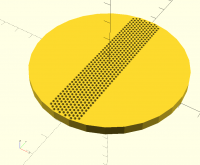
I found circle_extrude1.scad to be instantaneous for F6 in
OpenScad2015.05.16 (git e673fff) .
Total rendering time: 0 hours, 0 minutes, 0 seconds
Top level object is a 3D object:
Facets: 59016
The reason is it doesn't use GCAL for 2D or linear extrude.
Are you using an old version of OpenScad? It used to use GCAL for 2D.
On 3 March 2016 at 13:00, arnholm@arnholm.org wrote:
On 2016-03-03 11:39, Maël Naccache wrote:
I've attached two exemple that takes a long time to render.
Thanks. However, it seems your attachments didn't make it through (or
there is something wrong with my mail reader).
Yep, that's just it, I want to substract a lot of small cylinders (who
share the same size) from a big one.
I found circle_extrude1.scad to be instantaneous for F6 in
OpenScad2015.05.16 (git e673fff) .
Total rendering time: 0 hours, 0 minutes, 0 seconds
Top level object is a 3D object:
Facets: 59016
The reason is it doesn't use GCAL for 2D or linear extrude.
Are you using an old version of OpenScad? It used to use GCAL for 2D.
On 3 March 2016 at 13:00, <arnholm@arnholm.org> wrote:
> On 2016-03-03 11:39, Maël Naccache wrote:
>
>> I've attached two exemple that takes a long time to render.
>>
>
> Thanks. However, it seems your attachments didn't make it through (or
> there is something wrong with my mail reader).
>
> Yep, that's just it, I want to substract a lot of small cylinders (who
>> share the same size) from a big one.
>>
>
> Ok, that's easy enough to simulate directly, i will give it a go.
>
> Regards
>
> Carsten Arnholm
>
> _______________________________________________
> OpenSCAD mailing list
> Discuss@lists.openscad.org
> http://lists.openscad.org/mailman/listinfo/discuss_lists.openscad.org
>
MN
Maël Naccache
Thu, Mar 3, 2016 2:08 PM
On 2016-03-03 11:39, Maël Naccache wrote:
I've attached two exemple that takes a long time to render.
Thanks. However, it seems your attachments didn't make it through (or
there is something wrong with my mail reader).
I found circle_extrude1.scad to be instantaneous for F6 in
OpenScad2015.05.16 (git e673fff) .
Total rendering time: 0 hours, 0 minutes, 0 seconds
Top level object is a 3D object:
Facets: 59016
The reason is it doesn't use GCAL for 2D or linear extrude.
Are you using an old version of OpenScad? It used to use GCAL for 2D.
Oops, sorry, forgot to mention that I do most of my test on the version
2014.03 (I only have access to this version at work, but I can probably
update it), when I get back home, I will try your solution. Thanks :) !
Maël Naccache contact@maeln.com
Président de l'association Rally Point : rallypoint.fr
Le 2016-03-03 14:00, arnholm@arnholm.org a écrit :
> On 2016-03-03 11:39, Maël Naccache wrote:
>> I've attached two exemple that takes a long time to render.
>
> Thanks. However, it seems your attachments didn't make it through (or
> there is something wrong with my mail reader).
Everything seems ok on my side, but I've pasted them just in case :
http://paste.ubuntu.com/15273519/ - circle_extrude1.scad.
http://paste.ubuntu.com/15273525/ - cylinder_higher1.scad.
Le 2016-03-03 14:24, nop head a écrit :
> I found circle_extrude1.scad to be instantaneous for F6 in
> OpenScad2015.05.16 (git e673fff) .
>
> Total rendering time: 0 hours, 0 minutes, 0 seconds
>
> Top level object is a 3D object:
>
> Facets: 59016
>
> The reason is it doesn't use GCAL for 2D or linear extrude.
>
>
>
> Are you using an old version of OpenScad? It used to use GCAL for 2D.
Oops, sorry, forgot to mention that I do most of my test on the version
2014.03 (I only have access to this version at work, but I can probably
update it), when I get back home, I will try your solution. Thanks :) !
--
Maël Naccache <contact@maeln.com>
Président de l'association Rally Point : rallypoint.fr