

Gear looks weird

Using the code
include <MCAD/gears.scad>
gear(number_of_teeth=10,circular_pitch=200);
I get the picture as enclosed, where the teeth do no show a nice curve, and even seem to be larger at the tip than at the bottom.
What did I make wrong? Shouldn't it look like the involute at Wikipedia, i.e. like
http://en.wikipedia.org/wiki/Involute_gear
Rainer
--
Rainer Glaschick, Paderborn, Germany
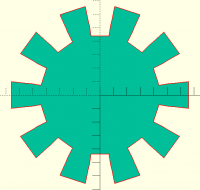

Perhaps you want involute_gear_tooth()?
Unless specifically shown otherwise above, my contribution is in the Public Domain; To the extent possible under law, I have waived all copyright and related or neighbouring rights to this work. This work is published globally via the internet. :) Inclusion of works of previous authors is not included in the above.
The TPP is no simple “trade agreement.” Fight it! http://www.ourfairdeal.org/
View this message in context: http://forum.openscad.org/Gear-looks-weird-tp12616p12617.html
Sent from the OpenSCAD mailing list archive at Nabble.com.
On 11.05.2015 13:38, MichaelAtOz wrote:
Perhaps you want involute_gear_tooth()?
Well, the function/module gear() uses involute_gear_tooth() to create the tooth, and I think this is a more or less internal subroutine.
The module test_gears() just uses gear(), but the gears produced look also not encouraging.
So my question is if someone has already successfully created nice working gears with the library, and how this is done.
Rainer
Perhaps you want MCAD\involute_gears.scad
http://forum.openscad.org/file/n12619/involute_gears.jpg
Unless specifically shown otherwise above, my contribution is in the Public Domain; To the extent possible under law, I have waived all copyright and related or neighbouring rights to this work. This work is published globally via the internet. :) Inclusion of works of previous authors is not included in the above.
The TPP is no simple “trade agreement.” Fight it! http://www.ourfairdeal.org/
View this message in context: http://forum.openscad.org/Gear-looks-weird-tp12616p12619.html
Sent from the OpenSCAD mailing list archive at Nabble.com.

On 2015-05-11 14:36, MichaelAtOz wrote:
I think that is a good idea. I used it some time ago with success, see
example at
http://arnholm.org/printing-3d-gears/
I found that the terminology of gears is somewhat (completely?)
inconsistent and depending on "who you talk to". It makes it hard if you
have not done this before as was the case for me.
In the example on that page I managed to print a gear that successfully
replaced a stripped plastic gear in a car ventilation system. It still
works :-)
Carsten Arnholm

On Mon, May 11, 2015 at 02:17:50PM +0200, Rainer Glaschick wrote:
On 11.05.2015 13:38, MichaelAtOz wrote:
Perhaps you want involute_gear_tooth()?
Well, the function/module gear() uses involute_gear_tooth() to create the
tooth, and I think this is a more or less internal subroutine.
The module test_gears() just uses gear(), but the gears produced look also not encouraging.
So my question is if someone has already successfully created nice working
gears with the library, and how this is done.
Here's my replacement shredder gear, scad included:
http://www.thingiverse.com/thing:343602/
It uses the gear from MCAD/gears/involute_gears.scad from the dev branch, but
<MCAD/involute_gears.scad> from the latest MCAD release should work just as
well.
The most confusing thing about the involute_gears.scad module is that gear()'s
circular pitch is defined in terms of actual circular pitch / PI * 180, so you
need to flip that around. For convenience's sake, and to preserve the meaning of
circular_pitch so that older designs may continue working, I have created a
function called convertcp() that handles this for you.
Here's a sample spur gear:
use <MCAD/gears/involute_gears.scad>
gear (
number_of_teeth = 20,
circular_pitch = convertcp (5),
gear_thickness = 5,
rim_width = 2,
hub_diameter = 10,
bore_dimaeter = 8,
circles = 7
);
--
Kind regards,
Loong Jin