

discuss@lists.openscad.org

OpenSCAD general discussion Mailing-list

View all threads

[semi-on-topic] print speed optimized sinus support material. integration interface possible??

P
pproj
Thu, Mar 10, 2016 12:12 AM

Hello Everyone
i am sorry if i am not off-topic with this,hope it is ok

i have thrown together a javascript tool to semi-automatically create
continuous sinusoidal support for my openscad models .i tried but failed
to implement it using  scad language only.

its aim is to minimize sharp corners and empty head moves(with filament
retractions) in the  inbuilt support of my openscad model.

in case you want to have a look,  i have put together some instructions
and put the tool on the github:
https://github.com/solidboredom/sinus-support/

After putting quite some effort into an .scad version of it, i could not
figure a possibility to make it continous around the parts outline
using openscad only, so i have aborted my efforts and created this
javascript tool.

external tool makes  the whole process more complicated, you have to
export SVG  and import twice.
so how could i simplify the process? is the only  way to implement
something like this directly in the source-code of openscad source?

reason i have made it:
i  was unhappy with slic3r generated support for long time.
it works very good on simple parts, but It fails quite a lot on my
complex models, and it fills all gaps in any height. i only wanted to
support the part from below.
the simple inbuilt support i have created before using n openscad  only,
always been slowing down my print because of discontinuities and sharp
corners.

so is this  possible to streamline the exchange between openscad and
javascript? (i actually do not think so)  is it time for an open
interface for openscad?

Peter

Hello Everyone i am sorry if i am not off-topic with this,hope it is ok i have thrown together a javascript tool to semi-automatically create continuous sinusoidal support for my openscad models .i tried but failed to implement it using scad language only. its aim is to minimize sharp corners and empty head moves(with filament retractions) in the inbuilt support of my openscad model. in case you want to have a look, i have put together some instructions and put the tool on the github: https://github.com/solidboredom/sinus-support/ After putting quite some effort into an .scad version of it, i could not figure a possibility to make it _continous_ around the parts outline using openscad only, so i have aborted my efforts and created this javascript tool. external tool makes the whole process more complicated, you have to export SVG and import twice. so how could i simplify the process? is the only way to implement something like this directly in the source-code of openscad source? reason i have made it: i was unhappy with slic3r generated support for long time. it works very good on simple parts, but It fails quite a lot on my complex models, and it fills all gaps in any height. i only wanted to support the part from below. the simple inbuilt support i have created before using n openscad only, always been slowing down my print because of discontinuities and sharp corners. so is this possible to streamline the exchange between openscad and javascript? (i actually do not think so) is it time for an open interface for openscad? Peter
DM
doug moen
Thu, Mar 10, 2016 2:19 AM

Pretty cool project.

With respect to your comments about an "open interface", I feel this is the
kind of project that ought to be possible in OpenSCAD. You are taking one
geometric object and transforming it into another, and that's exactly the
sort of thing that OpenSCAD ought to be good at, especially if the
application is 3D printing.

I don't know exactly what your roadblock was, but for support generation, I
think the missing feature is a full set of capabilities for querying the
geometry of an object. Creating a "plugin interface" to OpenSCAD is a big
can of worms, and in some ways it's easier to just fix the deficiencies in
the language. (Both approaches, plugins and geometric queries, are
controversial within the dev team, but my vote is to make the language more
powerful.)

As for Slic3r having poor support generation, this was being discussed in
another forum that I participate in, and a number of people recommend using
Simplify3D instead.

Note that Simplify3D is proprietary and costs money, but for some users,
that's not a problem. On the other hand, if OpenSCAD made it easier for
people to experiment with new support algorithms, then that could allow
progress to be made within the open source community without the
requirement to hack the internals of Slic3r or Cura.

On 9 March 2016 at 19:12, pproj pproj@posteo.de wrote:

Hello Everyone
i am sorry if i am not off-topic with this,hope it is ok

i have thrown together a javascript tool to semi-automatically create
continuous sinusoidal support for my openscad models .i tried but failed to
implement it using  scad language only.

its aim is to minimize sharp corners and empty head moves(with filament
retractions) in the  inbuilt support of my openscad model.

in case you want to have a look,  i have put together some instructions
and put the tool on the github:
https://github.com/solidboredom/sinus-support/

After putting quite some effort into an .scad version of it, i could not
figure a possibility to make it continous around the parts outline using
openscad only, so i have aborted my efforts and created this  javascript
tool.

external tool makes  the whole process more complicated, you have to
export SVG  and import twice.
so how could i simplify the process? is the only  way to implement
something like this directly in the source-code of openscad source?

reason i have made it:
i  was unhappy with slic3r generated support for long time.
it works very good on simple parts, but It fails quite a lot on my complex
models, and it fills all gaps in any height. i only wanted to support the
part from below.
the simple inbuilt support i have created before using n openscad  only,
always been slowing down my print because of discontinuities and sharp
corners.

so is this  possible to streamline the exchange between openscad and
javascript? (i actually do not think so)  is it time for an open interface
for openscad?

Peter


OpenSCAD mailing list
Discuss@lists.openscad.org
http://lists.openscad.org/mailman/listinfo/discuss_lists.openscad.org

Pretty cool project. With respect to your comments about an "open interface", I feel this is the kind of project that ought to be possible in OpenSCAD. You are taking one geometric object and transforming it into another, and that's exactly the sort of thing that OpenSCAD ought to be good at, especially if the application is 3D printing. I don't know exactly what your roadblock was, but for support generation, I think the missing feature is a full set of capabilities for querying the geometry of an object. Creating a "plugin interface" to OpenSCAD is a big can of worms, and in some ways it's easier to just fix the deficiencies in the language. (Both approaches, plugins and geometric queries, are controversial within the dev team, but my vote is to make the language more powerful.) As for Slic3r having poor support generation, this was being discussed in another forum that I participate in, and a number of people recommend using Simplify3D instead. Note that Simplify3D is proprietary and costs money, but for some users, that's not a problem. On the other hand, if OpenSCAD made it easier for people to experiment with new support algorithms, then that could allow progress to be made within the open source community without the requirement to hack the internals of Slic3r or Cura. On 9 March 2016 at 19:12, pproj <pproj@posteo.de> wrote: > Hello Everyone > i am sorry if i am not off-topic with this,hope it is ok > > i have thrown together a javascript tool to semi-automatically create > continuous sinusoidal support for my openscad models .i tried but failed to > implement it using scad language only. > > its aim is to minimize sharp corners and empty head moves(with filament > retractions) in the inbuilt support of my openscad model. > > in case you want to have a look, i have put together some instructions > and put the tool on the github: > https://github.com/solidboredom/sinus-support/ > > > After putting quite some effort into an .scad version of it, i could not > figure a possibility to make it _continous_ around the parts outline using > openscad only, so i have aborted my efforts and created this javascript > tool. > > external tool makes the whole process more complicated, you have to > export SVG and import twice. > so how could i simplify the process? is the only way to implement > something like this directly in the source-code of openscad source? > > reason i have made it: > i was unhappy with slic3r generated support for long time. > it works very good on simple parts, but It fails quite a lot on my complex > models, and it fills all gaps in any height. i only wanted to support the > part from below. > the simple inbuilt support i have created before using n openscad only, > always been slowing down my print because of discontinuities and sharp > corners. > > so is this possible to streamline the exchange between openscad and > javascript? (i actually do not think so) is it time for an open interface > for openscad? > > Peter > > > _______________________________________________ > OpenSCAD mailing list > Discuss@lists.openscad.org > http://lists.openscad.org/mailman/listinfo/discuss_lists.openscad.org > > >
P
pproj@posteo.de
Thu, Mar 10, 2016 3:46 PM

Thanks Doug!

anyways by now i started to think  openscad really lacks extensibility,
through plugins (like i.e. in inkscape) there would be more efficient
possibilities for the problems at hand,perhaps there would alse be less
openscad-variants, and more improvements.

the reason to switch to Javascript for me was indeed  the inability to
query existing geometry,

If the question at hand was, wether to make openscad geomeries
querieable or to build the plugin interface, my answer would be a
definitive "both"!
but i just like you i consider the queriability more important.

if one  needs a result quickly and can't wait untill openscad evolves to
more extensibility,  going the Javascript route like i did is perhaps
not the worst solution,
if anybody has a use for my script as base for his own processing i will
be very happy. and would be even more so if it will me made availiable
for others to use

and thanks for the hint on Simplify3D, but it looks like i will not need
it anymore :)
Peter

On 10.03.2016 03:19, doug moen wrote:

Pretty cool project.

With respect to your comments about an "open interface", I feel this
is the kind of project that ought to be possible in OpenSCAD. You are
taking one geometric object and transforming it into another, and
that's exactly the sort of thing that OpenSCAD ought to be good at,
especially if the application is 3D printing.

I don't know exactly what your roadblock was, but for support
generation, I think the missing feature is a full set of capabilities
for querying the geometry of an object. Creating a "plugin interface"
to OpenSCAD is a big can of worms, and in some ways it's easier to
just fix the deficiencies in the language. (Both approaches, plugins
and geometric queries, are controversial within the dev team, but my
vote is to make the language more powerful.)

As for Slic3r having poor support generation, this was being discussed
in another forum that I participate in, and a number of people
recommend using Simplify3D instead.

Note that Simplify3D is proprietary and costs money, but for some
users, that's not a problem. On the other hand, if OpenSCAD made it
easier for people to experiment with new support algorithms, then that
could allow progress to be made within the open source community
without the requirement to hack the internals of Slic3r or Cura.

On 9 March 2016 at 19:12, pproj <pproj@posteo.de
mailto:pproj@posteo.de> wrote:

 Hello Everyone
 i am sorry if i am not off-topic with this,hope it is ok

 i have thrown together a javascript tool to semi-automatically
 create continuous sinusoidal support for my openscad models .i
 tried but failed to implement it using  scad language only.

  its aim is to minimize sharp corners and empty head moves(with
 filament retractions) in the  inbuilt support of my openscad model.

 in case you want to have a look,  i have put together some
 instructions and put the tool on the github:
 https://github.com/solidboredom/sinus-support/


 After putting quite some effort into an .scad version of it, i
 could not figure a possibility to make it _continous_ around the
 parts outline using openscad only, so i have aborted my efforts
 and created this  javascript tool.

 external tool makes  the whole process more complicated, you have
 to export SVG  and import twice.
 so how could i simplify the process? is the only  way to implement
 something like this directly in the source-code of openscad source?

 reason i have made it:
 i  was unhappy with slic3r generated support for long time.
 it works very good on simple parts, but It fails quite a lot on my
 complex models, and it fills all gaps in any height. i only wanted
 to support the part from below.
 the simple inbuilt support i have created before using n openscad 
 only, always been slowing down my print because of discontinuities
 and sharp corners.

 so is this  possible to streamline the exchange between openscad
 and javascript? (i actually do not think so)  is it time for an
 open interface for openscad?

 Peter


 _______________________________________________
 OpenSCAD mailing list
 Discuss@lists.openscad.org <mailto:Discuss@lists.openscad.org>
 http://lists.openscad.org/mailman/listinfo/discuss_lists.openscad.org

OpenSCAD mailing list
Discuss@lists.openscad.org
http://lists.openscad.org/mailman/listinfo/discuss_lists.openscad.org

Thanks Doug! anyways by now i started to think openscad really lacks extensibility, through plugins (like i.e. in inkscape) there would be more efficient possibilities for the problems at hand,perhaps there would alse be less openscad-variants, and more improvements. the reason to switch to Javascript for me was indeed the inability to query existing geometry, If the question at hand was, wether to make openscad geomeries querieable or to build the plugin interface, my answer would be a definitive "both"! but i just like you i consider the queriability more important. if one needs a result quickly and can't wait untill openscad evolves to more extensibility, going the Javascript route like i did is perhaps not the worst solution, if anybody has a use for my script as base for his own processing i will be very happy. and would be even more so if it will me made availiable for others to use and thanks for the hint on Simplify3D, but it looks like i will not need it anymore :) Peter On 10.03.2016 03:19, doug moen wrote: > Pretty cool project. > > With respect to your comments about an "open interface", I feel this > is the kind of project that ought to be possible in OpenSCAD. You are > taking one geometric object and transforming it into another, and > that's exactly the sort of thing that OpenSCAD ought to be good at, > especially if the application is 3D printing. > > I don't know exactly what your roadblock was, but for support > generation, I think the missing feature is a full set of capabilities > for querying the geometry of an object. Creating a "plugin interface" > to OpenSCAD is a big can of worms, and in some ways it's easier to > just fix the deficiencies in the language. (Both approaches, plugins > and geometric queries, are controversial within the dev team, but my > vote is to make the language more powerful.) > > As for Slic3r having poor support generation, this was being discussed > in another forum that I participate in, and a number of people > recommend using Simplify3D instead. > > Note that Simplify3D is proprietary and costs money, but for some > users, that's not a problem. On the other hand, if OpenSCAD made it > easier for people to experiment with new support algorithms, then that > could allow progress to be made within the open source community > without the requirement to hack the internals of Slic3r or Cura. > > On 9 March 2016 at 19:12, pproj <pproj@posteo.de > <mailto:pproj@posteo.de>> wrote: > > Hello Everyone > i am sorry if i am not off-topic with this,hope it is ok > > i have thrown together a javascript tool to semi-automatically > create continuous sinusoidal support for my openscad models .i > tried but failed to implement it using scad language only. > > its aim is to minimize sharp corners and empty head moves(with > filament retractions) in the inbuilt support of my openscad model. > > in case you want to have a look, i have put together some > instructions and put the tool on the github: > https://github.com/solidboredom/sinus-support/ > > > After putting quite some effort into an .scad version of it, i > could not figure a possibility to make it _continous_ around the > parts outline using openscad only, so i have aborted my efforts > and created this javascript tool. > > external tool makes the whole process more complicated, you have > to export SVG and import twice. > so how could i simplify the process? is the only way to implement > something like this directly in the source-code of openscad source? > > reason i have made it: > i was unhappy with slic3r generated support for long time. > it works very good on simple parts, but It fails quite a lot on my > complex models, and it fills all gaps in any height. i only wanted > to support the part from below. > the simple inbuilt support i have created before using n openscad > only, always been slowing down my print because of discontinuities > and sharp corners. > > so is this possible to streamline the exchange between openscad > and javascript? (i actually do not think so) is it time for an > open interface for openscad? > > Peter > > > _______________________________________________ > OpenSCAD mailing list > Discuss@lists.openscad.org <mailto:Discuss@lists.openscad.org> > http://lists.openscad.org/mailman/listinfo/discuss_lists.openscad.org > > > > > > _______________________________________________ > OpenSCAD mailing list > Discuss@lists.openscad.org > http://lists.openscad.org/mailman/listinfo/discuss_lists.openscad.org
NH
nop head
Thu, Mar 10, 2016 6:32 PM

How do you print your support structures? Do you slice them separately and
apply a Z offset?

On 10 March 2016 at 15:46, pproj@posteo.de pproj@posteo.de wrote:

Thanks Doug!

anyways by now i started to think  openscad really lacks extensibility,
through plugins (like i.e. in inkscape) there would be more efficient
possibilities for the problems at hand,perhaps there would alse be less
openscad-variants, and more improvements.

the reason to switch to Javascript for me was indeed  the inability to
query existing geometry,

If the question at hand was, wether to make openscad geomeries querieable
or to build the plugin interface, my answer would be a definitive "both"!
but i just like you i consider the queriability more important.

if one  needs a result quickly and can't wait untill openscad evolves to
more extensibility,  going the Javascript route like i did is perhaps not
the worst solution,
if anybody has a use for my script as base for his own processing i will
be very happy. and would be even more so if it will me made availiable for
others to use

and thanks for the hint on Simplify3D, but it looks like i will not need
it anymore :)
Peter

On 10.03.2016 03:19, doug moen wrote:

Pretty cool project.

With respect to your comments about an "open interface", I feel this is
the kind of project that ought to be possible in OpenSCAD. You are taking
one geometric object and transforming it into another, and that's exactly
the sort of thing that OpenSCAD ought to be good at, especially if the
application is 3D printing.

I don't know exactly what your roadblock was, but for support generation,
I think the missing feature is a full set of capabilities for querying the
geometry of an object. Creating a "plugin interface" to OpenSCAD is a big
can of worms, and in some ways it's easier to just fix the deficiencies in
the language. (Both approaches, plugins and geometric queries, are
controversial within the dev team, but my vote is to make the language more
powerful.)

As for Slic3r having poor support generation, this was being discussed in
another forum that I participate in, and a number of people recommend using
Simplify3D instead.

Note that Simplify3D is proprietary and costs money, but for some users,
that's not a problem. On the other hand, if OpenSCAD made it easier for
people to experiment with new support algorithms, then that could allow
progress to be made within the open source community without the
requirement to hack the internals of Slic3r or Cura.

On 9 March 2016 at 19:12, pproj pproj@posteo.de wrote:

Hello Everyone
i am sorry if i am not off-topic with this,hope it is ok

i have thrown together a javascript tool to semi-automatically create
continuous sinusoidal support for my openscad models .i tried but failed to
implement it using  scad language only.

its aim is to minimize sharp corners and empty head moves(with filament
retractions) in the  inbuilt support of my openscad model.

in case you want to have a look,  i have put together some instructions
and put the tool on the github:
https://github.com/solidboredom/sinus-support/

After putting quite some effort into an .scad version of it, i could not
figure a possibility to make it continous around the parts outline using
openscad only, so i have aborted my efforts and created this  javascript
tool.

external tool makes  the whole process more complicated, you have to
export SVG  and import twice.
so how could i simplify the process? is the only  way to implement
something like this directly in the source-code of openscad source?

reason i have made it:
i  was unhappy with slic3r generated support for long time.
it works very good on simple parts, but It fails quite a lot on my
complex models, and it fills all gaps in any height. i only wanted to
support the part from below.
the simple inbuilt support i have created before using n openscad  only,
always been slowing down my print because of discontinuities and sharp
corners.

so is this  possible to streamline the exchange between openscad and
javascript? (i actually do not think so)  is it time for an open interface
for openscad?

Peter


OpenSCAD mailing list
Discuss@lists.openscad.org
http://lists.openscad.org/mailman/listinfo/discuss_lists.openscad.org


OpenSCAD mailing listDiscuss@lists.openscad.orghttp://lists.openscad.org/mailman/listinfo/discuss_lists.openscad.org


OpenSCAD mailing list
Discuss@lists.openscad.org
http://lists.openscad.org/mailman/listinfo/discuss_lists.openscad.org

How do you print your support structures? Do you slice them separately and apply a Z offset? On 10 March 2016 at 15:46, pproj@posteo.de <pproj@posteo.de> wrote: > Thanks Doug! > > anyways by now i started to think openscad really lacks extensibility, > through plugins (like i.e. in inkscape) there would be more efficient > possibilities for the problems at hand,perhaps there would alse be less > openscad-variants, and more improvements. > > the reason to switch to Javascript for me was indeed the inability to > query existing geometry, > > If the question at hand was, wether to make openscad geomeries querieable > or to build the plugin interface, my answer would be a definitive "both"! > but i just like you i consider the queriability more important. > > > if one needs a result quickly and can't wait untill openscad evolves to > more extensibility, going the Javascript route like i did is perhaps not > the worst solution, > if anybody has a use for my script as base for his own processing i will > be very happy. and would be even more so if it will me made availiable for > others to use > > and thanks for the hint on Simplify3D, but it looks like i will not need > it anymore :) > Peter > > On 10.03.2016 03:19, doug moen wrote: > > Pretty cool project. > > With respect to your comments about an "open interface", I feel this is > the kind of project that ought to be possible in OpenSCAD. You are taking > one geometric object and transforming it into another, and that's exactly > the sort of thing that OpenSCAD ought to be good at, especially if the > application is 3D printing. > > I don't know exactly what your roadblock was, but for support generation, > I think the missing feature is a full set of capabilities for querying the > geometry of an object. Creating a "plugin interface" to OpenSCAD is a big > can of worms, and in some ways it's easier to just fix the deficiencies in > the language. (Both approaches, plugins and geometric queries, are > controversial within the dev team, but my vote is to make the language more > powerful.) > > As for Slic3r having poor support generation, this was being discussed in > another forum that I participate in, and a number of people recommend using > Simplify3D instead. > > Note that Simplify3D is proprietary and costs money, but for some users, > that's not a problem. On the other hand, if OpenSCAD made it easier for > people to experiment with new support algorithms, then that could allow > progress to be made within the open source community without the > requirement to hack the internals of Slic3r or Cura. > > On 9 March 2016 at 19:12, pproj <pproj@posteo.de> wrote: > >> Hello Everyone >> i am sorry if i am not off-topic with this,hope it is ok >> >> i have thrown together a javascript tool to semi-automatically create >> continuous sinusoidal support for my openscad models .i tried but failed to >> implement it using scad language only. >> >> its aim is to minimize sharp corners and empty head moves(with filament >> retractions) in the inbuilt support of my openscad model. >> >> in case you want to have a look, i have put together some instructions >> and put the tool on the github: >> https://github.com/solidboredom/sinus-support/ >> >> >> After putting quite some effort into an .scad version of it, i could not >> figure a possibility to make it _continous_ around the parts outline using >> openscad only, so i have aborted my efforts and created this javascript >> tool. >> >> external tool makes the whole process more complicated, you have to >> export SVG and import twice. >> so how could i simplify the process? is the only way to implement >> something like this directly in the source-code of openscad source? >> >> reason i have made it: >> i was unhappy with slic3r generated support for long time. >> it works very good on simple parts, but It fails quite a lot on my >> complex models, and it fills all gaps in any height. i only wanted to >> support the part from below. >> the simple inbuilt support i have created before using n openscad only, >> always been slowing down my print because of discontinuities and sharp >> corners. >> >> so is this possible to streamline the exchange between openscad and >> javascript? (i actually do not think so) is it time for an open interface >> for openscad? >> >> Peter >> >> >> _______________________________________________ >> OpenSCAD mailing list >> Discuss@lists.openscad.org >> http://lists.openscad.org/mailman/listinfo/discuss_lists.openscad.org >> >> >> > > > _______________________________________________ > OpenSCAD mailing listDiscuss@lists.openscad.orghttp://lists.openscad.org/mailman/listinfo/discuss_lists.openscad.org > > > > _______________________________________________ > OpenSCAD mailing list > Discuss@lists.openscad.org > http://lists.openscad.org/mailman/listinfo/discuss_lists.openscad.org > >
TP
Torsten Paul
Thu, Mar 10, 2016 9:01 PM

On 03/10/2016 04:46 PM, pproj@posteo.de wrote:

anyways by now i started to think  openscad really lacks extensibility,
through plugins (like i.e. in inkscape) there would be more efficient
possibilities for the problems at hand, perhaps there would also be less
openscad-variants, and more improvements.

In general I do like the idea of plugins, but I'm not sure how manageable
that would be currently. Creating and maintaining a stable plugin API is
not an easy topic and that would probably mean even less improvements in
other areas.

The geometry query part is certainly one of the biggest issues, but that's
not solvable by just adding plugins, it needs the internal changes to
support that without completely breaking good things like the quick preview.
That's one of the big things the OpenSCAD2 discussion is supposed to give
and I hope we can slowly move into that direction so there's not a huge
leap in the end when trying to get the full list of new features.

As for the variants, and side projects, I'm not so sure. There will always
be a number of use cases where the descriptive nature of OpenSCAD is not
going to cover everything and some additional frontend in a general
programming language is appropriate (like for reading data from a database).

ciao,
Torsten.

On 03/10/2016 04:46 PM, pproj@posteo.de wrote: > anyways by now i started to think openscad really lacks extensibility, > through plugins (like i.e. in inkscape) there would be more efficient > possibilities for the problems at hand, perhaps there would also be less > openscad-variants, and more improvements. > In general I do like the idea of plugins, but I'm not sure how manageable that would be currently. Creating and maintaining a stable plugin API is not an easy topic and that would probably mean even less improvements in other areas. The geometry query part is certainly one of the biggest issues, but that's not solvable by just adding plugins, it needs the internal changes to support that without completely breaking good things like the quick preview. That's one of the big things the OpenSCAD2 discussion is supposed to give and I hope we can slowly move into that direction so there's not a huge leap in the end when trying to get the full list of new features. As for the variants, and side projects, I'm not so sure. There will always be a number of use cases where the descriptive nature of OpenSCAD is not going to cover everything and some additional frontend in a general programming language is appropriate (like for reading data from a database). ciao, Torsten.
P
Parkinbot
Fri, Mar 11, 2016 12:28 AM

Hm, nice approach, but somehow very ambitious.

Support structures are usually more than an stl. They interact with your
print as well as with your material. It is a good idea to have it calculated
by your slicer. Maybe you try another slicer like Kisslicer before you put a
lot of work into that.

This is some of the features you'll want to have:

  • support should easily break off. So it is better loosely connected with
    the object (a slicer uses jerk control for this)
  • support is only needed up to a certain angle and has a heightmap. Don't
    see that in your current approach
  • support can have a substructure ...

If you really want to go into that, I suggest to use some imperative
programming language and

  • parse the STL of your print object
  • analyse the triangles to determine the surface to be supported
  • do your own sine magic on that surface, which is not trivial to calculate
    as intersections are involved

OpenScad can help you with the sine magic

  • close your surface into an object (or a bunch of objects depending on your
    design) exactly hulling your support structure and export it as STL.
  • now you can import that STL into OpenScad and do your sine magic there in
    a generic fashion, intersect it and so on.

Rudolf

--
View this message in context: http://forum.openscad.org/semi-on-topic-print-speed-optimized-sinus-support-material-integration-interface-possible-tp16383p16402.html
Sent from the OpenSCAD mailing list archive at Nabble.com.

Hm, nice approach, but somehow very ambitious. Support structures are usually more than an stl. They interact with your print as well as with your material. It is a good idea to have it calculated by your slicer. Maybe you try another slicer like Kisslicer before you put a lot of work into that. This is some of the features you'll want to have: - support should easily break off. So it is better loosely connected with the object (a slicer uses jerk control for this) - support is only needed up to a certain angle and has a heightmap. Don't see that in your current approach - support can have a substructure ... If you really want to go into that, I suggest to use some imperative programming language and - parse the STL of your print object - analyse the triangles to determine the surface to be supported - do your own sine magic on that surface, which is not trivial to calculate as intersections are involved OpenScad can help you with the sine magic - close your surface into an object (or a bunch of objects depending on your design) exactly hulling your support structure and export it as STL. - now you can import that STL into OpenScad and do your sine magic there in a generic fashion, intersect it and so on. Rudolf -- View this message in context: http://forum.openscad.org/semi-on-topic-print-speed-optimized-sinus-support-material-integration-interface-possible-tp16383p16402.html Sent from the OpenSCAD mailing list archive at Nabble.com.
P
pproj@posteo.de
Fri, Mar 11, 2016 3:15 PM

i just include the support structure back into the .scad code of my
model (or import the stl of the model  into the support sructure .scad
code) they get "Unioned" to a new model with inbuilt suport, which i can
export as stl and slice.
it is not a "proper" support in terms of own gcode settings (speed,
extrusion thickness, etc..) but i do not care as long as i get better
results than with the native one. so i  just slice it as if it was a
part of the models Material rather than trying to acheive it through
slic3rs own support structues.
Peter

On 10.03.2016 19:32, nop head wrote:

How do you print your support structures? Do you slice them separately
and apply a Z offset?

On 10 March 2016 at 15:46, pproj@posteo.de <pproj@posteo.de
mailto:pproj@posteo.de> wrote:

 Thanks Doug!

  anyways by now i started to think  openscad really lacks
 extensibility, through plugins (like i.e. in inkscape) there would
 be more efficient possibilities for the problems at hand,perhaps
 there would alse be less openscad-variants, and more improvements.

 the reason to switch to Javascript for me was indeed  the
 inability to query existing geometry,

 If the question at hand was, wether to make openscad geomeries
 querieable or to build the plugin interface, my answer would be a
 definitive "both"!
 but i just like you i consider the queriability more important.


 if one  needs a result quickly and can't wait untill openscad
 evolves to more extensibility,  going the Javascript route like i
 did is perhaps not the worst solution,
 if anybody has a use for my script as base for his own processing
 i will be very happy. and would be even more so if it will me made
 availiable for others to use

 and thanks for the hint on Simplify3D, but it looks like i will
 not need it anymore :)
 Peter

 On 10.03.2016 03:19, doug moen wrote:
 Pretty cool project.

 With respect to your comments about an "open interface", I feel
 this is the kind of project that ought to be possible in
 OpenSCAD. You are taking one geometric object and transforming it
 into another, and that's exactly the sort of thing that OpenSCAD
 ought to be good at, especially if the application is 3D printing.

 I don't know exactly what your roadblock was, but for support
 generation, I think the missing feature is a full set of
 capabilities for querying the geometry of an object. Creating a
 "plugin interface" to OpenSCAD is a big can of worms, and in some
 ways it's easier to just fix the deficiencies in the language.
 (Both approaches, plugins and geometric queries, are
 controversial within the dev team, but my vote is to make the
 language more powerful.)

 As for Slic3r having poor support generation, this was being
 discussed in another forum that I participate in, and a number of
 people recommend using Simplify3D instead.

 Note that Simplify3D is proprietary and costs money, but for some
 users, that's not a problem. On the other hand, if OpenSCAD made
 it easier for people to experiment with new support algorithms,
 then that could allow progress to be made within the open source
 community without the requirement to hack the internals of Slic3r
 or Cura.

 On 9 March 2016 at 19:12, pproj <pproj@posteo.de
 <mailto:pproj@posteo.de>> wrote:

     Hello Everyone
     i am sorry if i am not off-topic with this,hope it is ok

     i have thrown together a javascript tool to
     semi-automatically create continuous sinusoidal support for
     my openscad models .i tried but failed to implement it using 
     scad language only.

      its aim is to minimize sharp corners and empty head
     moves(with filament retractions) in the  inbuilt support of
     my openscad model.

     in case you want to have a look,  i have put together some
     instructions and put the tool on the github:
     https://github.com/solidboredom/sinus-support/


     After putting quite some effort into an .scad version of it,
     i could not figure a possibility to make it _continous_
     around the parts outline using openscad only, so i have
     aborted my efforts and created this  javascript tool.

     external tool makes  the whole process more complicated, you
     have to export SVG  and import twice.
     so how could i simplify the process? is the only  way to
     implement something like this directly in the source-code of
     openscad source?

     reason i have made it:
     i  was unhappy with slic3r generated support for long time.
     it works very good on simple parts, but It fails quite a lot
     on my complex models, and it fills all gaps in any height. i
     only wanted to support the part from below.
     the simple inbuilt support i have created before using n
     openscad  only, always been slowing down my print because of
     discontinuities and sharp corners.

     so is this  possible to streamline the exchange between
     openscad and javascript? (i actually do not think so)  is it
     time for an open interface for openscad?

     Peter


     _______________________________________________
     OpenSCAD mailing list
     Discuss@lists.openscad.org <mailto:Discuss@lists.openscad.org>
     http://lists.openscad.org/mailman/listinfo/discuss_lists.openscad.org


 _______________________________________________
 OpenSCAD mailing list
 Discuss@lists.openscad.org <mailto:Discuss@lists.openscad.org>
 http://lists.openscad.org/mailman/listinfo/discuss_lists.openscad.org
 _______________________________________________
 OpenSCAD mailing list
 Discuss@lists.openscad.org <mailto:Discuss@lists.openscad.org>
 http://lists.openscad.org/mailman/listinfo/discuss_lists.openscad.org

OpenSCAD mailing list
Discuss@lists.openscad.org
http://lists.openscad.org/mailman/listinfo/discuss_lists.openscad.org
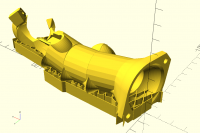
i just include the support structure back into the .scad code of my model (or import the stl of the model into the support sructure .scad code) they get "Unioned" to a new model with inbuilt suport, which i can export as stl and slice. it is not a "proper" support in terms of own gcode settings (speed, extrusion thickness, etc..) but i do not care as long as i get better results than with the native one. so i just slice it as if it was a part of the models Material rather than trying to acheive it through slic3rs own support structues. Peter On 10.03.2016 19:32, nop head wrote: > How do you print your support structures? Do you slice them separately > and apply a Z offset? > > On 10 March 2016 at 15:46, pproj@posteo.de <pproj@posteo.de > <mailto:pproj@posteo.de>> wrote: > > Thanks Doug! > > anyways by now i started to think openscad really lacks > extensibility, through plugins (like i.e. in inkscape) there would > be more efficient possibilities for the problems at hand,perhaps > there would alse be less openscad-variants, and more improvements. > > the reason to switch to Javascript for me was indeed the > inability to query existing geometry, > > If the question at hand was, wether to make openscad geomeries > querieable or to build the plugin interface, my answer would be a > definitive "both"! > but i just like you i consider the queriability more important. > > > if one needs a result quickly and can't wait untill openscad > evolves to more extensibility, going the Javascript route like i > did is perhaps not the worst solution, > if anybody has a use for my script as base for his own processing > i will be very happy. and would be even more so if it will me made > availiable for others to use > > and thanks for the hint on Simplify3D, but it looks like i will > not need it anymore :) > Peter > > On 10.03.2016 03:19, doug moen wrote: >> Pretty cool project. >> >> With respect to your comments about an "open interface", I feel >> this is the kind of project that ought to be possible in >> OpenSCAD. You are taking one geometric object and transforming it >> into another, and that's exactly the sort of thing that OpenSCAD >> ought to be good at, especially if the application is 3D printing. >> >> I don't know exactly what your roadblock was, but for support >> generation, I think the missing feature is a full set of >> capabilities for querying the geometry of an object. Creating a >> "plugin interface" to OpenSCAD is a big can of worms, and in some >> ways it's easier to just fix the deficiencies in the language. >> (Both approaches, plugins and geometric queries, are >> controversial within the dev team, but my vote is to make the >> language more powerful.) >> >> As for Slic3r having poor support generation, this was being >> discussed in another forum that I participate in, and a number of >> people recommend using Simplify3D instead. >> >> Note that Simplify3D is proprietary and costs money, but for some >> users, that's not a problem. On the other hand, if OpenSCAD made >> it easier for people to experiment with new support algorithms, >> then that could allow progress to be made within the open source >> community without the requirement to hack the internals of Slic3r >> or Cura. >> >> On 9 March 2016 at 19:12, pproj <pproj@posteo.de >> <mailto:pproj@posteo.de>> wrote: >> >> Hello Everyone >> i am sorry if i am not off-topic with this,hope it is ok >> >> i have thrown together a javascript tool to >> semi-automatically create continuous sinusoidal support for >> my openscad models .i tried but failed to implement it using >> scad language only. >> >> its aim is to minimize sharp corners and empty head >> moves(with filament retractions) in the inbuilt support of >> my openscad model. >> >> in case you want to have a look, i have put together some >> instructions and put the tool on the github: >> https://github.com/solidboredom/sinus-support/ >> >> >> After putting quite some effort into an .scad version of it, >> i could not figure a possibility to make it _continous_ >> around the parts outline using openscad only, so i have >> aborted my efforts and created this javascript tool. >> >> external tool makes the whole process more complicated, you >> have to export SVG and import twice. >> so how could i simplify the process? is the only way to >> implement something like this directly in the source-code of >> openscad source? >> >> reason i have made it: >> i was unhappy with slic3r generated support for long time. >> it works very good on simple parts, but It fails quite a lot >> on my complex models, and it fills all gaps in any height. i >> only wanted to support the part from below. >> the simple inbuilt support i have created before using n >> openscad only, always been slowing down my print because of >> discontinuities and sharp corners. >> >> so is this possible to streamline the exchange between >> openscad and javascript? (i actually do not think so) is it >> time for an open interface for openscad? >> >> Peter >> >> >> _______________________________________________ >> OpenSCAD mailing list >> Discuss@lists.openscad.org <mailto:Discuss@lists.openscad.org> >> http://lists.openscad.org/mailman/listinfo/discuss_lists.openscad.org >> >> >> >> >> >> _______________________________________________ >> OpenSCAD mailing list >> Discuss@lists.openscad.org <mailto:Discuss@lists.openscad.org> >> http://lists.openscad.org/mailman/listinfo/discuss_lists.openscad.org > > > _______________________________________________ > OpenSCAD mailing list > Discuss@lists.openscad.org <mailto:Discuss@lists.openscad.org> > http://lists.openscad.org/mailman/listinfo/discuss_lists.openscad.org > > > > > _______________________________________________ > OpenSCAD mailing list > Discuss@lists.openscad.org > http://lists.openscad.org/mailman/listinfo/discuss_lists.openscad.org
P
pproj@posteo.de
Fri, Mar 11, 2016 3:17 PM

Rudolf yes i agree you have a point here.

and of course it would be difficult to program all the functionality a
native support can give you in javascript,
but in my experiments, when slicing the thin  structures in the .stl  it
turned out,  slic3r produces
gcode which seems close enough to what is needed to replace its native
support structures. ( for the parts i have tried  so far at least).
as to the proper alignment of the support material, the art itself and
interface layers, again i agree, that would be quite a big task to
program it all in the js, but i think it is not really eededin in very
may cases.

i do nor mind if i have no thinned out support interface layers, if the
support is thin enough to easy break it off.
i do not mind if the support fills a bit of my model to a certain
heigh,t like in the picture,i have attached, for the  same reason.
creating fine gridded interface layers on top of the coarser  support
(with longer sinus periods and bigger amplitudes at the bottom) might be
needed in some cases, but should be doable in openscad as well, if one
really needs it.
so of course this not an ideal approach, but i think it might be just
practical enough to quickly get  quickly printing  support done quickly.
from what i grasp, it is actually not that difficult to do much of what
you have mentioned in  opencad either.
i.e. just as you write creating a hull of the model and subtracting it
from the support structures will help,
if the Model is not convex it will not quite work, but one can
"subdivide" the model using a small cube  "rastering" the Space
containing your model, creating smaller Hulls in the intersection with
this cube and then unioning them together and subtracting the whole
thing from the support structure.

creating the thinned  "support Structure interface" area where your
support meets the model does not seem that difficult in openscad either,
since one can scale the support a bit higher into the model intersect it
with the model itself, erode the intersection with minkowsi to make it
thinner and move it back just under under the model.
i actually have experimented quite a bit with smoothing and eroding of
the model with hull and minkowski or moving  "rastering" cubes  and it
works, but it is incredibly slow on a complex model.

but like i have said before  i think in quite many cases we might not
need to do any of it, but the support will still be very useful.
Peter
On 11.03.2016 01:28, Parkinbot wrote:

Hm, nice approach, but somehow very ambitious.

Support structures are usually more than an stl. They interact with your
print as well as with your material. It is a good idea to have it calculated
by your slicer. Maybe you try another slicer like Kisslicer before you put a
lot of work into that.

This is some of the features you'll want to have:

  • support should easily break off. So it is better loosely connected with
    the object (a slicer uses jerk control for this)
  • support is only needed up to a certain angle and has a heightmap. Don't
    see that in your current approach
  • support can have a substructure ...

If you really want to go into that, I suggest to use some imperative
programming language and

  • parse the STL of your print object
  • analyse the triangles to determine the surface to be supported
  • do your own sine magic on that surface, which is not trivial to calculate
    as intersections are involved

OpenScad can help you with the sine magic

  • close your surface into an object (or a bunch of objects depending on your
    design) exactly hulling your support structure and export it as STL.
  • now you can import that STL into OpenScad and do your sine magic there in
    a generic fashion, intersect it and so on.

Rudolf

--
View this message in context: http://forum.openscad.org/semi-on-topic-print-speed-optimized-sinus-support-material-integration-interface-possible-tp16383p16402.html
Sent from the OpenSCAD mailing list archive at Nabble.com.


OpenSCAD mailing list
Discuss@lists.openscad.org
http://lists.openscad.org/mailman/listinfo/discuss_lists.openscad.org

Rudolf yes i agree you have a point here. and of course it would be difficult to program all the functionality a native support can give you in javascript, but in my experiments, when slicing the thin structures in the .stl it turned out, slic3r produces gcode which seems close enough to what is needed to replace its native support structures. ( for the parts i have tried so far at least). as to the proper alignment of the support material, the art itself and interface layers, again i agree, that would be quite a big task to program it all in the js, but i think it is not really eededin in very may cases. i do nor mind if i have no thinned out support interface layers, if the support is thin enough to easy break it off. i do not mind if the support fills a bit of my model to a certain heigh,t like in the picture,i have attached, for the same reason. creating fine gridded interface layers on top of the coarser support (with longer sinus periods and bigger amplitudes at the bottom) might be needed in some cases, but should be doable in openscad as well, if one really needs it. so of course this not an ideal approach, but i think it might be just practical enough to quickly get quickly printing support done quickly. from what i grasp, it is actually not that difficult to do much of what you have mentioned in opencad either. i.e. just as you write creating a hull of the model and subtracting it from the support structures will help, if the Model is not convex it will not quite work, but one can "subdivide" the model using a small cube "rastering" the Space containing your model, creating smaller Hulls in the intersection with this cube and then unioning them together and subtracting the whole thing from the support structure. creating the thinned "support Structure interface" area where your support meets the model does not seem that difficult in openscad either, since one can scale the support a bit higher into the model intersect it with the model itself, erode the intersection with minkowsi to make it thinner and move it back just under under the model. i actually have experimented quite a bit with smoothing and eroding of the model with hull and minkowski or moving "rastering" cubes and it works, but it is incredibly slow on a complex model. but like i have said before i think in quite many cases we might not need to do any of it, but the support will still be very useful. Peter On 11.03.2016 01:28, Parkinbot wrote: > Hm, nice approach, but somehow very ambitious. > > Support structures are usually more than an stl. They interact with your > print as well as with your material. It is a good idea to have it calculated > by your slicer. Maybe you try another slicer like Kisslicer before you put a > lot of work into that. > > This is some of the features you'll want to have: > - support should easily break off. So it is better loosely connected with > the object (a slicer uses jerk control for this) > - support is only needed up to a certain angle and has a heightmap. Don't > see that in your current approach > - support can have a substructure ... > > If you really want to go into that, I suggest to use some imperative > programming language and > - parse the STL of your print object > - analyse the triangles to determine the surface to be supported > - do your own sine magic on that surface, which is not trivial to calculate > as intersections are involved > > OpenScad can help you with the sine magic > - close your surface into an object (or a bunch of objects depending on your > design) exactly hulling your support structure and export it as STL. > - now you can import that STL into OpenScad and do your sine magic there in > a generic fashion, intersect it and so on. > > Rudolf > > > > > > > -- > View this message in context: http://forum.openscad.org/semi-on-topic-print-speed-optimized-sinus-support-material-integration-interface-possible-tp16383p16402.html > Sent from the OpenSCAD mailing list archive at Nabble.com. > > _______________________________________________ > OpenSCAD mailing list > Discuss@lists.openscad.org > http://lists.openscad.org/mailman/listinfo/discuss_lists.openscad.org >
P
pproj@posteo.de
Fri, Mar 11, 2016 3:19 PM

Torsten  I was just thinking aloud.  of course i cannot be sure what
impact these features(shape queering and plugins) would have had on the
project development.
i beleive you have a much clearer perpective on the project as a whole
anyway.

as for keepig the fast rendering functionality, it makes sense to me,
but perhaps it could be an acceptable compromise for more complex models.
i have to gcal-render big deal of the  models i have created to make
them display properly or be able to turn them in the view without
waiting for tens of seconds.
i like complex models and i like to use .children() in my libraries,
that is probably why.  but that is what .children() was made for right?
i think i also see a compromise solution to pugins: if we could scripts
the export to different formats, which are already available from the
menu, from the scad code itself
and then could run an external tool and then import the results back,
that woud be almost as good as plugins.

yes this could affect the declarativity of the scad code.
so perhaps creating a separate special  module in  code like the classic
"main() function" accepting only imperative code as well as
render() calls could solve it.
i can also see a restriction to have only one main() in all included
.scad files and libraries so the utility libraries do not use it and do
not break the modularity and "nestability" of the library code which
than have to stay declarative only.
i expect people to ask now, why not use shell instead?
here are my considerations:
-calling out from scad would be much more convenient and put most of
simple "one line" dependencies into one scad file. it is also than
possible to pass information as command line parameters to the "plugin"
command.
-it is overall much closer to plug-ins. there is a reason other programs
have plugin systems besides being started from a shell as well, so why
do they need it then?
-it is much easier to share a scad file  than an archive full of shell
scripts and scad files, with scripts having to take care where they have
been started from, where are the other files they need, etc.
-it is much simpler to put everything into a single file and perhaps add
one external program or use a system program. HEY HOW ABOUT a 3D ls or
dir command with spheric files flying around your cubic folders and
sub-folder wiggling next to them? just run the 3d-dir.scad...:) it just
one  hypothetical example of integration possibilities and uses that
will open...
Peter
On 10.03.2016 22:01, Torsten Paul wrote:

On 03/10/2016 04:46 PM, pproj@posteo.de wrote:

anyways by now i started to think  openscad really lacks extensibility,
through plugins (like i.e. in inkscape) there would be more efficient
possibilities for the problems at hand, perhaps there would also be less
openscad-variants, and more improvements.

In general I do like the idea of plugins, but I'm not sure how manageable
that would be currently. Creating and maintaining a stable plugin API is
not an easy topic and that would probably mean even less improvements in
other areas.

The geometry query part is certainly one of the biggest issues, but that's
not solvable by just adding plugins, it needs the internal changes to
support that without completely breaking good things like the quick preview.
That's one of the big things the OpenSCAD2 discussion is supposed to give
and I hope we can slowly move into that direction so there's not a huge
leap in the end when trying to get the full list of new features.

As for the variants, and side projects, I'm not so sure. There will always
be a number of use cases where the descriptive nature of OpenSCAD is not
going to cover everything and some additional frontend in a general
programming language is appropriate (like for reading data from a database).

ciao,
Torsten.


OpenSCAD mailing list
Discuss@lists.openscad.org
http://lists.openscad.org/mailman/listinfo/discuss_lists.openscad.org

Torsten I was just thinking aloud. of course i cannot be sure what impact these features(shape queering and plugins) would have had on the project development. i beleive you have a much clearer perpective on the project as a whole anyway. as for keepig the fast rendering functionality, it makes sense to me, but perhaps it could be an acceptable compromise for more complex models. i have to gcal-render big deal of the models i have created to make them display properly or be able to turn them in the view without waiting for tens of seconds. i like complex models and i like to use .children() in my libraries, that is probably why. but that is what .children() was made for right? i think i also see a compromise solution to pugins: if we could scripts the export to different formats, which are already available from the menu, from the scad code itself and then could run an external tool and then import the results back, that woud be almost as good as plugins. yes this could affect the declarativity of the scad code. so perhaps creating a separate special module in code like the classic "main() function" accepting only imperative code as well as render() calls could solve it. i can also see a restriction to have only one main() in all included .scad files and libraries so the utility libraries do not use it and do not break the modularity and "nestability" of the library code which than have to stay declarative only. i expect people to ask now, why not use shell instead? here are my considerations: -calling out from scad would be much more convenient and put most of simple "one line" dependencies into one scad file. it is also than possible to pass information as command line parameters to the "plugin" command. -it is overall much closer to plug-ins. there is a reason other programs have plugin systems besides being started from a shell as well, so why do they need it then? -it is much easier to share a scad file than an archive full of shell scripts and scad files, with scripts having to take care where they have been started from, where are the other files they need, etc. -it is much simpler to put everything into a single file and perhaps add one external program or use a system program. HEY HOW ABOUT a 3D ls or dir command with spheric files flying around your cubic folders and sub-folder wiggling next to them? just run the 3d-dir.scad...:) it just one hypothetical example of integration possibilities and uses that will open... Peter On 10.03.2016 22:01, Torsten Paul wrote: > On 03/10/2016 04:46 PM, pproj@posteo.de wrote: >> anyways by now i started to think openscad really lacks extensibility, >> through plugins (like i.e. in inkscape) there would be more efficient >> possibilities for the problems at hand, perhaps there would also be less >> openscad-variants, and more improvements. >> > In general I do like the idea of plugins, but I'm not sure how manageable > that would be currently. Creating and maintaining a stable plugin API is > not an easy topic and that would probably mean even less improvements in > other areas. > > The geometry query part is certainly one of the biggest issues, but that's > not solvable by just adding plugins, it needs the internal changes to > support that without completely breaking good things like the quick preview. > That's one of the big things the OpenSCAD2 discussion is supposed to give > and I hope we can slowly move into that direction so there's not a huge > leap in the end when trying to get the full list of new features. > > As for the variants, and side projects, I'm not so sure. There will always > be a number of use cases where the descriptive nature of OpenSCAD is not > going to cover everything and some additional frontend in a general > programming language is appropriate (like for reading data from a database). > > ciao, > Torsten. > > > _______________________________________________ > OpenSCAD mailing list > Discuss@lists.openscad.org > http://lists.openscad.org/mailman/listinfo/discuss_lists.openscad.org >
J
jon
Fri, Mar 11, 2016 3:20 PM

I often do the same thing when automatic support structures are
ineffective.  I use posts or sheets that are roughly 0.3 mm in diameter
or thickness.  If I generate them in a separate module, then I can
disable them quickly if necessary.

Jon

On 3/11/2016 10:15 AM, pproj@posteo.de wrote:

i just include the support structure back into the .scad code of my
model (or import the stl of the model  into the support sructure .scad
code) they get "Unioned" to a new model with inbuilt suport, which i
can export as stl and slice.
it is not a "proper" support in terms of own gcode settings (speed,
extrusion thickness, etc..) but i do not care as long as i get better
results than with the native one. so i  just slice it as if it was a
part of the models Material rather than trying to acheive it through
slic3rs own support structues.
Peter

I often do the same thing when automatic support structures are ineffective. I use posts or sheets that are roughly 0.3 mm in diameter or thickness. If I generate them in a separate module, then I can disable them quickly if necessary. Jon On 3/11/2016 10:15 AM, pproj@posteo.de wrote: > i just include the support structure back into the .scad code of my > model (or import the stl of the model into the support sructure .scad > code) they get "Unioned" to a new model with inbuilt suport, which i > can export as stl and slice. > it is not a "proper" support in terms of own gcode settings (speed, > extrusion thickness, etc..) but i do not care as long as i get better > results than with the native one. so i just slice it as if it was a > part of the models Material rather than trying to acheive it through > slic3rs own support structues. > Peter >