sanity check, difference() with a unioned object

I need a quick sanity check. Should it be OK to do
difference() {
objectA();
union() {
	objectB();
	objectC();
}
}
or
difference() {
objectA();
objectD();
}
where objectD itself is built via union()?
Thanks,
Ken
Kenneth R. Beesley, D.Phil.
PO Box 540475
North Salt Lake UT 84054
USA

If b+c=d, then yes, they should be identical and should work just fine in openscad.
On Dec 11, 2019, at 10:46 PM, Kenneth Beesley krbeesley@gmail.com wrote:
I need a quick sanity check. Should it be OK to do
difference() {
objectA();
union() {
    objectB();
    objectC();
}
}
or
difference() {
objectA();
objectD();
}
where objectD itself is built via union()?
Thanks,
Ken
Kenneth R. Beesley, D.Phil.
PO Box 540475
North Salt Lake UT 84054
USA
OpenSCAD mailing list
Discuss@lists.openscad.org
http://lists.openscad.org/mailman/listinfo/discuss_lists.openscad.org

On 12/11/2019 7:46 PM, Kenneth Beesley wrote:
I need a quick sanity check. Should it be OK to do
difference() {
objectA();
union() {
	objectB();
	objectC();
}
}
or
difference() {
objectA();
objectD();
}
where objectD itself is built via union()?
Of course. You can difference (or intersect or union) any combination
of objects.
Fine print:  must all be 3D or all be 2D, must be legal objects
(manifold, et cetera).
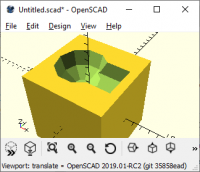
Example:
difference() {
    cube(10, center=true);
    union () {
        translate([-1, 0, 5]) sphere(3);
        translate([2, 0, 5]) cube(4, center=true);
    }
}