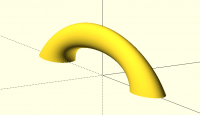
Modeling organic shapes

I'd like to make a handgrip for a project, but I don't have a clue how to
do organic shapes in OpenSCAD
Can someone point me in that direction please?
--
K1FZY (WA4TPW) SK 9/29/37-4/13/15

It might not be the perfect tool for this kind of model..
I suggest using wings3d
- staring with a cube
- using the extrude tool on faces
- and finally smoothing it for a good result. (you can smooth(S key twice)/undo as you go to see how your progressing)
This is a very good tool for that kind of object. Also the results are watertight and easily sliced for printing.
On 2/18/2017 4:35 PM, david vanhorn wrote:
I'd like to make a handgrip for a project, but I don't have a clue how to do organic shapes in OpenSCAD
Can someone point me in that direction please?
--
K1FZY (WA4TPW) SK 9/29/37-4/13/15

On 2/18/2017 4:35 PM, david vanhorn wrote:
I'd like to make a handgrip for a project, but I don't have a clue how to
do organic shapes in OpenSCAD
Can someone point me in that direction please?
Here are some ideas to model your handgrip in OpenSCAD. I use Bezier
surfaces to model the smooth surfaces of a handle and polyhedron as the
basic OpenSCAd primitive to build it.
The main code is simple and render in a snap.
// control points of the handle rounded surface
q0 = [ [ [-50,0, 0],[-50,30, 0],[-150,0, 0],[-50,-30, 0],[-50,0, 0] ],
[ [-50,0,25],[-50,15,25],[ -50,0,95],[-50,-15,25],[-50,0,25] ] ];
// add symetrical points
q = concat(q0, [ for(i=[1,0])
[for(pt=q0[i]) [ -pt.x, pt.y, pt.z ] ] ] );
show_CTP= false;
if(show_CTP)
color("blue")
for(p=q) polyhedron(p, [[for(i=[0:len(p)-1]) i]]);
render()
handle(q);
module handle(q, npu=60, npv=60) {
// mesh of the handle rounded surface
surf = Bezier_patch(q, degreeu=len(q)-1,degreev=len(
q[0])-1,nu=npu,nv=npv);
nu   = len(surf);
nv   = len(surf[0]);
// the above surface in polyhedron format: inversion was needed
poly_surf = mesh2polyhedron(surf, inv=true);
// the two closing faces of the handle, extracted from the surface
points
face1 = surf[0];
face2 = surf[nu-1];
// a list of the above faces in polyhedron format: one face is inverted
poly_faces = [ polygon2polyhedron(face1),
polygon2polyhedron(face2,inv=true) ];
// concatenating all in one list
polys = concat([ poly_surf ], poly_faces );
// the two center points of the handle holes: computed from surface
points
p1 = ( surf[0][nv/2] + surf[0][0] )/2;
p2 = ( surf[nu-1][nv/2] + surf[nu-1][0] )/2;
difference() {
    make_polyhedron(polys); // full solid handle
    translate(p1+[0,0,-1]) cylinder(r=2,h=10); // fixing holes
    translate(p2+[0,0,-1]) cylinder(r=2,h=10);
}
}
// Bezier stuffs
function Bezier_patch(p, degreeu, degreev, nu, nv) =
let( pu = [for(q=p) Bezier_curve(q,nv,degreev)] )
Bezier_curve(pu,nu,degreeu);
function Bezier_curve(p, n=10, degree=3, from=0) =
[ for(i=[0:n]) _uni_Bezier_eval(p, i/n, degree, from) ];
function _uni_Bezier_eval(p, u, degree=3, from=0) =
_Casteljau([for(i=[0:degree]) p[from+i]], u);
function _Casteljau(p, u) =
(len(p) == 2)?
u*p[1] + (1-u)p[0]:
_Casteljau([for(i=[0:len(p)-2]) up[i+1] + (1-u)*p[i]], u);
// drawing module stuffs
function mesh2polyhedron(mesh, inv=false) =
let( n = len(mesh) != 0 ? len(mesh) : 0,
m = n==0 ? 0 : len(mesh[0]) != 0 ? len(mesh[0]) : 0 ,
l = nm)
l > 0 ?
let( range = inv ? [len(mesh)-1: -1: 0] : [0:len(mesh)-1],
vertices = l == 0 ? [] : [ for(i=range) for(pt=mesh[i]) pt
],
tris = concat( [ for(i=[0:n-2],j=[0:m-2]) [ im+j, i*m+j+1,
(i+1)m+j ] ] ,
[ for(i=[0:n-2],j=[0:m-2]) [ im+j+1, (i+1)*m+j+1,
(i+1)*m+j ] ] ) )
[ vertices, tris ]:
[] ;
function polygon2polyhedron(polygon, inv=false) =
let( vertices = polygon,
range = inv ? [len(polygon)-1: -1: 0] : [0:len(polygon)-1],
facets = [[for(i=range) i ]] )
[ vertices, facets ];
module make_polyhedron(polys, convexity = 10) {
function _accum_sum(l, offs=0, res=[]) =
len(res) == len(l) ?
res :
_accum_sum(l, offs+l[len(res)], concat(res, [ offs+l[len(res)]
] ));
function acc_len( f ) =
    concat([0], _accum_sum([ for(fi=f) len(fi) ]));

vertlist = [for(p=polys, pt=p[0]) pt]; // collect all verts from
polyhedra
vertlen = [for(p=polys) p[0] ];
acclen = acc_len(vertlen);
facets = [ for(i=[0:len(polys)-1], f=polys[i][1] ) [ for(v=f)
acclen[i]+v ] ];
polyhedron(
    points = vertlist,
    faces  = facets,
    convexity = convexity
);
}
The handle surface is determined by the position of the control points q0.
Change it to your taste. With show_CTP=true you will see the polygons
formed by the lines of control points and its relation with the surface.