

discuss@lists.openscad.org

OpenSCAD general discussion Mailing-list

View all threads

"Geodesic sphere" A better sphere() for OpenSCAD ?
B
bassklampfe
Sat, Jan 30, 2021 7:43 AM

I am always disappointed with the spheres in OpenSCAL. With low $fn the look

  • well - not so pretty, especially for small sizes. But even with high $fn
    they always have a flat spot on the top/bottom and you can easily
    distinguish a rotated sphere from a not rotated.

Has anyone tried to create code for a  Geodesic polyhedron
https://en.wikipedia.org/wiki/Geodesic_polyhedron  ? What I see from the
wikipedia screens, I like it very much. Even the "truncated icosahedron"
already looks much better than a sphere(r=2);

--
Sent from: http://forum.openscad.org/

I am always disappointed with the spheres in OpenSCAL. With low $fn the look - well - not so pretty, especially for small sizes. But even with high $fn they always have a flat spot on the top/bottom and you can easily distinguish a rotated sphere from a not rotated. Has anyone tried to create code for a Geodesic polyhedron <https://en.wikipedia.org/wiki/Geodesic_polyhedron> ? What I see from the wikipedia screens, I like it very much. Even the "truncated icosahedron" already looks much better than a sphere(r=2); -- Sent from: http://forum.openscad.org/
NH
nop head
Sat, Jan 30, 2021 8:09 AM

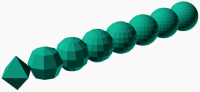
I think that has been coded but simply rotate_extruding a semicircle with
$fn set to a multiple of four gives a sphere with points on the poles. See
https://github.com/nophead/NopSCADlib#Sphere

[image: image.png]

I override the built in sphere with this to get hulls with the correct
dimensions when the spheres are placed in the corners.

On Sat, 30 Jan 2021 at 07:43, bassklampfe jjvb-openscad@bassklampfe.de
wrote:

I am always disappointed with the spheres in OpenSCAL. With low $fn the
look

  • well - not so pretty, especially for small sizes. But even with high $fn
    they always have a flat spot on the top/bottom and you can easily
    distinguish a rotated sphere from a not rotated.

Has anyone tried to create code for a  Geodesic polyhedron
https://en.wikipedia.org/wiki/Geodesic_polyhedron  ? What I see from
the
wikipedia screens, I like it very much. Even the "truncated icosahedron"
already looks much better than a sphere(r=2);

--
Sent from: http://forum.openscad.org/


OpenSCAD mailing list
Discuss@lists.openscad.org
http://lists.openscad.org/mailman/listinfo/discuss_lists.openscad.org
I think that has been coded but simply rotate_extruding a semicircle with $fn set to a multiple of four gives a sphere with points on the poles. See https://github.com/nophead/NopSCADlib#Sphere [image: image.png] I override the built in sphere with this to get hulls with the correct dimensions when the spheres are placed in the corners. On Sat, 30 Jan 2021 at 07:43, bassklampfe <jjvb-openscad@bassklampfe.de> wrote: > I am always disappointed with the spheres in OpenSCAL. With low $fn the > look > - well - not so pretty, especially for small sizes. But even with high $fn > they always have a flat spot on the top/bottom and you can easily > distinguish a rotated sphere from a not rotated. > > Has anyone tried to create code for a Geodesic polyhedron > <https://en.wikipedia.org/wiki/Geodesic_polyhedron> ? What I see from > the > wikipedia screens, I like it very much. Even the "truncated icosahedron" > already looks much better than a sphere(r=2); > > > > -- > Sent from: http://forum.openscad.org/ > > _______________________________________________ > OpenSCAD mailing list > Discuss@lists.openscad.org > http://lists.openscad.org/mailman/listinfo/discuss_lists.openscad.org >
A
arnholm@arnholm.org
Sat, Jan 30, 2021 8:12 AM

On 2021-01-30 08:43, bassklampfe wrote:

I am always disappointed with the spheres in OpenSCAL. With low $fn the
look

  • well - not so pretty, especially for small sizes. But even with high
    $fn
    they always have a flat spot on the top/bottom and you can easily
    distinguish a rotated sphere from a not rotated.

Has anyone tried to create code for a  Geodesic polyhedron
https://en.wikipedia.org/wiki/Geodesic_polyhedron  ? What I see from
the
wikipedia screens, I like it very much. Even the "truncated
icosahedron"
already looks much better than a sphere(r=2);

Write some OpenSCAD code with spheres, save it to an .scad file and run
it with AngelCAD. You will then get a geodesic sphere mesh.

sphere(r=2) usually means 2mm radius and that is very small, it will not
be pretty regardless of mesh type. Try a larger radius first.

Carsten Arnholm

On 2021-01-30 08:43, bassklampfe wrote: > I am always disappointed with the spheres in OpenSCAL. With low $fn the > look > - well - not so pretty, especially for small sizes. But even with high > $fn > they always have a flat spot on the top/bottom and you can easily > distinguish a rotated sphere from a not rotated. > > Has anyone tried to create code for a Geodesic polyhedron > <https://en.wikipedia.org/wiki/Geodesic_polyhedron> ? What I see from > the > wikipedia screens, I like it very much. Even the "truncated > icosahedron" > already looks much better than a sphere(r=2); Write some OpenSCAD code with spheres, save it to an .scad file and run it with AngelCAD. You will then get a geodesic sphere mesh. sphere(r=2) usually means 2mm radius and that is very small, it will not be pretty regardless of mesh type. Try a larger radius first. Carsten Arnholm
NH
nop head
Sat, Jan 30, 2021 8:24 AM

Does a geodesic sphere have vertices on the 6 semi-axis lines? I think that
is a requirement when using spheres to make accurate corners.

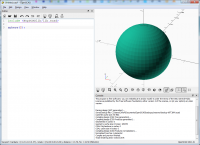
There is no reason why a small sphere can't be pretty if $fa is set.

[image: image.png]

On Sat, 30 Jan 2021 at 08:13, arnholm@arnholm.org wrote:

On 2021-01-30 08:43, bassklampfe wrote:

I am always disappointed with the spheres in OpenSCAL. With low $fn the
look

  • well - not so pretty, especially for small sizes. But even with high
    $fn
    they always have a flat spot on the top/bottom and you can easily
    distinguish a rotated sphere from a not rotated.

Has anyone tried to create code for a  Geodesic polyhedron
https://en.wikipedia.org/wiki/Geodesic_polyhedron  ? What I see from
the
wikipedia screens, I like it very much. Even the "truncated
icosahedron"
already looks much better than a sphere(r=2);

Write some OpenSCAD code with spheres, save it to an .scad file and run
it with AngelCAD. You will then get a geodesic sphere mesh.

sphere(r=2) usually means 2mm radius and that is very small, it will not
be pretty regardless of mesh type. Try a larger radius first.

Carsten Arnholm


OpenSCAD mailing list
Discuss@lists.openscad.org
http://lists.openscad.org/mailman/listinfo/discuss_lists.openscad.org
Does a geodesic sphere have vertices on the 6 semi-axis lines? I think that is a requirement when using spheres to make accurate corners. There is no reason why a small sphere can't be pretty if $fa is set. [image: image.png] On Sat, 30 Jan 2021 at 08:13, <arnholm@arnholm.org> wrote: > On 2021-01-30 08:43, bassklampfe wrote: > > I am always disappointed with the spheres in OpenSCAL. With low $fn the > > look > > - well - not so pretty, especially for small sizes. But even with high > > $fn > > they always have a flat spot on the top/bottom and you can easily > > distinguish a rotated sphere from a not rotated. > > > > Has anyone tried to create code for a Geodesic polyhedron > > <https://en.wikipedia.org/wiki/Geodesic_polyhedron> ? What I see from > > the > > wikipedia screens, I like it very much. Even the "truncated > > icosahedron" > > already looks much better than a sphere(r=2); > > Write some OpenSCAD code with spheres, save it to an .scad file and run > it with AngelCAD. You will then get a geodesic sphere mesh. > > sphere(r=2) usually means 2mm radius and that is very small, it will not > be pretty regardless of mesh type. Try a larger radius first. > > Carsten Arnholm > > _______________________________________________ > OpenSCAD mailing list > Discuss@lists.openscad.org > http://lists.openscad.org/mailman/listinfo/discuss_lists.openscad.org >
A
arnholm@arnholm.org
Sat, Jan 30, 2021 8:45 AM

On 2021-01-30 09:24, nop head wrote:

Does a geodesic sphere have vertices on the 6 semi-axis lines?

No.

I think
that is a requirement when using spheres to make accurate corners.

The question was whether anyone has tried to create code for a Geodesic
polyhedron. The answer is yes.

Carsten Arholm

On 2021-01-30 09:24, nop head wrote: > Does a geodesic sphere have vertices on the 6 semi-axis lines? No. > I think > that is a requirement when using spheres to make accurate corners. The question was whether anyone has tried to create code for a Geodesic polyhedron. The answer is yes. Carsten Arholm
RP
Ronaldo Persiano
Sat, Jan 30, 2021 9:29 AM

nop head nop.head@gmail.com wrote:

Does a geodesic sphere have vertices on the 6 semi-axis lines? I think
that is a requirement when using spheres to make accurate corners.

Yes, if it's based on the octahedron. The geodesic sphere based on the
icosahedron doesn't have that property. In BOSL2, you may find a module
called spheroid that is able to draw geodesic spheres in both styles.

https://github.com/revarbat/BOSL2/wiki/shapes.scad#spheroid

nop head <nop.head@gmail.com> wrote: > Does a geodesic sphere have vertices on the 6 semi-axis lines? I think > that is a requirement when using spheres to make accurate corners. > Yes, if it's based on the octahedron. The geodesic sphere based on the icosahedron doesn't have that property. In BOSL2, you may find a module called *spheroid* that is able to draw geodesic spheres in both styles. https://github.com/revarbat/BOSL2/wiki/shapes.scad#spheroid >
B
bassklampfe
Sat, Jan 30, 2021 9:38 AM

Ok, for some reasons my replies via email programm did not make it into the
mailing list.
I will copy them here


Ok, in the meantime I have found https://www.thingiverse.com/thing:1484333,
which does a pretty good job for me.
Even if written in OpenSCAD, it's pretty fast and does exactly what I want.
I've added some minor tweaks, because there was a numeric overflow on small
r's, but basically it's doing all I want.
Thanks for your replies.


I believe this picture explains, why I like geodesic sphere.
Both rendered with r=5 and $fn=50;
http://forum.openscad.org/file/t2988/test-geodesic_sphere.png
-8<-cut-here-8<-cut-here-8<-cut-here-8<-cut-here-8<-cut-here-8<-cut-here-
radius=5;
$fn=50;

use <geodesic_sphere.scad>

color("darkgrey")translate([5,-10,0])rotate([90,0,0])linear_extrude(1)text("OpenSCAD",size=5,halign="left");
color("darkgrey")translate([-5,-10,0])rotate([90,0,0])linear_extrude(1)text("geodesic",size=5,halign="right");
scale(10/radius)
{
color("LightGreen") translate([-radius, 0, radius])
geodesic_sphere(radius);
color("LightBlue")    translate([radius, 0,radius]) sphere(radius);
color("red")        translate([+radius, 2radius,radius])
difference(){geodesic_sphere(radius);sphere(radius);}
color("yellow")        translate([-radius, 2
radius,radius])
difference(){sphere(radius);geodesic_sphere(radius);}
}
-8<-cut-here-8<-cut-here-8<-cut-here-8<-cut-here-8<-cut-here-8<-cut-here-


Even in PrusaSlicer you can see the difference (see attached Picture)
http://forum.openscad.org/file/t2988/spheres-in-slicer.png
Ok folks, thank you for listening, for me this topic can be closed...

--
Sent from: http://forum.openscad.org/

Ok, for some reasons my replies via email programm did not make it into the mailing list. I will copy them here ------------------------ Ok, in the meantime I have found https://www.thingiverse.com/thing:1484333, which does a pretty good job for me. Even if written in OpenSCAD, it's pretty fast and does exactly what I want. I've added some minor tweaks, because there was a numeric overflow on small r's, but basically it's doing all I want. Thanks for your replies. ------------------------ I believe this picture explains, why I like geodesic sphere. Both rendered with r=5 and $fn=50; <http://forum.openscad.org/file/t2988/test-geodesic_sphere.png> -8<-cut-here-8<-cut-here-8<-cut-here-8<-cut-here-8<-cut-here-8<-cut-here- radius=5; $fn=50; use <geodesic_sphere.scad> color("darkgrey")translate([5,-10,0])rotate([90,0,0])linear_extrude(1)text("OpenSCAD",size=5,halign="left"); color("darkgrey")translate([-5,-10,0])rotate([90,0,0])linear_extrude(1)text("geodesic",size=5,halign="right"); scale(10/radius) { color("LightGreen") translate([-radius, 0, radius]) geodesic_sphere(radius); color("LightBlue") translate([radius, 0,radius]) sphere(radius); color("red") translate([+radius, 2*radius,radius]) difference(){geodesic_sphere(radius);sphere(radius);} color("yellow") translate([-radius, 2*radius,radius]) difference(){sphere(radius);geodesic_sphere(radius);} } -8<-cut-here-8<-cut-here-8<-cut-here-8<-cut-here-8<-cut-here-8<-cut-here- ------ Even in PrusaSlicer you can see the difference (see attached Picture) <http://forum.openscad.org/file/t2988/spheres-in-slicer.png> Ok folks, thank you for listening, for me this topic can be closed... -- Sent from: http://forum.openscad.org/
RD
Revar Desmera
Sat, Jan 30, 2021 10:54 AM

In BOSL2, the command spheroid(d=100, type=“octa”); will make a sphere based on a subdivided octahedron, which guarantees maxima/minima on all three axes. With type=“icosa”, it subdivides an icosahedron, but maxima/minima on axes is only guaranteed for $fn that are modulo to both 4 and 5.

-Revar

On Jan 30, 2021, at 1:30 AM, Ronaldo Persiano rcmpersiano@gmail.com wrote:


nop head nop.head@gmail.com wrote:

Does a geodesic sphere have vertices on the 6 semi-axis lines? I think that is a requirement when using spheres to make accurate corners.

Yes, if it's based on the octahedron. The geodesic sphere based on the icosahedron doesn't have that property. In BOSL2, you may find a module called spheroid that is able to draw geodesic spheres in both styles.

https://github.com/revarbat/BOSL2/wiki/shapes.scad#spheroid


OpenSCAD mailing list
Discuss@lists.openscad.org
http://lists.openscad.org/mailman/listinfo/discuss_lists.openscad.org
In BOSL2, the command `spheroid(d=100, type=“octa”);` will make a sphere based on a subdivided octahedron, which guarantees maxima/minima on all three axes. With type=“icosa”, it subdivides an icosahedron, but maxima/minima on axes is only guaranteed for $fn that are modulo to both 4 and 5. -Revar > On Jan 30, 2021, at 1:30 AM, Ronaldo Persiano <rcmpersiano@gmail.com> wrote: > >  > nop head <nop.head@gmail.com> wrote: >> Does a geodesic sphere have vertices on the 6 semi-axis lines? I think that is a requirement when using spheres to make accurate corners. > > > Yes, if it's based on the octahedron. The geodesic sphere based on the icosahedron doesn't have that property. In BOSL2, you may find a module called spheroid that is able to draw geodesic spheres in both styles. > > https://github.com/revarbat/BOSL2/wiki/shapes.scad#spheroid > _______________________________________________ > OpenSCAD mailing list > Discuss@lists.openscad.org > http://lists.openscad.org/mailman/listinfo/discuss_lists.openscad.org
M
MichaelAtOz
Sun, Jan 31, 2021 2:22 AM

Ok, for some reasons my replies via email programm did not make it into the
mailing list.
I will copy them here

Because you didn't use the address you subscribed with.
ie use the ...-openscad@ address and they make it, other addresses get discarded.

--
This email has been checked for viruses by AVG.
https://www.avg.com

> Ok, for some reasons my replies via email programm did not make it into the > mailing list. > I will copy them here Because you didn't use the address you subscribed with. ie use the ...-openscad@ address and they make it, other addresses get discarded. -- This email has been checked for viruses by AVG. https://www.avg.com
JO
jjvb-openscad@bassklampfe.de
Sun, Jan 31, 2021 6:54 AM

Am 31.01.21 um 03:22 schrieb MichaelAtOz:

Because you didn't use the address you subscribed with. ie use the
...-openscad@ address and they make it, other addresses get discarded.

Yes, thanks. I figured this out by myself now. Thank you anyway. Regards.

Am 31.01.21 um 03:22 schrieb MichaelAtOz: > Because you didn't use the address you subscribed with. ie use the > ...-openscad@ address and they make it, other addresses get discarded. Yes, thanks. I figured this out by myself now. Thank you anyway. Regards.