

General hints for efficiency?

Since I tend to end up with models that take ages to render and quite often
fail to do so at all because of RAM running out, I assume I'm doing
something wrong. Are there any general hints on how to write efficient
OpenSCAD code? I didn't find much in the manual.
--
Sent from: http://forum.openscad.org/

look at the "special" variables (in the manual) such as $fn and turn
them right down while developing your model, you can always turn them up
later for a final render - and often even with seemingly low settings
the exported STL can be "good enough"
On 21/12/17 16:30, Manuel wrote:
Since I tend to end up with models that take ages to render and quite often
fail to do so at all because of RAM running out, I assume I'm doing
something wrong. Are there any general hints on how to write efficient
OpenSCAD code? I didn't find much in the manual.
--
Sent from: http://forum.openscad.org/
OpenSCAD mailing list
Discuss@lists.openscad.org
http://lists.openscad.org/mailman/listinfo/discuss_lists.openscad.org

With current nightly, you can do this to make it happen automatically:
$fn = $preview ? 12 : 360;
On 22 December 2017 at 03:01, Chris Camacho chris@bedroomcoders.co.uk wrote:
look at the "special" variables (in the manual) such as $fn and turn them
right down while developing your model, you can always turn them up later
for a final render - and often even with seemingly low settings the exported
STL can be "good enough"
On 21/12/17 16:30, Manuel wrote:
Since I tend to end up with models that take ages to render and quite
often
fail to do so at all because of RAM running out, I assume I'm doing
something wrong. Are there any general hints on how to write efficient
OpenSCAD code? I didn't find much in the manual.
--
Sent from: http://forum.openscad.org/
OpenSCAD mailing list
Discuss@lists.openscad.org
http://lists.openscad.org/mailman/listinfo/discuss_lists.openscad.org

Use 2d subsystems when ever possible.
Use star * to hide anything you're not working on at the moment.
--
Sent from: http://forum.openscad.org/

On 2017-12-21 17:01, Chris Camacho wrote:
look at the "special" variables (in the manual) such as $fn and turn
them right down while developing your model, you can always turn them
up later for a final render
I do this extensively and always tend to do final renders from a make
file that passes in variables to control detail and which part to
create. Many of my designs have tens or even hundreds of separate parts
than need rendering to STLs and printing and a make file is the only way
to keep this sane.
I also turn off a lot of detail when working on unrelated parts,
particularly any surface detail like text cutouts on surfaces.
And perhaps controversially, I used the CSD features of OpenSCAD rather
sparingly and most of my geometry is generated by
functions/iterators/splines/etc., then transformed using matrices, and
finally skinned with triangles. I then mainly use CSD to "slice" my
object into different parts for printing, though there's always a lot of
unioning going on in the background.
BTW I pretty much never use minkowski and even find hull to be worth
avoiding if at all possible.
Regards
Ian

I do a lot of CAD stuff.
I do the best I can when I measure stuff, like where holes ought to be
placed.
But I always end up tweaking until it is perfect.
Rather than print the entire thing, while I am tweaking a smaller part of
it, I use intersection with a cube to only render exactly what I am working
on at the moment.
I save a lot of time, and filament while tweaking.
Then when I am satisfied with every part of the design, I bite the bullet
and do the entire design.
Also, if the design I am working on, is capable of being done in parts
(that can be glued together later, I use the same technique, to print each
part separately.
Jerry
--
Extra Ham Operator: K7AZJ
Registered Linux User: 275424
Raspberry Pi and Openscad developer
The most exciting phrase to hear in science - the one that heralds new
discoveries - is not "Eureka!" but "That's funny...".- Isaac. Asimov
On Fri, Dec 22, 2017 at 2:46 AM, Gadgetmind lists@foxhill.co.uk wrote:
On 2017-12-21 17:01, Chris Camacho wrote:
look at the "special" variables (in the manual) such as $fn and turn them
right down while developing your model, you can always turn them up later
for a final render
I do this extensively and always tend to do final renders from a make file
that passes in variables to control detail and which part to create. Many
of my designs have tens or even hundreds of separate parts than need
rendering to STLs and printing and a make file is the only way to keep this
sane.
I also turn off a lot of detail when working on unrelated parts,
particularly any surface detail like text cutouts on surfaces.
And perhaps controversially, I used the CSD features of OpenSCAD rather
sparingly and most of my geometry is generated by
functions/iterators/splines/etc., then transformed using matrices, and
finally skinned with triangles. I then mainly use CSD to "slice" my object
into different parts for printing, though there's always a lot of unioning
going on in the background.
BTW I pretty much never use minkowski and even find hull to be worth
avoiding if at all possible.
Regards
Ian
OpenSCAD mailing list
Discuss@lists.openscad.org
http://lists.openscad.org/mailman/listinfo/discuss_lists.openscad.org
On 22/12/17 14:20, Jerry Davis wrote:
Also, if the design I am working on, is capable of being done in parts
(that can be glued together later, I use the same technique, to print
each part separately.
Ditto, but often because parts will be different colours or would
require supports otherwise.
I tend to design in 1.75mm holes between mating parts so filament can be
used to join them when prototyping and it also acts as a guide when
finally glueing.
See my Thunderbird 1 on Thingiverse (or work in progress Fireflash) to
get the idea.

On 12/22/2017 10:49 AM, Gadgetmind wrote:
On 22/12/17 14:20, Jerry Davis wrote:
Also, if the design I am working on, is capable of being done in
parts (that can be glued together later, I use the same technique, to
print each part separately.
Ditto, but often because parts will be different colours or would
require supports otherwise.
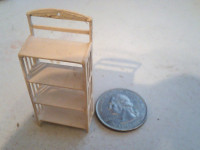
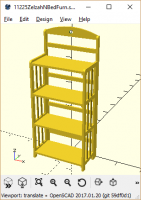
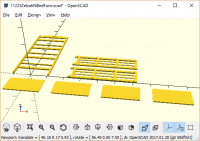
I've been doing that more, but my reason is that it lets me built thin
parts and still have them be strong, by keeping them in XY.

Gadgetmind wrote
On 22/12/17 14:20, Jerry Davis wrote:
I tend to design in 1.75mm holes between mating parts so filament can be
used to join them when prototyping and it also acts as a guide when
finally glueing.___________________________________________
OpenSCAD mailing list
Discuss@.openscad
Could I please ask what glue is best used with PLA and ABS?
--
Sent from: http://forum.openscad.org/

ABS can be solvent welded with acetone or solvent adhesive that contains
MEK. That gives a full strength weld after the solvent has completely
evaporated.
On 22 December 2017 at 21:40, BruceXling brucexling@outlook.com wrote:
Gadgetmind wrote
On 22/12/17 14:20, Jerry Davis wrote:
I tend to design in 1.75mm holes between mating parts so filament can be
used to join them when prototyping and it also acts as a guide when
finally glueing.___________________________________________
OpenSCAD mailing list
Discuss@.openscad
Could I please ask what glue is best used with PLA and ABS?
--
Sent from: http://forum.openscad.org/
OpenSCAD mailing list
Discuss@lists.openscad.org
http://lists.openscad.org/mailman/listinfo/discuss_lists.openscad.org