

First contact with the OpenSCAD community

Hi All,
Being a brand new subscriber to the *OpenSCAD *forum, I come with this
message to present myself and also to test thee access since the procedure
is very different from other sites.
I wrote two small applications to evaluate the product. It was revealed to
me by *FreeCAD *which has a workshop bearing its name.
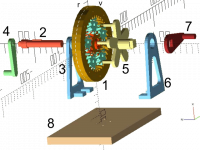
1°) - the epicyclic train :
After the theorical study under *FreeCAD *with animation, a small crank's
machine was produced in 3D printing. The illustration below details all its
components.
[image: eclate.png]
http://jeanpierre.rousset.free.fr/Automobile/Technique/Train_epicycloidal/Documentation/index.html
This marvelous gear is very old since James Watt used it in the 1780s. For
me it has always been the ideal gear that can replace at good profit
gearboxes and clutches in cars.
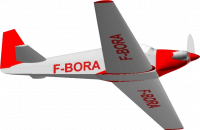
2°) - the model of the motor-glider Fournier RF4 D
- :*
This single engine, single seat airplane was my favorite aircraft on which
I flown the grea tmajority of my flying hours in paralel with gliding. So I
simply tried to make the model in order to 3D print it when the time will
come.
[image: F-BORA.png]
http://jeanpierre.rousset.free.fr/Informatique/Applications/OpenSCAD_OpenJSCAD/Fournier_RF4/presentation.html
This project interested me because it required the development of profiles
for which I favored the Bézier curves not foreseen by OpenSCAD,
treatment that I had difficulties to find on the forum.
Due to the somewhat limited language of OpenSCAD, I didn't want to process
Bézier surfaces. I made a simplified approach to generating volumes with
the tools of the software.
These two applications were not very difficult in programming writing. They
were rather difficult in terms of entering digital data. Indeed, I am
desperately to search for a graphic editor of technical drawings other
than the clones of AutoCAD having the great default of not being
intuitive. Interrupted use during several weeks leads to relearning the
software. It's a great pity that my old "microCADAM" program, that I had
for over twenty years when I retired, is obsolete even with the help of the
virtualization application "Oracle VM VirtualBox".
Maybe someone knows of a other type of technical drawing graphic
editor ?... Thank
you in advance.
Best Regards
Lou Papet
--
"Pourquoi faire simple quand on peut faire encore plus simple..." "Le plus
simple est de ne pas faire.....seulement si c'est possible !..."

Thank you Lou,
That is very impressive.
For others, note that there was a registration issue that lead to the
repeated post.
But that is now cleared up.
OpenSCAD Admin - email* me if you need anything, or if I've done something stupid...
- on the Forum, click on my MichaelAtOz label, there is a link to email me.
Unless specifically shown otherwise above, my contribution is in the Public Domain; to the extent possible under law, I have waived all copyright and related or neighbouring rights to this work. Obviously inclusion of works of previous authors is not included in the above.
--
Sent from: http://forum.openscad.org/

Great test!
Yes, adding data can be a bit of a pain in OpenSCAD.
but the way I see it is that that means we haven't really studied the subject we're modelling.
The Eiffel tower isn't symmetrical just because that looks better, but also because they only had to draw a portion of it, then mirror it about.
Nice website. Just wish I could understand it.
(I'm not going to debase it by using Google Translate)
I drive the modern day equivalent of the 2CV myself(first gen Berlingo. Yes, with the large 'ragtop')
But I fear I have bad news for you.
There's only ONE Renault ever worth owning or driving, and that's the FT.
It's like it was designed for the Paris traffic...
;-)
Trygve
In snowed down Norway!

Jean-Pierre,
Nice work!
I have not had a recent experience with any drawing graphic editor so I
can't help you with that. But certainly you will find suggestions on that
from the forum people.
I have just scratched your airplane code. And I have a few comments about
the evaluation conclusions about OpenSCAD in your referred site. As I
barely read french, I based my comments on a Google translation of them to
english.
First of all, hull() is not a linear interpolation of two shapes. It is the
minimal convex shape that includes all the shapes. The technical name of
that operation is convex hull https://en.wikipedia.org/wiki/Convex_hull.
That means that hull() is unable to produce holed shapes because its result
is always convex. There is no primitive operation in OpenSCAD that provides
a linear interpolation of two shapes.
Second, functions may be much more complex than a simple algebraic
expression as you suggest. Thanks to list comprehension and conditional
expressions, you can code iterations, recursions, tests and
pre-calculations inside a function. Here is a simple example that uses your
formule_Bezier() function:
// evaluates the points in a Bezier curve for a given list of parameter
values.
// if t is a list of numbers returns a list of points
// if t is a number returns a point
// ctl_pts should be a path, that is a list of pts with the same dimension
function Bezier_curve_sample(ctl_pts, t) =
is_num(t)
? formule_Bezier(t, ctl_pts)
: [for(ti=t) formule_Bezier (ti, ctl_pts)] ;
To get a display of the curve we may use a module similar to your Bezier()
module:
// draws a polygonal through pts
module line(pts,width) {
for(i=[0:len(pts)-2])

  hull() {

    translate(pts[i])   sphere(width);

    translate(pts[i+1]) sphere(width);

  }
}
// 2D curve example
pts = [ [0,0], [10,5], [20,-2], 30,20]];
curve = Bezier_curve_sample(pts, [for(i=[0:20]) i/20]);
polygon( curve );
color("red") line( curve, .3);
echo( curve = curve );
Note that above I don't call formule_Bezier() at each individual coordinate
as you do because OpenSCAD is not a typed language and the expression
inside is valid for both numerical control values and vector control
points. It is valid even for matricial control points, that is lists of
vector control points and suitable to sample Bezier Patches!
Finally, you mention the miss of a C-like break in OpenSCAD language. There
are many ways to deal with the need of premature interruptions in a
sequence of computations in OpenSCAD. Breaks are unavoidable in recursion,
an invaluable language tool. Here is an example:
// computes the list of Fibonacci numbers up to a limiting value greater
than 0
function Fibonacci(limit, _result) =
is_undef(_result)
? Fibonacci(limit,[0,1])
: let( n = len(_result) )
_result[n-1]+_result[n-2] > limit
? _result
: Fibonacci(limit, concat(_result, _result[n-1]+_result[n-2] ) );
Besides recursion, you have C-like for as a tool that can interrupt
iterations. A break() clause is not the only way to interrupt iterations.
Jean-Pierre Rousset loupapetjpr@gmail.com wrote:
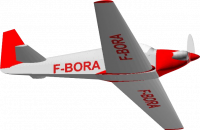
2°) - the model of the motor-glider Fournier RF4 D* :*
This single engine, single seat airplane was my favorite aircraft on which
I flown the grea tmajority of my flying hours in paralel with gliding. So I
simply tried to make the model in order to 3D print it when the time will
come.
[image: F-BORA.png]
http://jeanpierre.rousset.free.fr/Informatique/Applications/OpenSCAD_OpenJSCAD/Fournier_RF4/presentation.html
This project interested me because it required the development of profiles
for which I favored the Bézier curves not foreseen by OpenSCAD,
treatment that I had difficulties to find on the forum.
Due to the somewhat limited language of OpenSCAD, I didn't want to
process Bézier surfaces. I made a simplified approach to generating
volumes with the tools of the software.
Very happy to know that you were interested. Thank you.
Data entry was a bit tedious for modeling half of the plane since it is
symmetrical. But, for the interpolation squares to be the least visible
possible, it was necessary to enter the ribs and especially the frames for
the fuselage.
How to do it the easiest ?... I don't have a "CATIA" type software to
generate mathematically perfect shapes.
Personally, I do not master the spoken English language, I understand it by
reading, and I do not hesitate to use "Google Translate" which I sometimes
correct otherwise I would do nothing. It is not a dishonor to ignore a
language ! ...
Regarding the Renault FT tank, you are right ! ..
Today's manufacturers are especially interested in this kind of vehicle,
SUVs, "ox cart" in French "char à bœufs" that I find very ugly and very
old-fashioned, invented before the war ! ...
For everyone to his own tastes ! ...
There are too many unnecessary things in a car, which is why I prefer real
old vehicles without digital. They have a soul that I can't find now.
Greetings,
under a beautiful sun of Cannes / Nice
Le jeu. 28 janv. 2021 à 15:11, trygve@totallytrygve.com a écrit :
Great test!
Yes, adding data can be a bit of a pain in OpenSCAD.
but the way I see it is that that means we haven't really studied the
subject we're modelling.
The Eiffel tower isn't symmetrical just because that looks better, but
also because they only had to draw a portion of it, then mirror it about.
Nice website. Just wish I could understand it.
(I'm not going to debase it by using Google Translate)
I drive the modern day equivalent of the 2CV myself(first gen Berlingo.
Yes, with the large 'ragtop')
But I fear I have bad news for you.
There's only ONE Renault ever worth owning or driving, and that's the FT.
It's like it was designed for the Paris traffic...
;-)
Trygve
In snowed down Norway!
OpenSCAD mailing list
Discuss@lists.openscad.org
http://lists.openscad.org/mailman/listinfo/discuss_lists.openscad.org
--
"Pourquoi faire simple quand on peut faire encore plus simple..." "Le plus
simple est de ne pas faire.....seulement si c'est possible !..."

On 1/28/2021 9:43 AM, Jean-Pierre Rousset wrote:
How to do it the easiest ?... I don't have a "CATIA" type software to
generate mathematically perfect shapes.
You do have OpenSCAD to generate mathematically perfect shapes. You
have to supply your own math, or there are libraries available, but one
of the huge advantages of OpenSCAD is that if you can describe the shape
using math, you can model it.

There are too many unnecessary things in a car, which is why I prefer real
old vehicles without digital. They have a soul that I can't find now.
This is true for motorcycles as well. I have a newer (2015) BMW F800GS
that didn't run right for 5 years because of a sensor glitch in the
electronic ignition intake manifold that has another name.
While that was in the shop for a year I bought a 1988 'Bumblebee' R100GS.
Technically it's an inferior bike so why do I love it more?
I can fix it, that's why. And it has soul.
OpenSCAD mailing list

Jean-Pierre Rousset loupapetjpr@gmail.com
I am desperately to search for a graphic editor of technical drawings other than the clones of AutoCAD having the great default of not being intuitive.
A Bézier curve / vector drawing program might work well.
Inkscape is the free/opensource option (if you're on Mac OS X/Linux you could try Cenon), or for ChromeOS GraviT.
An affordable commercial option is Serif's Affinity Designer available for Mac OS X and Windows.
A programmatic option is METAPOST (or see Processing or Nodebox, though I had precision issues when I tried to use them for CAM).
William
I agree with you.I will perhaps surprise you but I do not appreciate what is
done today, especially in the automobile sector without taking the electric
ones which are, for me of course, an hoax against the planet! ...My 2CV is
42 yeaers old !...
"Pourquoi faire simple quand on peut faire encore plus simple !..."
"Why keep it simple when you can make it even simpler ! ..."
"Le plus simple est de ne pas faire.....seulement si c'est possible !..."
"The easiest way is not to do ..... only if it is possible ! ..."
Sent from: http://forum.openscad.org/

On the subject of bezier's, I implemented them in my own libraries with:
function linearBezier(p0, p1, t) = p0 + (p1 - p0) * t;
function quadraticBezier(p0, p1, p2, t) = linearBezier(linearBezier(p0,
p1, t), linearBezier(p1, p2, t), t);
function cubicBezier(p0, p1, p2, p3, t) = linearBezier(quadraticBezier(p0,
p1, p2, t), quadraticBezier(p1, p2, p3, t), t);
where all 3 functions take an argument t which is between 0 and 1, the
fraction of the path along the curve.
linearBezier (only named that for consistency, and I thought it was funny)
finds a linear interpretation between two points, quadraticBezier finds
the point along the parabolic segment defined by the 3 points, and
cubicBezier (the one normally used in most graphical applications) finds
the point along the cubic curve defined by the 4 points.
On Thu, Jan 28, 2021 at 6:49 PM Lou_Papet loupapetjpr@gmail.com wrote:
I agree with you. I will perhaps surprise you but I do not appreciate what
is done today, especially in the automobile sector without taking the
electric ones which are, for me of course, an hoax against the planet! ...
My 2CV is 42 yeaers old !...
"Pourquoi faire simple quand on peut faire encore plus simple !..."
"Why keep it simple when you can make it even simpler ! ..."
"Le plus simple est de ne pas faire.....seulement si c'est possible !..."
"The easiest way is not to do ..... only if it is possible ! ..."
Sent from the OpenSCAD mailing list archive http://forum.openscad.org/
at Nabble.com.
OpenSCAD mailing list
Discuss@lists.openscad.org
http://lists.openscad.org/mailman/listinfo/discuss_lists.openscad.org