

A
amundsen
Wed, Jun 24, 2020 9:05 PM
Hello,
I am trying to build a stack of polyhedra with each polyhedron build between
two semi-random 4-edges polygons. Also, the ceiling of a polyhedron is the
floor of the next one.
However I get weird results, and after rendering I get 2D shapes only.
What's wrong?
l_4 = [rands(-1,0,1)[0], rands(-1,0,1)[0], 0];
l_3 = [rands(-1,0,1)[0], rands(1,0,1)[0], 0];
l_2 = [rands(1,0,1)[0], rands(1,0,1)[0], 0];
l_1 = [rands(1,0,1)[0], rands(-1,0,1)[0], 0];
union() {
for(i=[1:10]) {
u_1 = [rands(-1,0,1)[0], rands(-1,0,1)[0],i];
u_2 = [rands(-1,0,1)[0], rands(1,0,1)[0], i];
u_3 = [rands(1,0,1)[0], rands(1,0,1)[0], i];
u_4 = [rands(1,0,1)[0], rands(-1,0,1)[0], i];
my_points = [l_1, l_2, l_3, l_4, u_1, u_2, u_3, u_4];
my_faces = [[0,1,2,3], [0,1,5,4], [1,2,6,5], [2,3,7,6], [3,0,4,7],
[4,5,6,7]];
polyhedron(points = my_points, faces = my_faces, convexity = 10);
l_1 = [rands(-1,0,1)[0], rands(-1,0,1)[0], i-1];
l_2 = [rands(-1,0,1)[0], rands(1,0,1)[0], i-1];
l_3 = [rands(1,0,1)[0], rands(1,0,1)[0], i-1];
l_4 = [rands(1,0,1)[0], rands(-1,0,1)[0], i-1];
}
}
--
Sent from: http://forum.openscad.org/

Hello,
I am trying to build a stack of polyhedra with each polyhedron build between
two semi-random 4-edges polygons. Also, the ceiling of a polyhedron is the
floor of the next one.
However I get weird results, and after rendering I get 2D shapes only.
What's wrong?
l_4 = [rands(-1,0,1)[0], rands(-1,0,1)[0], 0];
l_3 = [rands(-1,0,1)[0], rands(1,0,1)[0], 0];
l_2 = [rands(1,0,1)[0], rands(1,0,1)[0], 0];
l_1 = [rands(1,0,1)[0], rands(-1,0,1)[0], 0];
union() {
for(i=[1:10]) {
u_1 = [rands(-1,0,1)[0], rands(-1,0,1)[0],i];
u_2 = [rands(-1,0,1)[0], rands(1,0,1)[0], i];
u_3 = [rands(1,0,1)[0], rands(1,0,1)[0], i];
u_4 = [rands(1,0,1)[0], rands(-1,0,1)[0], i];
my_points = [l_1, l_2, l_3, l_4, u_1, u_2, u_3, u_4];
my_faces = [[0,1,2,3], [0,1,5,4], [1,2,6,5], [2,3,7,6], [3,0,4,7],
[4,5,6,7]];
polyhedron(points = my_points, faces = my_faces, convexity = 10);
l_1 = [rands(-1,0,1)[0], rands(-1,0,1)[0], i-1];
l_2 = [rands(-1,0,1)[0], rands(1,0,1)[0], i-1];
l_3 = [rands(1,0,1)[0], rands(1,0,1)[0], i-1];
l_4 = [rands(1,0,1)[0], rands(-1,0,1)[0], i-1];
}
}
--
Sent from: http://forum.openscad.org/
NH
nop head
Wed, Jun 24, 2020 9:14 PM
Some of your faces are inside out.
[image: image.png]
On Wed, 24 Jun 2020 at 22:06, amundsen roald.baudoux@brutele.be wrote:
Hello,
I am trying to build a stack of polyhedra with each polyhedron build
between
two semi-random 4-edges polygons. Also, the ceiling of a polyhedron is the
floor of the next one.
However I get weird results, and after rendering I get 2D shapes only.
What's wrong?
l_4 = [rands(-1,0,1)[0], rands(-1,0,1)[0], 0];
l_3 = [rands(-1,0,1)[0], rands(1,0,1)[0], 0];
l_2 = [rands(1,0,1)[0], rands(1,0,1)[0], 0];
l_1 = [rands(1,0,1)[0], rands(-1,0,1)[0], 0];
union() {
for(i=[1:10]) {
u_1 = [rands(-1,0,1)[0], rands(-1,0,1)[0],i];
u_2 = [rands(-1,0,1)[0], rands(1,0,1)[0], i];
u_3 = [rands(1,0,1)[0], rands(1,0,1)[0], i];
u_4 = [rands(1,0,1)[0], rands(-1,0,1)[0], i];
my_points = [l_1, l_2, l_3, l_4, u_1, u_2, u_3, u_4];
my_faces = [[0,1,2,3], [0,1,5,4], [1,2,6,5], [2,3,7,6],
[3,0,4,7],
[4,5,6,7]];
polyhedron(points = my_points, faces = my_faces, convexity
= 10);
l_1 = [rands(-1,0,1)[0], rands(-1,0,1)[0], i-1];
l_2 = [rands(-1,0,1)[0], rands(1,0,1)[0], i-1];
l_3 = [rands(1,0,1)[0], rands(1,0,1)[0], i-1];
l_4 = [rands(1,0,1)[0], rands(-1,0,1)[0], i-1];
}
}
--
Sent from: http://forum.openscad.org/
OpenSCAD mailing list
Discuss@lists.openscad.org
http://lists.openscad.org/mailman/listinfo/discuss_lists.openscad.org
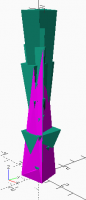
Some of your faces are inside out.
[image: image.png]
On Wed, 24 Jun 2020 at 22:06, amundsen <roald.baudoux@brutele.be> wrote:
> Hello,
>
> I am trying to build a stack of polyhedra with each polyhedron build
> between
> two semi-random 4-edges polygons. Also, the ceiling of a polyhedron is the
> floor of the next one.
>
> However I get weird results, and after rendering I get 2D shapes only.
>
> What's wrong?
>
> l_4 = [rands(-1,0,1)[0], rands(-1,0,1)[0], 0];
> l_3 = [rands(-1,0,1)[0], rands(1,0,1)[0], 0];
> l_2 = [rands(1,0,1)[0], rands(1,0,1)[0], 0];
> l_1 = [rands(1,0,1)[0], rands(-1,0,1)[0], 0];
>
> union() {
> for(i=[1:10]) {
> u_1 = [rands(-1,0,1)[0], rands(-1,0,1)[0],i];
> u_2 = [rands(-1,0,1)[0], rands(1,0,1)[0], i];
> u_3 = [rands(1,0,1)[0], rands(1,0,1)[0], i];
> u_4 = [rands(1,0,1)[0], rands(-1,0,1)[0], i];
> my_points = [l_1, l_2, l_3, l_4, u_1, u_2, u_3, u_4];
> my_faces = [[0,1,2,3], [0,1,5,4], [1,2,6,5], [2,3,7,6],
> [3,0,4,7],
> [4,5,6,7]];
> polyhedron(points = my_points, faces = my_faces, convexity
> = 10);
> l_1 = [rands(-1,0,1)[0], rands(-1,0,1)[0], i-1];
> l_2 = [rands(-1,0,1)[0], rands(1,0,1)[0], i-1];
> l_3 = [rands(1,0,1)[0], rands(1,0,1)[0], i-1];
> l_4 = [rands(1,0,1)[0], rands(-1,0,1)[0], i-1];
> }
> }
>
>
>
> --
> Sent from: http://forum.openscad.org/
>
> _______________________________________________
> OpenSCAD mailing list
> Discuss@lists.openscad.org
> http://lists.openscad.org/mailman/listinfo/discuss_lists.openscad.org
>
TP
Torsten Paul
Wed, Jun 24, 2020 10:19 PM
The easiest way for stacking things that have heights
defined in a list is via a recursive module. As noted
by nophead, the winding order is important, so the
point generation needs to make sure it's clear how
to enumerate in defined way.
// https://gist.github.com/thehans/c1721ba161249ad6830c50f1891af7d0
function cmul(c1,c2) = let(a=c1[0],b=c1[1],c=c2[0],d=c2[1]) [ac-bd, ad+bc];
function cpow(v, n) = n > 0 ? cpow(cmul(v, [0,1]), n - 1) : v;
// generate 4 points in 1st quadrant and rotate so we
// end up with one point in each quadrant in defined
// order
function points(z) = [ for (n = [0:3]) [ each cpow(rands(3, 10, 2), n), z ] ];
faces = [
[0, 1, 2, 3],
for (a = [0:3]) [ 4+a, (1+a)%4, a ],
for (a = [0:3]) [ 4+a, 4+(1+a)%4, (a+1)%4 ],
[7, 6, 5, 4]
];
module p(heights, bottom, h = 0, i = 0) {
if (i < len(heights)) {
height = h + heights[i];
top = points(height);
polyhedron([ each bottom, each top ], faces);
p(heights, top, height, i + 1);
}
}
p(rands(5, 20, 10), points(0));
ciao,
Torsten.
The easiest way for stacking things that have heights
defined in a list is via a recursive module. As noted
by nophead, the winding order is important, so the
point generation needs to make sure it's clear how
to enumerate in defined way.
// https://gist.github.com/thehans/c1721ba161249ad6830c50f1891af7d0
function cmul(c1,c2) = let(a=c1[0],b=c1[1],c=c2[0],d=c2[1]) [a*c-b*d, a*d+b*c];
function cpow(v, n) = n > 0 ? cpow(cmul(v, [0,1]), n - 1) : v;
// generate 4 points in 1st quadrant and rotate so we
// end up with one point in each quadrant in defined
// order
function points(z) = [ for (n = [0:3]) [ each cpow(rands(3, 10, 2), n), z ] ];
faces = [
[0, 1, 2, 3],
for (a = [0:3]) [ 4+a, (1+a)%4, a ],
for (a = [0:3]) [ 4+a, 4+(1+a)%4, (a+1)%4 ],
[7, 6, 5, 4]
];
module p(heights, bottom, h = 0, i = 0) {
if (i < len(heights)) {
height = h + heights[i];
top = points(height);
polyhedron([ each bottom, each top ], faces);
p(heights, top, height, i + 1);
}
}
p(rands(5, 20, 10), points(0));
ciao,
Torsten.