discuss@lists.openscad.org

OpenSCAD general discussion Mailing-list

View all threads

More on text alignment

MM
Michael Marx
Tue, Dec 29, 2020 7:08 AM

But is it a 'block' in all fonts?

It is in the default, Liberation Sans.

--
This email has been checked for viruses by AVG.
https://www.avg.com

> But is it a 'block' in all fonts? > It is in the default, Liberation Sans. -- This email has been checked for viruses by AVG. https://www.avg.com
A
arnholm@arnholm.org
Tue, Dec 29, 2020 9:29 AM

On 2020-12-29 08:08, Michael Marx wrote:

But is it a 'block' in all fonts?

It is in the default, Liberation Sans.

As a general comment to this text() talk, I think the way the text()
'spacing' parameter is implemented must be wrong in OpenSCAD, using
anything but default value gives odd results, try for example

linear_extrude(1)
text("Hello World", spacing=2);

I noticed this since I added (partial) support for text() in .scad
scripts when executed from AngelCAD v1.5-06.

Btw., why is there a need for a "font cache" in OpenSCAD?

Carsten Arnholm

On 2020-12-29 08:08, Michael Marx wrote: >> But is it a 'block' in all fonts? >> > > It is in the default, Liberation Sans. As a general comment to this text() talk, I think the way the text() 'spacing' parameter is implemented must be wrong in OpenSCAD, using anything but default value gives odd results, try for example linear_extrude(1) text("Hello World", spacing=2); I noticed this since I added (partial) support for text() in .scad scripts when executed from AngelCAD v1.5-06. Btw., why is there a need for a "font cache" in OpenSCAD? Carsten Arnholm
M
MichaelAtOz
Tue, Dec 29, 2020 10:08 PM

spacing= makes more sense with mono spaced fonts

linear_extrude(1)
text("Hello World", spacing=2, font="liberation mono");

There are issues with spacing and alignment, which I'll mention under Jordan's 'metrics' thread
later.

-----Original Message-----
From: Discuss [mailto:discuss-bounces@lists.openscad.org] On Behalf Of arnholm@arnholm.org
Sent: Tue, 29 Dec 2020 20:30
To: OpenSCAD general discussion
Subject: Re: [OpenSCAD] More on text alignment

On 2020-12-29 08:08, Michael Marx wrote:

But is it a 'block' in all fonts?

It is in the default, Liberation Sans.

As a general comment to this text() talk, I think the way the text()
'spacing' parameter is implemented must be wrong in OpenSCAD, using
anything but default value gives odd results, try for example

linear_extrude(1)
text("Hello World", spacing=2);

I noticed this since I added (partial) support for text() in .scad
scripts when executed from AngelCAD v1.5-06.

Btw., why is there a need for a "font cache" in OpenSCAD?

Carsten Arnholm


OpenSCAD mailing list
Discuss@lists.openscad.org
http://lists.openscad.org/mailman/listinfo/discuss_lists.openscad.org

--
This email has been checked for viruses by AVG.
https://www.avg.com

spacing= makes more sense with mono spaced fonts linear_extrude(1) text("Hello World", spacing=2, font="liberation mono"); There are issues with spacing and alignment, which I'll mention under Jordan's 'metrics' thread later. > -----Original Message----- > From: Discuss [mailto:discuss-bounces@lists.openscad.org] On Behalf Of arnholm@arnholm.org > Sent: Tue, 29 Dec 2020 20:30 > To: OpenSCAD general discussion > Subject: Re: [OpenSCAD] More on text alignment > > On 2020-12-29 08:08, Michael Marx wrote: > >> But is it a 'block' in all fonts? > >> > > > > It is in the default, Liberation Sans. > > As a general comment to this text() talk, I think the way the text() > 'spacing' parameter is implemented must be wrong in OpenSCAD, using > anything but default value gives odd results, try for example > > linear_extrude(1) > text("Hello World", spacing=2); > > I noticed this since I added (partial) support for text() in .scad > scripts when executed from AngelCAD v1.5-06. > > > Btw., why is there a need for a "font cache" in OpenSCAD? > > Carsten Arnholm > > _______________________________________________ > OpenSCAD mailing list > Discuss@lists.openscad.org > http://lists.openscad.org/mailman/listinfo/discuss_lists.openscad.org -- This email has been checked for viruses by AVG. https://www.avg.com
JB
Jordan Brown
Tue, Dec 29, 2020 11:14 PM

On 12/29/2020 1:29 AM, arnholm@arnholm.org wrote:

As a general comment to this text() talk, I think the way the text()
'spacing' parameter is implemented must be wrong in OpenSCAD, using
anything but default value gives odd results, try for example

linear_extrude(1)
text("Hello World", spacing=2);

I noticed this since I added (partial) support for text() in .scad
scripts when executed from AngelCAD v1.5-06.

It's a straight multiplier on the "advance" value for each glyph.

Yeah, that can go wrong in a couple of ways.  A series of Ws will get a
lot more space between them than a series of Is.

You might think that it should be a value that's added to the advance
value, but that forgets the fact that OpenSCAD (through HarfBuzz)
supports ligatures.  If you want even weirder spacing, check out
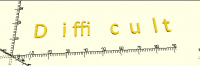
"Difficult" in Calibri:

What's going on there is that "ffi" is compressed down into being one
glyph, and then the extra spacing is applied.  And since the "ffi"
ligature is extra-wide, the extra spacing after it is extra-wide too.

I don't know what the right answer is, but I'm going to draw a line and
say that I'm not going to try to fix it as part of my text metrics project.

Btw., why is there a need for a "font cache" in OpenSCAD?

Carsten Arnholm


OpenSCAD mailing list
Discuss@lists.openscad.org
http://lists.openscad.org/mailman/listinfo/discuss_lists.openscad.org
On 12/29/2020 1:29 AM, arnholm@arnholm.org wrote: > As a general comment to this text() talk, I think the way the text() > 'spacing' parameter is implemented must be wrong in OpenSCAD, using > anything but default value gives odd results, try for example > > linear_extrude(1) > text("Hello World", spacing=2); > > I noticed this since I added (partial) support for text() in .scad > scripts when executed from AngelCAD v1.5-06. It's a straight multiplier on the "advance" value for each glyph. Yeah, that can go wrong in a couple of ways.  A series of Ws will get a lot more space between them than a series of Is. You might think that it should be a value that's *added* to the advance value, but that forgets the fact that OpenSCAD (through HarfBuzz) supports ligatures.  If you want even weirder spacing, check out "Difficult" in Calibri: What's going on there is that "ffi" is compressed down into being one glyph, and *then* the extra spacing is applied.  And since the "ffi" ligature is extra-wide, the extra spacing after it is extra-wide too. I don't know what the right answer is, but I'm going to draw a line and say that I'm not going to try to fix it as part of my text metrics project. > > > Btw., why is there a need for a "font cache" in OpenSCAD? > > Carsten Arnholm > > _______________________________________________ > OpenSCAD mailing list > Discuss@lists.openscad.org > http://lists.openscad.org/mailman/listinfo/discuss_lists.openscad.org
CA
Carsten Arnholm
Wed, Dec 30, 2020 5:02 AM

On 29.12.2020 23:08, MichaelAtOz wrote:

spacing= makes more sense with mono spaced fonts

linear_extrude(1)
text("Hello World", spacing=2, font="liberation mono");

There are issues with spacing and alignment, which I'll mention under Jordan's 'metrics' thread
later.

That is avoiding the issue i mentioned. Spacing should have a meaningful
definition with any font. A natural interpretation is for it to define
the size of the spacing between the characters.

In my opinion, and why I made a comment, it is precisely because it is
implemented incorrectly in OpenSCAD it can't be used for anything but
mono spaced fonts (you could question its use there as well).

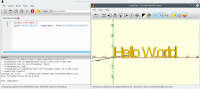
Consider this, I would expect zero spacing between the characters:

linear_extrude(1)
text("Hello World", spacing=0, font="liberation mono");

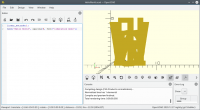
See attached "openscad_spacing0.png", where all characters are drawn on
top of each other, I don't think that is correct.

Compare with the same .scad code executed in AngelCAD, where you get
zero spacing between characters. I don't claim this to be perfect
either, but it makes much more sense to me.

Crsten Arnholm.
On 29.12.2020 23:08, MichaelAtOz wrote: > spacing= makes more sense with mono spaced fonts > > linear_extrude(1) > text("Hello World", spacing=2, font="liberation mono"); > > There are issues with spacing and alignment, which I'll mention under Jordan's 'metrics' thread > later. That is avoiding the issue i mentioned. Spacing should have a meaningful definition with any font. A natural interpretation is for it to define the size of the spacing between the characters. In my opinion, and why I made a comment, it is precisely because it is implemented incorrectly in OpenSCAD it can't be used for anything but mono spaced fonts (you could question its use there as well). Consider this, I would expect zero spacing between the characters: linear_extrude(1) text("Hello World", spacing=0, font="liberation mono"); See attached "openscad_spacing0.png", where all characters are drawn on top of each other, I don't think that is correct. Compare with the same .scad code executed in AngelCAD, where you get zero spacing between characters. I don't claim this to be perfect either, but it makes much more sense to me. Crsten Arnholm.
CA
Carsten Arnholm
Wed, Dec 30, 2020 5:25 AM

On 30.12.2020 00:14, Jordan Brown wrote:

It's a straight multiplier on the "advance" value for each glyph.

And I think that is wrong.

You might think that it should be a value that's added to the advance
value,

I would think so, yes.

but that forgets the fact that OpenSCAD (through HarfBuzz)
supports ligatures.  If you want even weirder spacing, check out
"Difficult" in Calibri:

What's going on there is that "ffi" is compressed down into being one
glyph, and then the extra spacing is applied.  And since the "ffi"
ligature is extra-wide, the extra spacing after it is extra-wide too.

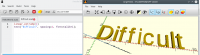
Fist of all, I don't see the ligature effect you are describing, even in
the very latest nightly: OpenSCAD version 2020.12.27.nightly (git
52eb8ec), see attached. That is probably something unreleased you have
added?

The discussion of ligatures seems to be making things more difficult
(pun intended) than required for the purposes of including text in
3d-printing models. What you showed is surely something different from
current OpenSCAD, even the latest nightly, and it does not seem like an
improvement when it comes to spacings.

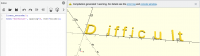
Compare with the exact same .scad code Executed in AngelCAD 1.5-06
(attached screenshot), it does not need to be any more difficult than
that. AngelCAD does not use HarfBuzz, btw.

Carsten Arnholm
On 30.12.2020 00:14, Jordan Brown wrote: > It's a straight multiplier on the "advance" value for each glyph. And I think that is wrong. > You might think that it should be a value that's *added* to the advance > value, I would think so, yes. > but that forgets the fact that OpenSCAD (through HarfBuzz) > supports ligatures.  If you want even weirder spacing, check out > "Difficult" in Calibri: > > What's going on there is that "ffi" is compressed down into being one > glyph, and *then* the extra spacing is applied.  And since the "ffi" > ligature is extra-wide, the extra spacing after it is extra-wide too. Fist of all, I don't see the ligature effect you are describing, even in the very latest nightly: OpenSCAD version 2020.12.27.nightly (git 52eb8ec), see attached. That is probably something unreleased you have added? The discussion of ligatures seems to be making things more difficult (pun intended) than required for the purposes of including text in 3d-printing models. What you showed is surely something different from current OpenSCAD, even the latest nightly, and it does not seem like an improvement when it comes to spacings. Compare with the exact same .scad code Executed in AngelCAD 1.5-06 (attached screenshot), it does not need to be any more difficult than that. AngelCAD does not use HarfBuzz, btw. Carsten Arnholm
M
MichaelAtOz
Wed, Dec 30, 2020 11:13 PM

valign - I can't see a rational for it doing that. Probably bug.

halign - This is the case of the font designers choice,

they wanted that bit intruding outside the normal space.

If in print they had two lines of text that back-intrusion makes it all fit together.

a. one view is if you wanted to do the same layout in OpenSCAD it should do as it currently does.

b. another is that you shuffle the text up/right to align with the origin, or otherwise for
rtl/ttb/btt,

but then you cannot achieve what the font intends, and some fonts are really weird.

Leaving it as a. with textmetrics() giving you info to manually shuffle would probably be best.?


From: Discuss [mailto:discuss-bounces@lists.openscad.org] On Behalf Of Jordan Brown
Sent: Mon, 28 Dec 2020 15:16
To: OpenSCAD general discussion
Subject: [OpenSCAD] More on text alignment

I've been noticing a few more "odd" cases.  I'd like opinions on whether or not they are bugs.

--- valign ---

valign=top doesn't always slam the top of the string against the X axis.  If the glyph is below and
not touching the baseline, it only adjusts the baseline up to the X axis.  Thus
text("_",valign="top") has the underscore a bit -Y below the X axis.

Similarly with valign="bottom", if the glyph is above and not touching the baseline.  text(" ' ",
valign="bottom") has the apostrophe well +Y of the X axis.

--- halign ---

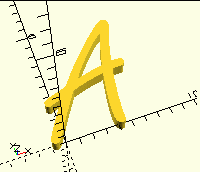
Some fonts want to put ink left of the origin, or right of their nominal width.  This mostly
happens in script and italic fonts.

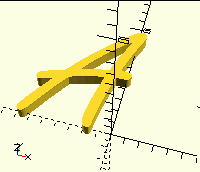
text("A", font="Freestyle Script", halign="left") has part of the left tail of the A left of the Y
axis.

Similarly, text("A", font="Freestyle Script", halign="right") has part to the right of the Y axis.


For all of these...

Feature?

Bug that should be fixed?

Regrettable legacy behavior that shouldn't change?

--
This email has been checked for viruses by AVG.
https://www.avg.com
valign - I can't see a rational for it doing that. Probably bug. halign - This is the case of the font designers choice, they wanted that bit intruding outside the normal space. If in print they had two lines of text that back-intrusion makes it all fit together. a. one view is if you wanted to do the same layout in OpenSCAD it should do as it currently does. b. another is that you shuffle the text up/right to align with the origin, or otherwise for rtl/ttb/btt, but then you cannot achieve what the font intends, and some fonts are really weird. Leaving it as a. with textmetrics() giving you info to manually shuffle would probably be best.? _____ From: Discuss [mailto:discuss-bounces@lists.openscad.org] On Behalf Of Jordan Brown Sent: Mon, 28 Dec 2020 15:16 To: OpenSCAD general discussion Subject: [OpenSCAD] More on text alignment I've been noticing a few more "odd" cases. I'd like opinions on whether or not they are bugs. --- valign --- valign=top doesn't always slam the top of the string against the X axis. If the glyph is below and not touching the baseline, it only adjusts the baseline up to the X axis. Thus text("_",valign="top") has the underscore a bit -Y below the X axis. Similarly with valign="bottom", if the glyph is above and not touching the baseline. text(" ' ", valign="bottom") has the apostrophe well +Y of the X axis. --- halign --- Some fonts want to put ink left of the origin, or right of their nominal width. This mostly happens in script and italic fonts. text("A", font="Freestyle Script", halign="left") has part of the left tail of the A left of the Y axis. Similarly, text("A", font="Freestyle Script", halign="right") has part to the right of the Y axis. --- For all of these... Feature? Bug that should be fixed? Regrettable legacy behavior that shouldn't change? -- This email has been checked for viruses by AVG. https://www.avg.com
JB
Jordan Brown
Thu, Dec 31, 2020 8:42 PM

On 12/29/2020 9:25 PM, Carsten Arnholm wrote:

You might think that [spacing] should be a value that's added to
the advance value,

I would think so, yes.

That's not an unreasonable answer, but isn't current behavior and
(except for the default) isn't compatible with current behavior.  Or
with the ligature issue discussed below.  (And perhaps others, with
combining characters.)

Net, I'm not optimistic about fixing "spacing" in the general case.

First of all, I don't see the ligature effect you are describing, even
in the very latest nightly: OpenSCAD version 2020.12.27.nightly (git
52eb8ec), see attached. That is probably something unreleased you have
added?

No, it's stock OpenSCAD.  (Right now I'm demonstrating it with 2019.05
on Windows 10.)  But it depends on the font; it only applies to fonts
that have ligature support.  Liberation Sans does not seem to have
ligature support.  I've been testing it with Calibri.

The discussion of ligatures seems to be making things more difficult
(pun intended) than required for the purposes of including text in
3d-printing models.

It depends on how picky you are about your text.  Typographers consider
ligatures to be important.  Are they important in 3D design and 3D
printing?  If you're just trying to put "ON" and "OFF" labels on a box,
probably not.  If you're trying to print plates for a printing press, maybe.

One might also wonder whether kerning, another "advanced" typographic
feature that OpenSCAD supports, is "required".  (Compare the spacing
between "AAAVVV" and "AVAVAV" - the same letters, just in a different
order.)

Compare with the exact same .scad code Executed in AngelCAD 1.5-06
(attached screenshot), it does not need to be any more difficult than
that. AngelCAD does not use HarfBuzz, btw.

What does it do with this program and its variants?  (Also attached, in
case something mangles the non-ASCII text.)

israel = "יִשְׂרָאֵל";
harfbuzz = "حرف‌باز";
f = "Arial";
spacing=1;
direction = "rtl";

text(israel, font=f, spacing=spacing, direction=direction);
translate([0,-20,0]) text(harfbuzz, font=f, spacing=spacing, direction=direction);

For extra special fun, note that for this Hebrew and Persian text
OpenSCAD defaults to right-to-left.

Note:  there's no telling how the RTL text here will be presented by any
particular program.  As I compose this, Thunderbird is presenting it
correctly, where in "Israel" the first character, the yod, which looks
sort of like an apostrophe, is on the right.  I can sort of read Hebrew,
so I know which character is which, but I can't read Persian so I can't
say a lot about the "harfbuzz".  I can't even really see how the
individual characters in that string are constructed into the glyphs
that result. But I can tell you that there's a glyph that looks sort of
like a semicolon; it's supposed to be on the left.  On the other hand,
OpenSCAD's editor kind of mangles it.

On 12/29/2020 9:25 PM, Carsten Arnholm wrote: >> You might think that [spacing] should be a value that's *added* to >> the advance value, > I would think so, yes. That's not an unreasonable answer, but isn't current behavior and (except for the default) isn't compatible with current behavior.  Or with the ligature issue discussed below.  (And perhaps others, with combining characters.) Net, I'm not optimistic about fixing "spacing" in the general case. > First of all, I don't see the ligature effect you are describing, even > in the very latest nightly: OpenSCAD version 2020.12.27.nightly (git > 52eb8ec), see attached. That is probably something unreleased you have > added? No, it's stock OpenSCAD.  (Right now I'm demonstrating it with 2019.05 on Windows 10.)  But it depends on the font; it only applies to fonts that have ligature support.  Liberation Sans does not seem to have ligature support.  I've been testing it with Calibri. > The discussion of ligatures seems to be making things more difficult > (pun intended) than required for the purposes of including text in > 3d-printing models. It depends on how picky you are about your text.  Typographers consider ligatures to be important.  Are they important in 3D design and 3D printing?  If you're just trying to put "ON" and "OFF" labels on a box, probably not.  If you're trying to print plates for a printing press, maybe. One might also wonder whether kerning, another "advanced" typographic feature that OpenSCAD supports, is "required".  (Compare the spacing between "AAAVVV" and "AVAVAV" - the same letters, just in a different order.) > Compare with the exact same .scad code Executed in AngelCAD 1.5-06 > (attached screenshot), it does not need to be any more difficult than > that. AngelCAD does not use HarfBuzz, btw. What does it do with this program and its variants?  (Also attached, in case something mangles the non-ASCII text.) israel = "יִשְׂרָאֵל"; harfbuzz = "حرف‌باز"; f = "Arial"; spacing=1; direction = "rtl"; text(israel, font=f, spacing=spacing, direction=direction); translate([0,-20,0]) text(harfbuzz, font=f, spacing=spacing, direction=direction); For extra special fun, note that for this Hebrew and Persian text OpenSCAD defaults to right-to-left. Note:  there's no telling how the RTL text here will be presented by any particular program.  As I compose this, Thunderbird is presenting it correctly, where in "Israel" the first character, the yod, which looks sort of like an apostrophe, is on the right.  I can sort of read Hebrew, so I know which character is which, but I can't read Persian so I can't say a lot about the "harfbuzz".  I can't even really see how the individual characters in that string are constructed into the glyphs that result. But I can tell you that there's a glyph that looks sort of like a semicolon; it's supposed to be on the left.  On the other hand, OpenSCAD's editor kind of mangles it.