discuss@lists.openscad.org

OpenSCAD general discussion Mailing-list

View all threads

Problems making a negative space

MM
matt meek
Mon, Oct 21, 2019 7:55 PM

Hello,

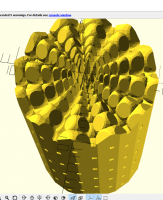
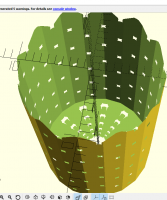
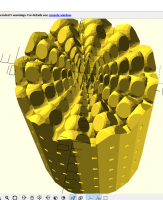
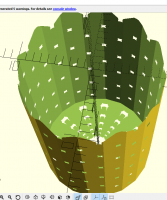
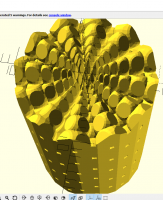
I'm having issues making a negative space with difference. I'm trying to make a lattice, and have made all of what will be negative spaces, but when I try to invert them the difference function removed my whole model. I've tried offsetting the shape I'm subtracting, and that hasn't made a difference. I also tried increasing the number of facets in case it was a resolution issue, and also changing the order in which I use the difference function, but that also has made no difference.Please could someone help? Apologies for the unelegant code, I'm a newbie.

Matt
[cid:c4aabeea-e83d-49a1-92cb-656151fa520a][cid:5e4ebe26-737b-44a1-8627-cb01603d9392]

$fn=20;

R=10;
n=12;
C=sqrt((pow((2PIR)/n,2))/2);
S=0.625*C;

difference(){
inverse_lattice_proper();
cyl();
}

module inverse_lattice_proper(){
intersection(){
cyl();
inverse_lattice();
}}

module inverse_lattice(){
layer_1();
layer_2();
layer_3();
layer_4();
layer_5();
layer_6();
}

module layer_6(){
scale([(R-(sqrt(pow(C,2)*2)/2))/R,(R-(sqrt(pow(C,2)*2)/2))/R,1]) layer_5();
}
module layer_5(){
scale([(R-(sqrt(pow(C,2)*2)/2))/R,(R-(sqrt(pow(C,2)*2)/2))/R,1]) layer_4();
}

module layer_4(){
scale([(R-(sqrt(pow(C,2)*2)/2))/R,(R-(sqrt(pow(C,2)*2)/2))/R,1]) layer_3();
}

module layer_3(){
scale([(R-(sqrt(pow(C,2)*2)/2))/R,(R-(sqrt(pow(C,2)*2)/2))/R,1]) layer_2();
}

module layer_2(){
scale([(R-(sqrt(pow(C,2)*2)/2))/R,(R-(sqrt(pow(C,2)*2)/2))/R,1]) layer_1();
}

module lattice(){
rotate([45,0,0]){
intersection(){
cube(C, center=true);
sphere(S, center=true);
}
}
}
module cyl(){
translate([0,0,10]){
cylinder (h=40,r=R,center=true);
}
}module layer_1(){
layer();
translate([0,0,sqrt(pow(C,2)*2)/2]){
rotate ([0,0,180/n]){
layer();
translate([0,0,sqrt(pow(C,2)*2)/2]){
rotate ([0,0,180/n]){
layer();
translate([0,0,sqrt(pow(C,2)*2)/2]){
rotate ([0,0,180/n]){
layer();translate([0,0,sqrt(pow(C,2)*2)/2]){
rotate ([0,0,180/n]){
layer();translate([0,0,sqrt(pow(C,2)*2)/2]){
rotate ([0,0,180/n]){
layer();translate([0,0,sqrt(pow(C,2)*2)/2]){
rotate ([0,0,180/n]){
layer();translate([0,0,sqrt(pow(C,2)*2)/2]){
rotate ([0,0,180/n]){
layer();
translate([0,0,sqrt(pow(C,2)*2)/2]){
rotate ([0,0,180/n]){
layer();
translate([0,0,sqrt(pow(C,2)*2)/2]){
rotate ([0,0,180/n]){
layer();
translate([0,0,sqrt(pow(C,2)*2)/2]){
rotate ([0,0,180/n]){
layer();
translate([0,0,sqrt(pow(C,2)*2)/2]){
rotate ([0,0,180/n]){
layer();
translate([0,0,sqrt(pow(C,2)*2)/2]){
rotate ([0,0,180/n]){
layer();
translate([0,0,sqrt(pow(C,2)*2)/2]){
rotate ([0,0,180/n]){
layer();
}
}}}}}}}}}}}}}}}}}}}}}}}}}}

module layer(){
union(){
translate([R,0,0.5C]){lattice();
translate([R
cos(360/n)-R,Rsin(360/n),0]){
rotate ([0,0,360/n]){lattice();
translate([R
cos(360/n)-R,Rsin(360/n),0]){
rotate ([0,0,360/n]){lattice();
translate([R
cos(360/n)-R,Rsin(360/n),0]){
rotate ([0,0,360/n]){lattice();
translate([R
cos(360/n)-R,Rsin(360/n),0]){
rotate ([0,0,360/n]){lattice();translate([R
cos(360/n)-R,Rsin(360/n),0]){
rotate ([0,0,360/n]){lattice();
translate([R
cos(360/n)-R,Rsin(360/n),0]){
rotate ([0,0,360/n]){lattice();
translate([R
cos(360/n)-R,Rsin(360/n),0]){
rotate ([0,0,360/n]){lattice();
translate([R
cos(360/n)-R,Rsin(360/n),0]){
rotate ([0,0,360/n]){lattice();
translate([R
cos(360/n)-R,Rsin(360/n),0]){
rotate ([0,0,360/n]){lattice();
translate([R
cos(360/n)-R,Rsin(360/n),0]){
rotate ([0,0,360/n]){lattice();translate([R
cos(360/n)-R,Rsin(360/n),0]){
rotate ([0,0,360/n]){lattice();
translate([R
cos(360/n)-R,Rsin(360/n),0]){
rotate ([0,0,360/n]){lattice();
translate([R
cos(360/n)-R,Rsin(360/n),0]){
rotate ([0,0,360/n]){lattice();
translate([R
cos(360/n)-R,Rsin(360/n),0]){
rotate ([0,0,360/n]){lattice();
translate([R
cos(360/n)-R,Rsin(360/n),0]){
rotate ([0,0,360/n]){lattice();
translate([R
cos(360/n)-R,Rsin(360/n),0]){
rotate ([0,0,360/n]){lattice();translate([R
cos(360/n)-R,Rsin(360/n),0]){
rotate ([0,0,360/n]){lattice();
translate([R
cos(360/n)-R,Rsin(360/n),0]){
rotate ([0,0,360/n]){lattice();
translate([R
cos(360/n)-R,Rsin(360/n),0]){
rotate ([0,0,360/n]){lattice();
translate([R
cos(360/n)-R,Rsin(360/n),0]){
rotate ([0,0,360/n]){lattice();
translate([R
cos(360/n)-R,Rsin(360/n),0]){
rotate ([0,0,360/n]){lattice();
translate([R
cos(360/n)-R,Rsin(360/n),0]){
rotate ([0,0,360/n]){lattice();translate([R
cos(360/n)-R,Rsin(360/n),0]){
rotate ([0,0,360/n]){lattice();
translate([R
cos(360/n)-R,R*sin(360/n),0]){
rotate ([0,0,360/n]){lattice();
}}}}}}}}}}}}}}}}}}}}}}}}}}}}}}}}}}}}}}}}}}}}}}}}}}};
Hello, I'm having issues making a negative space with difference. I'm trying to make a lattice, and have made all of what will be negative spaces, but when I try to invert them the difference function removed my whole model. I've tried offsetting the shape I'm subtracting, and that hasn't made a difference. I also tried increasing the number of facets in case it was a resolution issue, and also changing the order in which I use the difference function, but that also has made no difference.Please could someone help? Apologies for the unelegant code, I'm a newbie. Matt [cid:c4aabeea-e83d-49a1-92cb-656151fa520a][cid:5e4ebe26-737b-44a1-8627-cb01603d9392] $fn=20; R=10; n=12; C=sqrt((pow((2*PI*R)/n,2))/2); S=0.625*C; difference(){ inverse_lattice_proper(); cyl(); } module inverse_lattice_proper(){ intersection(){ cyl(); inverse_lattice(); }} module inverse_lattice(){ layer_1(); layer_2(); layer_3(); layer_4(); layer_5(); layer_6(); } module layer_6(){ scale([(R-(sqrt(pow(C,2)*2)/2))/R,(R-(sqrt(pow(C,2)*2)/2))/R,1]) layer_5(); } module layer_5(){ scale([(R-(sqrt(pow(C,2)*2)/2))/R,(R-(sqrt(pow(C,2)*2)/2))/R,1]) layer_4(); } module layer_4(){ scale([(R-(sqrt(pow(C,2)*2)/2))/R,(R-(sqrt(pow(C,2)*2)/2))/R,1]) layer_3(); } module layer_3(){ scale([(R-(sqrt(pow(C,2)*2)/2))/R,(R-(sqrt(pow(C,2)*2)/2))/R,1]) layer_2(); } module layer_2(){ scale([(R-(sqrt(pow(C,2)*2)/2))/R,(R-(sqrt(pow(C,2)*2)/2))/R,1]) layer_1(); } module lattice(){ rotate([45,0,0]){ intersection(){ cube(C, center=true); sphere(S, center=true); } } } module cyl(){ translate([0,0,10]){ cylinder (h=40,r=R,center=true); } }module layer_1(){ layer(); translate([0,0,sqrt(pow(C,2)*2)/2]){ rotate ([0,0,180/n]){ layer(); translate([0,0,sqrt(pow(C,2)*2)/2]){ rotate ([0,0,180/n]){ layer(); translate([0,0,sqrt(pow(C,2)*2)/2]){ rotate ([0,0,180/n]){ layer();translate([0,0,sqrt(pow(C,2)*2)/2]){ rotate ([0,0,180/n]){ layer();translate([0,0,sqrt(pow(C,2)*2)/2]){ rotate ([0,0,180/n]){ layer();translate([0,0,sqrt(pow(C,2)*2)/2]){ rotate ([0,0,180/n]){ layer();translate([0,0,sqrt(pow(C,2)*2)/2]){ rotate ([0,0,180/n]){ layer(); translate([0,0,sqrt(pow(C,2)*2)/2]){ rotate ([0,0,180/n]){ layer(); translate([0,0,sqrt(pow(C,2)*2)/2]){ rotate ([0,0,180/n]){ layer(); translate([0,0,sqrt(pow(C,2)*2)/2]){ rotate ([0,0,180/n]){ layer(); translate([0,0,sqrt(pow(C,2)*2)/2]){ rotate ([0,0,180/n]){ layer(); translate([0,0,sqrt(pow(C,2)*2)/2]){ rotate ([0,0,180/n]){ layer(); translate([0,0,sqrt(pow(C,2)*2)/2]){ rotate ([0,0,180/n]){ layer(); } }}}}}}}}}}}}}}}}}}}}}}}}}} module layer(){ union(){ translate([R,0,0.5*C]){lattice(); translate([R*cos(360/n)-R,R*sin(360/n),0]){ rotate ([0,0,360/n]){lattice(); translate([R*cos(360/n)-R,R*sin(360/n),0]){ rotate ([0,0,360/n]){lattice(); translate([R*cos(360/n)-R,R*sin(360/n),0]){ rotate ([0,0,360/n]){lattice(); translate([R*cos(360/n)-R,R*sin(360/n),0]){ rotate ([0,0,360/n]){lattice();translate([R*cos(360/n)-R,R*sin(360/n),0]){ rotate ([0,0,360/n]){lattice(); translate([R*cos(360/n)-R,R*sin(360/n),0]){ rotate ([0,0,360/n]){lattice(); translate([R*cos(360/n)-R,R*sin(360/n),0]){ rotate ([0,0,360/n]){lattice(); translate([R*cos(360/n)-R,R*sin(360/n),0]){ rotate ([0,0,360/n]){lattice(); translate([R*cos(360/n)-R,R*sin(360/n),0]){ rotate ([0,0,360/n]){lattice(); translate([R*cos(360/n)-R,R*sin(360/n),0]){ rotate ([0,0,360/n]){lattice();translate([R*cos(360/n)-R,R*sin(360/n),0]){ rotate ([0,0,360/n]){lattice(); translate([R*cos(360/n)-R,R*sin(360/n),0]){ rotate ([0,0,360/n]){lattice(); translate([R*cos(360/n)-R,R*sin(360/n),0]){ rotate ([0,0,360/n]){lattice(); translate([R*cos(360/n)-R,R*sin(360/n),0]){ rotate ([0,0,360/n]){lattice(); translate([R*cos(360/n)-R,R*sin(360/n),0]){ rotate ([0,0,360/n]){lattice(); translate([R*cos(360/n)-R,R*sin(360/n),0]){ rotate ([0,0,360/n]){lattice();translate([R*cos(360/n)-R,R*sin(360/n),0]){ rotate ([0,0,360/n]){lattice(); translate([R*cos(360/n)-R,R*sin(360/n),0]){ rotate ([0,0,360/n]){lattice(); translate([R*cos(360/n)-R,R*sin(360/n),0]){ rotate ([0,0,360/n]){lattice(); translate([R*cos(360/n)-R,R*sin(360/n),0]){ rotate ([0,0,360/n]){lattice(); translate([R*cos(360/n)-R,R*sin(360/n),0]){ rotate ([0,0,360/n]){lattice(); translate([R*cos(360/n)-R,R*sin(360/n),0]){ rotate ([0,0,360/n]){lattice();translate([R*cos(360/n)-R,R*sin(360/n),0]){ rotate ([0,0,360/n]){lattice(); translate([R*cos(360/n)-R,R*sin(360/n),0]){ rotate ([0,0,360/n]){lattice(); }}}}}}}}}}}}}}}}}}}}}}}}}}}}}}}}}}}}}}}}}}}}}}}}}}};
HL
Hans L
Mon, Oct 21, 2019 11:08 PM

Hoo boy, there's a lot going on here.

  1. Your main issue looks like you have the modules swapped around in your
    difference operation.  You want the (cylinder minus the "inverse_lattice")
    right?    A - B is not the same as B - A, so the module you list first
    matters.
  2. Your "module_inverse_proper" is unnecessary.  There's no reason to get
    the intersection of your negative object with the same positive object that
    its about to be subtracted from.
  3. Learn to use "for" loops, instead of nesting dozens of calls, you could
    probably shorten your code by 10x or so.
  4. This is a really complex model and going to take quite a while to
    render.  Read this
    https://en.wikibooks.org/wiki/OpenSCAD_User_Manual/FAQ#Why_is_the_preview_so_slow?
    You can get around the issue of exponentially exploding number of CSG
    elements somewhat, by wrapping your lattice with a call to render() (
    https://en.wikibooks.org/wiki/OpenSCAD_User_Manual/CSG_Modelling#render )
    like so:

module lattice() {
render() rotate([45, 0, 0]) intersection() {
cube(C, center = true);
sphere(S);
}
}

  1. sphere doesn't have a "center" parameter.  Its always centered, which is
    why those warnings are showing.
  2. You have these weird patterns of expression all around your code:
    sqrt(pow(X,2) * Y)  OR  sqrt(pow(X,2) / Y)
    sqrt(pow(X,2) * Y)  ==  ( X * sqrt(Y) ) since your X expression is always
    positive anyways.  So they can be simplified for better readability.
  • Hans

On Mon, Oct 21, 2019 at 2:55 PM matt meek via Discuss <
discuss@lists.openscad.org> wrote:

Hello,

I'm having issues making a negative space with difference. I'm trying to
make a lattice, and have made all of what will be negative spaces, but when
I try to invert them the difference function removed my whole model. I've
tried offsetting the shape I'm subtracting, and that hasn't made a
difference. I also tried increasing the number of facets in case it was a
resolution issue, and also changing the order in which I use the difference
function, but that also has made no difference.Please could someone help?
Apologies for the unelegant code, I'm a newbie.

Matt

$fn=20;

R=10;
n=12;
C=sqrt((pow((2PIR)/n,2))/2);
S=0.625*C;

difference(){
inverse_lattice_proper();
cyl();
}

module inverse_lattice_proper(){
intersection(){
cyl();
inverse_lattice();
}}

module inverse_lattice(){
layer_1();
layer_2();
layer_3();
layer_4();
layer_5();
layer_6();
}

module layer_6(){
scale([(R-(sqrt(pow(C,2)*2)/2))/R,(R-(sqrt(pow(C,2)*2)/2))/R,1])
layer_5();
}
module layer_5(){
scale([(R-(sqrt(pow(C,2)*2)/2))/R,(R-(sqrt(pow(C,2)*2)/2))/R,1])
layer_4();
}

module layer_4(){
scale([(R-(sqrt(pow(C,2)*2)/2))/R,(R-(sqrt(pow(C,2)*2)/2))/R,1])
layer_3();
}

module layer_3(){
scale([(R-(sqrt(pow(C,2)*2)/2))/R,(R-(sqrt(pow(C,2)*2)/2))/R,1])
layer_2();
}

module layer_2(){
scale([(R-(sqrt(pow(C,2)*2)/2))/R,(R-(sqrt(pow(C,2)*2)/2))/R,1])
layer_1();
}

module lattice(){
rotate([45,0,0]){
intersection(){
cube(C, center=true);
sphere(S, center=true);
}
}
}
module cyl(){
translate([0,0,10]){
cylinder (h=40,r=R,center=true);
}
}module layer_1(){
layer();
translate([0,0,sqrt(pow(C,2)*2)/2]){
rotate ([0,0,180/n]){
layer();
translate([0,0,sqrt(pow(C,2)*2)/2]){
rotate ([0,0,180/n]){
layer();
translate([0,0,sqrt(pow(C,2)*2)/2]){
rotate ([0,0,180/n]){
layer();translate([0,0,sqrt(pow(C,2)*2)/2]){
rotate ([0,0,180/n]){
layer();translate([0,0,sqrt(pow(C,2)*2)/2]){
rotate ([0,0,180/n]){
layer();translate([0,0,sqrt(pow(C,2)*2)/2]){
rotate ([0,0,180/n]){
layer();translate([0,0,sqrt(pow(C,2)*2)/2]){
rotate ([0,0,180/n]){
layer();
translate([0,0,sqrt(pow(C,2)*2)/2]){
rotate ([0,0,180/n]){
layer();
translate([0,0,sqrt(pow(C,2)*2)/2]){
rotate ([0,0,180/n]){
layer();
translate([0,0,sqrt(pow(C,2)*2)/2]){
rotate ([0,0,180/n]){
layer();
translate([0,0,sqrt(pow(C,2)*2)/2]){
rotate ([0,0,180/n]){
layer();
translate([0,0,sqrt(pow(C,2)*2)/2]){
rotate ([0,0,180/n]){
layer();
translate([0,0,sqrt(pow(C,2)*2)/2]){
rotate ([0,0,180/n]){
layer();
}
}}}}}}}}}}}}}}}}}}}}}}}}}}

module layer(){
union(){
translate([R,0,0.5C]){lattice();
translate([R
cos(360/n)-R,Rsin(360/n),0]){
rotate ([0,0,360/n]){lattice();
translate([R
cos(360/n)-R,Rsin(360/n),0]){
rotate ([0,0,360/n]){lattice();
translate([R
cos(360/n)-R,Rsin(360/n),0]){
rotate ([0,0,360/n]){lattice();
translate([R
cos(360/n)-R,Rsin(360/n),0]){
rotate
([0,0,360/n]){lattice();translate([R
cos(360/n)-R,Rsin(360/n),0]){
rotate ([0,0,360/n]){lattice();
translate([R
cos(360/n)-R,Rsin(360/n),0]){
rotate ([0,0,360/n]){lattice();
translate([R
cos(360/n)-R,Rsin(360/n),0]){
rotate ([0,0,360/n]){lattice();
translate([R
cos(360/n)-R,Rsin(360/n),0]){
rotate ([0,0,360/n]){lattice();
translate([R
cos(360/n)-R,Rsin(360/n),0]){
rotate ([0,0,360/n]){lattice();
translate([R
cos(360/n)-R,Rsin(360/n),0]){
rotate
([0,0,360/n]){lattice();translate([R
cos(360/n)-R,Rsin(360/n),0]){
rotate ([0,0,360/n]){lattice();
translate([R
cos(360/n)-R,Rsin(360/n),0]){
rotate ([0,0,360/n]){lattice();
translate([R
cos(360/n)-R,Rsin(360/n),0]){
rotate ([0,0,360/n]){lattice();
translate([R
cos(360/n)-R,Rsin(360/n),0]){
rotate ([0,0,360/n]){lattice();
translate([R
cos(360/n)-R,Rsin(360/n),0]){
rotate ([0,0,360/n]){lattice();
translate([R
cos(360/n)-R,Rsin(360/n),0]){
rotate
([0,0,360/n]){lattice();translate([R
cos(360/n)-R,Rsin(360/n),0]){
rotate ([0,0,360/n]){lattice();
translate([R
cos(360/n)-R,Rsin(360/n),0]){
rotate ([0,0,360/n]){lattice();
translate([R
cos(360/n)-R,Rsin(360/n),0]){
rotate ([0,0,360/n]){lattice();
translate([R
cos(360/n)-R,Rsin(360/n),0]){
rotate ([0,0,360/n]){lattice();
translate([R
cos(360/n)-R,Rsin(360/n),0]){
rotate ([0,0,360/n]){lattice();
translate([R
cos(360/n)-R,Rsin(360/n),0]){
rotate
([0,0,360/n]){lattice();translate([R
cos(360/n)-R,Rsin(360/n),0]){
rotate ([0,0,360/n]){lattice();
translate([R
cos(360/n)-R,R*sin(360/n),0]){
rotate ([0,0,360/n]){lattice();
}}}}}}}}}}}}}}}}}}}}}}}}}}}}}}}}}}}}}}}}}}}}}}}}}}};


OpenSCAD mailing list
Discuss@lists.openscad.org
http://lists.openscad.org/mailman/listinfo/discuss_lists.openscad.org
Hoo boy, there's a lot going on here. 1) Your main issue looks like you have the modules swapped around in your difference operation. You want the (cylinder minus the "inverse_lattice") right? A - B is not the same as B - A, so the module you list first matters. 2) Your "module_inverse_proper" is unnecessary. There's no reason to get the intersection of your negative object with the same positive object that its about to be subtracted from. 3) Learn to use "for" loops, instead of nesting dozens of calls, you could probably shorten your code by 10x or so. 4) This is a really complex model and going to take quite a while to render. Read this https://en.wikibooks.org/wiki/OpenSCAD_User_Manual/FAQ#Why_is_the_preview_so_slow? You can get around the issue of exponentially exploding number of CSG elements somewhat, by wrapping your lattice with a call to render() ( https://en.wikibooks.org/wiki/OpenSCAD_User_Manual/CSG_Modelling#render ) like so: module lattice() { render() rotate([45, 0, 0]) intersection() { cube(C, center = true); sphere(S); } } 5) sphere doesn't have a "center" parameter. Its always centered, which is why those warnings are showing. 6) You have these weird patterns of expression all around your code: sqrt(pow(X,2) * Y) OR sqrt(pow(X,2) / Y) sqrt(pow(X,2) * Y) == ( X * sqrt(Y) ) since your X expression is always positive anyways. So they can be simplified for better readability. - Hans On Mon, Oct 21, 2019 at 2:55 PM matt meek via Discuss < discuss@lists.openscad.org> wrote: > Hello, > > I'm having issues making a negative space with difference. I'm trying to > make a lattice, and have made all of what will be negative spaces, but when > I try to invert them the difference function removed my whole model. I've > tried offsetting the shape I'm subtracting, and that hasn't made a > difference. I also tried increasing the number of facets in case it was a > resolution issue, and also changing the order in which I use the difference > function, but that also has made no difference.Please could someone help? > Apologies for the unelegant code, I'm a newbie. > > Matt > > > > > $fn=20; > > R=10; > n=12; > C=sqrt((pow((2*PI*R)/n,2))/2); > S=0.625*C; > > difference(){ > inverse_lattice_proper(); > cyl(); > } > > module inverse_lattice_proper(){ > intersection(){ > cyl(); > inverse_lattice(); > }} > > > > module inverse_lattice(){ > layer_1(); > layer_2(); > layer_3(); > layer_4(); > layer_5(); > layer_6(); > } > > module layer_6(){ > scale([(R-(sqrt(pow(C,2)*2)/2))/R,(R-(sqrt(pow(C,2)*2)/2))/R,1]) > layer_5(); > } > module layer_5(){ > scale([(R-(sqrt(pow(C,2)*2)/2))/R,(R-(sqrt(pow(C,2)*2)/2))/R,1]) > layer_4(); > } > > module layer_4(){ > scale([(R-(sqrt(pow(C,2)*2)/2))/R,(R-(sqrt(pow(C,2)*2)/2))/R,1]) > layer_3(); > } > > module layer_3(){ > scale([(R-(sqrt(pow(C,2)*2)/2))/R,(R-(sqrt(pow(C,2)*2)/2))/R,1]) > layer_2(); > } > > module layer_2(){ > scale([(R-(sqrt(pow(C,2)*2)/2))/R,(R-(sqrt(pow(C,2)*2)/2))/R,1]) > layer_1(); > } > > module lattice(){ > rotate([45,0,0]){ > intersection(){ > cube(C, center=true); > sphere(S, center=true); > } > } > } > module cyl(){ > translate([0,0,10]){ > cylinder (h=40,r=R,center=true); > } > }module layer_1(){ > layer(); > translate([0,0,sqrt(pow(C,2)*2)/2]){ > rotate ([0,0,180/n]){ > layer(); > translate([0,0,sqrt(pow(C,2)*2)/2]){ > rotate ([0,0,180/n]){ > layer(); > translate([0,0,sqrt(pow(C,2)*2)/2]){ > rotate ([0,0,180/n]){ > layer();translate([0,0,sqrt(pow(C,2)*2)/2]){ > rotate ([0,0,180/n]){ > layer();translate([0,0,sqrt(pow(C,2)*2)/2]){ > rotate ([0,0,180/n]){ > layer();translate([0,0,sqrt(pow(C,2)*2)/2]){ > rotate ([0,0,180/n]){ > layer();translate([0,0,sqrt(pow(C,2)*2)/2]){ > rotate ([0,0,180/n]){ > layer(); > translate([0,0,sqrt(pow(C,2)*2)/2]){ > rotate ([0,0,180/n]){ > layer(); > translate([0,0,sqrt(pow(C,2)*2)/2]){ > rotate ([0,0,180/n]){ > layer(); > translate([0,0,sqrt(pow(C,2)*2)/2]){ > rotate ([0,0,180/n]){ > layer(); > translate([0,0,sqrt(pow(C,2)*2)/2]){ > rotate ([0,0,180/n]){ > layer(); > translate([0,0,sqrt(pow(C,2)*2)/2]){ > rotate ([0,0,180/n]){ > layer(); > translate([0,0,sqrt(pow(C,2)*2)/2]){ > rotate ([0,0,180/n]){ > layer(); > } > }}}}}}}}}}}}}}}}}}}}}}}}}} > > module layer(){ > union(){ > translate([R,0,0.5*C]){lattice(); > translate([R*cos(360/n)-R,R*sin(360/n),0]){ > rotate ([0,0,360/n]){lattice(); > translate([R*cos(360/n)-R,R*sin(360/n),0]){ > rotate ([0,0,360/n]){lattice(); > translate([R*cos(360/n)-R,R*sin(360/n),0]){ > rotate ([0,0,360/n]){lattice(); > translate([R*cos(360/n)-R,R*sin(360/n),0]){ > rotate > ([0,0,360/n]){lattice();translate([R*cos(360/n)-R,R*sin(360/n),0]){ > rotate ([0,0,360/n]){lattice(); > translate([R*cos(360/n)-R,R*sin(360/n),0]){ > rotate ([0,0,360/n]){lattice(); > translate([R*cos(360/n)-R,R*sin(360/n),0]){ > rotate ([0,0,360/n]){lattice(); > translate([R*cos(360/n)-R,R*sin(360/n),0]){ > rotate ([0,0,360/n]){lattice(); > translate([R*cos(360/n)-R,R*sin(360/n),0]){ > rotate ([0,0,360/n]){lattice(); > translate([R*cos(360/n)-R,R*sin(360/n),0]){ > rotate > ([0,0,360/n]){lattice();translate([R*cos(360/n)-R,R*sin(360/n),0]){ > rotate ([0,0,360/n]){lattice(); > translate([R*cos(360/n)-R,R*sin(360/n),0]){ > rotate ([0,0,360/n]){lattice(); > translate([R*cos(360/n)-R,R*sin(360/n),0]){ > rotate ([0,0,360/n]){lattice(); > translate([R*cos(360/n)-R,R*sin(360/n),0]){ > rotate ([0,0,360/n]){lattice(); > translate([R*cos(360/n)-R,R*sin(360/n),0]){ > rotate ([0,0,360/n]){lattice(); > translate([R*cos(360/n)-R,R*sin(360/n),0]){ > rotate > ([0,0,360/n]){lattice();translate([R*cos(360/n)-R,R*sin(360/n),0]){ > rotate ([0,0,360/n]){lattice(); > translate([R*cos(360/n)-R,R*sin(360/n),0]){ > rotate ([0,0,360/n]){lattice(); > translate([R*cos(360/n)-R,R*sin(360/n),0]){ > rotate ([0,0,360/n]){lattice(); > translate([R*cos(360/n)-R,R*sin(360/n),0]){ > rotate ([0,0,360/n]){lattice(); > translate([R*cos(360/n)-R,R*sin(360/n),0]){ > rotate ([0,0,360/n]){lattice(); > translate([R*cos(360/n)-R,R*sin(360/n),0]){ > rotate > ([0,0,360/n]){lattice();translate([R*cos(360/n)-R,R*sin(360/n),0]){ > rotate ([0,0,360/n]){lattice(); > translate([R*cos(360/n)-R,R*sin(360/n),0]){ > rotate ([0,0,360/n]){lattice(); > }}}}}}}}}}}}}}}}}}}}}}}}}}}}}}}}}}}}}}}}}}}}}}}}}}}; > > > > _______________________________________________ > OpenSCAD mailing list > Discuss@lists.openscad.org > http://lists.openscad.org/mailman/listinfo/discuss_lists.openscad.org >
JB
Jordan Brown
Mon, Oct 21, 2019 11:45 PM

On 10/21/2019 4:08 PM, Hans L via Discuss wrote:

  1. You have these weird patterns of expression all around your code: 
    sqrt(pow(X,2) * Y)  OR   sqrt(pow(X,2) / Y)
    sqrt(pow(X,2) * Y)  ==  ( X * sqrt(Y) ) since your X expression is
    always positive anyways.  So they can be simplified for better
    readability.

Especially when X and Y are constants and all of the expressions are the
same, as they are in this case - those sqrt(pow(C,2)*2)/2 expressions
could all be collapsed into one

CC = C * sqrt(2) / 2;

and then use CC throughout.  (I'd use a more meaningful name, except I
haven't figured out what the value really represents.)

It looks like, for all the math that's going on, there are really only
maybe five or six values that are calculated.

On 10/21/2019 4:08 PM, Hans L via Discuss wrote: > 6) You have these weird patterns of expression all around your code:  > sqrt(pow(X,2) * Y)  OR   sqrt(pow(X,2) / Y) > sqrt(pow(X,2) * Y)  ==  ( X * sqrt(Y) ) since your X expression is > always positive anyways.  So they can be simplified for better > readability. > Especially when X and Y are constants and all of the expressions are the same, as they are in this case - those sqrt(pow(C,2)*2)/2 expressions could all be collapsed into one CC = C * sqrt(2) / 2; and then use CC throughout.  (I'd use a more meaningful name, except I haven't figured out what the value really represents.) It looks like, for all the math that's going on, there are really only maybe five or six values that are calculated.
MM
matt meek
Tue, Oct 22, 2019 8:48 AM

Thanks for all the help everyone - there's a lot to learn here, so thanks for the hints re loops and render() especially. I'll definitely spend some time getting to grips with those.
sqrt(pow(C,2)*2) is the length of the hypotenuse of the cube - making it a constant would definitely clean up the maths a bit, thank you.
For some reason even reversing the order of my modules in the difference operation didn't work, however I did manage to get the model working- I had to perform the difference operator on my original basic unit (module lattice), rather than on the compiled module , and that produced what I wanted.

Thanks again everyone, as I say, I'm only a beginner, so really appreciate the patient advice!

Matt
[cid:beff9dab-0635-4539-b8cf-5e0222044647]


From: Discuss discuss-bounces@lists.openscad.org on behalf of Hans L via Discuss discuss@lists.openscad.org
Sent: 21 October 2019 23:08
To: OpenSCAD general discussion discuss@lists.openscad.org
Cc: Hans L thehans@gmail.com
Subject: Re: [OpenSCAD] Problems making a negative space

Hoo boy, there's a lot going on here.

  1. Your main issue looks like you have the modules swapped around in your difference operation.  You want the (cylinder minus the "inverse_lattice") right?    A - B is not the same as B - A, so the module you list first matters.
  2. Your "module_inverse_proper" is unnecessary.  There's no reason to get the intersection of your negative object with the same positive object that its about to be subtracted from.
  3. Learn to use "for" loops, instead of nesting dozens of calls, you could probably shorten your code by 10x or so.
  4. This is a really complex model and going to take quite a while to render.  Read this https://en.wikibooks.org/wiki/OpenSCAD_User_Manual/FAQ#Why_is_the_preview_so_slow?
    You can get around the issue of exponentially exploding number of CSG elements somewhat, by wrapping your lattice with a call to render() ( https://en.wikibooks.org/wiki/OpenSCAD_User_Manual/CSG_Modelling#render )  like so:

module lattice() {
render() rotate([45, 0, 0]) intersection() {
cube(C, center = true);
sphere(S);
}
}

  1. sphere doesn't have a "center" parameter.  Its always centered, which is why those warnings are showing.
  2. You have these weird patterns of expression all around your code:  sqrt(pow(X,2) * Y)  OR  sqrt(pow(X,2) / Y)
    sqrt(pow(X,2) * Y)  ==  ( X * sqrt(Y) ) since your X expression is always positive anyways.  So they can be simplified for better readability.
  • Hans

On Mon, Oct 21, 2019 at 2:55 PM matt meek via Discuss <discuss@lists.openscad.orgmailto:discuss@lists.openscad.org> wrote:
Hello,

I'm having issues making a negative space with difference. I'm trying to make a lattice, and have made all of what will be negative spaces, but when I try to invert them the difference function removed my whole model. I've tried offsetting the shape I'm subtracting, and that hasn't made a difference. I also tried increasing the number of facets in case it was a resolution issue, and also changing the order in which I use the difference function, but that also has made no difference.Please could someone help? Apologies for the unelegant code, I'm a newbie.

Matt
[cid:16df07d76c76374261b1][cid:16df07d76c76528feba2]

$fn=20;

R=10;
n=12;
C=sqrt((pow((2PIR)/n,2))/2);
S=0.625*C;

difference(){
inverse_lattice_proper();
cyl();
}

module inverse_lattice_proper(){
intersection(){
cyl();
inverse_lattice();
}}

module inverse_lattice(){
layer_1();
layer_2();
layer_3();
layer_4();
layer_5();
layer_6();
}

module layer_6(){
scale([(R-(sqrt(pow(C,2)*2)/2))/R,(R-(sqrt(pow(C,2)*2)/2))/R,1]) layer_5();
}
module layer_5(){
scale([(R-(sqrt(pow(C,2)*2)/2))/R,(R-(sqrt(pow(C,2)*2)/2))/R,1]) layer_4();
}

module layer_4(){
scale([(R-(sqrt(pow(C,2)*2)/2))/R,(R-(sqrt(pow(C,2)*2)/2))/R,1]) layer_3();
}

module layer_3(){
scale([(R-(sqrt(pow(C,2)*2)/2))/R,(R-(sqrt(pow(C,2)*2)/2))/R,1]) layer_2();
}

module layer_2(){
scale([(R-(sqrt(pow(C,2)*2)/2))/R,(R-(sqrt(pow(C,2)*2)/2))/R,1]) layer_1();
}

module lattice(){
rotate([45,0,0]){
intersection(){
cube(C, center=true);
sphere(S, center=true);
}
}
}
module cyl(){
translate([0,0,10]){
cylinder (h=40,r=R,center=true);
}
}module layer_1(){
layer();
translate([0,0,sqrt(pow(C,2)*2)/2]){
rotate ([0,0,180/n]){
layer();
translate([0,0,sqrt(pow(C,2)*2)/2]){
rotate ([0,0,180/n]){
layer();
translate([0,0,sqrt(pow(C,2)*2)/2]){
rotate ([0,0,180/n]){
layer();translate([0,0,sqrt(pow(C,2)*2)/2]){
rotate ([0,0,180/n]){
layer();translate([0,0,sqrt(pow(C,2)*2)/2]){
rotate ([0,0,180/n]){
layer();translate([0,0,sqrt(pow(C,2)*2)/2]){
rotate ([0,0,180/n]){
layer();translate([0,0,sqrt(pow(C,2)*2)/2]){
rotate ([0,0,180/n]){
layer();
translate([0,0,sqrt(pow(C,2)*2)/2]){
rotate ([0,0,180/n]){
layer();
translate([0,0,sqrt(pow(C,2)*2)/2]){
rotate ([0,0,180/n]){
layer();
translate([0,0,sqrt(pow(C,2)*2)/2]){
rotate ([0,0,180/n]){
layer();
translate([0,0,sqrt(pow(C,2)*2)/2]){
rotate ([0,0,180/n]){
layer();
translate([0,0,sqrt(pow(C,2)*2)/2]){
rotate ([0,0,180/n]){
layer();
translate([0,0,sqrt(pow(C,2)*2)/2]){
rotate ([0,0,180/n]){
layer();
}
}}}}}}}}}}}}}}}}}}}}}}}}}}

module layer(){
union(){
translate([R,0,0.5C]){lattice();
translate([R
cos(360/n)-R,Rsin(360/n),0]){
rotate ([0,0,360/n]){lattice();
translate([R
cos(360/n)-R,Rsin(360/n),0]){
rotate ([0,0,360/n]){lattice();
translate([R
cos(360/n)-R,Rsin(360/n),0]){
rotate ([0,0,360/n]){lattice();
translate([R
cos(360/n)-R,Rsin(360/n),0]){
rotate ([0,0,360/n]){lattice();translate([R
cos(360/n)-R,Rsin(360/n),0]){
rotate ([0,0,360/n]){lattice();
translate([R
cos(360/n)-R,Rsin(360/n),0]){
rotate ([0,0,360/n]){lattice();
translate([R
cos(360/n)-R,Rsin(360/n),0]){
rotate ([0,0,360/n]){lattice();
translate([R
cos(360/n)-R,Rsin(360/n),0]){
rotate ([0,0,360/n]){lattice();
translate([R
cos(360/n)-R,Rsin(360/n),0]){
rotate ([0,0,360/n]){lattice();
translate([R
cos(360/n)-R,Rsin(360/n),0]){
rotate ([0,0,360/n]){lattice();translate([R
cos(360/n)-R,Rsin(360/n),0]){
rotate ([0,0,360/n]){lattice();
translate([R
cos(360/n)-R,Rsin(360/n),0]){
rotate ([0,0,360/n]){lattice();
translate([R
cos(360/n)-R,Rsin(360/n),0]){
rotate ([0,0,360/n]){lattice();
translate([R
cos(360/n)-R,Rsin(360/n),0]){
rotate ([0,0,360/n]){lattice();
translate([R
cos(360/n)-R,Rsin(360/n),0]){
rotate ([0,0,360/n]){lattice();
translate([R
cos(360/n)-R,Rsin(360/n),0]){
rotate ([0,0,360/n]){lattice();translate([R
cos(360/n)-R,Rsin(360/n),0]){
rotate ([0,0,360/n]){lattice();
translate([R
cos(360/n)-R,Rsin(360/n),0]){
rotate ([0,0,360/n]){lattice();
translate([R
cos(360/n)-R,Rsin(360/n),0]){
rotate ([0,0,360/n]){lattice();
translate([R
cos(360/n)-R,Rsin(360/n),0]){
rotate ([0,0,360/n]){lattice();
translate([R
cos(360/n)-R,Rsin(360/n),0]){
rotate ([0,0,360/n]){lattice();
translate([R
cos(360/n)-R,Rsin(360/n),0]){
rotate ([0,0,360/n]){lattice();translate([R
cos(360/n)-R,Rsin(360/n),0]){
rotate ([0,0,360/n]){lattice();
translate([R
cos(360/n)-R,R*sin(360/n),0]){
rotate ([0,0,360/n]){lattice();
}}}}}}}}}}}}}}}}}}}}}}}}}}}}}}}}}}}}}}}}}}}}}}}}}}};


OpenSCAD mailing list
Discuss@lists.openscad.orgmailto:Discuss@lists.openscad.org
http://lists.openscad.org/mailman/listinfo/discuss_lists.openscad.org
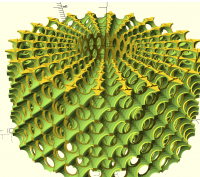
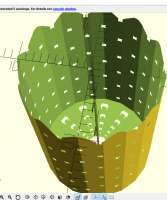
Thanks for all the help everyone - there's a lot to learn here, so thanks for the hints re loops and render() especially. I'll definitely spend some time getting to grips with those. sqrt(pow(C,2)*2) is the length of the hypotenuse of the cube - making it a constant would definitely clean up the maths a bit, thank you. For some reason even reversing the order of my modules in the difference operation didn't work, however I did manage to get the model working- I had to perform the difference operator on my original basic unit (module lattice), rather than on the compiled module , and that produced what I wanted. Thanks again everyone, as I say, I'm only a beginner, so really appreciate the patient advice! Matt [cid:beff9dab-0635-4539-b8cf-5e0222044647] ________________________________ From: Discuss <discuss-bounces@lists.openscad.org> on behalf of Hans L via Discuss <discuss@lists.openscad.org> Sent: 21 October 2019 23:08 To: OpenSCAD general discussion <discuss@lists.openscad.org> Cc: Hans L <thehans@gmail.com> Subject: Re: [OpenSCAD] Problems making a negative space Hoo boy, there's a lot going on here. 1) Your main issue looks like you have the modules swapped around in your difference operation. You want the (cylinder minus the "inverse_lattice") right? A - B is not the same as B - A, so the module you list first matters. 2) Your "module_inverse_proper" is unnecessary. There's no reason to get the intersection of your negative object with the same positive object that its about to be subtracted from. 3) Learn to use "for" loops, instead of nesting dozens of calls, you could probably shorten your code by 10x or so. 4) This is a really complex model and going to take quite a while to render. Read this https://en.wikibooks.org/wiki/OpenSCAD_User_Manual/FAQ#Why_is_the_preview_so_slow? You can get around the issue of exponentially exploding number of CSG elements somewhat, by wrapping your lattice with a call to render() ( https://en.wikibooks.org/wiki/OpenSCAD_User_Manual/CSG_Modelling#render ) like so: module lattice() { render() rotate([45, 0, 0]) intersection() { cube(C, center = true); sphere(S); } } 5) sphere doesn't have a "center" parameter. Its always centered, which is why those warnings are showing. 6) You have these weird patterns of expression all around your code: sqrt(pow(X,2) * Y) OR sqrt(pow(X,2) / Y) sqrt(pow(X,2) * Y) == ( X * sqrt(Y) ) since your X expression is always positive anyways. So they can be simplified for better readability. - Hans On Mon, Oct 21, 2019 at 2:55 PM matt meek via Discuss <discuss@lists.openscad.org<mailto:discuss@lists.openscad.org>> wrote: Hello, I'm having issues making a negative space with difference. I'm trying to make a lattice, and have made all of what will be negative spaces, but when I try to invert them the difference function removed my whole model. I've tried offsetting the shape I'm subtracting, and that hasn't made a difference. I also tried increasing the number of facets in case it was a resolution issue, and also changing the order in which I use the difference function, but that also has made no difference.Please could someone help? Apologies for the unelegant code, I'm a newbie. Matt [cid:16df07d76c76374261b1][cid:16df07d76c76528feba2] $fn=20; R=10; n=12; C=sqrt((pow((2*PI*R)/n,2))/2); S=0.625*C; difference(){ inverse_lattice_proper(); cyl(); } module inverse_lattice_proper(){ intersection(){ cyl(); inverse_lattice(); }} module inverse_lattice(){ layer_1(); layer_2(); layer_3(); layer_4(); layer_5(); layer_6(); } module layer_6(){ scale([(R-(sqrt(pow(C,2)*2)/2))/R,(R-(sqrt(pow(C,2)*2)/2))/R,1]) layer_5(); } module layer_5(){ scale([(R-(sqrt(pow(C,2)*2)/2))/R,(R-(sqrt(pow(C,2)*2)/2))/R,1]) layer_4(); } module layer_4(){ scale([(R-(sqrt(pow(C,2)*2)/2))/R,(R-(sqrt(pow(C,2)*2)/2))/R,1]) layer_3(); } module layer_3(){ scale([(R-(sqrt(pow(C,2)*2)/2))/R,(R-(sqrt(pow(C,2)*2)/2))/R,1]) layer_2(); } module layer_2(){ scale([(R-(sqrt(pow(C,2)*2)/2))/R,(R-(sqrt(pow(C,2)*2)/2))/R,1]) layer_1(); } module lattice(){ rotate([45,0,0]){ intersection(){ cube(C, center=true); sphere(S, center=true); } } } module cyl(){ translate([0,0,10]){ cylinder (h=40,r=R,center=true); } }module layer_1(){ layer(); translate([0,0,sqrt(pow(C,2)*2)/2]){ rotate ([0,0,180/n]){ layer(); translate([0,0,sqrt(pow(C,2)*2)/2]){ rotate ([0,0,180/n]){ layer(); translate([0,0,sqrt(pow(C,2)*2)/2]){ rotate ([0,0,180/n]){ layer();translate([0,0,sqrt(pow(C,2)*2)/2]){ rotate ([0,0,180/n]){ layer();translate([0,0,sqrt(pow(C,2)*2)/2]){ rotate ([0,0,180/n]){ layer();translate([0,0,sqrt(pow(C,2)*2)/2]){ rotate ([0,0,180/n]){ layer();translate([0,0,sqrt(pow(C,2)*2)/2]){ rotate ([0,0,180/n]){ layer(); translate([0,0,sqrt(pow(C,2)*2)/2]){ rotate ([0,0,180/n]){ layer(); translate([0,0,sqrt(pow(C,2)*2)/2]){ rotate ([0,0,180/n]){ layer(); translate([0,0,sqrt(pow(C,2)*2)/2]){ rotate ([0,0,180/n]){ layer(); translate([0,0,sqrt(pow(C,2)*2)/2]){ rotate ([0,0,180/n]){ layer(); translate([0,0,sqrt(pow(C,2)*2)/2]){ rotate ([0,0,180/n]){ layer(); translate([0,0,sqrt(pow(C,2)*2)/2]){ rotate ([0,0,180/n]){ layer(); } }}}}}}}}}}}}}}}}}}}}}}}}}} module layer(){ union(){ translate([R,0,0.5*C]){lattice(); translate([R*cos(360/n)-R,R*sin(360/n),0]){ rotate ([0,0,360/n]){lattice(); translate([R*cos(360/n)-R,R*sin(360/n),0]){ rotate ([0,0,360/n]){lattice(); translate([R*cos(360/n)-R,R*sin(360/n),0]){ rotate ([0,0,360/n]){lattice(); translate([R*cos(360/n)-R,R*sin(360/n),0]){ rotate ([0,0,360/n]){lattice();translate([R*cos(360/n)-R,R*sin(360/n),0]){ rotate ([0,0,360/n]){lattice(); translate([R*cos(360/n)-R,R*sin(360/n),0]){ rotate ([0,0,360/n]){lattice(); translate([R*cos(360/n)-R,R*sin(360/n),0]){ rotate ([0,0,360/n]){lattice(); translate([R*cos(360/n)-R,R*sin(360/n),0]){ rotate ([0,0,360/n]){lattice(); translate([R*cos(360/n)-R,R*sin(360/n),0]){ rotate ([0,0,360/n]){lattice(); translate([R*cos(360/n)-R,R*sin(360/n),0]){ rotate ([0,0,360/n]){lattice();translate([R*cos(360/n)-R,R*sin(360/n),0]){ rotate ([0,0,360/n]){lattice(); translate([R*cos(360/n)-R,R*sin(360/n),0]){ rotate ([0,0,360/n]){lattice(); translate([R*cos(360/n)-R,R*sin(360/n),0]){ rotate ([0,0,360/n]){lattice(); translate([R*cos(360/n)-R,R*sin(360/n),0]){ rotate ([0,0,360/n]){lattice(); translate([R*cos(360/n)-R,R*sin(360/n),0]){ rotate ([0,0,360/n]){lattice(); translate([R*cos(360/n)-R,R*sin(360/n),0]){ rotate ([0,0,360/n]){lattice();translate([R*cos(360/n)-R,R*sin(360/n),0]){ rotate ([0,0,360/n]){lattice(); translate([R*cos(360/n)-R,R*sin(360/n),0]){ rotate ([0,0,360/n]){lattice(); translate([R*cos(360/n)-R,R*sin(360/n),0]){ rotate ([0,0,360/n]){lattice(); translate([R*cos(360/n)-R,R*sin(360/n),0]){ rotate ([0,0,360/n]){lattice(); translate([R*cos(360/n)-R,R*sin(360/n),0]){ rotate ([0,0,360/n]){lattice(); translate([R*cos(360/n)-R,R*sin(360/n),0]){ rotate ([0,0,360/n]){lattice();translate([R*cos(360/n)-R,R*sin(360/n),0]){ rotate ([0,0,360/n]){lattice(); translate([R*cos(360/n)-R,R*sin(360/n),0]){ rotate ([0,0,360/n]){lattice(); }}}}}}}}}}}}}}}}}}}}}}}}}}}}}}}}}}}}}}}}}}}}}}}}}}}; _______________________________________________ OpenSCAD mailing list Discuss@lists.openscad.org<mailto:Discuss@lists.openscad.org> http://lists.openscad.org/mailman/listinfo/discuss_lists.openscad.org