AG
Alex Gibson
Fri, Jul 19, 2019 4:07 PM
I agree the gel superglue is the best for surfaces with good contact.
For joining parts by textured sides, I would recommend the original 'Gorilla
glue'. It expands slightly into the texture and makes a less brittle joint.
Another option is I use a '3d printing pen' as a welding device. For a
really solid join, if you can get the internal access to the part, make a
grid of holes on the mating surface and 'plug weld' the two parts together
at those points.
You can add a couple of studs to the other side which line up with the holes
for a fantastic alignment - or just a matching hole and put a bolt through
them while you do the other welds.
This is a description of the process in metal but the actions are exactly
the same, I just use a pastel pink '3Doodler' clone!
https://www.mig-welding.co.uk/plug-weld.htm
Cheers,
Alex Gibson
admg consulting
edumaker limited
. Project management
. Operations & Process improvement
. 3D Printing
-----Original Message-----
From: Discuss [mailto:discuss-bounces@lists.openscad.org] On Behalf Of Bryan
Lee
Sent: 19 July 2019 16:25
To: OpenSCAD general discussion
Subject: Re: [OpenSCAD] Joining parts
I was just recommended this:
https://smile.amazon.com/dp/B0778LB4RX
Thus arnholm@arnholm.org hast written on Fri, Jul 19, 2019 at 05:15:13PM
+0200, and, according to prophecy, it shall come to pass that:
On 2019-07-19 16:40, Bryan Lee wrote:
Other than that, I've used Cyanoacrylate/superglue to glue PLA.
Thanks for the replies. I was mostly interested in something easily
available and superglue fits the bill.
Carsten Arnholm
I agree the gel superglue is the best for surfaces with good contact.
For joining parts by textured sides, I would recommend the original 'Gorilla
glue'. It expands slightly into the texture and makes a less brittle joint.
Another option is I use a '3d printing pen' as a welding device. For a
really solid join, if you can get the internal access to the part, make a
grid of holes on the mating surface and 'plug weld' the two parts together
at those points.
You can add a couple of studs to the other side which line up with the holes
for a fantastic alignment - or just a matching hole and put a bolt through
them while you do the other welds.
This is a description of the process in metal but the actions are exactly
the same, I just use a pastel pink '3Doodler' clone!
https://www.mig-welding.co.uk/plug-weld.htm
Cheers,
Alex Gibson
admg consulting
edumaker limited
. Project management
. Operations & Process improvement
. 3D Printing
-----Original Message-----
From: Discuss [mailto:discuss-bounces@lists.openscad.org] On Behalf Of Bryan
Lee
Sent: 19 July 2019 16:25
To: OpenSCAD general discussion
Subject: Re: [OpenSCAD] Joining parts
I was just recommended this:
https://smile.amazon.com/dp/B0778LB4RX
Thus arnholm@arnholm.org hast written on Fri, Jul 19, 2019 at 05:15:13PM
+0200, and, according to prophecy, it shall come to pass that:
> On 2019-07-19 16:40, Bryan Lee wrote:
> > Other than that, I've used Cyanoacrylate/superglue to glue PLA.
>
> Thanks for the replies. I was mostly interested in something easily
> available and superglue fits the bill.
>
> Carsten Arnholm
_______________________________________________
OpenSCAD mailing list
Discuss@lists.openscad.org
http://lists.openscad.org/mailman/listinfo/discuss_lists.openscad.org

HJ
Hugo Jackson
Fri, Jul 19, 2019 4:22 PM
E6000 (labelled as an automotive & industrial) glue was recently recommended to me for PLA. It’s a gel like substance and It comes in a 59ml grey coloured tube and according to the testing conducted by my friend PLA parts will break before the bond does. I’ve not done any testing but I have used it and I’m finding it great. Only downside is that it requires a 24 hr. cure.
On Jul 19, 2019, at 9:07 AM, Alex Gibson alex@alexgibson.net wrote:
I agree the gel superglue is the best for surfaces with good contact.
For joining parts by textured sides, I would recommend the original 'Gorilla
glue'. It expands slightly into the texture and makes a less brittle joint.
Another option is I use a '3d printing pen' as a welding device. For a
really solid join, if you can get the internal access to the part, make a
grid of holes on the mating surface and 'plug weld' the two parts together
at those points.
You can add a couple of studs to the other side which line up with the holes
for a fantastic alignment - or just a matching hole and put a bolt through
them while you do the other welds.
This is a description of the process in metal but the actions are exactly
the same, I just use a pastel pink '3Doodler' clone!
https://www.mig-welding.co.uk/plug-weld.htm
Cheers,
Alex Gibson
admg consulting
edumaker limited
. Project management
. Operations & Process improvement
. 3D Printing
-----Original Message-----
From: Discuss [mailto:discuss-bounces@lists.openscad.org] On Behalf Of Bryan
Lee
Sent: 19 July 2019 16:25
To: OpenSCAD general discussion
Subject: Re: [OpenSCAD] Joining parts
I was just recommended this:
https://smile.amazon.com/dp/B0778LB4RX
Thus arnholm@arnholm.org hast written on Fri, Jul 19, 2019 at 05:15:13PM
+0200, and, according to prophecy, it shall come to pass that:
On 2019-07-19 16:40, Bryan Lee wrote:
Other than that, I've used Cyanoacrylate/superglue to glue PLA.
Thanks for the replies. I was mostly interested in something easily
available and superglue fits the bill.
Carsten Arnholm
E6000 (labelled as an automotive & industrial) glue was recently recommended to me for PLA. It’s a gel like substance and It comes in a 59ml grey coloured tube and according to the testing conducted by my friend PLA parts will break before the bond does. I’ve not done any testing but I have used it and I’m finding it great. Only downside is that it requires a 24 hr. cure.
> On Jul 19, 2019, at 9:07 AM, Alex Gibson <alex@alexgibson.net> wrote:
>
> I agree the gel superglue is the best for surfaces with good contact.
>
> For joining parts by textured sides, I would recommend the original 'Gorilla
> glue'. It expands slightly into the texture and makes a less brittle joint.
>
> Another option is I use a '3d printing pen' as a welding device. For a
> really solid join, if you can get the internal access to the part, make a
> grid of holes on the mating surface and 'plug weld' the two parts together
> at those points.
>
> You can add a couple of studs to the other side which line up with the holes
> for a fantastic alignment - or just a matching hole and put a bolt through
> them while you do the other welds.
>
> This is a description of the process in metal but the actions are exactly
> the same, I just use a pastel pink '3Doodler' clone!
> https://www.mig-welding.co.uk/plug-weld.htm
>
> Cheers,
>
> Alex Gibson
>
>
> admg consulting
>
> edumaker limited
>
> . Project management
> . Operations & Process improvement
> . 3D Printing
>
> -----Original Message-----
> From: Discuss [mailto:discuss-bounces@lists.openscad.org] On Behalf Of Bryan
> Lee
> Sent: 19 July 2019 16:25
> To: OpenSCAD general discussion
> Subject: Re: [OpenSCAD] Joining parts
>
> I was just recommended this:
> https://smile.amazon.com/dp/B0778LB4RX
>
>
> Thus arnholm@arnholm.org hast written on Fri, Jul 19, 2019 at 05:15:13PM
> +0200, and, according to prophecy, it shall come to pass that:
>> On 2019-07-19 16:40, Bryan Lee wrote:
>>> Other than that, I've used Cyanoacrylate/superglue to glue PLA.
>>
>> Thanks for the replies. I was mostly interested in something easily
>> available and superglue fits the bill.
>>
>> Carsten Arnholm
>
> _______________________________________________
> OpenSCAD mailing list
> Discuss@lists.openscad.org
> http://lists.openscad.org/mailman/listinfo/discuss_lists.openscad.org
>
>
> _______________________________________________
> OpenSCAD mailing list
> Discuss@lists.openscad.org
> http://lists.openscad.org/mailman/listinfo/discuss_lists.openscad.org

RP
Ronaldo Persiano
Fri, Jul 19, 2019 4:40 PM
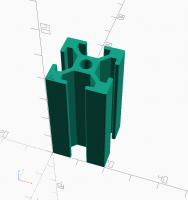
To linear_extrude the projection of a linear_extruded shape in a STL file
seems to be a nonsense. You just need to resize its import:
 resize([20,20,40])
 import("PROFILE20X20_001.stl");
Alternatively, you can generate the profile STL with a unitary height and
scale its import:
 scale([1,1,40])
 import("PROFILE20X20_001.stl");
Em sex, 19 de jul de 2019 às 08:19, Juan C.Cilleruelo <
juanc.cilleruelo@gmail.com> escreveu:
Thank you very much!!!!
It's just what I looking for!!!
/---------- PROFILE 20X20 => ALUMINIUM PROFILE 20x20
----------/
linear_extrude(height = 40, center = false, convexity = 10, twist = 0){
projection(){
import("PROFILE20X20_001.stl");
}
}
To linear_extrude the projection of a linear_extruded shape in a STL file
seems to be a nonsense. You just need to resize its import:
resize([20,20,40])
import("PROFILE20X20_001.stl");
Alternatively, you can generate the profile STL with a unitary height and
scale its import:
scale([1,1,40])
import("PROFILE20X20_001.stl");
Em sex, 19 de jul de 2019 às 08:19, Juan C.Cilleruelo <
juanc.cilleruelo@gmail.com> escreveu:
> Thank you very much!!!!
>
> It's just what I looking for!!!
>
>
>
> /*---------- PROFILE 20X20 => ALUMINIUM PROFILE 20x20
> ----------*/
> linear_extrude(height = 40, center = false, convexity = 10, twist = 0){
> projection(){
> import("PROFILE20X20_001.stl");
> }
> }
>
>
>
>

NH
nop head
Fri, Jul 19, 2019 5:04 PM
Yes that is a better way to do it if you know the height of the STL.
Projection is very slow.
On Fri, 19 Jul 2019 at 17:40, Ronaldo Persiano rcmpersiano@gmail.com
wrote:
To linear_extrude the projection of a linear_extruded shape in a STL file
seems to be a nonsense. You just need to resize its import:
resize([20,20,40])
import("PROFILE20X20_001.stl");
Alternatively, you can generate the profile STL with a unitary height and
scale its import:
scale([1,1,40])
import("PROFILE20X20_001.stl");
Em sex, 19 de jul de 2019 às 08:19, Juan C.Cilleruelo <
juanc.cilleruelo@gmail.com> escreveu:
Thank you very much!!!!
It's just what I looking for!!!
/---------- PROFILE 20X20 => ALUMINIUM PROFILE 20x20
----------/
linear_extrude(height = 40, center = false, convexity = 10, twist = 0){
projection(){
import("PROFILE20X20_001.stl");
}
}
Yes that is a better way to do it if you know the height of the STL.
Projection is very slow.
On Fri, 19 Jul 2019 at 17:40, Ronaldo Persiano <rcmpersiano@gmail.com>
wrote:
> To linear_extrude the projection of a linear_extruded shape in a STL file
> seems to be a nonsense. You just need to resize its import:
>
> resize([20,20,40])
> import("PROFILE20X20_001.stl");
>
> Alternatively, you can generate the profile STL with a unitary height and
> scale its import:
>
> scale([1,1,40])
> import("PROFILE20X20_001.stl");
>
>
>
> Em sex, 19 de jul de 2019 às 08:19, Juan C.Cilleruelo <
> juanc.cilleruelo@gmail.com> escreveu:
>
>> Thank you very much!!!!
>>
>> It's just what I looking for!!!
>>
>>
>>
>> /*---------- PROFILE 20X20 => ALUMINIUM PROFILE 20x20
>> ----------*/
>> linear_extrude(height = 40, center = false, convexity = 10, twist = 0){
>> projection(){
>> import("PROFILE20X20_001.stl");
>> }
>> }
>>
>>
>>
>> _______________________________________________
> OpenSCAD mailing list
> Discuss@lists.openscad.org
> http://lists.openscad.org/mailman/listinfo/discuss_lists.openscad.org
>

DS
Dan Shriver
Fri, Jul 19, 2019 5:06 PM
E6000 seems kind of overkill since it is a specialized epoxy for high
strength joins. It also looks like it uses a chlorinated solvent so it has
the same health downside as a dichloromethane solvent weld.
nop_head's suggestion of ethyl acetate for a solvent weld (with low health
risk); or standard cyanoacrylate (superglue) or epoxy would probably be
less expensive.
On Fri, Jul 19, 2019 at 12:23 PM Hugo Jackson hugo@apres.net wrote:
E6000 (labelled as an automotive & industrial) glue was recently
recommended to me for PLA. It’s a gel like substance and It comes in a 59ml
grey coloured tube and according to the testing conducted by my friend PLA
parts will break before the bond does. I’ve not done any testing but I have
used it and I’m finding it great. Only downside is that it requires a 24
hr. cure.
On Jul 19, 2019, at 9:07 AM, Alex Gibson alex@alexgibson.net wrote:
I agree the gel superglue is the best for surfaces with good contact.
For joining parts by textured sides, I would recommend the original
glue'. It expands slightly into the texture and makes a less brittle
Another option is I use a '3d printing pen' as a welding device. For a
really solid join, if you can get the internal access to the part, make a
grid of holes on the mating surface and 'plug weld' the two parts
at those points.
You can add a couple of studs to the other side which line up with the
for a fantastic alignment - or just a matching hole and put a bolt
them while you do the other welds.
This is a description of the process in metal but the actions are exactly
the same, I just use a pastel pink '3Doodler' clone!
https://www.mig-welding.co.uk/plug-weld.htm
Cheers,
Alex Gibson
admg consulting
edumaker limited
. Project management
. Operations & Process improvement
. 3D Printing
-----Original Message-----
From: Discuss [mailto:discuss-bounces@lists.openscad.org] On Behalf Of
Lee
Sent: 19 July 2019 16:25
To: OpenSCAD general discussion
Subject: Re: [OpenSCAD] Joining parts
I was just recommended this:
https://smile.amazon.com/dp/B0778LB4RX
Thus arnholm@arnholm.org hast written on Fri, Jul 19, 2019 at 05:15:13PM
+0200, and, according to prophecy, it shall come to pass that:
On 2019-07-19 16:40, Bryan Lee wrote:
Other than that, I've used Cyanoacrylate/superglue to glue PLA.
Thanks for the replies. I was mostly interested in something easily
available and superglue fits the bill.
Carsten Arnholm
E6000 seems kind of overkill since it is a specialized epoxy for high
strength joins. It also looks like it uses a chlorinated solvent so it has
the same health downside as a dichloromethane solvent weld.
nop_head's suggestion of ethyl acetate for a solvent weld (with low health
risk); or standard cyanoacrylate (superglue) or epoxy would probably be
less expensive.
On Fri, Jul 19, 2019 at 12:23 PM Hugo Jackson <hugo@apres.net> wrote:
> E6000 (labelled as an automotive & industrial) glue was recently
> recommended to me for PLA. It’s a gel like substance and It comes in a 59ml
> grey coloured tube and according to the testing conducted by my friend PLA
> parts will break before the bond does. I’ve not done any testing but I have
> used it and I’m finding it great. Only downside is that it requires a 24
> hr. cure.
>
> > On Jul 19, 2019, at 9:07 AM, Alex Gibson <alex@alexgibson.net> wrote:
> >
> > I agree the gel superglue is the best for surfaces with good contact.
> >
> > For joining parts by textured sides, I would recommend the original
> 'Gorilla
> > glue'. It expands slightly into the texture and makes a less brittle
> joint.
> >
> > Another option is I use a '3d printing pen' as a welding device. For a
> > really solid join, if you can get the internal access to the part, make a
> > grid of holes on the mating surface and 'plug weld' the two parts
> together
> > at those points.
> >
> > You can add a couple of studs to the other side which line up with the
> holes
> > for a fantastic alignment - or just a matching hole and put a bolt
> through
> > them while you do the other welds.
> >
> > This is a description of the process in metal but the actions are exactly
> > the same, I just use a pastel pink '3Doodler' clone!
> > https://www.mig-welding.co.uk/plug-weld.htm
> >
> > Cheers,
> >
> > Alex Gibson
> >
> >
> > admg consulting
> >
> > edumaker limited
> >
> > . Project management
> > . Operations & Process improvement
> > . 3D Printing
> >
> > -----Original Message-----
> > From: Discuss [mailto:discuss-bounces@lists.openscad.org] On Behalf Of
> Bryan
> > Lee
> > Sent: 19 July 2019 16:25
> > To: OpenSCAD general discussion
> > Subject: Re: [OpenSCAD] Joining parts
> >
> > I was just recommended this:
> > https://smile.amazon.com/dp/B0778LB4RX
> >
> >
> > Thus arnholm@arnholm.org hast written on Fri, Jul 19, 2019 at 05:15:13PM
> > +0200, and, according to prophecy, it shall come to pass that:
> >> On 2019-07-19 16:40, Bryan Lee wrote:
> >>> Other than that, I've used Cyanoacrylate/superglue to glue PLA.
> >>
> >> Thanks for the replies. I was mostly interested in something easily
> >> available and superglue fits the bill.
> >>
> >> Carsten Arnholm
> >
> > _______________________________________________
> > OpenSCAD mailing list
> > Discuss@lists.openscad.org
> > http://lists.openscad.org/mailman/listinfo/discuss_lists.openscad.org
> >
> >
> > _______________________________________________
> > OpenSCAD mailing list
> > Discuss@lists.openscad.org
> > http://lists.openscad.org/mailman/listinfo/discuss_lists.openscad.org
>
>
> _______________________________________________
> OpenSCAD mailing list
> Discuss@lists.openscad.org
> http://lists.openscad.org/mailman/listinfo/discuss_lists.openscad.org
>

DG
David Gustavson
Fri, Jul 19, 2019 5:22 PM
E6000 is not an epoxy. It's a tough, flexible, glue.
--
David Gustavson
dbg@SCIzzL.com
On Fri, Jul 19, 2019, at 10:07 AM, Dan Shriver wrote:
E6000 seems kind of overkill since it is a specialized epoxy for high strength joins. It also looks like it uses a chlorinated solvent so it has the same health downside as a dichloromethane solvent weld.
nop_head's suggestion of ethyl acetate for a solvent weld (with low health risk); or standard cyanoacrylate (superglue) or epoxy would probably be less expensive.
On Fri, Jul 19, 2019 at 12:23 PM Hugo Jackson hugo@apres.net wrote:
E6000 (labelled as an automotive & industrial) glue was recently recommended to me for PLA. It’s a gel like substance and It comes in a 59ml grey coloured tube and according to the testing conducted by my friend PLA parts will break before the bond does. I’ve not done any testing but I have used it and I’m finding it great. Only downside is that it requires a 24 hr. cure.
On Jul 19, 2019, at 9:07 AM, Alex Gibson alex@alexgibson.net wrote:
I agree the gel superglue is the best for surfaces with good contact.
For joining parts by textured sides, I would recommend the original 'Gorilla
glue'. It expands slightly into the texture and makes a less brittle joint.
Another option is I use a '3d printing pen' as a welding device. For a
really solid join, if you can get the internal access to the part, make a
grid of holes on the mating surface and 'plug weld' the two parts together
at those points.
You can add a couple of studs to the other side which line up with the holes
for a fantastic alignment - or just a matching hole and put a bolt through
them while you do the other welds.
This is a description of the process in metal but the actions are exactly
the same, I just use a pastel pink '3Doodler' clone!
https://www.mig-welding.co.uk/plug-weld.htm
Cheers,
Alex Gibson
admg consulting
edumaker limited
. Project management
. Operations & Process improvement
. 3D Printing
-----Original Message-----
From: Discuss [mailto:discuss-bounces@lists.openscad.org] On Behalf Of Bryan
Lee
Sent: 19 July 2019 16:25
To: OpenSCAD general discussion
Subject: Re: [OpenSCAD] Joining parts
I was just recommended this:
https://smile.amazon.com/dp/B0778LB4RX
Thus arnholm@arnholm.org hast written on Fri, Jul 19, 2019 at 05:15:13PM
+0200, and, according to prophecy, it shall come to pass that:
On 2019-07-19 16:40, Bryan Lee wrote:
Other than that, I've used Cyanoacrylate/superglue to glue PLA.
Thanks for the replies. I was mostly interested in something easily
available and superglue fits the bill.
Carsten Arnholm
E6000 is not an epoxy. It's a tough, flexible, glue.
--
David Gustavson
dbg@SCIzzL.com
On Fri, Jul 19, 2019, at 10:07 AM, Dan Shriver wrote:
> E6000 seems kind of overkill since it is a specialized epoxy for high strength joins. It also looks like it uses a chlorinated solvent so it has the same health downside as a dichloromethane solvent weld.
>
> nop_head's suggestion of ethyl acetate for a solvent weld (with low health risk); or standard cyanoacrylate (superglue) or epoxy would probably be less expensive.
>
> On Fri, Jul 19, 2019 at 12:23 PM Hugo Jackson <hugo@apres.net> wrote:
>> E6000 (labelled as an automotive & industrial) glue was recently recommended to me for PLA. It’s a gel like substance and It comes in a 59ml grey coloured tube and according to the testing conducted by my friend PLA parts will break before the bond does. I’ve not done any testing but I have used it and I’m finding it great. Only downside is that it requires a 24 hr. cure.
>>
>> > On Jul 19, 2019, at 9:07 AM, Alex Gibson <alex@alexgibson.net> wrote:
>> >
>> > I agree the gel superglue is the best for surfaces with good contact.
>> >
>> > For joining parts by textured sides, I would recommend the original 'Gorilla
>> > glue'. It expands slightly into the texture and makes a less brittle joint.
>> >
>> > Another option is I use a '3d printing pen' as a welding device. For a
>> > really solid join, if you can get the internal access to the part, make a
>> > grid of holes on the mating surface and 'plug weld' the two parts together
>> > at those points.
>> >
>> > You can add a couple of studs to the other side which line up with the holes
>> > for a fantastic alignment - or just a matching hole and put a bolt through
>> > them while you do the other welds.
>> >
>> > This is a description of the process in metal but the actions are exactly
>> > the same, I just use a pastel pink '3Doodler' clone!
>> > https://www.mig-welding.co.uk/plug-weld.htm
>> >
>> > Cheers,
>> >
>> > Alex Gibson
>> >
>> >
>> > admg consulting
>> >
>> > edumaker limited
>> >
>> > . Project management
>> > . Operations & Process improvement
>> > . 3D Printing
>> >
>> > -----Original Message-----
>> > From: Discuss [mailto:discuss-bounces@lists.openscad.org] On Behalf Of Bryan
>> > Lee
>> > Sent: 19 July 2019 16:25
>> > To: OpenSCAD general discussion
>> > Subject: Re: [OpenSCAD] Joining parts
>> >
>> > I was just recommended this:
>> > https://smile.amazon.com/dp/B0778LB4RX
>> >
>> >
>> > Thus arnholm@arnholm.org hast written on Fri, Jul 19, 2019 at 05:15:13PM
>> > +0200, and, according to prophecy, it shall come to pass that:
>> >> On 2019-07-19 16:40, Bryan Lee wrote:
>> >>> Other than that, I've used Cyanoacrylate/superglue to glue PLA.
>> >>
>> >> Thanks for the replies. I was mostly interested in something easily
>> >> available and superglue fits the bill.
>> >>
>> >> Carsten Arnholm
>> >
>> > _______________________________________________
>> > OpenSCAD mailing list
>> > Discuss@lists.openscad.org
>> > http://lists.openscad.org/mailman/listinfo/discuss_lists.openscad.org
>> >
>> >
>> > _______________________________________________
>> > OpenSCAD mailing list
>> > Discuss@lists.openscad.org
>> > http://lists.openscad.org/mailman/listinfo/discuss_lists.openscad.org
>>
>>
>> _______________________________________________
>> OpenSCAD mailing list
>> Discuss@lists.openscad.org
>> http://lists.openscad.org/mailman/listinfo/discuss_lists.openscad.org
> _______________________________________________
> OpenSCAD mailing list
> Discuss@lists.openscad.org
> http://lists.openscad.org/mailman/listinfo/discuss_lists.openscad.org
>

JC
Juan C.Cilleruelo
Fri, Jul 19, 2019 5:23 PM
This response seems to be, actually, a nonsense.
If I am the creator of the STL and I positioned it, as you can see,
exactly in X = 0, Y = 0 and Z = 0 and plain to Z, I'm almost sure I
don't need to resize it!
scale() and resize() deforms the original figure. linear_extrude only
"EXTRUDE" it. This is what I want. An extrusion.
Thanks for your response, but it's not an appropriate solution for my
problem.
On 19/07/2019 18:40, Ronaldo Persiano wrote:
To linear_extrude the projection of a linear_extruded shape in a STL
file seems to be a nonsense. You just need to resize its import:
resize([20,20,40])
import("PROFILE20X20_001.stl");
Alternatively, you can generate the profile STL with a unitary height
and scale its import:
scale([1,1,40])
import("PROFILE20X20_001.stl");
Em sex, 19 de jul de 2019 às 08:19, Juan C.Cilleruelo
<juanc.cilleruelo@gmail.com mailto:juanc.cilleruelo@gmail.com> escreveu:
 Thank you very much!!!!

 It's just what I looking for!!!


 /*----------  PROFILE 20X20 => ALUMINIUM PROFILE 20x20  ----------*/
    linear_extrude(height = 40, center = false, convexity = 10,
 twist = 0){
       projection(){
 import("PROFILE20X20_001.stl");
       }
    }
OpenSCAD mailing list
Discuss@lists.openscad.org
http://lists.openscad.org/mailman/listinfo/discuss_lists.openscad.org
This response seems to be, actually, a nonsense.
If I am the creator of the STL and I positioned it, as you can see,
exactly in X = 0, Y = 0 and Z = 0 and plain to Z, I'm almost sure I
don't need to resize it!
scale() and resize() deforms the original figure. linear_extrude only
"EXTRUDE" it. This is what I want. An extrusion.
Thanks for your response, but it's not an appropriate solution for my
problem.
On 19/07/2019 18:40, Ronaldo Persiano wrote:
> To linear_extrude the projection of a linear_extruded shape in a STL
> file seems to be a nonsense. You just need to resize its import:
>
> resize([20,20,40])
> import("PROFILE20X20_001.stl");
>
> Alternatively, you can generate the profile STL with a unitary height
> and scale its import:
>
> scale([1,1,40])
> import("PROFILE20X20_001.stl");
>
>
>
> Em sex, 19 de jul de 2019 às 08:19, Juan C.Cilleruelo
> <juanc.cilleruelo@gmail.com <mailto:juanc.cilleruelo@gmail.com>> escreveu:
>
> Thank you very much!!!!
>
> It's just what I looking for!!!
>
>
>
> /*---------- PROFILE 20X20 => ALUMINIUM PROFILE 20x20 ----------*/
> linear_extrude(height = 40, center = false, convexity = 10,
> twist = 0){
> projection(){
> import("PROFILE20X20_001.stl");
> }
> }
>
>
>
>
> _______________________________________________
> OpenSCAD mailing list
> Discuss@lists.openscad.org
> http://lists.openscad.org/mailman/listinfo/discuss_lists.openscad.org
DS
Dan Shriver
Fri, Jul 19, 2019 5:29 PM
So it is kind of hard to be definitive since they want to keep the
composition a trade secret - that being said if you ask google ("What is
e6000 made of") you get this text:
"E6000 is an industrial-strength glue made from a clear drying, flexible
epoxy that works well on wood, metal, glass, ceramics, rubber, vinyl,
leather and (most) plastic. It dries very clear, though can form air
bubbles if you're trying to use it as a sealant."
On Fri, Jul 19, 2019 at 1:23 PM David Gustavson dbg@scizzl.com wrote:
E6000 is not an epoxy. It's a tough, flexible, glue.
--
David Gustavson
dbg@SCIzzL.com
On Fri, Jul 19, 2019, at 10:07 AM, Dan Shriver wrote:
E6000 seems kind of overkill since it is a specialized epoxy for high
strength joins. It also looks like it uses a chlorinated solvent so it has
the same health downside as a dichloromethane solvent weld.
nop_head's suggestion of ethyl acetate for a solvent weld (with low health
risk); or standard cyanoacrylate (superglue) or epoxy would probably be
less expensive.
On Fri, Jul 19, 2019 at 12:23 PM Hugo Jackson hugo@apres.net wrote:
E6000 (labelled as an automotive & industrial) glue was recently
recommended to me for PLA. It’s a gel like substance and It comes in a 59ml
grey coloured tube and according to the testing conducted by my friend PLA
parts will break before the bond does. I’ve not done any testing but I have
used it and I’m finding it great. Only downside is that it requires a 24
hr. cure.
On Jul 19, 2019, at 9:07 AM, Alex Gibson alex@alexgibson.net wrote:
I agree the gel superglue is the best for surfaces with good contact.
For joining parts by textured sides, I would recommend the original
glue'. It expands slightly into the texture and makes a less brittle
Another option is I use a '3d printing pen' as a welding device. For a
really solid join, if you can get the internal access to the part, make a
grid of holes on the mating surface and 'plug weld' the two parts
at those points.
You can add a couple of studs to the other side which line up with the
for a fantastic alignment - or just a matching hole and put a bolt
them while you do the other welds.
This is a description of the process in metal but the actions are exactly
the same, I just use a pastel pink '3Doodler' clone!
https://www.mig-welding.co.uk/plug-weld.htm
Cheers,
Alex Gibson
admg consulting
edumaker limited
. Project management
. Operations & Process improvement
. 3D Printing
-----Original Message-----
From: Discuss [mailto:discuss-bounces@lists.openscad.org] On Behalf Of
Lee
Sent: 19 July 2019 16:25
To: OpenSCAD general discussion
Subject: Re: [OpenSCAD] Joining parts
I was just recommended this:
https://smile.amazon.com/dp/B0778LB4RX
Thus arnholm@arnholm.org hast written on Fri, Jul 19, 2019 at 05:15:13PM
+0200, and, according to prophecy, it shall come to pass that:
On 2019-07-19 16:40, Bryan Lee wrote:
Other than that, I've used Cyanoacrylate/superglue to glue PLA.
Thanks for the replies. I was mostly interested in something easily
available and superglue fits the bill.
Carsten Arnholm
So it is kind of hard to be definitive since they want to keep the
composition a trade secret - that being said if you ask google ("What is
e6000 made of") you get this text:
"E6000 is an industrial-strength *glue* made from a clear drying, flexible
*epoxy* that works well on wood, metal, glass, ceramics, rubber, vinyl,
leather and (most) plastic. It dries very clear, though can form air
bubbles if you're trying to use it as a sealant."
On Fri, Jul 19, 2019 at 1:23 PM David Gustavson <dbg@scizzl.com> wrote:
> E6000 is not an epoxy. It's a tough, flexible, glue.
>
> --
> David Gustavson
> dbg@SCIzzL.com
>
>
>
> On Fri, Jul 19, 2019, at 10:07 AM, Dan Shriver wrote:
>
> E6000 seems kind of overkill since it is a specialized epoxy for high
> strength joins. It also looks like it uses a chlorinated solvent so it has
> the same health downside as a dichloromethane solvent weld.
>
> nop_head's suggestion of ethyl acetate for a solvent weld (with low health
> risk); or standard cyanoacrylate (superglue) or epoxy would probably be
> less expensive.
>
> On Fri, Jul 19, 2019 at 12:23 PM Hugo Jackson <hugo@apres.net> wrote:
>
> E6000 (labelled as an automotive & industrial) glue was recently
> recommended to me for PLA. It’s a gel like substance and It comes in a 59ml
> grey coloured tube and according to the testing conducted by my friend PLA
> parts will break before the bond does. I’ve not done any testing but I have
> used it and I’m finding it great. Only downside is that it requires a 24
> hr. cure.
>
> > On Jul 19, 2019, at 9:07 AM, Alex Gibson <alex@alexgibson.net> wrote:
> >
> > I agree the gel superglue is the best for surfaces with good contact.
> >
> > For joining parts by textured sides, I would recommend the original
> 'Gorilla
> > glue'. It expands slightly into the texture and makes a less brittle
> joint.
> >
> > Another option is I use a '3d printing pen' as a welding device. For a
> > really solid join, if you can get the internal access to the part, make a
> > grid of holes on the mating surface and 'plug weld' the two parts
> together
> > at those points.
> >
> > You can add a couple of studs to the other side which line up with the
> holes
> > for a fantastic alignment - or just a matching hole and put a bolt
> through
> > them while you do the other welds.
> >
> > This is a description of the process in metal but the actions are exactly
> > the same, I just use a pastel pink '3Doodler' clone!
> > https://www.mig-welding.co.uk/plug-weld.htm
> >
> > Cheers,
> >
> > Alex Gibson
> >
> >
> > admg consulting
> >
> > edumaker limited
> >
> > . Project management
> > . Operations & Process improvement
> > . 3D Printing
> >
> > -----Original Message-----
> > From: Discuss [mailto:discuss-bounces@lists.openscad.org] On Behalf Of
> Bryan
> > Lee
> > Sent: 19 July 2019 16:25
> > To: OpenSCAD general discussion
> > Subject: Re: [OpenSCAD] Joining parts
> >
> > I was just recommended this:
> > https://smile.amazon.com/dp/B0778LB4RX
> >
> >
> > Thus arnholm@arnholm.org hast written on Fri, Jul 19, 2019 at 05:15:13PM
> > +0200, and, according to prophecy, it shall come to pass that:
> >> On 2019-07-19 16:40, Bryan Lee wrote:
> >>> Other than that, I've used Cyanoacrylate/superglue to glue PLA.
> >>
> >> Thanks for the replies. I was mostly interested in something easily
> >> available and superglue fits the bill.
> >>
> >> Carsten Arnholm
> >
> > _______________________________________________
> > OpenSCAD mailing list
> > Discuss@lists.openscad.org
> > http://lists.openscad.org/mailman/listinfo/discuss_lists.openscad.org
> >
> >
> > _______________________________________________
> > OpenSCAD mailing list
> > Discuss@lists.openscad.org
> > http://lists.openscad.org/mailman/listinfo/discuss_lists.openscad.org
>
>
> _______________________________________________
> OpenSCAD mailing list
> Discuss@lists.openscad.org
> http://lists.openscad.org/mailman/listinfo/discuss_lists.openscad.org
>
> _______________________________________________
> OpenSCAD mailing list
> Discuss@lists.openscad.org
> http://lists.openscad.org/mailman/listinfo/discuss_lists.openscad.org
>
>
> _______________________________________________
> OpenSCAD mailing list
> Discuss@lists.openscad.org
> http://lists.openscad.org/mailman/listinfo/discuss_lists.openscad.org
>

A
adrianv
Fri, Jul 19, 2019 8:52 PM
I agree the gel superglue is the best for surfaces with good contact.
For joining parts by textured sides, I would recommend the original
'Gorilla
glue'. It expands slightly into the texture and makes a less brittle
joint.
Another option is I use a '3d printing pen' as a welding device. For a
really solid join, if you can get the internal access to the part, make a
grid of holes on the mating surface and 'plug weld' the two parts together
at those points.
You can add a couple of studs to the other side which line up with the
holes
for a fantastic alignment - or just a matching hole and put a bolt through
them while you do the other welds.
This is a description of the process in metal but the actions are exactly
the same, I just use a pastel pink '3Doodler' clone!
https://www.mig-welding.co.uk/plug-weld.htm
Cheers,
Alex Gibson
admg consulting
edumaker limited
. Project management
. Operations & Process improvement
. 3D Printing
-----Original Message-----
From: Discuss [mailto:
discuss-bounces@.openscad
] On Behalf Of Bryan
Lee
Sent: 19 July 2019 16:25
To: OpenSCAD general discussion
Subject: Re: [OpenSCAD] Joining parts
I was just recommended this:
https://smile.amazon.com/dp/B0778LB4RX
Thus
hast written on Fri, Jul 19, 2019 at 05:15:13PM
+0200, and, according to prophecy, it shall come to pass that:
On 2019-07-19 16:40, Bryan Lee wrote:
Other than that, I've used Cyanoacrylate/superglue to glue PLA.
Thanks for the replies. I was mostly interested in something easily
available and superglue fits the bill.
Carsten Arnholm
Actually a thick or gel cyanoacrylate glue may be the best glue even for
filling small gaps if you pick the right one. Cheap superglues don't
perform particularly well, but take a look at the test results below. This
glue test was done on wood, not PLA, but the CA glue 2P-10 was remarkably
strong even in gap filling. Much stronger than gorilla glue---in fact, it
was the strongest glue tested in gaps, outperforming even epoxy.
https://www.youtube.com/watch?v=ZoaTZY5cSQE
https://docs.google.com/spreadsheets/d/1GAZrhrtJPi8-iqPRVfqgOgf7RTg8Vqmen6OKJ4Ae6_I/edit#gid=321279609
A problem with gorilla glue is that it expands into gaps by foaming, which
makes it weak.
alexgibson wrote
> I agree the gel superglue is the best for surfaces with good contact.
>
> For joining parts by textured sides, I would recommend the original
> 'Gorilla
> glue'. It expands slightly into the texture and makes a less brittle
> joint.
>
> Another option is I use a '3d printing pen' as a welding device. For a
> really solid join, if you can get the internal access to the part, make a
> grid of holes on the mating surface and 'plug weld' the two parts together
> at those points.
>
> You can add a couple of studs to the other side which line up with the
> holes
> for a fantastic alignment - or just a matching hole and put a bolt through
> them while you do the other welds.
>
> This is a description of the process in metal but the actions are exactly
> the same, I just use a pastel pink '3Doodler' clone!
> https://www.mig-welding.co.uk/plug-weld.htm
>
> Cheers,
>
> Alex Gibson
>
>
> admg consulting
>
> edumaker limited
>
> . Project management
> . Operations & Process improvement
> . 3D Printing
>
> -----Original Message-----
> From: Discuss [mailto:
> discuss-bounces@.openscad
> ] On Behalf Of Bryan
> Lee
> Sent: 19 July 2019 16:25
> To: OpenSCAD general discussion
> Subject: Re: [OpenSCAD] Joining parts
>
> I was just recommended this:
> https://smile.amazon.com/dp/B0778LB4RX
>
>
> Thus
> arnholm@
> hast written on Fri, Jul 19, 2019 at 05:15:13PM
> +0200, and, according to prophecy, it shall come to pass that:
>> On 2019-07-19 16:40, Bryan Lee wrote:
>> > Other than that, I've used Cyanoacrylate/superglue to glue PLA.
>>
>> Thanks for the replies. I was mostly interested in something easily
>> available and superglue fits the bill.
>>
>> Carsten Arnholm
>
> _______________________________________________
> OpenSCAD mailing list
> Discuss@.openscad
> http://lists.openscad.org/mailman/listinfo/discuss_lists.openscad.org
>
>
> _______________________________________________
> OpenSCAD mailing list
> Discuss@.openscad
> http://lists.openscad.org/mailman/listinfo/discuss_lists.openscad.org
--
Sent from: http://forum.openscad.org/
A
adrianv
Fri, Jul 19, 2019 8:54 PM
Other downsides to E6000 are very strong fumes (that persisted for days on a
project where I used a lot) and short shelf life once the tube is opened.
It starts to thicken in the tube and I think becomes difficult to use in a
couple months.
boxcarmib wrote
E6000 (labelled as an automotive & industrial) glue was recently
recommended to me for PLA. It’s a gel like substance and It comes in a
59ml grey coloured tube and according to the testing conducted by my
friend PLA parts will break before the bond does. I’ve not done any
testing but I have used it and I’m finding it great. Only downside is that
it requires a 24 hr. cure.
On Jul 19, 2019, at 9:07 AM, Alex Gibson <
I agree the gel superglue is the best for surfaces with good contact.
For joining parts by textured sides, I would recommend the original
'Gorilla
glue'. It expands slightly into the texture and makes a less brittle
joint.
Another option is I use a '3d printing pen' as a welding device. For a
really solid join, if you can get the internal access to the part, make a
grid of holes on the mating surface and 'plug weld' the two parts
together
at those points.
You can add a couple of studs to the other side which line up with the
holes
for a fantastic alignment - or just a matching hole and put a bolt
through
them while you do the other welds.
This is a description of the process in metal but the actions are exactly
the same, I just use a pastel pink '3Doodler' clone!
https://www.mig-welding.co.uk/plug-weld.htm
Cheers,
Alex Gibson
admg consulting
edumaker limited
. Project management
. Operations & Process improvement
. 3D Printing
-----Original Message-----
From: Discuss [mailto:
discuss-bounces@.openscad
hast written on Fri, Jul 19, 2019 at 05:15:13PM
+0200, and, according to prophecy, it shall come to pass that:
On 2019-07-19 16:40, Bryan Lee wrote:
Other than that, I've used Cyanoacrylate/superglue to glue PLA.
Thanks for the replies. I was mostly interested in something easily
available and superglue fits the bill.
Carsten Arnholm
Other downsides to E6000 are very strong fumes (that persisted for days on a
project where I used a lot) and short shelf life once the tube is opened.
It starts to thicken in the tube and I think becomes difficult to use in a
couple months.
boxcarmib wrote
> E6000 (labelled as an automotive & industrial) glue was recently
> recommended to me for PLA. It’s a gel like substance and It comes in a
> 59ml grey coloured tube and according to the testing conducted by my
> friend PLA parts will break before the bond does. I’ve not done any
> testing but I have used it and I’m finding it great. Only downside is that
> it requires a 24 hr. cure.
>
>> On Jul 19, 2019, at 9:07 AM, Alex Gibson <
> alex@
> > wrote:
>>
>> I agree the gel superglue is the best for surfaces with good contact.
>>
>> For joining parts by textured sides, I would recommend the original
>> 'Gorilla
>> glue'. It expands slightly into the texture and makes a less brittle
>> joint.
>>
>> Another option is I use a '3d printing pen' as a welding device. For a
>> really solid join, if you can get the internal access to the part, make a
>> grid of holes on the mating surface and 'plug weld' the two parts
>> together
>> at those points.
>>
>> You can add a couple of studs to the other side which line up with the
>> holes
>> for a fantastic alignment - or just a matching hole and put a bolt
>> through
>> them while you do the other welds.
>>
>> This is a description of the process in metal but the actions are exactly
>> the same, I just use a pastel pink '3Doodler' clone!
>> https://www.mig-welding.co.uk/plug-weld.htm
>>
>> Cheers,
>>
>> Alex Gibson
>>
>>
>> admg consulting
>>
>> edumaker limited
>>
>> . Project management
>> . Operations & Process improvement
>> . 3D Printing
>>
>> -----Original Message-----
>> From: Discuss [mailto:
> discuss-bounces@.openscad
> ] On Behalf Of Bryan
>> Lee
>> Sent: 19 July 2019 16:25
>> To: OpenSCAD general discussion
>> Subject: Re: [OpenSCAD] Joining parts
>>
>> I was just recommended this:
>> https://smile.amazon.com/dp/B0778LB4RX
>>
>>
>> Thus
> arnholm@
> hast written on Fri, Jul 19, 2019 at 05:15:13PM
>> +0200, and, according to prophecy, it shall come to pass that:
>>> On 2019-07-19 16:40, Bryan Lee wrote:
>>>> Other than that, I've used Cyanoacrylate/superglue to glue PLA.
>>>
>>> Thanks for the replies. I was mostly interested in something easily
>>> available and superglue fits the bill.
>>>
>>> Carsten Arnholm
>>
>> _______________________________________________
>> OpenSCAD mailing list
>>
> Discuss@.openscad
>> http://lists.openscad.org/mailman/listinfo/discuss_lists.openscad.org
>>
>>
>> _______________________________________________
>> OpenSCAD mailing list
>>
> Discuss@.openscad
>> http://lists.openscad.org/mailman/listinfo/discuss_lists.openscad.org
>
>
> _______________________________________________
> OpenSCAD mailing list
> Discuss@.openscad
> http://lists.openscad.org/mailman/listinfo/discuss_lists.openscad.org
--
Sent from: http://forum.openscad.org/