

discuss@lists.openscad.org

OpenSCAD general discussion Mailing-list

View all threads

A 70's revival: the Utah Teapot

R
Ronaldo
Fri, Apr 22, 2016 11:48 PM

Some young people may be enchanted by the music, fashion and ideas of the
70's. Few of them, however, have heard about the Newell's teapot, a hit in
the Computer Graphics community. Created in 1975 by a researcher of the
University of Utah - Martin Newell - , the teapot model was a star of many
bench tests of new realistic graphic algorithms and techniques. You will
find a historical appraisal of its pedigree in an entry of Wikipedia: "Utah
Teapot".

The Utah teapot dataset spread around the world beyond the following decade
and may be found yet here and then. It contains the control points of 28
degree 3 Bezier patches that defines the outer surface of the main teapot
body, its lid, its spout and its handle. It is not a solid however. It
misses the interior surfaces of the main body and the spout, has no bottom
closure, and the handle doesn't meet the body nicely.

I have been working in a modelling system that allows the use of Bezier
surfaces as boundary of OpenSCAD models. It is now under tests and I thought
that the Utah Teapot would be a nice demo of the system. I have completed
the teapot model correcting some imperfections in the handle and creating a
internal surface where it is needed. And I got this outcome.
http://forum.openscad.org/file/n17166/OpenSCAD_Teapot.png
This is a render of the model and it has passed all CGAL checks so it can be
boolean-operated with other solids. Here is a difference operation that
shows the internal surfaces of the model:
http://forum.openscad.org/file/n17166/OpenSCAD_cut_Teapot.png
How this model was built? Well, it is the boolean operation of 3 polyhedron
(the spout, the handle and a solid to make the spout hole in the main body)
and two rotate_extrude of Bezier curves (the main body and the lid). I could
avoid the use of rotate_extrude but I have prefered that way to illustrate
many modelling alternatives. To model the main body, I extracted the control
points of a profile (section) of the main body from the dataset, and used
that to feed rotate_extrude. The lid has been made the same way. For the
spout and the handle, I have used the dataset patches, added patches for the
spout inner surface and close their ends with planar faces.
http://forum.openscad.org/file/n17166/OpenSCAD_disassembled_Teapot.png
For each independent part (spout and handle), I collect all the surface
information (vertices of planar faces and meshes of Bezier surfaces) and
send all to a module which builds the data for a polyhedron primitive. That
module scan the data, builds the vertex lists and the triangular face lists
without caring to identify the common vertices of adjacent patches or
adjacent to a face and a patch. So the vertex list sent to the polyhedron
has many repetitions. CGAL cares to consolidate the vertex list and builds a
solid when the union of all surfaces is a manyfold.

My lifemate was kind to 3D print the teapot from a stl file I generated with
OpenSCAD. A very tiny teapot: with a diameter of only 1 inch.

http://forum.openscad.org/file/n17166/Without_lid_1-1024.jpg

I was amazingly surprised that a so small version of the teapot is able to
pour water from the spout!

http://forum.openscad.org/file/n17166/Pouring_water-1024.jpg
Pourring water-1024.jpg

--
View this message in context: http://forum.openscad.org/A-70-s-revival-the-Utah-Teapot-tp17166.html
Sent from the OpenSCAD mailing list archive at Nabble.com.

Some young people may be enchanted by the music, fashion and ideas of the 70's. Few of them, however, have heard about the Newell's teapot, a hit in the Computer Graphics community. Created in 1975 by a researcher of the University of Utah - Martin Newell - , the teapot model was a star of many bench tests of new realistic graphic algorithms and techniques. You will find a historical appraisal of its pedigree in an entry of Wikipedia: "Utah Teapot". The Utah teapot dataset spread around the world beyond the following decade and may be found yet here and then. It contains the control points of 28 degree 3 Bezier patches that defines the outer surface of the main teapot body, its lid, its spout and its handle. It is not a solid however. It misses the interior surfaces of the main body and the spout, has no bottom closure, and the handle doesn't meet the body nicely. I have been working in a modelling system that allows the use of Bezier surfaces as boundary of OpenSCAD models. It is now under tests and I thought that the Utah Teapot would be a nice demo of the system. I have completed the teapot model correcting some imperfections in the handle and creating a internal surface where it is needed. And I got this outcome. <http://forum.openscad.org/file/n17166/OpenSCAD_Teapot.png> This is a render of the model and it has passed all CGAL checks so it can be boolean-operated with other solids. Here is a difference operation that shows the internal surfaces of the model: <http://forum.openscad.org/file/n17166/OpenSCAD_cut_Teapot.png> How this model was built? Well, it is the boolean operation of 3 polyhedron (the spout, the handle and a solid to make the spout hole in the main body) and two rotate_extrude of Bezier curves (the main body and the lid). I could avoid the use of rotate_extrude but I have prefered that way to illustrate many modelling alternatives. To model the main body, I extracted the control points of a profile (section) of the main body from the dataset, and used that to feed rotate_extrude. The lid has been made the same way. For the spout and the handle, I have used the dataset patches, added patches for the spout inner surface and close their ends with planar faces. <http://forum.openscad.org/file/n17166/OpenSCAD_disassembled_Teapot.png> For each independent part (spout and handle), I collect all the surface information (vertices of planar faces and meshes of Bezier surfaces) and send all to a module which builds the data for a polyhedron primitive. That module scan the data, builds the vertex lists and the triangular face lists without caring to identify the common vertices of adjacent patches or adjacent to a face and a patch. So the vertex list sent to the polyhedron has many repetitions. CGAL cares to consolidate the vertex list and builds a solid when the union of all surfaces is a manyfold. My lifemate was kind to 3D print the teapot from a stl file I generated with OpenSCAD. A very tiny teapot: with a diameter of only 1 inch. <http://forum.openscad.org/file/n17166/Without_lid_1-1024.jpg> I was amazingly surprised that a so small version of the teapot is able to pour water from the spout! <http://forum.openscad.org/file/n17166/Pouring_water-1024.jpg> Pourring water-1024.jpg -- View this message in context: http://forum.openscad.org/A-70-s-revival-the-Utah-Teapot-tp17166.html Sent from the OpenSCAD mailing list archive at Nabble.com.
N
Neon22
Sat, Apr 23, 2016 12:45 AM

Really nice to see a physical instantiation of the Utah teapot. Thanks.
Looking fwd to seeing whatever it is you're doing :)

--
View this message in context: http://forum.openscad.org/A-70-s-revival-the-Utah-Teapot-tp17166p17167.html
Sent from the OpenSCAD mailing list archive at Nabble.com.

Really nice to see a physical instantiation of the Utah teapot. Thanks. Looking fwd to seeing whatever it is you're doing :) -- View this message in context: http://forum.openscad.org/A-70-s-revival-the-Utah-Teapot-tp17166p17167.html Sent from the OpenSCAD mailing list archive at Nabble.com.
MD
Michele Denber
Sun, Apr 24, 2016 12:17 AM

On 04-22-2016 7:48 PM, Ronaldo wrote:

Some young people may be enchanted by the music, fashion and ideas of the
70's. Few of them, however, have heard about the Newell's teapot, a hit in
the Computer Graphics community.

Yes indeed.  The Teapot was all the rage at SIGGRAPH for a while in the
80's.  IIRC, it made the cover of the Proceedings one year.  Thanks for
the trip down memory lane.  I'll have to print this one out for sure.

         - Michele
On 04-22-2016 7:48 PM, Ronaldo wrote: > Some young people may be enchanted by the music, fashion and ideas of the > 70's. Few of them, however, have heard about the Newell's teapot, a hit in > the Computer Graphics community. > Yes indeed. The Teapot was all the rage at SIGGRAPH for a while in the 80's. IIRC, it made the cover of the Proceedings one year. Thanks for the trip down memory lane. I'll have to print this one out for sure. - Michele
KS
Kenneth Sloan
Sun, Apr 24, 2016 1:09 AM

There’s a decent .stl file floating around (thingiverse?)  I downloaded it and printed a full-size model a few years ago.

I don’t think I want tea brewed in an ABS pot, but it appears functional.

Which, of course, means that the .stl model is wrong.  The original model didn’t have a bottom.  And then there’s the whole “aspect ratio” thing…

Google is your friend.  If you can’t find Google, find an old guy who was there in the beginning.  I’m a newbie.  I didn’t make it to the first SIGGRAPH.  My first one was 1976, I think…

--
Kenneth Sloan
KennethRSloan@gmail.com
Vision is the art of seeing what is invisible to others.

On Apr 23, 2016, at 19:17 , Michele Denber denber@mindspring.com wrote:

On 04-22-2016 7:48 PM, Ronaldo wrote:

Some young people may be enchanted by the music, fashion and ideas of the
70's. Few of them, however, have heard about the Newell's teapot, a hit in
the Computer Graphics community.

Yes indeed.  The Teapot was all the rage at SIGGRAPH for a while in the 80's.  IIRC, it made the cover of the Proceedings one year.  Thanks for the trip down memory lane.  I'll have to print this one out for sure.

        - Michele

OpenSCAD mailing list
Discuss@lists.openscad.org
http://lists.openscad.org/mailman/listinfo/discuss_lists.openscad.org

There’s a decent .stl file floating around (thingiverse?) I downloaded it and printed a full-size model a few years ago. I don’t think I want tea brewed in an ABS pot, but it appears functional. Which, of course, means that the .stl model is wrong. The original model didn’t have a bottom. And then there’s the whole “aspect ratio” thing… Google is your friend. If you can’t find Google, find an old guy who was there in the beginning. I’m a newbie. I didn’t make it to the first SIGGRAPH. My first one was 1976, I think… -- Kenneth Sloan KennethRSloan@gmail.com Vision is the art of seeing what is invisible to others. > On Apr 23, 2016, at 19:17 , Michele Denber <denber@mindspring.com> wrote: > > On 04-22-2016 7:48 PM, Ronaldo wrote: >> Some young people may be enchanted by the music, fashion and ideas of the >> 70's. Few of them, however, have heard about the Newell's teapot, a hit in >> the Computer Graphics community. >> > > Yes indeed. The Teapot was all the rage at SIGGRAPH for a while in the 80's. IIRC, it made the cover of the Proceedings one year. Thanks for the trip down memory lane. I'll have to print this one out for sure. > > - Michele > > > > _______________________________________________ > OpenSCAD mailing list > Discuss@lists.openscad.org > http://lists.openscad.org/mailman/listinfo/discuss_lists.openscad.org
R
Ronaldo
Sun, Apr 24, 2016 3:01 PM

Michele wrote

I'll have to print this one out for sure.

Well, you will need a stl file for that:
teapot_demo.stl http://forum.openscad.org/file/n17183/teapot_demo.stl

As I remarked and Sloan confirmed, the original Newell's teapot is a rather
incomplete model. Here you may have an idea of the original model:
http://forum.openscad.org/file/n17183/OpenSCAD_original_cut_Teapot.png
I will publish my Bezier libraries and modelling system as soon as it has
been enough tested. By now, for give you a glimpse of how it is used, you
may take a look into the OpenSCAd file I used to render the teapot. It is a
rather complete and complex demo though.

teapot_demo.scad http://forum.openscad.org/file/n17183/teapot_demo.scad

--
View this message in context: http://forum.openscad.org/A-70-s-revival-the-Utah-Teapot-tp17166p17183.html
Sent from the OpenSCAD mailing list archive at Nabble.com.

Michele wrote > I'll have to print this one out for sure. Well, you will need a stl file for that: teapot_demo.stl <http://forum.openscad.org/file/n17183/teapot_demo.stl> As I remarked and Sloan confirmed, the original Newell's teapot is a rather incomplete model. Here you may have an idea of the original model: <http://forum.openscad.org/file/n17183/OpenSCAD_original_cut_Teapot.png> I will publish my Bezier libraries and modelling system as soon as it has been enough tested. By now, for give you a glimpse of how it is used, you may take a look into the OpenSCAd file I used to render the teapot. It is a rather complete and complex demo though. teapot_demo.scad <http://forum.openscad.org/file/n17183/teapot_demo.scad> -- View this message in context: http://forum.openscad.org/A-70-s-revival-the-Utah-Teapot-tp17166p17183.html Sent from the OpenSCAD mailing list archive at Nabble.com.
MD
Michele Denber
Tue, Apr 26, 2016 5:07 PM

On 04-24-2016 11:01 AM, Ronaldo wrote:

Well, you will need a stl file for that:
teapot_demo.stlhttp://forum.openscad.org/file/n17183/teapot_demo.stl

Thanks, and for the source code too!  That worked out very nicely
without even needing support.  1987 was a big year for the Teapot at
SIGGRAPH.  It was featured in no fewer than three papers.

         - Michele
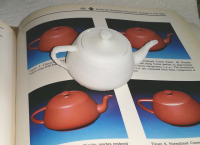
On 04-24-2016 11:01 AM, Ronaldo wrote: > Well, you will need a stl file for that: > teapot_demo.stl<http://forum.openscad.org/file/n17183/teapot_demo.stl> > Thanks, and for the source code too! That worked out very nicely without even needing support. 1987 was a big year for the Teapot at SIGGRAPH. It was featured in no fewer than three papers. - Michele