
DV
david vanhorn
Wed, Feb 16, 2022 8:40 PM
I'm creating a "snout" for a lightning sensor. Lightning Sensor IV by
Stepping Stone Products
The sensor has a HUGE field of view, which makes it trip on things the
camera can't see.
Different lens focal lengths have different fields of view.
My intent is to print multiple of these for different focal lengths, and
use whichever matches the lens I'm shooting with. (See BoxHAngle and
BoxVAngle settings)
The first problem is to restrict the field of view using a hull box.
This is slightly complicated by the fact that the sensor is not centered
within the case, but I've dealt with that.
Next up, the box has to change size on the far end to set the intended
field of view. That's done.
The thing I'm having trouble with is creating and positioning shapes inside
the box so that light hitting the sides of the hole doesn't reflect into
the sensor. I can and probably will ALSO paint the inside with ultra flat
black, but that is secondary.
If you render the attached file, the sensor is at the small end, and the
big end faces the storm.
Lightning off to the sides, past the intended view angles, will hit the
sidewalls and reflect further in, causing the sensor to trip on lightning
that the camera can't see.
Of course the whole thing needs to be printable, so big overhangs will be
an issue.
Ideas?
--
K1FZY (WA4TPW) SK 9/29/37-4/13/15
I'm creating a "snout" for a lightning sensor. Lightning Sensor IV by
Stepping Stone Products
The sensor has a HUGE field of view, which makes it trip on things the
camera can't see.
Different lens focal lengths have different fields of view.
My intent is to print multiple of these for different focal lengths, and
use whichever matches the lens I'm shooting with. (See BoxHAngle and
BoxVAngle settings)
The first problem is to restrict the field of view using a hull box.
This is slightly complicated by the fact that the sensor is not centered
within the case, but I've dealt with that.
Next up, the box has to change size on the far end to set the intended
field of view. That's done.
The thing I'm having trouble with is creating and positioning shapes inside
the box so that light hitting the sides of the hole doesn't reflect into
the sensor. I can and probably will ALSO paint the inside with ultra flat
black, but that is secondary.
If you render the attached file, the sensor is at the small end, and the
big end faces the storm.
Lightning off to the sides, past the intended view angles, will hit the
sidewalls and reflect further in, causing the sensor to trip on lightning
that the camera can't see.
Of course the whole thing needs to be printable, so big overhangs will be
an issue.
Ideas?
--
K1FZY (WA4TPW) SK 9/29/37-4/13/15

FS
FF Systems
Wed, Feb 16, 2022 9:45 PM
Ever seen the inside of an anechoic chamber? Lots of pyramids made of RF
absorbing foam-rubber. The pyramids absorb RF, but they aren't perfect, so
they reflect some too. The idea is that there is a critical angle between
adjacent pyramid facets for which an impinging RF wave will nearly always
reflect down to the vertex between the facets. At each reflection point,
more is absorbed. By the time the signal bounces in and out, there is very
little of it left.
Figuring out the angle can be a tricky geometry problem, but you may not
need to go that far. Line the inside of your "snout" with lots of small
4-sided pyramids. I'd suggest a height-to-base ratio of between 2:1 and
3:1 (so that the height is more than the base) -- this is just a guess, but
it feels like the right range. They don't need to be very large, just a
few (3-5) mm. The smallest you could likely print is much larger than a
wavelength at optical frequencies.
Instead of individual pyramids, you could create concentric rings (or
rectangles, depending on the cross-section of your snout) -- easier to
model and just as effective (or at least near enough). If you want to
ponder the angle, then strike a ray from your sensor to the furthest lip of
your aperture (this would be half the viewing angle). Translate that ray
so that it strikes the side of the snout. You want the reflection from the
ridge-rings to be directed towards the outside of the channel after it
reflects off of the adjacent facet. The taller the ridges, the more the
reflections, but the more difficult to print. A few mm should be doable
without a lot of crazy support structure.
Any rays that are well within the viewing angle should be as much a
concern RE reflections, you would likely be most concerned with the rays
that originate outside the viewing cone (I'm assuming this is a single
pixel sensor, if it is an imager, then that previous statement doesn't
apply so much). If the rays from just inside the viewing cone reflect
into the side of the structure, then those originating outside the cone
would also reflect into the sides. The point I'm angling for here is that
the "rings" or "pyramids" won't print perfectly, so you will probably get
some reflections off the tips of the structures (they will be somewhat
rounded). However, this will be something like a filament width of
reflection space vs. the entire stack of filaments were the structure to be
"smooth". In this regard, there may be an argument for making the ridge
height as large as possible and use the minimum H2B ratio so as to maximize
the spacing between ridges.
Uber-flat paint would help with that last little bit of reflectivity.
Your mileage may vary...
Please post your results with whatever you end up trying. This sounds like
an interesting science experiment.
On Wed, Feb 16, 2022 at 2:41 PM david vanhorn kc6ete@gmail.com wrote:
I'm creating a "snout" for a lightning sensor. Lightning Sensor IV by
Stepping Stone Products
The sensor has a HUGE field of view, which makes it trip on things the
camera can't see.
Different lens focal lengths have different fields of view.
My intent is to print multiple of these for different focal lengths, and
use whichever matches the lens I'm shooting with. (See BoxHAngle and
BoxVAngle settings)
The first problem is to restrict the field of view using a hull box.
This is slightly complicated by the fact that the sensor is not centered
within the case, but I've dealt with that.
Next up, the box has to change size on the far end to set the intended
field of view. That's done.
The thing I'm having trouble with is creating and positioning shapes
inside the box so that light hitting the sides of the hole doesn't reflect
into the sensor. I can and probably will ALSO paint the inside with ultra
flat black, but that is secondary.
If you render the attached file, the sensor is at the small end, and the
big end faces the storm.
Lightning off to the sides, past the intended view angles, will hit the
sidewalls and reflect further in, causing the sensor to trip on lightning
that the camera can't see.
Of course the whole thing needs to be printable, so big overhangs will be
an issue.
Ideas?
--
K1FZY (WA4TPW) SK 9/29/37-4/13/15
OpenSCAD mailing list
To unsubscribe send an email to discuss-leave@lists.openscad.org
Ever seen the inside of an anechoic chamber? Lots of pyramids made of RF
absorbing foam-rubber. The pyramids absorb RF, but they aren't perfect, so
they reflect some too. The idea is that there is a critical angle between
adjacent pyramid facets for which an impinging RF wave will nearly always
reflect down to the vertex between the facets. At each reflection point,
more is absorbed. By the time the signal bounces in and out, there is very
little of it left.
Figuring out the angle can be a tricky geometry problem, but you may not
need to go that far. Line the inside of your "snout" with lots of small
4-sided pyramids. I'd suggest a height-to-base ratio of between 2:1 and
3:1 (so that the height is more than the base) -- this is just a guess, but
it feels like the right range. They don't need to be very large, just a
few (3-5) mm. The smallest you could likely print is much larger than a
wavelength at optical frequencies.
Instead of individual pyramids, you could create concentric rings (or
rectangles, depending on the cross-section of your snout) -- easier to
model and just as effective (or at least near enough). If you want to
ponder the angle, then strike a ray from your sensor to the furthest lip of
your aperture (this would be half the viewing angle). Translate that ray
so that it strikes the side of the snout. You want the reflection from the
ridge-rings to be directed towards the outside of the channel after it
reflects off of the adjacent facet. The taller the ridges, the more the
reflections, but the more difficult to print. A few mm should be doable
without a lot of crazy support structure.
Any rays that are well within the viewing angle should be as much a
concern RE reflections, you would likely be most concerned with the rays
that originate outside the viewing cone (I'm assuming this is a single
pixel sensor, if it is an imager, then that previous statement doesn't
apply so much). If the rays from just inside the viewing cone reflect
into the side of the structure, then those originating outside the cone
would also reflect into the sides. The point I'm angling for here is that
the "rings" or "pyramids" won't print perfectly, so you will probably get
some reflections off the tips of the structures (they will be somewhat
rounded). However, this will be something like a filament width of
reflection space vs. the entire stack of filaments were the structure to be
"smooth". In this regard, there may be an argument for making the ridge
height as large as possible and use the minimum H2B ratio so as to maximize
the spacing between ridges.
Uber-flat paint would help with that last little bit of reflectivity.
Your mileage may vary...
Please post your results with whatever you end up trying. This sounds like
an interesting science experiment.
On Wed, Feb 16, 2022 at 2:41 PM david vanhorn <kc6ete@gmail.com> wrote:
> I'm creating a "snout" for a lightning sensor. Lightning Sensor IV by
> Stepping Stone Products
> The sensor has a HUGE field of view, which makes it trip on things the
> camera can't see.
> Different lens focal lengths have different fields of view.
> My intent is to print multiple of these for different focal lengths, and
> use whichever matches the lens I'm shooting with. (See BoxHAngle and
> BoxVAngle settings)
>
> The first problem is to restrict the field of view using a hull box.
> This is slightly complicated by the fact that the sensor is not centered
> within the case, but I've dealt with that.
>
> Next up, the box has to change size on the far end to set the intended
> field of view. That's done.
>
> The thing I'm having trouble with is creating and positioning shapes
> inside the box so that light hitting the sides of the hole doesn't reflect
> into the sensor. I can and probably will ALSO paint the inside with ultra
> flat black, but that is secondary.
>
> If you render the attached file, the sensor is at the small end, and the
> big end faces the storm.
> Lightning off to the sides, past the intended view angles, will hit the
> sidewalls and reflect further in, causing the sensor to trip on lightning
> that the camera can't see.
>
> Of course the whole thing needs to be printable, so big overhangs will be
> an issue.
>
> Ideas?
>
> --
> K1FZY (WA4TPW) SK 9/29/37-4/13/15
> _______________________________________________
> OpenSCAD mailing list
> To unsubscribe send an email to discuss-leave@lists.openscad.org
>
DV
david vanhorn
Wed, Feb 16, 2022 9:53 PM
It's less complicated than that. I work as an EE designing radio gear, so
yeah I get the pyramid approach, but light is nanometers and our smallest
features are in 10's of microns.
The usual approach in a camera lens is to use a baffle plate with hole such
that the intended rays pass through the holes, but unintended ones hit the
plate and bounce back.
Plates would likely make this unprintable, so I was looking for some other
way.
This basically ends up as a very oddly shaped hollow pyramid with the front
of the thing being the base of the pyramid and the sensor (3x10cm area) at
the apex.
In use the base would be pointed to the storm.
On Wed, Feb 16, 2022 at 2:45 PM FF Systems joeh@rollanet.org wrote:
Ever seen the inside of an anechoic chamber? Lots of pyramids made of RF
absorbing foam-rubber. The pyramids absorb RF, but they aren't perfect, so
they reflect some too. The idea is that there is a critical angle between
adjacent pyramid facets for which an impinging RF wave will nearly always
reflect down to the vertex between the facets. At each reflection point,
more is absorbed. By the time the signal bounces in and out, there is very
little of it left.
Figuring out the angle can be a tricky geometry problem, but you may not
need to go that far. Line the inside of your "snout" with lots of small
4-sided pyramids. I'd suggest a height-to-base ratio of between 2:1 and
3:1 (so that the height is more than the base) -- this is just a guess, but
it feels like the right range. They don't need to be very large, just a
few (3-5) mm. The smallest you could likely print is much larger than a
wavelength at optical frequencies.
Instead of individual pyramids, you could create concentric rings (or
rectangles, depending on the cross-section of your snout) -- easier to
model and just as effective (or at least near enough). If you want to
ponder the angle, then strike a ray from your sensor to the furthest lip of
your aperture (this would be half the viewing angle). Translate that ray
so that it strikes the side of the snout. You want the reflection from the
ridge-rings to be directed towards the outside of the channel after it
reflects off of the adjacent facet. The taller the ridges, the more the
reflections, but the more difficult to print. A few mm should be doable
without a lot of crazy support structure.
Any rays that are well within the viewing angle should be as much a
concern RE reflections, you would likely be most concerned with the rays
that originate outside the viewing cone (I'm assuming this is a single
pixel sensor, if it is an imager, then that previous statement doesn't
apply so much). If the rays from just inside the viewing cone reflect
into the side of the structure, then those originating outside the cone
would also reflect into the sides. The point I'm angling for here is that
the "rings" or "pyramids" won't print perfectly, so you will probably get
some reflections off the tips of the structures (they will be somewhat
rounded). However, this will be something like a filament width of
reflection space vs. the entire stack of filaments were the structure to be
"smooth". In this regard, there may be an argument for making the ridge
height as large as possible and use the minimum H2B ratio so as to maximize
the spacing between ridges.
Uber-flat paint would help with that last little bit of reflectivity.
Your mileage may vary...
Please post your results with whatever you end up trying. This sounds
like an interesting science experiment.
On Wed, Feb 16, 2022 at 2:41 PM david vanhorn kc6ete@gmail.com wrote:
I'm creating a "snout" for a lightning sensor. Lightning Sensor IV by
Stepping Stone Products
The sensor has a HUGE field of view, which makes it trip on things the
camera can't see.
Different lens focal lengths have different fields of view.
My intent is to print multiple of these for different focal lengths, and
use whichever matches the lens I'm shooting with. (See BoxHAngle and
BoxVAngle settings)
The first problem is to restrict the field of view using a hull box.
This is slightly complicated by the fact that the sensor is not centered
within the case, but I've dealt with that.
Next up, the box has to change size on the far end to set the intended
field of view. That's done.
The thing I'm having trouble with is creating and positioning shapes
inside the box so that light hitting the sides of the hole doesn't reflect
into the sensor. I can and probably will ALSO paint the inside with ultra
flat black, but that is secondary.
If you render the attached file, the sensor is at the small end, and the
big end faces the storm.
Lightning off to the sides, past the intended view angles, will hit the
sidewalls and reflect further in, causing the sensor to trip on lightning
that the camera can't see.
Of course the whole thing needs to be printable, so big overhangs will be
an issue.
Ideas?
--
K1FZY (WA4TPW) SK 9/29/37-4/13/15
OpenSCAD mailing list
To unsubscribe send an email to discuss-leave@lists.openscad.org
--
K1FZY (WA4TPW) SK 9/29/37-4/13/15
It's less complicated than that. I work as an EE designing radio gear, so
yeah I get the pyramid approach, but light is nanometers and our smallest
features are in 10's of microns.
The usual approach in a camera lens is to use a baffle plate with hole such
that the intended rays pass through the holes, but unintended ones hit the
plate and bounce back.
Plates would likely make this unprintable, so I was looking for some other
way.
This basically ends up as a very oddly shaped hollow pyramid with the front
of the thing being the base of the pyramid and the sensor (3x10cm area) at
the apex.
In use the base would be pointed to the storm.
On Wed, Feb 16, 2022 at 2:45 PM FF Systems <joeh@rollanet.org> wrote:
> Ever seen the inside of an anechoic chamber? Lots of pyramids made of RF
> absorbing foam-rubber. The pyramids absorb RF, but they aren't perfect, so
> they reflect some too. The idea is that there is a critical angle between
> adjacent pyramid facets for which an impinging RF wave will nearly always
> reflect down to the vertex between the facets. At each reflection point,
> more is absorbed. By the time the signal bounces in and out, there is very
> little of it left.
>
> Figuring out the angle can be a tricky geometry problem, but you may not
> need to go that far. Line the inside of your "snout" with lots of small
> 4-sided pyramids. I'd suggest a height-to-base ratio of between 2:1 and
> 3:1 (so that the height is more than the base) -- this is just a guess, but
> it feels like the right range. They don't need to be very large, just a
> few (3-5) mm. The smallest you could likely print is much larger than a
> wavelength at optical frequencies.
>
> Instead of individual pyramids, you could create concentric rings (or
> rectangles, depending on the cross-section of your snout) -- easier to
> model and just as effective (or at least near enough). If you want to
> ponder the angle, then strike a ray from your sensor to the furthest lip of
> your aperture (this would be half the viewing angle). Translate that ray
> so that it strikes the side of the snout. You want the reflection from the
> ridge-rings to be directed towards the outside of the channel after it
> reflects off of the adjacent facet. The taller the ridges, the more the
> reflections, but the more difficult to print. A few mm should be doable
> without a lot of crazy support structure.
>
> Any rays that are well within the viewing angle should be as much a
> concern RE reflections, you would likely be most concerned with the rays
> that originate outside the viewing cone (I'm assuming this is a single
> pixel sensor, if it is an imager, then that previous statement doesn't
> apply so much). If the rays from just inside the viewing cone reflect
> into the side of the structure, then those originating outside the cone
> would also reflect into the sides. The point I'm angling for here is that
> the "rings" or "pyramids" won't print perfectly, so you will probably get
> some reflections off the tips of the structures (they will be somewhat
> rounded). However, this will be something like a filament width of
> reflection space vs. the entire stack of filaments were the structure to be
> "smooth". In this regard, there may be an argument for making the ridge
> height as large as possible and use the minimum H2B ratio so as to maximize
> the spacing between ridges.
>
> Uber-flat paint would help with that last little bit of reflectivity.
>
> Your mileage may vary...
>
> Please post your results with whatever you end up trying. This sounds
> like an interesting science experiment.
>
>
> On Wed, Feb 16, 2022 at 2:41 PM david vanhorn <kc6ete@gmail.com> wrote:
>
>> I'm creating a "snout" for a lightning sensor. Lightning Sensor IV by
>> Stepping Stone Products
>> The sensor has a HUGE field of view, which makes it trip on things the
>> camera can't see.
>> Different lens focal lengths have different fields of view.
>> My intent is to print multiple of these for different focal lengths, and
>> use whichever matches the lens I'm shooting with. (See BoxHAngle and
>> BoxVAngle settings)
>>
>> The first problem is to restrict the field of view using a hull box.
>> This is slightly complicated by the fact that the sensor is not centered
>> within the case, but I've dealt with that.
>>
>> Next up, the box has to change size on the far end to set the intended
>> field of view. That's done.
>>
>> The thing I'm having trouble with is creating and positioning shapes
>> inside the box so that light hitting the sides of the hole doesn't reflect
>> into the sensor. I can and probably will ALSO paint the inside with ultra
>> flat black, but that is secondary.
>>
>> If you render the attached file, the sensor is at the small end, and the
>> big end faces the storm.
>> Lightning off to the sides, past the intended view angles, will hit the
>> sidewalls and reflect further in, causing the sensor to trip on lightning
>> that the camera can't see.
>>
>> Of course the whole thing needs to be printable, so big overhangs will be
>> an issue.
>>
>> Ideas?
>>
>> --
>> K1FZY (WA4TPW) SK 9/29/37-4/13/15
>> _______________________________________________
>> OpenSCAD mailing list
>> To unsubscribe send an email to discuss-leave@lists.openscad.org
>>
> _______________________________________________
> OpenSCAD mailing list
> To unsubscribe send an email to discuss-leave@lists.openscad.org
>
--
K1FZY (WA4TPW) SK 9/29/37-4/13/15
FS
FF Systems
Wed, Feb 16, 2022 10:03 PM
Well, you were concerned that uber-flat paint alone mightn't cover it...
Sorry, I haven't had the chance to load your source. Might be able to look
at that later tonight.
The first rule in 3D print club is that there are no rules in 3D print
club... You can always print it as 2 pieces (plate and snout).
On Wed, Feb 16, 2022 at 3:53 PM david vanhorn kc6ete@gmail.com wrote:
It's less complicated than that. I work as an EE designing radio gear, so
yeah I get the pyramid approach, but light is nanometers and our smallest
features are in 10's of microns.
The usual approach in a camera lens is to use a baffle plate with hole
such that the intended rays pass through the holes, but unintended ones hit
the plate and bounce back.
Plates would likely make this unprintable, so I was looking for some other
way.
This basically ends up as a very oddly shaped hollow pyramid with the
front of the thing being the base of the pyramid and the sensor (3x10cm
area) at the apex.
In use the base would be pointed to the storm.
On Wed, Feb 16, 2022 at 2:45 PM FF Systems joeh@rollanet.org wrote:
Ever seen the inside of an anechoic chamber? Lots of pyramids made of RF
absorbing foam-rubber. The pyramids absorb RF, but they aren't perfect, so
they reflect some too. The idea is that there is a critical angle between
adjacent pyramid facets for which an impinging RF wave will nearly always
reflect down to the vertex between the facets. At each reflection point,
more is absorbed. By the time the signal bounces in and out, there is very
little of it left.
Figuring out the angle can be a tricky geometry problem, but you may not
need to go that far. Line the inside of your "snout" with lots of small
4-sided pyramids. I'd suggest a height-to-base ratio of between 2:1 and
3:1 (so that the height is more than the base) -- this is just a guess, but
it feels like the right range. They don't need to be very large, just a
few (3-5) mm. The smallest you could likely print is much larger than a
wavelength at optical frequencies.
Instead of individual pyramids, you could create concentric rings (or
rectangles, depending on the cross-section of your snout) -- easier to
model and just as effective (or at least near enough). If you want to
ponder the angle, then strike a ray from your sensor to the furthest lip of
your aperture (this would be half the viewing angle). Translate that ray
so that it strikes the side of the snout. You want the reflection from the
ridge-rings to be directed towards the outside of the channel after it
reflects off of the adjacent facet. The taller the ridges, the more the
reflections, but the more difficult to print. A few mm should be doable
without a lot of crazy support structure.
Any rays that are well within the viewing angle should be as much a
concern RE reflections, you would likely be most concerned with the rays
that originate outside the viewing cone (I'm assuming this is a single
pixel sensor, if it is an imager, then that previous statement doesn't
apply so much). If the rays from just inside the viewing cone reflect
into the side of the structure, then those originating outside the cone
would also reflect into the sides. The point I'm angling for here is that
the "rings" or "pyramids" won't print perfectly, so you will probably get
some reflections off the tips of the structures (they will be somewhat
rounded). However, this will be something like a filament width of
reflection space vs. the entire stack of filaments were the structure to be
"smooth". In this regard, there may be an argument for making the ridge
height as large as possible and use the minimum H2B ratio so as to maximize
the spacing between ridges.
Uber-flat paint would help with that last little bit of reflectivity.
Your mileage may vary...
Please post your results with whatever you end up trying. This sounds
like an interesting science experiment.
On Wed, Feb 16, 2022 at 2:41 PM david vanhorn kc6ete@gmail.com wrote:
I'm creating a "snout" for a lightning sensor. Lightning Sensor IV by
Stepping Stone Products
The sensor has a HUGE field of view, which makes it trip on things the
camera can't see.
Different lens focal lengths have different fields of view.
My intent is to print multiple of these for different focal lengths, and
use whichever matches the lens I'm shooting with. (See BoxHAngle and
BoxVAngle settings)
The first problem is to restrict the field of view using a hull box.
This is slightly complicated by the fact that the sensor is not
centered within the case, but I've dealt with that.
Next up, the box has to change size on the far end to set the intended
field of view. That's done.
The thing I'm having trouble with is creating and positioning shapes
inside the box so that light hitting the sides of the hole doesn't reflect
into the sensor. I can and probably will ALSO paint the inside with ultra
flat black, but that is secondary.
If you render the attached file, the sensor is at the small end, and the
big end faces the storm.
Lightning off to the sides, past the intended view angles, will hit the
sidewalls and reflect further in, causing the sensor to trip on lightning
that the camera can't see.
Of course the whole thing needs to be printable, so big overhangs will
be an issue.
Ideas?
--
K1FZY (WA4TPW) SK 9/29/37-4/13/15
OpenSCAD mailing list
To unsubscribe send an email to discuss-leave@lists.openscad.org
Well, you were concerned that uber-flat paint alone mightn't cover it...
Sorry, I haven't had the chance to load your source. Might be able to look
at that later tonight.
The first rule in 3D print club is that there are no rules in 3D print
club... You can always print it as 2 pieces (plate and snout).
On Wed, Feb 16, 2022 at 3:53 PM david vanhorn <kc6ete@gmail.com> wrote:
> It's less complicated than that. I work as an EE designing radio gear, so
> yeah I get the pyramid approach, but light is nanometers and our smallest
> features are in 10's of microns.
> The usual approach in a camera lens is to use a baffle plate with hole
> such that the intended rays pass through the holes, but unintended ones hit
> the plate and bounce back.
> Plates would likely make this unprintable, so I was looking for some other
> way.
> This basically ends up as a very oddly shaped hollow pyramid with the
> front of the thing being the base of the pyramid and the sensor (3x10cm
> area) at the apex.
> In use the base would be pointed to the storm.
>
>
> On Wed, Feb 16, 2022 at 2:45 PM FF Systems <joeh@rollanet.org> wrote:
>
>> Ever seen the inside of an anechoic chamber? Lots of pyramids made of RF
>> absorbing foam-rubber. The pyramids absorb RF, but they aren't perfect, so
>> they reflect some too. The idea is that there is a critical angle between
>> adjacent pyramid facets for which an impinging RF wave will nearly always
>> reflect down to the vertex between the facets. At each reflection point,
>> more is absorbed. By the time the signal bounces in and out, there is very
>> little of it left.
>>
>> Figuring out the angle can be a tricky geometry problem, but you may not
>> need to go that far. Line the inside of your "snout" with lots of small
>> 4-sided pyramids. I'd suggest a height-to-base ratio of between 2:1 and
>> 3:1 (so that the height is more than the base) -- this is just a guess, but
>> it feels like the right range. They don't need to be very large, just a
>> few (3-5) mm. The smallest you could likely print is much larger than a
>> wavelength at optical frequencies.
>>
>> Instead of individual pyramids, you could create concentric rings (or
>> rectangles, depending on the cross-section of your snout) -- easier to
>> model and just as effective (or at least near enough). If you want to
>> ponder the angle, then strike a ray from your sensor to the furthest lip of
>> your aperture (this would be half the viewing angle). Translate that ray
>> so that it strikes the side of the snout. You want the reflection from the
>> ridge-rings to be directed towards the outside of the channel after it
>> reflects off of the adjacent facet. The taller the ridges, the more the
>> reflections, but the more difficult to print. A few mm should be doable
>> without a lot of crazy support structure.
>>
>> Any rays that are well within the viewing angle should be as much a
>> concern RE reflections, you would likely be most concerned with the rays
>> that originate outside the viewing cone (I'm assuming this is a single
>> pixel sensor, if it is an imager, then that previous statement doesn't
>> apply so much). If the rays from just inside the viewing cone reflect
>> into the side of the structure, then those originating outside the cone
>> would also reflect into the sides. The point I'm angling for here is that
>> the "rings" or "pyramids" won't print perfectly, so you will probably get
>> some reflections off the tips of the structures (they will be somewhat
>> rounded). However, this will be something like a filament width of
>> reflection space vs. the entire stack of filaments were the structure to be
>> "smooth". In this regard, there may be an argument for making the ridge
>> height as large as possible and use the minimum H2B ratio so as to maximize
>> the spacing between ridges.
>>
>> Uber-flat paint would help with that last little bit of reflectivity.
>>
>> Your mileage may vary...
>>
>> Please post your results with whatever you end up trying. This sounds
>> like an interesting science experiment.
>>
>>
>> On Wed, Feb 16, 2022 at 2:41 PM david vanhorn <kc6ete@gmail.com> wrote:
>>
>>> I'm creating a "snout" for a lightning sensor. Lightning Sensor IV by
>>> Stepping Stone Products
>>> The sensor has a HUGE field of view, which makes it trip on things the
>>> camera can't see.
>>> Different lens focal lengths have different fields of view.
>>> My intent is to print multiple of these for different focal lengths, and
>>> use whichever matches the lens I'm shooting with. (See BoxHAngle and
>>> BoxVAngle settings)
>>>
>>> The first problem is to restrict the field of view using a hull box.
>>> This is slightly complicated by the fact that the sensor is not
>>> centered within the case, but I've dealt with that.
>>>
>>> Next up, the box has to change size on the far end to set the intended
>>> field of view. That's done.
>>>
>>> The thing I'm having trouble with is creating and positioning shapes
>>> inside the box so that light hitting the sides of the hole doesn't reflect
>>> into the sensor. I can and probably will ALSO paint the inside with ultra
>>> flat black, but that is secondary.
>>>
>>> If you render the attached file, the sensor is at the small end, and the
>>> big end faces the storm.
>>> Lightning off to the sides, past the intended view angles, will hit the
>>> sidewalls and reflect further in, causing the sensor to trip on lightning
>>> that the camera can't see.
>>>
>>> Of course the whole thing needs to be printable, so big overhangs will
>>> be an issue.
>>>
>>> Ideas?
>>>
>>> --
>>> K1FZY (WA4TPW) SK 9/29/37-4/13/15
>>> _______________________________________________
>>> OpenSCAD mailing list
>>> To unsubscribe send an email to discuss-leave@lists.openscad.org
>>>
>> _______________________________________________
>> OpenSCAD mailing list
>> To unsubscribe send an email to discuss-leave@lists.openscad.org
>>
>
>
> --
> K1FZY (WA4TPW) SK 9/29/37-4/13/15
> _______________________________________________
> OpenSCAD mailing list
> To unsubscribe send an email to discuss-leave@lists.openscad.org
>
DV
david vanhorn
Wed, Feb 16, 2022 10:04 PM
Yup. still evolving. I fixed some issues with how the main shape is
generated, see attached.
On Wed, Feb 16, 2022 at 3:03 PM FF Systems joeh@rollanet.org wrote:
Well, you were concerned that uber-flat paint alone mightn't cover it...
Sorry, I haven't had the chance to load your source. Might be able to
look at that later tonight.
The first rule in 3D print club is that there are no rules in 3D print
club... You can always print it as 2 pieces (plate and snout).
On Wed, Feb 16, 2022 at 3:53 PM david vanhorn kc6ete@gmail.com wrote:
It's less complicated than that. I work as an EE designing radio gear, so
yeah I get the pyramid approach, but light is nanometers and our smallest
features are in 10's of microns.
The usual approach in a camera lens is to use a baffle plate with hole
such that the intended rays pass through the holes, but unintended ones hit
the plate and bounce back.
Plates would likely make this unprintable, so I was looking for some
other way.
This basically ends up as a very oddly shaped hollow pyramid with the
front of the thing being the base of the pyramid and the sensor (3x10cm
area) at the apex.
In use the base would be pointed to the storm.
On Wed, Feb 16, 2022 at 2:45 PM FF Systems joeh@rollanet.org wrote:
Ever seen the inside of an anechoic chamber? Lots of pyramids made of
RF absorbing foam-rubber. The pyramids absorb RF, but they aren't perfect,
so they reflect some too. The idea is that there is a critical angle
between adjacent pyramid facets for which an impinging RF wave will nearly
always reflect down to the vertex between the facets. At each reflection
point, more is absorbed. By the time the signal bounces in and out, there
is very little of it left.
Figuring out the angle can be a tricky geometry problem, but you may not
need to go that far. Line the inside of your "snout" with lots of small
4-sided pyramids. I'd suggest a height-to-base ratio of between 2:1 and
3:1 (so that the height is more than the base) -- this is just a guess, but
it feels like the right range. They don't need to be very large, just a
few (3-5) mm. The smallest you could likely print is much larger than a
wavelength at optical frequencies.
Instead of individual pyramids, you could create concentric rings (or
rectangles, depending on the cross-section of your snout) -- easier to
model and just as effective (or at least near enough). If you want to
ponder the angle, then strike a ray from your sensor to the furthest lip of
your aperture (this would be half the viewing angle). Translate that ray
so that it strikes the side of the snout. You want the reflection from the
ridge-rings to be directed towards the outside of the channel after it
reflects off of the adjacent facet. The taller the ridges, the more the
reflections, but the more difficult to print. A few mm should be doable
without a lot of crazy support structure.
Any rays that are well within the viewing angle should be as much a
concern RE reflections, you would likely be most concerned with the rays
that originate outside the viewing cone (I'm assuming this is a single
pixel sensor, if it is an imager, then that previous statement doesn't
apply so much). If the rays from just inside the viewing cone reflect
into the side of the structure, then those originating outside the cone
would also reflect into the sides. The point I'm angling for here is that
the "rings" or "pyramids" won't print perfectly, so you will probably get
some reflections off the tips of the structures (they will be somewhat
rounded). However, this will be something like a filament width of
reflection space vs. the entire stack of filaments were the structure to be
"smooth". In this regard, there may be an argument for making the ridge
height as large as possible and use the minimum H2B ratio so as to maximize
the spacing between ridges.
Uber-flat paint would help with that last little bit of reflectivity.
Your mileage may vary...
Please post your results with whatever you end up trying. This sounds
like an interesting science experiment.
On Wed, Feb 16, 2022 at 2:41 PM david vanhorn kc6ete@gmail.com wrote:
I'm creating a "snout" for a lightning sensor. Lightning Sensor IV by
Stepping Stone Products
The sensor has a HUGE field of view, which makes it trip on things the
camera can't see.
Different lens focal lengths have different fields of view.
My intent is to print multiple of these for different focal lengths,
and use whichever matches the lens I'm shooting with. (See BoxHAngle and
BoxVAngle settings)
The first problem is to restrict the field of view using a hull box.
This is slightly complicated by the fact that the sensor is not
centered within the case, but I've dealt with that.
Next up, the box has to change size on the far end to set the intended
field of view. That's done.
The thing I'm having trouble with is creating and positioning shapes
inside the box so that light hitting the sides of the hole doesn't reflect
into the sensor. I can and probably will ALSO paint the inside with ultra
flat black, but that is secondary.
If you render the attached file, the sensor is at the small end, and
the big end faces the storm.
Lightning off to the sides, past the intended view angles, will hit the
sidewalls and reflect further in, causing the sensor to trip on lightning
that the camera can't see.
Of course the whole thing needs to be printable, so big overhangs will
be an issue.
Ideas?
--
K1FZY (WA4TPW) SK 9/29/37-4/13/15
OpenSCAD mailing list
To unsubscribe send an email to discuss-leave@lists.openscad.org
--
K1FZY (WA4TPW) SK 9/29/37-4/13/15
Yup. still evolving. I fixed some issues with how the main shape is
generated, see attached.
On Wed, Feb 16, 2022 at 3:03 PM FF Systems <joeh@rollanet.org> wrote:
> Well, you were concerned that uber-flat paint alone mightn't cover it...
>
> Sorry, I haven't had the chance to load your source. Might be able to
> look at that later tonight.
>
> The first rule in 3D print club is that there are no rules in 3D print
> club... You can always print it as 2 pieces (plate and snout).
>
>
>
>
> On Wed, Feb 16, 2022 at 3:53 PM david vanhorn <kc6ete@gmail.com> wrote:
>
>> It's less complicated than that. I work as an EE designing radio gear, so
>> yeah I get the pyramid approach, but light is nanometers and our smallest
>> features are in 10's of microns.
>> The usual approach in a camera lens is to use a baffle plate with hole
>> such that the intended rays pass through the holes, but unintended ones hit
>> the plate and bounce back.
>> Plates would likely make this unprintable, so I was looking for some
>> other way.
>> This basically ends up as a very oddly shaped hollow pyramid with the
>> front of the thing being the base of the pyramid and the sensor (3x10cm
>> area) at the apex.
>> In use the base would be pointed to the storm.
>>
>>
>> On Wed, Feb 16, 2022 at 2:45 PM FF Systems <joeh@rollanet.org> wrote:
>>
>>> Ever seen the inside of an anechoic chamber? Lots of pyramids made of
>>> RF absorbing foam-rubber. The pyramids absorb RF, but they aren't perfect,
>>> so they reflect some too. The idea is that there is a critical angle
>>> between adjacent pyramid facets for which an impinging RF wave will nearly
>>> always reflect down to the vertex between the facets. At each reflection
>>> point, more is absorbed. By the time the signal bounces in and out, there
>>> is very little of it left.
>>>
>>> Figuring out the angle can be a tricky geometry problem, but you may not
>>> need to go that far. Line the inside of your "snout" with lots of small
>>> 4-sided pyramids. I'd suggest a height-to-base ratio of between 2:1 and
>>> 3:1 (so that the height is more than the base) -- this is just a guess, but
>>> it feels like the right range. They don't need to be very large, just a
>>> few (3-5) mm. The smallest you could likely print is much larger than a
>>> wavelength at optical frequencies.
>>>
>>> Instead of individual pyramids, you could create concentric rings (or
>>> rectangles, depending on the cross-section of your snout) -- easier to
>>> model and just as effective (or at least near enough). If you want to
>>> ponder the angle, then strike a ray from your sensor to the furthest lip of
>>> your aperture (this would be half the viewing angle). Translate that ray
>>> so that it strikes the side of the snout. You want the reflection from the
>>> ridge-rings to be directed towards the outside of the channel after it
>>> reflects off of the adjacent facet. The taller the ridges, the more the
>>> reflections, but the more difficult to print. A few mm should be doable
>>> without a lot of crazy support structure.
>>>
>>> Any rays that are well within the viewing angle should be as much a
>>> concern RE reflections, you would likely be most concerned with the rays
>>> that originate outside the viewing cone (I'm assuming this is a single
>>> pixel sensor, if it is an imager, then that previous statement doesn't
>>> apply so much). If the rays from just inside the viewing cone reflect
>>> into the side of the structure, then those originating outside the cone
>>> would also reflect into the sides. The point I'm angling for here is that
>>> the "rings" or "pyramids" won't print perfectly, so you will probably get
>>> some reflections off the tips of the structures (they will be somewhat
>>> rounded). However, this will be something like a filament width of
>>> reflection space vs. the entire stack of filaments were the structure to be
>>> "smooth". In this regard, there may be an argument for making the ridge
>>> height as large as possible and use the minimum H2B ratio so as to maximize
>>> the spacing between ridges.
>>>
>>> Uber-flat paint would help with that last little bit of reflectivity.
>>>
>>> Your mileage may vary...
>>>
>>> Please post your results with whatever you end up trying. This sounds
>>> like an interesting science experiment.
>>>
>>>
>>> On Wed, Feb 16, 2022 at 2:41 PM david vanhorn <kc6ete@gmail.com> wrote:
>>>
>>>> I'm creating a "snout" for a lightning sensor. Lightning Sensor IV by
>>>> Stepping Stone Products
>>>> The sensor has a HUGE field of view, which makes it trip on things the
>>>> camera can't see.
>>>> Different lens focal lengths have different fields of view.
>>>> My intent is to print multiple of these for different focal lengths,
>>>> and use whichever matches the lens I'm shooting with. (See BoxHAngle and
>>>> BoxVAngle settings)
>>>>
>>>> The first problem is to restrict the field of view using a hull box.
>>>> This is slightly complicated by the fact that the sensor is not
>>>> centered within the case, but I've dealt with that.
>>>>
>>>> Next up, the box has to change size on the far end to set the intended
>>>> field of view. That's done.
>>>>
>>>> The thing I'm having trouble with is creating and positioning shapes
>>>> inside the box so that light hitting the sides of the hole doesn't reflect
>>>> into the sensor. I can and probably will ALSO paint the inside with ultra
>>>> flat black, but that is secondary.
>>>>
>>>> If you render the attached file, the sensor is at the small end, and
>>>> the big end faces the storm.
>>>> Lightning off to the sides, past the intended view angles, will hit the
>>>> sidewalls and reflect further in, causing the sensor to trip on lightning
>>>> that the camera can't see.
>>>>
>>>> Of course the whole thing needs to be printable, so big overhangs will
>>>> be an issue.
>>>>
>>>> Ideas?
>>>>
>>>> --
>>>> K1FZY (WA4TPW) SK 9/29/37-4/13/15
>>>> _______________________________________________
>>>> OpenSCAD mailing list
>>>> To unsubscribe send an email to discuss-leave@lists.openscad.org
>>>>
>>> _______________________________________________
>>> OpenSCAD mailing list
>>> To unsubscribe send an email to discuss-leave@lists.openscad.org
>>>
>>
>>
>> --
>> K1FZY (WA4TPW) SK 9/29/37-4/13/15
>> _______________________________________________
>> OpenSCAD mailing list
>> To unsubscribe send an email to discuss-leave@lists.openscad.org
>>
> _______________________________________________
> OpenSCAD mailing list
> To unsubscribe send an email to discuss-leave@lists.openscad.org
>
--
K1FZY (WA4TPW) SK 9/29/37-4/13/15
DV
david vanhorn
Wed, Feb 16, 2022 10:17 PM
In the end, this horn shape will be the front end, followed by an aperture
plate to control sensitivity (like a camera iris only fixed) and another
bit that will handle attaching this stuff to the case.
It's an older pactec case, practically all complex curves, so that will be
challenging. The sensor itself has a mount that fits in a camera hotshoe,
but I adapt that to a 1/4-20 so the sensor can be tripod mounted.
Haven't worked that far yet.
On Wed, Feb 16, 2022 at 3:04 PM david vanhorn kc6ete@gmail.com wrote:
Yup. still evolving. I fixed some issues with how the main shape is
generated, see attached.
On Wed, Feb 16, 2022 at 3:03 PM FF Systems joeh@rollanet.org wrote:
Well, you were concerned that uber-flat paint alone mightn't cover it...
Sorry, I haven't had the chance to load your source. Might be able to
look at that later tonight.
The first rule in 3D print club is that there are no rules in 3D print
club... You can always print it as 2 pieces (plate and snout).
On Wed, Feb 16, 2022 at 3:53 PM david vanhorn kc6ete@gmail.com wrote:
It's less complicated than that. I work as an EE designing radio gear,
so yeah I get the pyramid approach, but light is nanometers and our
smallest features are in 10's of microns.
The usual approach in a camera lens is to use a baffle plate with hole
such that the intended rays pass through the holes, but unintended ones hit
the plate and bounce back.
Plates would likely make this unprintable, so I was looking for some
other way.
This basically ends up as a very oddly shaped hollow pyramid with the
front of the thing being the base of the pyramid and the sensor (3x10cm
area) at the apex.
In use the base would be pointed to the storm.
On Wed, Feb 16, 2022 at 2:45 PM FF Systems joeh@rollanet.org wrote:
Ever seen the inside of an anechoic chamber? Lots of pyramids made of
RF absorbing foam-rubber. The pyramids absorb RF, but they aren't perfect,
so they reflect some too. The idea is that there is a critical angle
between adjacent pyramid facets for which an impinging RF wave will nearly
always reflect down to the vertex between the facets. At each reflection
point, more is absorbed. By the time the signal bounces in and out, there
is very little of it left.
Figuring out the angle can be a tricky geometry problem, but you may
not need to go that far. Line the inside of your "snout" with lots of
small 4-sided pyramids. I'd suggest a height-to-base ratio of between 2:1
and 3:1 (so that the height is more than the base) -- this is just a guess,
but it feels like the right range. They don't need to be very large, just
a few (3-5) mm. The smallest you could likely print is much larger than a
wavelength at optical frequencies.
Instead of individual pyramids, you could create concentric rings (or
rectangles, depending on the cross-section of your snout) -- easier to
model and just as effective (or at least near enough). If you want to
ponder the angle, then strike a ray from your sensor to the furthest lip of
your aperture (this would be half the viewing angle). Translate that ray
so that it strikes the side of the snout. You want the reflection from the
ridge-rings to be directed towards the outside of the channel after it
reflects off of the adjacent facet. The taller the ridges, the more the
reflections, but the more difficult to print. A few mm should be doable
without a lot of crazy support structure.
Any rays that are well within the viewing angle should be as much a
concern RE reflections, you would likely be most concerned with the rays
that originate outside the viewing cone (I'm assuming this is a single
pixel sensor, if it is an imager, then that previous statement doesn't
apply so much). If the rays from just inside the viewing cone reflect
into the side of the structure, then those originating outside the cone
would also reflect into the sides. The point I'm angling for here is that
the "rings" or "pyramids" won't print perfectly, so you will probably get
some reflections off the tips of the structures (they will be somewhat
rounded). However, this will be something like a filament width of
reflection space vs. the entire stack of filaments were the structure to be
"smooth". In this regard, there may be an argument for making the ridge
height as large as possible and use the minimum H2B ratio so as to maximize
the spacing between ridges.
Uber-flat paint would help with that last little bit of reflectivity.
Your mileage may vary...
Please post your results with whatever you end up trying. This sounds
like an interesting science experiment.
On Wed, Feb 16, 2022 at 2:41 PM david vanhorn kc6ete@gmail.com wrote:
I'm creating a "snout" for a lightning sensor. Lightning Sensor IV by
Stepping Stone Products
The sensor has a HUGE field of view, which makes it trip on things the
camera can't see.
Different lens focal lengths have different fields of view.
My intent is to print multiple of these for different focal lengths,
and use whichever matches the lens I'm shooting with. (See BoxHAngle and
BoxVAngle settings)
The first problem is to restrict the field of view using a hull box.
This is slightly complicated by the fact that the sensor is not
centered within the case, but I've dealt with that.
Next up, the box has to change size on the far end to set the intended
field of view. That's done.
The thing I'm having trouble with is creating and positioning shapes
inside the box so that light hitting the sides of the hole doesn't reflect
into the sensor. I can and probably will ALSO paint the inside with ultra
flat black, but that is secondary.
If you render the attached file, the sensor is at the small end, and
the big end faces the storm.
Lightning off to the sides, past the intended view angles, will hit
the sidewalls and reflect further in, causing the sensor to trip on
lightning that the camera can't see.
Of course the whole thing needs to be printable, so big overhangs will
be an issue.
Ideas?
--
K1FZY (WA4TPW) SK 9/29/37-4/13/15
OpenSCAD mailing list
To unsubscribe send an email to discuss-leave@lists.openscad.org
--
K1FZY (WA4TPW) SK 9/29/37-4/13/15
--
K1FZY (WA4TPW) SK 9/29/37-4/13/15
In the end, this horn shape will be the front end, followed by an aperture
plate to control sensitivity (like a camera iris only fixed) and another
bit that will handle attaching this stuff to the case.
It's an older pactec case, practically all complex curves, so that will be
challenging. The sensor itself has a mount that fits in a camera hotshoe,
but I adapt that to a 1/4-20 so the sensor can be tripod mounted.
Haven't worked that far yet.
On Wed, Feb 16, 2022 at 3:04 PM david vanhorn <kc6ete@gmail.com> wrote:
> Yup. still evolving. I fixed some issues with how the main shape is
> generated, see attached.
>
>
> On Wed, Feb 16, 2022 at 3:03 PM FF Systems <joeh@rollanet.org> wrote:
>
>> Well, you were concerned that uber-flat paint alone mightn't cover it...
>>
>> Sorry, I haven't had the chance to load your source. Might be able to
>> look at that later tonight.
>>
>> The first rule in 3D print club is that there are no rules in 3D print
>> club... You can always print it as 2 pieces (plate and snout).
>>
>>
>>
>>
>> On Wed, Feb 16, 2022 at 3:53 PM david vanhorn <kc6ete@gmail.com> wrote:
>>
>>> It's less complicated than that. I work as an EE designing radio gear,
>>> so yeah I get the pyramid approach, but light is nanometers and our
>>> smallest features are in 10's of microns.
>>> The usual approach in a camera lens is to use a baffle plate with hole
>>> such that the intended rays pass through the holes, but unintended ones hit
>>> the plate and bounce back.
>>> Plates would likely make this unprintable, so I was looking for some
>>> other way.
>>> This basically ends up as a very oddly shaped hollow pyramid with the
>>> front of the thing being the base of the pyramid and the sensor (3x10cm
>>> area) at the apex.
>>> In use the base would be pointed to the storm.
>>>
>>>
>>> On Wed, Feb 16, 2022 at 2:45 PM FF Systems <joeh@rollanet.org> wrote:
>>>
>>>> Ever seen the inside of an anechoic chamber? Lots of pyramids made of
>>>> RF absorbing foam-rubber. The pyramids absorb RF, but they aren't perfect,
>>>> so they reflect some too. The idea is that there is a critical angle
>>>> between adjacent pyramid facets for which an impinging RF wave will nearly
>>>> always reflect down to the vertex between the facets. At each reflection
>>>> point, more is absorbed. By the time the signal bounces in and out, there
>>>> is very little of it left.
>>>>
>>>> Figuring out the angle can be a tricky geometry problem, but you may
>>>> not need to go that far. Line the inside of your "snout" with lots of
>>>> small 4-sided pyramids. I'd suggest a height-to-base ratio of between 2:1
>>>> and 3:1 (so that the height is more than the base) -- this is just a guess,
>>>> but it feels like the right range. They don't need to be very large, just
>>>> a few (3-5) mm. The smallest you could likely print is much larger than a
>>>> wavelength at optical frequencies.
>>>>
>>>> Instead of individual pyramids, you could create concentric rings (or
>>>> rectangles, depending on the cross-section of your snout) -- easier to
>>>> model and just as effective (or at least near enough). If you want to
>>>> ponder the angle, then strike a ray from your sensor to the furthest lip of
>>>> your aperture (this would be half the viewing angle). Translate that ray
>>>> so that it strikes the side of the snout. You want the reflection from the
>>>> ridge-rings to be directed towards the outside of the channel after it
>>>> reflects off of the adjacent facet. The taller the ridges, the more the
>>>> reflections, but the more difficult to print. A few mm should be doable
>>>> without a lot of crazy support structure.
>>>>
>>>> Any rays that are well within the viewing angle should be as much a
>>>> concern RE reflections, you would likely be most concerned with the rays
>>>> that originate outside the viewing cone (I'm assuming this is a single
>>>> pixel sensor, if it is an imager, then that previous statement doesn't
>>>> apply so much). If the rays from just inside the viewing cone reflect
>>>> into the side of the structure, then those originating outside the cone
>>>> would also reflect into the sides. The point I'm angling for here is that
>>>> the "rings" or "pyramids" won't print perfectly, so you will probably get
>>>> some reflections off the tips of the structures (they will be somewhat
>>>> rounded). However, this will be something like a filament width of
>>>> reflection space vs. the entire stack of filaments were the structure to be
>>>> "smooth". In this regard, there may be an argument for making the ridge
>>>> height as large as possible and use the minimum H2B ratio so as to maximize
>>>> the spacing between ridges.
>>>>
>>>> Uber-flat paint would help with that last little bit of reflectivity.
>>>>
>>>> Your mileage may vary...
>>>>
>>>> Please post your results with whatever you end up trying. This sounds
>>>> like an interesting science experiment.
>>>>
>>>>
>>>> On Wed, Feb 16, 2022 at 2:41 PM david vanhorn <kc6ete@gmail.com> wrote:
>>>>
>>>>> I'm creating a "snout" for a lightning sensor. Lightning Sensor IV by
>>>>> Stepping Stone Products
>>>>> The sensor has a HUGE field of view, which makes it trip on things the
>>>>> camera can't see.
>>>>> Different lens focal lengths have different fields of view.
>>>>> My intent is to print multiple of these for different focal lengths,
>>>>> and use whichever matches the lens I'm shooting with. (See BoxHAngle and
>>>>> BoxVAngle settings)
>>>>>
>>>>> The first problem is to restrict the field of view using a hull box.
>>>>> This is slightly complicated by the fact that the sensor is not
>>>>> centered within the case, but I've dealt with that.
>>>>>
>>>>> Next up, the box has to change size on the far end to set the intended
>>>>> field of view. That's done.
>>>>>
>>>>> The thing I'm having trouble with is creating and positioning shapes
>>>>> inside the box so that light hitting the sides of the hole doesn't reflect
>>>>> into the sensor. I can and probably will ALSO paint the inside with ultra
>>>>> flat black, but that is secondary.
>>>>>
>>>>> If you render the attached file, the sensor is at the small end, and
>>>>> the big end faces the storm.
>>>>> Lightning off to the sides, past the intended view angles, will hit
>>>>> the sidewalls and reflect further in, causing the sensor to trip on
>>>>> lightning that the camera can't see.
>>>>>
>>>>> Of course the whole thing needs to be printable, so big overhangs will
>>>>> be an issue.
>>>>>
>>>>> Ideas?
>>>>>
>>>>> --
>>>>> K1FZY (WA4TPW) SK 9/29/37-4/13/15
>>>>> _______________________________________________
>>>>> OpenSCAD mailing list
>>>>> To unsubscribe send an email to discuss-leave@lists.openscad.org
>>>>>
>>>> _______________________________________________
>>>> OpenSCAD mailing list
>>>> To unsubscribe send an email to discuss-leave@lists.openscad.org
>>>>
>>>
>>>
>>> --
>>> K1FZY (WA4TPW) SK 9/29/37-4/13/15
>>> _______________________________________________
>>> OpenSCAD mailing list
>>> To unsubscribe send an email to discuss-leave@lists.openscad.org
>>>
>> _______________________________________________
>> OpenSCAD mailing list
>> To unsubscribe send an email to discuss-leave@lists.openscad.org
>>
>
>
> --
> K1FZY (WA4TPW) SK 9/29/37-4/13/15
>
--
K1FZY (WA4TPW) SK 9/29/37-4/13/15

J
jon
Wed, Feb 16, 2022 10:18 PM
There is a lot of Z fighting in the preview; it would look better if the
inner box (which is being subtracted) stuck out just a hair.
One side of the box is very thick: you will waste a lot of plastic
printing this. Does the box need to fit inside something, or can you
reduce the exterior of the box to match the interior?
Interesting project
Jon
On 2/16/2022 5:04 PM, david vanhorn wrote:
Yup. still evolving. I fixed some issues with how the main shape is
generated, see attached.
There is a lot of Z fighting in the preview; it would look better if the
inner box (which is being subtracted) stuck out just a hair.
One side of the box is very thick: you will waste a lot of plastic
printing this. Does the box need to fit inside something, or can you
reduce the exterior of the box to match the interior?
Interesting project
Jon
On 2/16/2022 5:04 PM, david vanhorn wrote:
> Yup. still evolving. I fixed some issues with how the main shape is
> generated, see attached.
>
>
DV
david vanhorn
Wed, Feb 16, 2022 10:24 PM
Yup, aware of the Z fighting. It's on my list. :)
The device itself is about 6.5 x 2.6cm, and the apex of this cone needs to
block the light from all of that.
The sensor is about 3x1 cm and offset left of center about 5mm which
complicates things.
I haven't really dug into shaving the plastic at all, since anything I do
to fight reflections has to come out of the plastic thickness.
If I add anything that projects inside the open volume, then the sensor
can't see what it needs to see.
--
K1FZY (WA4TPW) SK 9/29/37-4/13/15
Yup, aware of the Z fighting. It's on my list. :)
The device itself is about 6.5 x 2.6cm, and the apex of this cone needs to
block the light from all of that.
The sensor is about 3x1 cm and offset left of center about 5mm which
complicates things.
I haven't really dug into shaving the plastic at all, since anything I do
to fight reflections has to come out of the plastic thickness.
If I add anything that projects inside the open volume, then the sensor
can't see what it needs to see.
--
K1FZY (WA4TPW) SK 9/29/37-4/13/15

L
larry
Thu, Feb 17, 2022 5:35 PM
On Wed, 2022-02-16 at 15:24 -0700, david vanhorn wrote:
Yup, aware of the Z fighting. It's on my list. :)
The device itself is about 6.5 x 2.6cm, and the apex of this cone
needs to block the light from all of that.
The sensor is about 3x1 cm and offset left of center about 5mm which
complicates things.
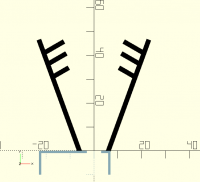
Sure, but hey, you can design around that problem by offsetting the
opening. See picture
I haven't really dug into shaving the plastic at all, since anything
I do to fight reflections has to come out of the plastic thickness.
If I add anything that projects inside the open volume, then the
sensor can't see what it needs to see.
I think that depends on the size of the open volume, no?
If the cone is wider, then you can afford to block some of the light
with baffles of some sort.
What about this, referring to the attached picture?
It's just 2D to illustrate the idea. I leave the implementation and
dimensions up to you.
The narrow end of the cone is just large enough for the sensor, not the
whole device. The whole device sits in the light blue box.
The large end of the cone would be large enough so that the baffles
would create the field of view required.
I think the baffles would need to be designed carefully, in both
length and angle, so that light entering from the side, when reflecting
off the bottom of a baffle (referring to the orientation in the
picture), reflects into the area between each baffle and the one below
it.
You might need only one baffle, or perhaps more.
Anyway.. food for thought.
On Wed, 2022-02-16 at 15:24 -0700, david vanhorn wrote:
> Yup, aware of the Z fighting. It's on my list. :)
> The device itself is about 6.5 x 2.6cm, and the apex of this cone
> needs to block the light from all of that.
> The sensor is about 3x1 cm and offset left of center about 5mm which
> complicates things.
Sure, but hey, you can design around that problem by offsetting the
opening. See picture
> I haven't really dug into shaving the plastic at all, since anything
> I do to fight reflections has to come out of the plastic thickness.
> If I add anything that projects inside the open volume, then the
> sensor can't see what it needs to see.
I think that depends on the size of the open volume, no?
If the cone is wider, then you can afford to block some of the light
with baffles of some sort.
What about this, referring to the attached picture?
It's just 2D to illustrate the idea. I leave the implementation and
dimensions up to you.
The narrow end of the cone is just large enough for the sensor, not the
whole device. The whole device sits in the light blue box.
The large end of the cone would be large enough so that the baffles
would create the field of view required.
I _think_ the baffles would need to be designed carefully, in both
length and angle, so that light entering from the side, when reflecting
off the bottom of a baffle (referring to the orientation in the
picture), reflects into the area between each baffle and the one below
it.
You might need only one baffle, or perhaps more.
Anyway.. food for thought.
DV
david vanhorn
Thu, Feb 17, 2022 7:09 PM
Interesting idea. I wish OpenSCAD and PovRay talked to each other better.
I've used Povray to design a bunch of optical sensors over the years. VERY
accurate.
In Pov I would put a BRIGHT light source out at an appropriate distance,
and then I could "stick my head" in the baffle area which does NOT obstruct
the light, and look at how much is falling on the sensor.
Then do an animation rotating from just inside the cutoff to just past the
cutoff, and see how that looks on a white target at the sensor area.
On Thu, Feb 17, 2022 at 10:35 AM larry lar3ry@sasktel.net wrote:
On Wed, 2022-02-16 at 15:24 -0700, david vanhorn wrote:
Yup, aware of the Z fighting. It's on my list. :)
The device itself is about 6.5 x 2.6cm, and the apex of this cone
needs to block the light from all of that.
The sensor is about 3x1 cm and offset left of center about 5mm which
complicates things.
Sure, but hey, you can design around that problem by offsetting the
opening. See picture
I haven't really dug into shaving the plastic at all, since anything
I do to fight reflections has to come out of the plastic thickness.
If I add anything that projects inside the open volume, then the
sensor can't see what it needs to see.
I think that depends on the size of the open volume, no?
If the cone is wider, then you can afford to block some of the light
with baffles of some sort.
What about this, referring to the attached picture?
It's just 2D to illustrate the idea. I leave the implementation and
dimensions up to you.
The narrow end of the cone is just large enough for the sensor, not the
whole device. The whole device sits in the light blue box.
The large end of the cone would be large enough so that the baffles
would create the field of view required.
I think the baffles would need to be designed carefully, in both
length and angle, so that light entering from the side, when reflecting
off the bottom of a baffle (referring to the orientation in the
picture), reflects into the area between each baffle and the one below
it.
You might need only one baffle, or perhaps more.
Anyway.. food for thought.
OpenSCAD mailing list
To unsubscribe send an email to discuss-leave@lists.openscad.org
--
K1FZY (WA4TPW) SK 9/29/37-4/13/15
Interesting idea. I wish OpenSCAD and PovRay talked to each other better.
I've used Povray to design a bunch of optical sensors over the years. VERY
accurate.
In Pov I would put a BRIGHT light source out at an appropriate distance,
and then I could "stick my head" in the baffle area which does NOT obstruct
the light, and look at how much is falling on the sensor.
Then do an animation rotating from just inside the cutoff to just past the
cutoff, and see how that looks on a white target at the sensor area.
On Thu, Feb 17, 2022 at 10:35 AM larry <lar3ry@sasktel.net> wrote:
> On Wed, 2022-02-16 at 15:24 -0700, david vanhorn wrote:
> > Yup, aware of the Z fighting. It's on my list. :)
> > The device itself is about 6.5 x 2.6cm, and the apex of this cone
> > needs to block the light from all of that.
> > The sensor is about 3x1 cm and offset left of center about 5mm which
> > complicates things.
>
> Sure, but hey, you can design around that problem by offsetting the
> opening. See picture
>
> > I haven't really dug into shaving the plastic at all, since anything
> > I do to fight reflections has to come out of the plastic thickness.
>
> > If I add anything that projects inside the open volume, then the
> > sensor can't see what it needs to see.
>
> I think that depends on the size of the open volume, no?
> If the cone is wider, then you can afford to block some of the light
> with baffles of some sort.
>
> What about this, referring to the attached picture?
>
> It's just 2D to illustrate the idea. I leave the implementation and
> dimensions up to you.
>
> The narrow end of the cone is just large enough for the sensor, not the
> whole device. The whole device sits in the light blue box.
>
> The large end of the cone would be large enough so that the baffles
> would create the field of view required.
>
> I _think_ the baffles would need to be designed carefully, in both
> length and angle, so that light entering from the side, when reflecting
> off the bottom of a baffle (referring to the orientation in the
> picture), reflects into the area between each baffle and the one below
> it.
>
> You might need only one baffle, or perhaps more.
>
> Anyway.. food for thought.
>
> _______________________________________________
> OpenSCAD mailing list
> To unsubscribe send an email to discuss-leave@lists.openscad.org
>
--
K1FZY (WA4TPW) SK 9/29/37-4/13/15

