

discuss@lists.openscad.org

OpenSCAD general discussion Mailing-list

View all threads

Triangulation of quads

P
Parkinbot
Tue, Jan 29, 2019 8:00 PM

Ronaldo

if you want to estimate an error, it is better to use a max norm, especially
when you sum up something like rotations. A two norm will only give you a
mean square error, where outliers are cancelled out by the well behaved
elements.

The problem with the derived trajectory is that the code has to solve a
reverse problem and then applies some dowhatImean function that will not
always have the desired result.

You are right, I leave it to the user to define the path, because it is as
easy as defining a path that places cylinders along the trajectory. Having
done that, you translate the module code into function code.

use <Naca_sweep.scad>

spring();

module spring(R = 30, r=10, windings = 4, H=100, N=40)
{
slope = atan(H/windings/2/R/PI);
for (i=[0:Nwindings])
rotate([0,0,360/N
i])
translate([0,R,H/N/windings*i])
rotate([0,90+slope,0])
cylinder(r=r, h=1, center=true);
}

translate([100, 0, 0]) sweep(spring());

function spring(R = 30, r=10, windings = 4, H=100, N=40) =
let(shape = [for(i=[0:N]) let(w = -360/Ni) r[sin(w), cos(w), 0]])
let (slope = atan(H/windings/2/R/PI))
echo(shape)
[for (i=[0:Nwindings])
R_(0, 0, 360/N
i,
T_(0,R,H/N/windings*i,
R_(0,90-slope,0, shape)))];

http://forum.openscad.org/file/t887/srping.png

Want to add twist for a rect? Add a line ...

module spring(R = 30, r=10, windings = 4, twist=0, H=100, N=40)
{
slope = atan(H/windings/2/R/PI);
for (i=[0:Nwindings])
rotate([0,0,360/N
i])
translate([0,R,H/N/windingsi])
rotate([0,90+slope,0])
rotate([0,0,twist/N/windings
i])
cylinder(r=r, h=1, center=true, $fn=4);
}

--
Sent from: http://forum.openscad.org/

Ronaldo if you want to estimate an error, it is better to use a max norm, especially when you sum up something like rotations. A two norm will only give you a mean square error, where outliers are cancelled out by the well behaved elements. The problem with the derived trajectory is that the code has to solve a reverse problem and then applies some dowhatImean function that will not always have the desired result. You are right, I leave it to the user to define the path, because it is as easy as defining a path that places cylinders along the trajectory. Having done that, you translate the module code into function code. use <Naca_sweep.scad> spring(); module spring(R = 30, r=10, windings = 4, H=100, N=40) { slope = atan(H/windings/2/R/PI); for (i=[0:N*windings]) rotate([0,0,360/N*i]) translate([0,R,H/N/windings*i]) rotate([0,90+slope,0]) cylinder(r=r, h=1, center=true); } translate([100, 0, 0]) sweep(spring()); function spring(R = 30, r=10, windings = 4, H=100, N=40) = let(shape = [for(i=[0:N]) let(w = -360/N*i) r*[sin(w), cos(w), 0]]) let (slope = atan(H/windings/2/R/PI)) echo(shape) [for (i=[0:N*windings]) R_(0, 0, 360/N*i, T_(0,R,H/N/windings*i, R_(0,90-slope,0, shape)))]; <http://forum.openscad.org/file/t887/srping.png> Want to add twist for a rect? Add a line ... module spring(R = 30, r=10, windings = 4, twist=0, H=100, N=40) { slope = atan(H/windings/2/R/PI); for (i=[0:N*windings]) rotate([0,0,360/N*i]) translate([0,R,H/N/windings*i]) rotate([0,90+slope,0]) rotate([0,0,twist/N/windings*i]) cylinder(r=r, h=1, center=true, $fn=4); } -- Sent from: http://forum.openscad.org/
P
Parkinbot
Tue, Jan 29, 2019 8:41 PM

Ronaldo,

I had a look at your code. The error indeed cancels out or doesn't occur on
well posed problems. Why do I get a much larger error on the following
problem?

m = 100;
Rm = [for(  a = 100/m,
            i = 0,
            R = Rz(0);
            i<=m;
            R = R*Rz(a),
            i = i+1 ) if(i==m) R][0];
echo(Rm=Rm);            
echo(error=matrixNorm(Rz(0)-Rm));

function Rz(a)= let(c=cos(a), s=sin(a)) [[c,s,0],[-s,c,0],[0,0,1]];
function matrixNorm(M) = norm([for(Mi=M) norm(Mi)]);

--
Sent from: http://forum.openscad.org/

Ronaldo, I had a look at your code. The error indeed cancels out or doesn't occur on well posed problems. Why do I get a much larger error on the following problem? m = 100; Rm = [for( a = 100/m, i = 0, R = Rz(0); i<=m; R = R*Rz(a), i = i+1 ) if(i==m) R][0]; echo(Rm=Rm); echo(error=matrixNorm(Rz(0)-Rm)); function Rz(a)= let(c=cos(a), s=sin(a)) [[c,s,0],[-s,c,0],[0,0,1]]; function matrixNorm(M) = norm([for(Mi=M) norm(Mi)]); -- Sent from: http://forum.openscad.org/
RP
Ronaldo Persiano
Tue, Jan 29, 2019 10:20 PM

Parkinbot rudolf@digitaldocument.de wrote:

I had a look at your code. The error indeed cancels out or doesn't occur on
well posed problems. Why do I get a much larger error on the following
problem?

Parkinbot,

That was unfair! The accumulated rotation should be compared to Rz(100) and
not with the identity matrix. With:

echo(error=matrixNorm(Rz(100)-Rm));

I got the following Euclidean norm error :

ECHO: error = 4.06721e-15

Using the max norm:

function norm(p) = max([for(pi=p) abs(pi)]);

the error decreased somewhat to:

ECHO: error = 2.88658e-15

And using the sum norm:

function norm(p) = sum([for(pi=p) abs(pi)]);

the error increases to 6.57807e-15 .

Parkinbot <rudolf@digitaldocument.de> wrote: > I had a look at your code. The error indeed cancels out or doesn't occur on > well posed problems. Why do I get a much larger error on the following > problem? > Parkinbot, That was unfair! The accumulated rotation should be compared to Rz(100) and not with the identity matrix. With: echo(error=matrixNorm(Rz(100)-Rm)); I got the following Euclidean norm error : ECHO: error = 4.06721e-15 Using the max norm: function norm(p) = max([for(pi=p) abs(pi)]); the error decreased somewhat to: ECHO: error = 2.88658e-15 And using the sum norm: function norm(p) = sum([for(pi=p) abs(pi)]); the error increases to 6.57807e-15 .
RP
Ronaldo Persiano
Tue, Jan 29, 2019 11:08 PM

Parkinbot rudolf@digitaldocument.de wrote:

The problem with the derived trajectory is that the code has to solve a
reverse problem and then applies some dowhatImean function that will not
always have the desired result.

You are right, I leave it to the user to define the path, because it is as
easy as defining a path that places cylinders along the trajectory. Having
done that, you translate the module code into function code.

The harder step is not to compute the path but to compute the section
rotations along the path. The helicoidal spring is relatively simple but
with other more general path it is not. For instance:

p = [[0,0,0], [20,0,0], [10,30,0], [0,0,0], [0,0,20]];
n= 20;
path = [for(i=[0:n]) Bz(i/n,p,4)];

line(path);

function Bz(u, p, n=3, from=0) =
(n == 1)?
u*p[from+1] + (1-u)p[from]:
u
Bz(u,p,n-1,from+1) + (1-u)*Bz(u,p,n-1,from);

module line(p,w=0.1)
for(i=[0:len(p)-2])
hull(){ translate(p[i])  sphere(w);
translate(p[(i+1)%len(p)]) sphere(w); }

[image: Bz4.PNG]
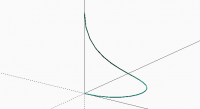
Parkinbot <rudolf@digitaldocument.de> wrote: > The problem with the derived trajectory is that the code has to solve a > reverse problem and then applies some dowhatImean function that will not > always have the desired result. > > You are right, I leave it to the user to define the path, because it is as > easy as defining a path that places cylinders along the trajectory. Having > done that, you translate the module code into function code. > The harder step is not to compute the path but to compute the section rotations along the path. The helicoidal spring is relatively simple but with other more general path it is not. For instance: p = [[0,0,0], [20,0,0], [10,30,0], [0,0,0], [0,0,20]]; n= 20; path = [for(i=[0:n]) Bz(i/n,p,4)]; line(path); function Bz(u, p, n=3, from=0) = (n == 1)? u*p[from+1] + (1-u)*p[from]: u*Bz(u,p,n-1,from+1) + (1-u)*Bz(u,p,n-1,from); module line(p,w=0.1) for(i=[0:len(p)-2]) hull(){ translate(p[i]) sphere(w); translate(p[(i+1)%len(p)]) sphere(w); } [image: Bz4.PNG]
P
Parkinbot
Tue, Jan 29, 2019 11:26 PM

Ronaldo wrote

That was unfair! The accumulated rotation should be compared to Rz(100)
and
not with the identity matrix. With:

Ups, sorry, you are right, I didn't see that in my quick review of the code.
I wasn't expecting such a good result and still have my doubts with respect
to applying rotations to a polygon again and again.

Are you sure that it is enough to calc the error of R^m to get a measure of
the error your code will produce?
Am I wrong that in code you calculate a sequence of relative rotations and
translations and apply them to the polygon by using the result of step n as
operand for step n+1?
That means you apply rotations R_i for a polygon P over and over: P1 =
(((PR1)R2)R3)R4 ... So one should compare P1 with P2 = P(R1R2R3R4
... ) which has the problem that R1R2R3*R4 can have a bad condition as
well as any matrix R1, R2 ...

Presuming that your sweep has many steps, than the relative rotation angle
gets smaller and smaller. This  is good news for the condition of the
relative rotation matrices. So you are mainly left with a possible bad
condition of the first rotation R1, which you could split ...

--
Sent from: http://forum.openscad.org/

Ronaldo wrote > That was unfair! The accumulated rotation should be compared to Rz(100) > and > not with the identity matrix. With: Ups, sorry, you are right, I didn't see that in my quick review of the code. I wasn't expecting such a good result and still have my doubts with respect to applying rotations to a polygon again and again. Are you sure that it is enough to calc the error of R^m to get a measure of the error your code will produce? Am I wrong that in code you calculate a sequence of relative rotations and translations and apply them to the polygon by using the result of step n as operand for step n+1? That means you apply rotations R_i for a polygon P over and over: P1 = (((P*R1)*R2)*R3)*R4 ... So one should compare P1 with P2 = P*(R1*R2*R3*R4 ... ) which has the problem that R1*R2*R3*R4 can have a bad condition as well as any matrix R1, R2 ... Presuming that your sweep has many steps, than the relative rotation angle gets smaller and smaller. This is good news for the condition of the relative rotation matrices. So you are mainly left with a possible bad condition of the first rotation R1, which you could split ... -- Sent from: http://forum.openscad.org/
RP
Ronaldo Persiano
Wed, Jan 30, 2019 3:23 AM

Parkinbot rudolf@digitaldocument.de wrote:

Are you sure that it is enough to calc the error of R^m to get a measure of
the error your code will produce?
Am I wrong that in code you calculate a sequence of relative rotations and
translations and apply them to the polygon by using the result of step n as
operand for step n+1?

That is exactly what the code does.

That means you apply rotations R_i for a polygon P over and over: P1 =
(((PR1)R2)R3)R4 ... So one should compare P1 with P2 = P(R1R2R3R4
... ) which has the problem that R1R2R3*R4 can have a bad condition as
well as any matrix R1, R2 ...

To consider that I have done another test code:

m = 10000;
// Rz(360/m)^m
Rm = [for(  a = 360/m, i = 0, R = Rz(0);
i<=m;
R = R*Rz(a), i = i+1 )
if(i==m) R ][0];

P = circ();
Pm = PRm;
echo("Errors of P-P
R^m");
echo(errEucl= matrixNorm(P-Pm));
echo(errMax = norMax(P-Pm));
echo(errSum = norSum(P-Pm));

// compute the rotations of P like in sweep.scad and keep the last one
PR_ = [for( a = 360/m, i = 0, Pi = P;
i<=m;
Pi = Pi*Rz(a), i = i+1 )
if(i==m) Pi][0];

echo("Errors of P-(((P*R)*R)*R...)");
echo(errEucl= matrixNorm(P-PR_));
echo(errMax = norMax(P-PR_));
echo(errSum = norSum(P-PR_));

echo(Id=Rm*transpose(Rm));

function Rz(a)= let(c=cos(a), s=sin(a)) [[c,s,0],[-s,c,0],[0,0,1]];
function matrixNorm(M) = norm([for(Mi=M) norm(Mi)]);
function norMax(p) = max([for(pi=p) norm(pi)]);
function norSum(p) = [for(pi=p) norm(pi)]*[for(pi=p) 1];

function circ(m=20) = [for(i=[0:m-1]) [cos(360i/m), sin(360i/m),0] ];

where P is a list of points. The code produced the following output:

ECHO: "Errors of P-P*R^m"

ECHO: errEucl = 1.84876e-12

ECHO: errMax = 4.1515e-13

ECHO: errSum = 8.26788e-12

ECHO: "Errors of P-(((P*R)*R)*R...)"

ECHO: errEucl = 1.84209e-12

ECHO: errMax = 4.16634e-13

ECHO: errSum = 8.23773e-12

ECHO: Id = [[1, 1.13101e-14, 0], [1.13101e-14, 1, 0], [0, 0, 1]]

which shows that there is no significant difference among the various ways
of computing errors as I was expecting. Note that Rm multiplied by its
transpose differs from the identity matrix by an error even smaller.

As I said before, if this is critical for some application, the use of
quaternions may decrease the accumulated errors.

Parkinbot <rudolf@digitaldocument.de> wrote: > Are you sure that it is enough to calc the error of R^m to get a measure of > the error your code will produce? > Am I wrong that in code you calculate a sequence of relative rotations and > translations and apply them to the polygon by using the result of step n as > operand for step n+1? > That is exactly what the code does. > That means you apply rotations R_i for a polygon P over and over: P1 = > (((P*R1)*R2)*R3)*R4 ... So one should compare P1 with P2 = P*(R1*R2*R3*R4 > ... ) which has the problem that R1*R2*R3*R4 can have a bad condition as > well as any matrix R1, R2 ... > To consider that I have done another test code: m = 10000; // Rz(360/m)^m Rm = [for( a = 360/m, i = 0, R = Rz(0); i<=m; R = R*Rz(a), i = i+1 ) if(i==m) R ][0]; P = circ(); Pm = P*Rm; echo("Errors of P-P*R^m"); echo(errEucl= matrixNorm(P-Pm)); echo(errMax = norMax(P-Pm)); echo(errSum = norSum(P-Pm)); // compute the rotations of P like in sweep.scad and keep the last one PR_ = [for( a = 360/m, i = 0, Pi = P; i<=m; Pi = Pi*Rz(a), i = i+1 ) if(i==m) Pi][0]; echo("Errors of P-(((P*R)*R)*R...)"); echo(errEucl= matrixNorm(P-PR_)); echo(errMax = norMax(P-PR_)); echo(errSum = norSum(P-PR_)); echo(Id=Rm*transpose(Rm)); function Rz(a)= let(c=cos(a), s=sin(a)) [[c,s,0],[-s,c,0],[0,0,1]]; function matrixNorm(M) = norm([for(Mi=M) norm(Mi)]); function norMax(p) = max([for(pi=p) norm(pi)]); function norSum(p) = [for(pi=p) norm(pi)]*[for(pi=p) 1]; function circ(m=20) = [for(i=[0:m-1]) [cos(360*i/m), sin(360*i/m),0] ]; where P is a list of points. The code produced the following output: ECHO: "Errors of P-P*R^m" ECHO: errEucl = 1.84876e-12 ECHO: errMax = 4.1515e-13 ECHO: errSum = 8.26788e-12 ECHO: "Errors of P-(((P*R)*R)*R...)" ECHO: errEucl = 1.84209e-12 ECHO: errMax = 4.16634e-13 ECHO: errSum = 8.23773e-12 ECHO: Id = [[1, 1.13101e-14, 0], [1.13101e-14, 1, 0], [0, 0, 1]] which shows that there is no significant difference among the various ways of computing errors as I was expecting. Note that Rm multiplied by its transpose differs from the identity matrix by an error even smaller. As I said before, if this is critical for some application, the use of quaternions may decrease the accumulated errors.
P
Parkinbot
Wed, Jan 30, 2019 12:51 PM

As you could read in the last sentence of my previous post, I meanwhile
understand, that it is not the condition of the rotation matrix itself that
is problematic (orthogonal matrices have a perfect condition: 1),
but the condition of the function the determines the rotation matrix from a
given normal vector. A normal defining a rotation with an absolute angle
near 90° has itself a small angle against the plane defined by the polygon
and suffers under the tangens problem, respectively under a problematic
divison, spoiling the condition.
Your relative angle extrusion scheme therefore has indeed no serious
numerical problems exept for the first rotation, given that you don't get
into the pitfall of near 90° angles. In a sufficiently refined extrusion
path, this case will probably happen only with the first rotation, and the
good news is, that one cannot see it, because you build up upon the first
rotation in a relative way.
Therefore the significant error in your calculus will indeed be produced by
determinining the first rotation (and any relative rotation near 90°) and
can be opposed by splitting the rotation into a sequence of two rotations: a
90° rotation and a small 90°-α rotation.

As for the determination of the best z-rotation I could imagine that your
scheme could also be extented to optionally accept user input. Imagine a
user wants to extrude an airfoil or any other non rotation symmetric shape
in a specific twisted way.

To also allow for a parametrisation of the shape (e.g. a wing is a morphing
sequence of airfoils, therefore the shape generator needs at least one
argument) a last comment on

Ronaldo wrote

That is exactly what the code does.

That means you apply rotations R_i for a polygon P over and over: P1 =
(((PR1)R2)R3)R4 ... So one should compare P1 with P2 = P(R1R2R3R4
... ) which has the problem that R1R2R3*R4 can have a bad condition as
well as any matrix R1, R2 ...

The analysis has so far shown that it is not the rotations that spoil the
result, but the determination of the rotation matrices. In order to allow
for morphing shapes along the path you can indeed calculate

Pi = PR  with R= R1R2*...*Ri

instead of P(i+1) = Pi*R(i+1)

But I guess you do this anyway.

BTW: if I had to extrude a shape along the line you showed, I would probably
exactly follow this way and implement a preprocessor that generates the
polygon sequence for extrusion with Naca_Sweep. :-)

--
Sent from: http://forum.openscad.org/

As you could read in the last sentence of my previous post, I meanwhile understand, that it is not the condition of the rotation matrix itself that is problematic (orthogonal matrices have a perfect condition: 1), but the condition of the function the determines the rotation matrix from a given normal vector. A normal defining a rotation with an absolute angle near 90° has itself a small angle against the plane defined by the polygon and suffers under the tangens problem, respectively under a problematic divison, spoiling the condition. Your relative angle extrusion scheme therefore has indeed no serious numerical problems exept for the first rotation, given that you don't get into the pitfall of near 90° angles. In a sufficiently refined extrusion path, this case will probably happen only with the first rotation, and the good news is, that one cannot see it, because you build up upon the first rotation in a relative way. Therefore the significant error in your calculus will indeed be produced by determinining the first rotation (and any relative rotation near 90°) and can be opposed by splitting the rotation into a sequence of two rotations: a 90° rotation and a small 90°-α rotation. As for the determination of the best z-rotation I could imagine that your scheme could also be extented to optionally accept user input. Imagine a user wants to extrude an airfoil or any other non rotation symmetric shape in a specific twisted way. To also allow for a parametrisation of the shape (e.g. a wing is a morphing sequence of airfoils, therefore the shape generator needs at least one argument) a last comment on Ronaldo wrote > That is exactly what the code does. > >> That means you apply rotations R_i for a polygon P over and over: P1 = >> (((P*R1)*R2)*R3)*R4 ... So one should compare P1 with P2 = P*(R1*R2*R3*R4 >> ... ) which has the problem that R1*R2*R3*R4 can have a bad condition as >> well as any matrix R1, R2 ... The analysis has so far shown that it is not the rotations that spoil the result, but the determination of the rotation matrices. In order to allow for morphing shapes along the path you can indeed calculate Pi = P*R with R= R1*R2*...*Ri instead of P(i+1) = Pi*R(i+1) But I guess you do this anyway. BTW: if I had to extrude a shape along the line you showed, I would probably exactly follow this way and implement a preprocessor that generates the polygon sequence for extrusion with Naca_Sweep. :-) -- Sent from: http://forum.openscad.org/
RP
Ronaldo Persiano
Wed, Jan 30, 2019 7:01 PM

Parkinbot rudolf@digitaldocument.de wrote:

A normal defining a rotation with an absolute angle
near 90° has itself a small angle against the plane defined by the polygon
and suffers under the tangens problem, respectively under a problematic
divison, spoiling the condition.

You probably meant 180°. And that requires a big account.

You are right saying we need to consider the condition of the process
during a sweep.  At each step in the global method (the one in the code of
sweep.scad in the List Comprehension Demos), it is computed a matrix (of a
minimum rotation) transforming the section from its base in the xy plane to
a plane orthogonal to the path tangent at a given point. At each step in
the local method (in my github repository), the minimum rotation is
computed to transform the previously transformed section to the next
tangent direction. Both method use the same function to compute the
rotation:

function rotate_from_to(a,b) =
let( axis = unit(cross(a,b)) )
axis*axis >= 0.99 ?
transpose([unit(b), axis, cross(axis, unit(b))]) * [unit(a), axis,
cross(axis, unit(a))] :
[[1, 0, 0], [0, 1, 0], [0, 0, 1]];

a minimum rotation that brings a to b.

When a and b have opposing directions (180°), there is an infinite number
of possible minimum rotation. That function solves this singularity by
arbitrarily outputing the identity matrix. This is a bug indeed, a subtle
one! In the context of a sweep, that arbitrary solution may lead to an
inversion of the section vertex circulation from CCW to CW which is the
source of wild twists reported in
http://forum.openscad.org/Twisty-problem-with-scad-utils-quot-sweep-quot-tc9775.html
. In that thread, may be found the original proposal of the local method.

When a path starts with a tangent direction [0,0,-1], all the sweep faces
will have a CW circulation and any boolean operation with the polyhedron
will be rejected by CGAL. So, yes, Parkinbot, you are right: there is a bug
in sweep. But not only at the start point: if the path has three or more
collinear points, the local method will show wild twists and face
circulation reversal!

To solve the bug I rewrote the minimum rotation function:

function rotate_from_to(a,b) =
let( axis = unit(cross(a,b)) )
axis*axis >= 0.99 ?
transpose([unit(b), axis, cross(axis, unit(b))]) * [unit(a), axis,
cross(axis, unit(a))] :
rotate_from_to(a,b+[1e-24,0,0]);

where I arbitrarily perturb the vector b to escape from the singularity.
That is enough to avoid the circulation changes and wild twists. I have not
check it but I guess the original global method, which is simpler, more
precise and faster then the local one, will produce basically the same
results then the local one with no wildness. Note that the rotation of the
first section of the sweep about to its own center is arbitrary but the
following sections will have a consistent rotation with the first one.

The non-diagonal elements of matrix rotate_from_to(a,b+[1e-24,0,0]) are
very small and may be reset to 0 without any drawbacks.

As for the determination of the best z-rotation I could imagine that your

scheme could also be extented to optionally accept user input. Imagine a
user wants to extrude an airfoil or any other non rotation symmetric shape
in a specific twisted way.

It really accepts an initial rotation angle to cover that.

The analysis has so far shown that it is not the rotations that spoil the
result, but the determination of the rotation matrices. In order to allow
for morphing shapes along the path you can indeed calculate

Pi = PR  with R= R1R2*...*Ri

instead of P(i+1) = Pi*R(i+1)

But I guess you do this anyway.

Yes, that is the way it is done.

BTW: if I had to extrude a shape along the line you showed, I would
probably
exactly follow this way and implement a preprocessor that generates the
polygon sequence for extrusion with Naca_Sweep. :-)

In my version of sweep.scad, a function sweep_polyhedron() generates a
polyhedron data ([points,faces]) ready to be sent to polyhedron().  The
sweep() module just call that function and polyhedron() with its output.
The function sweep_polyhedron() may or may not add caps to the sweep ends
allowing additions of special caps or even polygons with holes (elsewhere
pre-processed). So, to do a sweep of a polygon with holes it is just a
matter of:

outer = sweep_polyhedron(shape=outer_section, path_transforms=pt,
caps=false);
hole  = sweep_polyhedron(shape=hole_section,  path_transforms=pt,
caps=false);
ppoly = partition_polygon_with_holes(outer,[hole]); // generate [points,
faces]
caps  = caps_of(ppoly, pt); // transform ppoly points by pt[0] and
pt[len(pt)-1], keep faces
lazzy_union([outer, hole, caps]);

when function partition_polygon_with_holes() be available. :)

Parkinbot <rudolf@digitaldocument.de> wrote: > A normal defining a rotation with an absolute angle > near 90° has itself a small angle against the plane defined by the polygon > and suffers under the tangens problem, respectively under a problematic > divison, spoiling the condition. You probably meant 180°. And that requires a big account. You are right saying we need to consider the condition of the process during a sweep. At each step in the global method (the one in the code of sweep.scad in the List Comprehension Demos), it is computed a matrix (of a minimum rotation) transforming the section from its base in the xy plane to a plane orthogonal to the path tangent at a given point. At each step in the local method (in my github repository), the minimum rotation is computed to transform the previously transformed section to the next tangent direction. Both method use the same function to compute the rotation: function rotate_from_to(a,b) = let( axis = unit(cross(a,b)) ) axis*axis >= 0.99 ? transpose([unit(b), axis, cross(axis, unit(b))]) * [unit(a), axis, cross(axis, unit(a))] : [[1, 0, 0], [0, 1, 0], [0, 0, 1]]; a minimum rotation that brings a to b. When a and b have opposing directions (180°), there is an infinite number of possible minimum rotation. That function solves this singularity by arbitrarily outputing the identity matrix. This is a bug indeed, a subtle one! In the context of a sweep, that arbitrary solution may lead to an inversion of the section vertex circulation from CCW to CW which is the source of wild twists reported in http://forum.openscad.org/Twisty-problem-with-scad-utils-quot-sweep-quot-tc9775.html . In that thread, may be found the original proposal of the local method. When a path starts with a tangent direction [0,0,-1], all the sweep faces will have a CW circulation and any boolean operation with the polyhedron will be rejected by CGAL. So, yes, Parkinbot, you are right: there is a bug in sweep. But not only at the start point: if the path has three or more collinear points, the local method will show wild twists and face circulation reversal! To solve the bug I rewrote the minimum rotation function: function rotate_from_to(a,b) = let( axis = unit(cross(a,b)) ) axis*axis >= 0.99 ? transpose([unit(b), axis, cross(axis, unit(b))]) * [unit(a), axis, cross(axis, unit(a))] : rotate_from_to(a,b+[1e-24,0,0]); where I arbitrarily perturb the vector b to escape from the singularity. That is enough to avoid the circulation changes and wild twists. I have not check it but I guess the original global method, which is simpler, more precise and faster then the local one, will produce basically the same results then the local one with no wildness. Note that the rotation of the first section of the sweep about to its own center is arbitrary but the following sections will have a consistent rotation with the first one. The non-diagonal elements of matrix rotate_from_to(a,b+[1e-24,0,0]) are very small and may be reset to 0 without any drawbacks. As for the determination of the best z-rotation I could imagine that your > scheme could also be extented to optionally accept user input. Imagine a > user wants to extrude an airfoil or any other non rotation symmetric shape > in a specific twisted way. > It really accepts an initial rotation angle to cover that. > The analysis has so far shown that it is not the rotations that spoil the > result, but the determination of the rotation matrices. In order to allow > for morphing shapes along the path you can indeed calculate > > Pi = P*R with R= R1*R2*...*Ri > > instead of P(i+1) = Pi*R(i+1) > > But I guess you do this anyway. > Yes, that is the way it is done. > BTW: if I had to extrude a shape along the line you showed, I would > probably > exactly follow this way and implement a preprocessor that generates the > polygon sequence for extrusion with Naca_Sweep. :-) > In my version of sweep.scad, a function sweep_polyhedron() generates a polyhedron data ([points,faces]) ready to be sent to polyhedron(). The sweep() module just call that function and polyhedron() with its output. The function sweep_polyhedron() may or may not add caps to the sweep ends allowing additions of special caps or even polygons with holes (elsewhere pre-processed). So, to do a sweep of a polygon with holes it is just a matter of: outer = sweep_polyhedron(shape=outer_section, path_transforms=pt, caps=false); hole = sweep_polyhedron(shape=hole_section, path_transforms=pt, caps=false); ppoly = partition_polygon_with_holes(outer,[hole]); // generate [points, faces] caps = caps_of(ppoly, pt); // transform ppoly points by pt[0] and pt[len(pt)-1], keep faces lazzy_union([outer, hole, caps]); when function partition_polygon_with_holes() be available. :)
NH
nop head
Wed, Jan 30, 2019 7:37 PM

I have not check it but I guess the original global method, which is

simpler, more precise and faster then the local one, will produce basically
the same results then the local one with no wildness.

The problem with the global one is it produces a 360 degree twist for every
orbit of the Z axis. The relative one does not.

To avoid the singularity shouldn't you look at the next tangent and orient
it around the axis the way that indicates? How does a fixed direction
perturbation help?

On Wed, 30 Jan 2019 at 19:02, Ronaldo Persiano rcmpersiano@gmail.com
wrote:

Parkinbot rudolf@digitaldocument.de wrote:

A normal defining a rotation with an absolute angle
near 90° has itself a small angle against the plane defined by the
polygon
and suffers under the tangens problem, respectively under a problematic
divison, spoiling the condition.

You probably meant 180°. And that requires a big account.

You are right saying we need to consider the condition of the process
during a sweep.  At each step in the global method (the one in the code
of sweep.scad in the List Comprehension Demos), it is computed a matrix (of
a minimum rotation) transforming the section from its base in the xy plane
to a plane orthogonal to the path tangent at a given point. At each step in
the local method (in my github repository), the minimum rotation is
computed to transform the previously transformed section to the next
tangent direction. Both method use the same function to compute the
rotation:

function rotate_from_to(a,b) =
let( axis = unit(cross(a,b)) )
axis*axis >= 0.99 ?
transpose([unit(b), axis, cross(axis, unit(b))]) * [unit(a),
axis, cross(axis, unit(a))] :
[[1, 0, 0], [0, 1, 0], [0, 0, 1]];

a minimum rotation that brings a to b.

When a and b have opposing directions (180°), there is an infinite number
of possible minimum rotation. That function solves this singularity by
arbitrarily outputing the identity matrix. This is a bug indeed, a subtle
one! In the context of a sweep, that arbitrary solution may lead to an
inversion of the section vertex circulation from CCW to CW which is the
source of wild twists reported in
http://forum.openscad.org/Twisty-problem-with-scad-utils-quot-sweep-quot-tc9775.html
. In that thread, may be found the original proposal of the local method.

When a path starts with a tangent direction [0,0,-1], all the sweep faces
will have a CW circulation and any boolean operation with the polyhedron
will be rejected by CGAL. So, yes, Parkinbot, you are right: there is a bug
in sweep. But not only at the start point: if the path has three or more
collinear points, the local method will show wild twists and face
circulation reversal!

To solve the bug I rewrote the minimum rotation function:

function rotate_from_to(a,b) =
let( axis = unit(cross(a,b)) )
axis*axis >= 0.99 ?
transpose([unit(b), axis, cross(axis, unit(b))]) * [unit(a), axis,
cross(axis, unit(a))] :
rotate_from_to(a,b+[1e-24,0,0]);

where I arbitrarily perturb the vector b to escape from the singularity.
That is enough to avoid the circulation changes and wild twists. I have not
check it but I guess the original global method, which is simpler, more
precise and faster then the local one, will produce basically the same
results then the local one with no wildness. Note that the rotation of the
first section of the sweep about to its own center is arbitrary but the
following sections will have a consistent rotation with the first one.

The non-diagonal elements of matrix rotate_from_to(a,b+[1e-24,0,0]) are
very small and may be reset to 0 without any drawbacks.

As for the determination of the best z-rotation I could imagine that your

scheme could also be extented to optionally accept user input. Imagine a
user wants to extrude an airfoil or any other non rotation symmetric shape
in a specific twisted way.

It really accepts an initial rotation angle to cover that.

The analysis has so far shown that it is not the rotations that spoil the
result, but the determination of the rotation matrices. In order to allow
for morphing shapes along the path you can indeed calculate

Pi = PR  with R= R1R2*...*Ri

instead of P(i+1) = Pi*R(i+1)

But I guess you do this anyway.

Yes, that is the way it is done.

BTW: if I had to extrude a shape along the line you showed, I would
probably
exactly follow this way and implement a preprocessor that generates the
polygon sequence for extrusion with Naca_Sweep. :-)

In my version of sweep.scad, a function sweep_polyhedron() generates a
polyhedron data ([points,faces]) ready to be sent to polyhedron().  The
sweep() module just call that function and polyhedron() with its output.
The function sweep_polyhedron() may or may not add caps to the sweep ends
allowing additions of special caps or even polygons with holes (elsewhere
pre-processed). So, to do a sweep of a polygon with holes it is just a
matter of:

outer = sweep_polyhedron(shape=outer_section, path_transforms=pt,
caps=false);
hole  = sweep_polyhedron(shape=hole_section,  path_transforms=pt,
caps=false);
ppoly = partition_polygon_with_holes(outer,[hole]); // generate [points,
faces]
caps  = caps_of(ppoly, pt); // transform ppoly points by pt[0] and
pt[len(pt)-1], keep faces
lazzy_union([outer, hole, caps]);

when function partition_polygon_with_holes() be available. :)


OpenSCAD mailing list
Discuss@lists.openscad.org
http://lists.openscad.org/mailman/listinfo/discuss_lists.openscad.org

> I have not check it but I guess the original global method, which is simpler, more precise and faster then the local one, will produce basically the same results then the local one with no wildness. The problem with the global one is it produces a 360 degree twist for every orbit of the Z axis. The relative one does not. To avoid the singularity shouldn't you look at the next tangent and orient it around the axis the way that indicates? How does a fixed direction perturbation help? On Wed, 30 Jan 2019 at 19:02, Ronaldo Persiano <rcmpersiano@gmail.com> wrote: > > > Parkinbot <rudolf@digitaldocument.de> wrote: > >> A normal defining a rotation with an absolute angle >> near 90° has itself a small angle against the plane defined by the >> polygon >> and suffers under the tangens problem, respectively under a problematic >> divison, spoiling the condition. > > > You probably meant 180°. And that requires a big account. > > You are right saying we need to consider the condition of the process > during a sweep. At each step in the global method (the one in the code > of sweep.scad in the List Comprehension Demos), it is computed a matrix (of > a minimum rotation) transforming the section from its base in the xy plane > to a plane orthogonal to the path tangent at a given point. At each step in > the local method (in my github repository), the minimum rotation is > computed to transform the previously transformed section to the next > tangent direction. Both method use the same function to compute the > rotation: > > function rotate_from_to(a,b) = > let( axis = unit(cross(a,b)) ) > axis*axis >= 0.99 ? > transpose([unit(b), axis, cross(axis, unit(b))]) * [unit(a), > axis, cross(axis, unit(a))] : > [[1, 0, 0], [0, 1, 0], [0, 0, 1]]; > > > a minimum rotation that brings a to b. > > When a and b have opposing directions (180°), there is an infinite number > of possible minimum rotation. That function solves this singularity by > arbitrarily outputing the identity matrix. This is a bug indeed, a subtle > one! In the context of a sweep, that arbitrary solution may lead to an > inversion of the section vertex circulation from CCW to CW which is the > source of wild twists reported in > http://forum.openscad.org/Twisty-problem-with-scad-utils-quot-sweep-quot-tc9775.html > . In that thread, may be found the original proposal of the local method. > > When a path starts with a tangent direction [0,0,-1], all the sweep faces > will have a CW circulation and any boolean operation with the polyhedron > will be rejected by CGAL. So, yes, Parkinbot, you are right: there is a bug > in sweep. But not only at the start point: if the path has three or more > collinear points, the local method will show wild twists and face > circulation reversal! > > To solve the bug I rewrote the minimum rotation function: > > function rotate_from_to(a,b) = > let( axis = unit(cross(a,b)) ) > axis*axis >= 0.99 ? > transpose([unit(b), axis, cross(axis, unit(b))]) * [unit(a), axis, > cross(axis, unit(a))] : > rotate_from_to(a,b+[1e-24,0,0]); > > > where I arbitrarily perturb the vector b to escape from the singularity. > That is enough to avoid the circulation changes and wild twists. I have not > check it but I guess the original global method, which is simpler, more > precise and faster then the local one, will produce basically the same > results then the local one with no wildness. Note that the rotation of the > first section of the sweep about to its own center is arbitrary but the > following sections will have a consistent rotation with the first one. > > The non-diagonal elements of matrix rotate_from_to(a,b+[1e-24,0,0]) are > very small and may be reset to 0 without any drawbacks. > > > As for the determination of the best z-rotation I could imagine that your >> scheme could also be extented to optionally accept user input. Imagine a >> user wants to extrude an airfoil or any other non rotation symmetric shape >> in a specific twisted way. >> > > It really accepts an initial rotation angle to cover that. > >> The analysis has so far shown that it is not the rotations that spoil the >> result, but the determination of the rotation matrices. In order to allow >> for morphing shapes along the path you can indeed calculate >> >> Pi = P*R with R= R1*R2*...*Ri >> >> instead of P(i+1) = Pi*R(i+1) >> >> But I guess you do this anyway. >> > > Yes, that is the way it is done. > >> BTW: if I had to extrude a shape along the line you showed, I would >> probably >> exactly follow this way and implement a preprocessor that generates the >> polygon sequence for extrusion with Naca_Sweep. :-) >> > > In my version of sweep.scad, a function sweep_polyhedron() generates a > polyhedron data ([points,faces]) ready to be sent to polyhedron(). The > sweep() module just call that function and polyhedron() with its output. > The function sweep_polyhedron() may or may not add caps to the sweep ends > allowing additions of special caps or even polygons with holes (elsewhere > pre-processed). So, to do a sweep of a polygon with holes it is just a > matter of: > > outer = sweep_polyhedron(shape=outer_section, path_transforms=pt, > caps=false); > hole = sweep_polyhedron(shape=hole_section, path_transforms=pt, > caps=false); > ppoly = partition_polygon_with_holes(outer,[hole]); // generate [points, > faces] > caps = caps_of(ppoly, pt); // transform ppoly points by pt[0] and > pt[len(pt)-1], keep faces > lazzy_union([outer, hole, caps]); > > > when function partition_polygon_with_holes() be available. :) > _______________________________________________ > OpenSCAD mailing list > Discuss@lists.openscad.org > http://lists.openscad.org/mailman/listinfo/discuss_lists.openscad.org >
P
Parkinbot
Wed, Jan 30, 2019 9:19 PM

Ronaldo wrote

You probably meant 180°. And that requires a big account.

you are right it is 180° and the critical operation is unit(). I haven't
studied the orginal sweep code extensively and it is a long while ago. But
it is obvious that the code can run into badly conditioned situations that
need special treatment. I will refer back to this discussion, and what I
have learned from it, when it is less academic for me, i.e. when I encounter
the practical problem having to extrude along a "strange" trajectory.

Because you mentioned it: My current implementation of the multi hole sweep
looks like this:

module sweep_multihole(outer, holes, convexity = 5)
difference()
{
sweep(outer, convexity = convexity);
sweeps(holes, convexity = convexity);
}

module sweeps(Dat, convexity = 5) // lazy union sweep
{
soup = sweeps(Dat);
polyhedron(soup[0], soup[1], convexity = convexity);
}

Yours looks straight forward to me.

--
Sent from: http://forum.openscad.org/

Ronaldo wrote > You probably meant 180°. And that requires a big account. you are right it is 180° and the critical operation is unit(). I haven't studied the orginal sweep code extensively and it is a long while ago. But it is obvious that the code can run into badly conditioned situations that need special treatment. I will refer back to this discussion, and what I have learned from it, when it is less academic for me, i.e. when I encounter the practical problem having to extrude along a "strange" trajectory. Because you mentioned it: My current implementation of the multi hole sweep looks like this: module sweep_multihole(outer, holes, convexity = 5) difference() { sweep(outer, convexity = convexity); sweeps(holes, convexity = convexity); } module sweeps(Dat, convexity = 5) // lazy union sweep { soup = sweeps(Dat); polyhedron(soup[0], soup[1], convexity = convexity); } Yours looks straight forward to me. -- Sent from: http://forum.openscad.org/