

Re: sweep in BOSL2

Do I get a kick out of solving trig? not really
Do I use BOSL2?, no, I don't, guilty as charged.
I've created hundreds of 3D models [which I enjoy doing], and not one
uses any component of BOSL2, I tried and the concepts of Left Up Down
etc. were just an impediment to getting a job done.
However, use cases are always an invitation to learn, so I might have a go.
But yeah, I was just using the geometry because the model has a user
friendly angle across the top, for the display, and I don't have a VNF.
Sometimes you have to go backwards, especially when re-engineering
someone else's model, which I am, it came without a base, I need a base
to attach stuff to.
This one [[https://www.thingiverse.com/thing:5280352/files]]

If you're happy writing models without libraries---or at least without
BOSL2---by all means keep at it. The thread does say "in BOSL2" in the
subject, though.
I'm not sure what you mean about "sometimes you have to go backwards". The
question basically is what situations will make it unavoidable to use
trigonometry to create your model instead of using geometric methods. The
answer obviously depends on what geometric methods are available. You
could choose to use trigonometry in native OpenSCAD by doing all your
transformations with multmatrix instead of using rotate, but rotate is
available, so that provides a geometric alternative. As a library author,
I would like to free the user as much as possible from trigonometry and
calculation and make things more geometric and descriptive. It's not
going to be possible to totally eliminate the need for users to use
trigonometry, but it should only be needed rarely, for unusual situations.
That's the hope, at least. This should make it easier to construct and
easier to understand, modify and maintain models.
I'm not sure what the thingiverse model is meant to illustrate.
If you dislike LEFT, RIGHT, etc you can still use BOSL2 and just never use
those. Write [-1,0,0], [1,0,0], etc instead. And if you don't like
left(x) you can still use translate([-x,0,0]) if you prefer. There's also
xmove(-x).
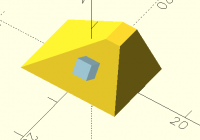
Here's a model with a simple geometric description that would be somewhat
more complicated to make without BOSL2, written without using direction
names:
include<BOSL2/std.scad>
prismoid([14,20],[5,3], h=10, shift=[-2,5])
attach([1,0,0], [0,0,-1])
color("lightblue") cube(3);
[image: image.png]
The attachment system knows the orientation of the face and puts the object
there. No user calculation (trigonometry) is needed to figure that out.
On Sat, Sep 27, 2025 at 6:33 AM Roger Whiteley via Discuss <
discuss@lists.openscad.org> wrote:
Do I get a kick out of solving trig? not really
Do I use BOSL2?, no, I don't, guilty as charged.
I've created hundreds of 3D models [which I enjoy doing], and not one
uses any component of BOSL2, I tried and the concepts of Left Up Down
etc. were just an impediment to getting a job done.
However, use cases are always an invitation to learn, so I might have a go.
But yeah, I was just using the geometry because the model has a user
friendly angle across the top, for the display, and I don't have a VNF.
Sometimes you have to go backwards, especially when re-engineering
someone else's model, which I am, it came without a base, I need a base
to attach stuff to.
This one [[https://www.thingiverse.com/thing:5280352/files]]
OpenSCAD mailing list
To unsubscribe send an email to discuss-leave@lists.openscad.org

But yeah, I was just using the geometry because the model has a user friendly angle across the top, for the display, and I don't have a VNF.
It is because the 'user friendly angles' I love the attachment model of BOSL2. My friendly angles always become foes when my model grows :-( And you don't need a VNF to work with attachments. The fact that you can is a great compliment to the skills of Adrian & Revar but all common geometries like cubes, prisma's spheres, cylinders, tubes, torus, path sweeps, etc. are directly supported. Initially I was too afraid of the model to make my own components 'attachable' but it turns out that that is much easier than I thought and lets your component play along in the buildup of bigger components.
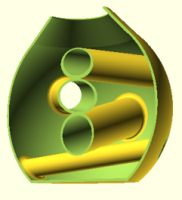
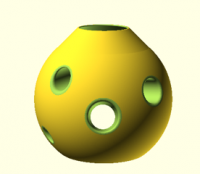
I wouldn't even know where to start doing the following model (a vase as birthday present for my 94 year old mother ...) with trigonometry... It uses the 'prism_connector' and the 'parts' that Adrian recently added. I therefore only need to specify where I want the holes and their size and the tubes and roundings are automatically calculated. It really feels like magic.

And yes, getting rid of the Breakaway filament will be hell :-( And I've not been able to print with PVA yet, it always seems to fail.
But it is arguably true that the learning curve of BOSL2 is quite steep. The documentation is excellent but it is so big and wide that you often miss the essence when you first start with a topic.
Peter

On Tue, 2025-09-30 at 16:13 +0200, Peter Kriens via Discuss wrote:
I wouldn't even know where to start doing the following model (a vase
as birthday present for my 94 year old mother ...) with
trigonometry... It uses the 'prism_connector' and the 'parts' that
Adrian recently added. I therefore only need to specify where I want
the holes and their size and the tubes and roundings are
automatically calculated. It really feels like magic.
I hope you are using PVA only for the support interface.
PastedGraphic-1.pngPastedGraphic-3.png
And yes, getting rid of the Breakaway filament will be hell :-( And
I've not been able to print with PVA yet, it always seems to fail.
But it is arguably true that the learning curve of BOSL2 is quite
steep. The documentation is excellent but it is so big and wide that
you often miss the essence when you first start with a topic.
Peter
OpenSCAD mailing list
To unsubscribe send an email to discuss-leave@lists.openscad.org

Each area of BOSL2 is in my experience medium difficulty. Each takes a day or two of experimentation and playing. I’ve produced a few attachable items in my own library and it’s not to hard, but takes some investment.
I would encourage anyone to take the time to learn to use VNFs if they come across a likely use for it. When I finally perfected my Hirth Joint code it was only possible when I did it using VNFs. I’m not usually sensitive to efficiency, but the VNF code was also much faster than my non-VNF early attempts at the Hirth Joint. VNFs are basically geometry that you can access all the details of. All the same basic transformations are available. They just require an alternative syntax.
It is certainly true that understanding the whole of BOSL2 is impractical for most, but it’s worth exploring anything that seems like it might be useful. I’ve never regretted the time spent learning a new area of BOSL2.
-Bob
On Sep 30, 2025, at 07:13, Peter Kriens via Discuss discuss@lists.openscad.org wrote:
But yeah, I was just using the geometry because the model has a user friendly angle across the top, for the display, and I don't have a VNF.
It is because the 'user friendly angles' I love the attachment model of BOSL2. My friendly angles always become foes when my model grows :-( And you don't need a VNF to work with attachments. The fact that you can is a great compliment to the skills of Adrian & Revar but all common geometries like cubes, prisma's spheres, cylinders, tubes, torus, path sweeps, etc. are directly supported. Initially I was too afraid of the model to make my own components 'attachable' but it turns out that that is much easier than I thought and lets your component play along in the buildup of bigger components.
I wouldn't even know where to start doing the following model (a vase as birthday present for my 94 year old mother ...) with trigonometry... It uses the 'prism_connector' and the 'parts' that Adrian recently added. I therefore only need to specify where I want the holes and their size and the tubes and roundings are automatically calculated. It really feels like magic.
<PastedGraphic-1.png><PastedGraphic-3.png>
And yes, getting rid of the Breakaway filament will be hell :-( And I've not been able to print with PVA yet, it always seems to fail.
But it is arguably true that the learning curve of BOSL2 is quite steep. The documentation is excellent but it is so big and wide that you often miss the essence when you first start with a topic.
Peter
OpenSCAD mailing list
To unsubscribe send an email to discuss-leave@lists.openscad.org

I agree. I depend on BOSL2. It is a gem.
Jon
On 10/1/2025 6:09 PM, Bob Carlson via Discuss wrote:
Each area of BOSL2 is in my experience medium difficulty. Each takes a
day or two of experimentation and playing. I’ve produced a few
attachable items in my own library and it’s not to hard, but takes
some investment.
I would encourage anyone to take the time to learn to use VNFs if they
come across a likely use for it. When I finally perfected my Hirth
Joint code it was only possible when I did it using VNFs. I’m not
usually sensitive to efficiency, but the VNF code was also much faster
than my non-VNF early attempts at the Hirth Joint. VNFs are basically
geometry that you can access all the details of. All the same basic
transformations are available. They just require an alternative syntax.
It is certainly true that understanding the whole of BOSL2 is
impractical for most, but it’s worth exploring anything that seems
like it might be useful. I’ve never regretted the time spent learning
a new area of BOSL2.
-Bob
--
This email has been checked for viruses by AVG antivirus software.
www.avg.com